



Credit Checks and Existing Financial Obligations
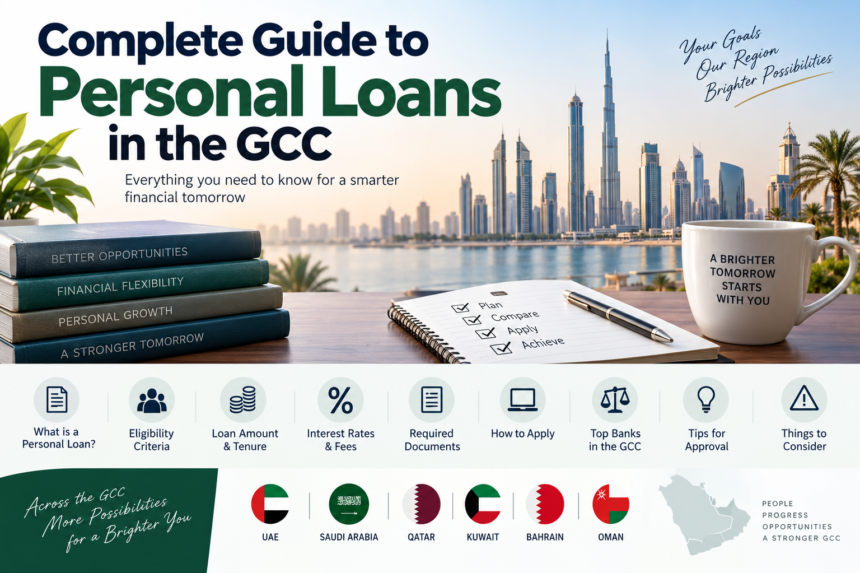
Complete Guide to Personal Loans in the GCC explains how personal borrowing works across the UAE, Saudi Arabia, Qatar, Bahrain, Oman and Kuwait, including eligibility, salary requirements, repayment periods, financing costs and the rules designed to prevent borrowers from taking on more debt than they can realistically afford.
- Complete Guide to Personal Loans in the GCC: 2026 Overview
- 1. Understanding Personal Loans and Personal Finance
- 2. Personal Loan Eligibility for GCC Expats
- 3. Salary Requirements and Employment Conditions
- 4. Credit Checks and Existing Financial Obligations
- 5. Loan Amounts and Borrowing Limits
- 6. Repayment Periods and Monthly Instalments
- 7. Interest Rates, Profit Rates and APR
- 8. Personal Loan Fees and Additional Charges
- 9. Salary Transfer and Bank Requirements
- 10. Islamic Personal Finance and Conventional Loans
- 11. Early Settlement, Refinancing and Loan Transfers
- 12. Personal Loans When Changing Jobs or Leaving the Gulf
- Personal Loans in the UAE
- Personal Loans in Saudi Arabia
- Personal Loans in Qatar
- Personal Loans in Bahrain
- Personal Loans in Oman
- Personal Loans in Kuwait
- Comparing Personal Loan Rules Across GCC Countries
- Credit Scores and Personal Loan Applications
- Personal Loans for Expatriates
- Personal Loans for Self-Employed Residents
- Choosing the Right Personal Loan in the GCC
- Common Personal Loan Mistakes Gulf Residents Should Avoid
- Practical Personal Loan Comparison Checklist
- Final Thoughts on Personal Loans in the GCC
Personal loans are widely available across Gulf banking markets. Residents may use them for education, home improvements, medical expenses, family needs, debt consolidation or other personal purposes, depending on the lender and applicable regulations.
The basic concept is simple. A bank or licensed finance company provides a fixed amount of money, and the borrower repays it through regular monthly instalments over an agreed period.
The details, however, can be very different from one GCC country to another.
The UAE places regulatory limits on personal-loan amounts, repayment periods and overall debt burden. Saudi Arabia uses responsible-lending rules that vary according to income and the type of credit obligation. Kuwait sets particularly clear limits for consumer finance. Oman regulates personal finance through debt-burden and tenor rules, while Qatar and Bahrain supervise consumer lending through their respective central banks and institution-specific credit assessments.
For expatriates, employment and residency can add another layer. Salary transfer, employer category, time in employment, remaining visa validity and credit history can all influence approval.
A personal loan should therefore never be chosen only by looking at the monthly instalment.
The total amount repayable, annual percentage rate, loan term, fees, early-settlement conditions and impact on your monthly budget matter just as much.
Complete Guide to Personal Loans in the GCC: 2026 Overview
Personal lending across the Gulf is regulated by six different central banks.
| Country | Main regulator | Important personal-finance consideration |
|---|---|---|
| UAE | Central Bank of the UAE | Loan and debt-burden limits |
| Saudi Arabia | Saudi Central Bank | Responsible lending and deductible ratios |
| Qatar | Qatar Central Bank | Salary and retail finance regulation |
| Bahrain | Central Bank of Bahrain | Consumer finance and affordability |
| Oman | Central Bank of Oman | Debt burden and maximum financing tenor |
| Kuwait | Central Bank of Kuwait | Clear consumer-loan amount and repayment limits |
All six systems place responsibility on financial institutions to evaluate borrowers before extending credit.
This usually means checking income, existing debt, employment and credit history.
The UAE currently limits the total repayment burden for individual borrowers to 50% of regular income under its personal lending framework. Its personal-loan rules also set the standard maximum personal-loan amount at 20 times salary or verifiable regular income and a maximum repayment period of 48 months.
The UAE is also introducing updated responsible-financing rules taking effect on September 13, 2026. These require financial institutions to evaluate affordability and credit history before granting additional credit.
Saudi Arabia similarly requires lenders to follow formal responsible-lending principles covering personal finance, vehicle finance, credit cards and real estate finance.
The common principle throughout the GCC is straightforward: having enough income to qualify does not necessarily mean borrowing the maximum available amount is financially sensible.
1. Understanding Personal Loans and Personal Finance
A personal loan is normally an instalment-based credit product used for non-business purposes.
The customer receives an approved amount and repays it over an agreed period.
A conventional bank normally charges interest, while Islamic banks structure personal finance using Sharia-compliant arrangements.
Personal finance can be used for different purposes depending on the bank and country. Typical uses include education, weddings, home renovation, medical expenses, travel and consolidating existing financial obligations.
Personal loans are different from mortgages because they are generally not primarily secured against residential property.
They also differ from credit cards because a personal loan usually provides a fixed amount with scheduled instalments and a defined repayment period.
For budgeting purposes, this predictability can be useful.
However, a fixed instalment also creates a long-term commitment. A monthly payment that seems manageable today may feel much larger if employment changes, rent increases or another family expense appears later.
2. Personal Loan Eligibility for GCC Expats
Personal-loan eligibility is not determined by nationality alone.
Banks usually look at several factors together.
These include residency, monthly income, employer, length of employment, age, existing credit obligations and previous repayment behaviour.
For expats, the lender may also consider how long the applicant has lived in the country and how stable their employment appears.
A customer working for a large established employer may receive different lending conditions from someone who recently joined a small company.
Likewise, a person earning a high salary may still be rejected if they already carry substantial credit-card balances and other loans.
Approval criteria also differ between financial institutions.
Meeting a regulator’s legal maximum does not create a right to receive that amount.
Banks remain responsible for deciding whether the individual borrower represents an acceptable risk.
3. Salary Requirements and Employment Conditions
Salary is one of the most important factors in Gulf personal lending.
Banks frequently advertise minimum monthly salary requirements for particular products.
These thresholds are commercial product conditions rather than universal GCC rules.
One bank may accept a certain income level while another requires substantially more.
Salary transfer can also matter.
Some lenders prefer or require the applicant’s salary to be credited directly to an account with the lending bank.
Employment history may be another requirement. A customer who joined an employer recently may need to complete a minimum period of service before applying.
Applicants should therefore ask three separate questions:
Does the bank have a minimum salary? Does the salary have to be transferred? Is there a minimum period of employment?
These conditions can significantly narrow the available options before interest rates are even compared.
4. Credit Checks and Existing Financial Obligations

A personal-loan application is not assessed in isolation.
Banks look at existing liabilities.
These can include personal loans, vehicle finance, mortgages, credit cards and other credit obligations.
Credit-information systems help lenders see how much debt a customer already has and whether previous payments were made on time.
In the UAE, responsible financing rules require financial institutions to examine a customer’s credit record and, under the new provisions taking effect on September 13, 2026, obtain relevant information from the credit-information agency before providing credit.
Saudi Arabia’s responsible-lending framework similarly requires financial institutions to consider the customer’s overall credit obligations when determining affordability.
A strong salary therefore cannot completely compensate for poor repayment behaviour.
Late payments on existing credit can reduce the chance of receiving new finance or lead to less favourable terms.
5. Loan Amounts and Borrowing Limits
The maximum amount available can be controlled by both regulation and bank policy.
The UAE provides one of the clearest examples.
Current Central Bank rules define a personal loan as financing repaid from salary, end-of-service benefits or another verifiable source of regular income. The normal regulatory maximum is 20 times the borrower’s salary or total regular income, with repayment generally limited to 48 months.
This does not mean every borrower should receive twenty times their salary.
The Central Bank specifically states that banks may lend less where borrowers have heavy commitments, lower disposable income or uncertain employment prospects.
Kuwait operates another clearly defined model.
The Central Bank of Kuwait says consumer loans or finance facilities can reach 25 times net monthly salary, subject to a maximum of KWD 25,000 and the applicable debt-service-to-income limit.
Different countries use different mechanisms, so borrowers should never apply one country’s limit across the entire GCC.
6. Repayment Periods and Monthly Instalments
Loan duration has an enormous effect on affordability.
A longer repayment period usually reduces the monthly instalment.
However, it may increase the total financing cost because the loan remains outstanding for longer.
The UAE’s standard personal-loan framework limits repayment to 48 months.
Kuwait allows consumer financing to be repaid over a maximum period of five years.
Oman’s updated 2025 Master Circular on Personal Loans and Finance provides a maximum tenor of 10 years for general personal loans, subject to age and other regulatory requirements.
These differences demonstrate why a loan advertisement should always be read in the local regulatory context.
The lowest monthly instalment is not automatically the best deal.
A borrower should compare both the monthly commitment and the total amount ultimately paid.
7. Interest Rates, Profit Rates and APR
One of the most confusing parts of comparing Gulf personal loans is financing terminology.
A conventional bank may advertise an interest rate.
An Islamic bank may describe a profit rate.
Another advertisement may show a flat rate, reducing rate or annual percentage rate.
These figures are not automatically comparable.
The Annual Percentage Rate or APR is particularly useful because it is designed to show the annualised cost of borrowing in a more standardised form.
Before signing, ask for the total repayment amount.
For example, if you borrow 100,000 in local currency, do not stop at asking how much the monthly payment will be.
Ask:
How much will I have paid in total when the final instalment is completed?
This makes it easier to understand the real cost of the loan.
Variable-rate financing deserves additional attention because repayments or financing costs can be affected when benchmark rates change.
8. Personal Loan Fees and Additional Charges
The interest or profit rate is not necessarily the only cost.
Personal finance may involve charges such as processing fees, documentation fees, insurance or Takaful costs, late-payment charges and early-settlement fees where allowed.
Some banks may also charge for refinancing or restructuring.
Consumers should request the bank’s current tariff and key product disclosure before signing.
Never rely exclusively on the headline marketing rate.
Two loans carrying apparently similar rates can have different total costs once fees are included.
A simple comparison should therefore consider:
| Cost | What to check |
|---|---|
| Financing rate | APR or comparable annual cost |
| Processing fee | Upfront cost |
| Insurance/Takaful | Whether compulsory |
| Late charges | Consequence of missed payments |
| Early settlement | Cost of repaying ahead of schedule |
| Refinancing | Charges for changing the facility |
| Total repayment | Amount paid across full term |
The total repayment figure is often the clearest number for borrowers.
9. Salary Transfer and Bank Requirements
Salary-transfer loans are common across GCC banking.
The arrangement allows the bank to receive the borrower’s monthly salary directly before the customer uses the remaining funds.
This can reduce lending risk and may allow a bank to offer more competitive pricing.
However, it can also make changing employers or moving to another bank more complicated.
Before accepting salary-transfer finance, understand what happens if employment ends.
Ask whether the account conditions change if salary stops temporarily and whether the bank requires notification when changing jobs.
Expats should pay particular attention to this because residency and employment can be connected.
A financial commitment that appears easy during stable employment may become more complicated during a relocation or job transition.
10. Islamic Personal Finance and Conventional Loans
Islamic finance is a major part of banking across the GCC.
Rather than using conventional interest-based lending, Islamic financial institutions structure products according to Sharia principles.
The specific contract varies between products and banks.
Customers may encounter structures based on Murabaha, Tawarruq or other approved arrangements.
From the customer’s everyday perspective, there may still be a financing amount, repayment schedule and monthly instalments.
However, the underlying legal and financial structure differs from a conventional interest-bearing loan.
Customers seeking Islamic finance should compare total repayment amounts, profit rates, fees and settlement conditions just as carefully as they would with conventional credit.
The label “Islamic” does not mean the product has no cost.
It means the financing is structured according to Islamic financial principles.
11. Early Settlement, Refinancing and Loan Transfers
Financial circumstances can improve after borrowing.
A customer may receive a bonus, salary increase or other funds and decide to settle the loan early.
Others may want to refinance because another bank offers better conditions.
Before doing either, check the existing contract.
Early settlement can involve a regulated or contractually permitted charge.
Refinancing can also create costs through processing charges, settlement fees or a longer repayment period.
A lower monthly payment is not automatically a saving.
If refinancing extends a loan substantially, the total amount paid could increase even if each monthly instalment becomes smaller.
Borrowers should compare the remaining cost of the existing loan against the full cost of the replacement finance.
12. Personal Loans When Changing Jobs or Leaving the Gulf
Employment changes are particularly important for expatriate borrowers.
Before resigning, find out how the loan will be treated if salary payments stop.
Banks may review the account when they receive an end-of-service payment or notice a break in salary transfers.
Policies differ by institution and country.
Borrowers planning to leave a GCC country permanently should contact the lender well before departure.
Outstanding finance should not simply be ignored because the borrower is relocating internationally.
Obtain a settlement figure, clear any required amount and keep written documentation showing that the facility has been settled where appropriate.
Someone who expects to relocate frequently should consider this risk before taking a long loan in the first place.
Personal Loans in the UAE
The UAE has a large personal lending market covering conventional and Islamic finance.
Under current Central Bank rules, a standard personal loan can generally reach up to 20 times the borrower’s salary or regular income, and the normal maximum repayment period is 48 months.
The overall repayment burden for loans at banks and lending entities must generally remain within 50% of regular income under the existing debt-burden framework.
Importantly, the 50% level is a ceiling rather than a target.
The Central Bank explicitly states that financial institutions should assess each borrower’s ability to repay instead of automatically lending up to the maximum permitted debt-burden ratio.
From September 13, 2026, updated responsible-financing provisions further reinforce affordability and credit-record assessments before credit is provided.
For UAE expats, the practical comparison should therefore include salary-transfer requirements, APR, processing costs and what happens when employment changes.
Personal Loans in Saudi Arabia
Saudi Arabia regulates personal finance through SAMA’s responsible-lending framework.
The principles apply across personal finance, vehicle finance, credit cards and real estate finance.
Debt ratios depend partly on income and the kind of credit involved.
For consumers earning SAR 15,000 per month or less, financing obligations linked only to salary deduction generally cannot exceed 33.33% of gross salary for employees, while monthly non-real-estate credit obligations generally cannot exceed 45% of total monthly income. Broader total finance obligations are subject to additional limits.
Different provisions apply to higher income categories, meaning borrowers should not reduce Saudi responsible-lending rules to one universal percentage.
The lender must assess the applicant’s ability to meet monthly commitments.
For expats, salary, employer, Iqama validity, credit history and individual bank policy can all influence approval.
Personal Loans in Qatar
Qatar’s financial sector is supervised by Qatar Central Bank.
QCB recognises salary loans and other forms of personal term finance within its retail lending framework. Its banking rules classify personal term finance, salary loans, credit cards, overdrafts, educational finance and vehicle finance within regulated retail-credit categories.
Individual banks set product-specific eligibility requirements within the regulatory framework.
For expatriates, these can include salary level, QID validity, employer, salary transfer and employment history.
Qatar residents should therefore compare products directly rather than assuming every bank follows identical commercial eligibility rules.
Borrowers should also check whether the quoted rate is flat, reducing or presented as APR and ask for the total amount repayable before accepting the facility.
Personal Loans in Bahrain
Personal finance in Bahrain is regulated by the Central Bank of Bahrain.
CBB defines consumer finance broadly as fixed-period financing provided to individuals for non-business purposes. Its definition of consumer credit also covers products such as personal overdrafts and credit cards.
Affordability forms an important part of Bahrain’s framework.
Recent CBB regulatory work has addressed the relationship between consumer-finance repayment periods and debt-service ratios, reflecting the regulator’s focus on preventing excessive monthly obligations.
Individual bank products still differ substantially.
Residents should compare salary requirements, DBR calculations, interest or profit costs and whether employment with a particular company is required.
Expats should also check how remaining employment period and residency influence the maximum finance term offered.
Personal Loans in Oman
Oman has updated its personal-loan regulatory framework relatively recently.
The Central Bank of Oman’s February 2025 Master Circular on Personal Loans and Finance provides detailed prudential requirements for banks.
For general personal loans, the circular allows a maximum tenor of 10 years or until age 70, whichever comes earlier, subject to the relevant debt-burden requirements.
CBO’s broader regulatory framework also imposes debt-service limitations on personal lending and maintains prudential restrictions on banks’ overall personal-loan portfolios.
This makes Oman notably different from the UAE’s shorter four-year standard personal-loan period.
Borrowers should not assume that a longer available tenor necessarily means they should use the full period.
Longer repayment can lower monthly instalments while increasing the overall financing cost.
Personal Loans in Kuwait
Kuwait has some of the GCC’s clearest publicly stated consumer-loan rules.
According to the Central Bank of Kuwait, a consumer loan or financing facility can be up to 25 times net monthly salary, subject to a maximum of KWD 25,000.
The maximum repayment period is five years.
The applicable debt-service-to-income ratio is also important. CBK states that total monthly debt obligations generally cannot exceed 40% of net monthly salary for employees and 30% for retirees.
Kuwait’s rules also require lenders to examine the customer’s financial position and existing obligations rather than relying only on data from the credit-information company.
The Central Bank updated its Consumer Protection Guide in October 2025 to strengthen transparency and consumer rights in banking relationships.
Comparing Personal Loan Rules Across GCC Countries
The main differences become clearer side by side.
| Country | Key regulatory feature |
|---|---|
| UAE | Personal loan generally up to 20× income; standard maximum 48 months; 50% overall DBR ceiling |
| Saudi Arabia | Responsible-lending ratios vary by income and credit type |
| Qatar | Salary and personal finance regulated within retail-credit framework |
| Bahrain | Consumer finance subject to CBB affordability and credit-risk rules |
| Oman | General personal-loan tenor can reach 10 years under 2025 framework |
| Kuwait | Consumer loan up to 25× net salary, maximum KWD 25,000, up to 5 years |
These figures should not be treated as guaranteed eligibility.
Regulatory maximums define boundaries. Banks can still approve less or reject an application after assessing the individual customer.
Credit Scores and Personal Loan Applications
Credit history matters increasingly across Gulf banking.
A credit report can show existing liabilities and repayment behaviour.
Repeated late payments can affect future borrowing even when salary increases later.
Before applying for personal finance, consider reducing unnecessary credit-card balances and correcting any genuine errors appearing in your credit record through the appropriate process.
Avoid applying to many lenders simultaneously simply to “see what happens.”
A stronger approach is to compare eligibility first and then apply selectively.
Long-term credit health is more valuable than receiving a slightly larger loan today.
Personal Loans for Expatriates
Expats should approach personal borrowing differently from residents who expect to remain permanently in one country.
Employment contracts can change.
Residence permits can depend on employment.
A family may relocate because of a new job opportunity.
This makes liquidity particularly important.
An expat who uses nearly half of monthly income for debt repayment may find relocation extremely difficult.
Keeping emergency savings while carrying manageable debt can provide much greater flexibility.
Before borrowing, ask yourself whether you could continue making instalments through several months of employment uncertainty.
If the answer is no, the requested loan may be too large even if the bank approves it.
Personal Loans for Self-Employed Residents
Self-employed residents and business owners may face different eligibility requirements from salaried employees.
Banks may ask for business bank statements, trade licences, financial statements, proof of business ownership and evidence of stable income.
Loan approval may therefore take longer.
The amount offered can also depend on how consistently personal income can be verified.
A business with strong revenue does not automatically mean the owner has the same amount available as stable personal income.
Self-employed applicants should maintain clear separation between business and personal finances and keep financial records organised well before applying.
Choosing the Right Personal Loan in the GCC
Start with affordability rather than loan size.
Suppose one bank offers 150,000 while another offers 200,000.
The larger number is not automatically the better product.
Compare the APR or equivalent annual financing cost, monthly instalment, total repayment, processing fees, settlement rules, salary-transfer conditions and repayment period.
Then consider your personal financial risk.
A stable government employee with significant savings may reasonably tolerate a different debt level from someone working on a short private-sector contract.
The right personal loan is the one that solves a genuine financial need while leaving enough monthly income for rent, food, insurance, family expenses, savings and emergencies.
Common Personal Loan Mistakes Gulf Residents Should Avoid
Borrowing the maximum offered is one of the most common mistakes. Regulatory eligibility should never be confused with affordability.
Another mistake is choosing a loan entirely because of the monthly instalment. A longer term can make a payment look attractive while increasing the total cost.
Borrowers should also avoid comparing flat rates with reducing rates as though they were identical.
Ignoring processing charges, insurance and settlement fees can similarly make a supposedly cheap loan more expensive than expected.
Taking new finance immediately before changing jobs is another major risk for expats.
Finally, using repeated personal loans to support an unaffordable lifestyle can create a debt cycle. Personal finance works best when used for a defined need with a clear repayment strategy.
Practical Personal Loan Comparison Checklist
Before signing any personal-loan or personal-finance agreement, compare these factors:
| Factor | What to verify |
|---|---|
| Loan amount | Borrow only what is genuinely needed |
| Eligibility | Salary, employer and residency conditions |
| Financing cost | APR or equivalent annual cost |
| Instalment | Impact on monthly disposable income |
| Loan period | Shortest realistic repayment term |
| Total repayment | Full amount paid by final instalment |
| Processing fees | Upfront charges |
| Insurance/Takaful | Cost and coverage |
| Early settlement | Applicable fee or conditions |
| Salary transfer | Whether compulsory |
| Job change | Effect on loan agreement |
| Credit history | Impact of missed payments |
| Refinancing | Total cost rather than lower instalment |
| Departure | Settlement procedure before leaving country |
Do not sign until the repayment structure is clear.
Final Thoughts on Personal Loans in the GCC
This Complete Guide to Personal Loans in the GCC shows that borrowing rules across the Gulf share a common objective but differ significantly in their details.
The UAE has clearly defined personal-loan limits, including a standard maximum of twenty times salary or regular income, a 48-month repayment period and an overall debt-burden ceiling of 50% under the current framework.
Saudi Arabia uses a more detailed responsible-lending structure, with deductible ratios varying according to customer income and the type of financial obligation.
Qatar regulates salary loans and personal term finance within its broader retail-credit framework.
Bahrain treats personal borrowing as regulated consumer finance and places emphasis on affordability and responsible repayment.
Oman updated its personal-finance rules in 2025, including a maximum general personal-loan tenor of ten years under specified conditions.
Kuwait sets particularly transparent limits, with consumer finance capped at 25 times net monthly salary and KWD 25,000, generally repayable within five years and subject to debt-service limits.
For Gulf residents, however, the most important limit is not necessarily the one set by the regulator or offered by the bank.
It is the amount your own household budget can safely support.
Compare the annual financing cost, understand every fee, choose a manageable repayment period and leave room for emergencies and savings.
For expatriates, add one more question: could you still manage this debt if your employment or residency situation changed unexpectedly?
If the answer is uncertain, borrowing less can be far more valuable than qualifying for more.
Do follow us on Instagram
Read More – World’s Most Expensive Cities: 10 Eye-Opening Cost-of-Living Hotspots in 2026