



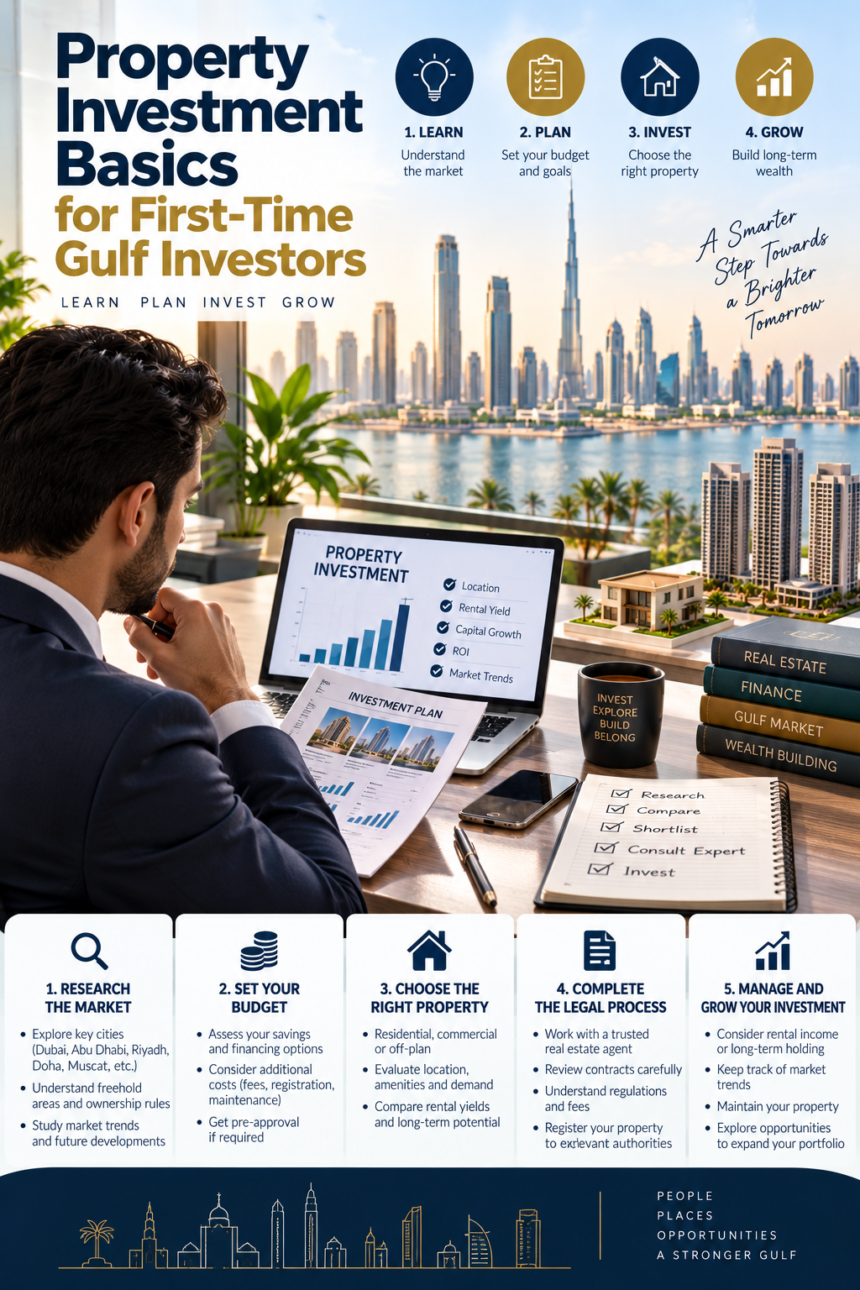
Practical First-Time Gulf Investor Checklist
Property Investment Basics for First-Time Gulf Investors begin with understanding that buying real estate is very different from simply finding a property that looks attractive. A successful investment should be based on ownership rights, demand, rental income, financing, transaction costs, future supply and a realistic exit strategy.
- Property Investment Basics for First-Time Gulf Investors: 2026 Overview
- 1. Defining a Clear Property Investment Goal
- 2. Choosing Between Residential and Commercial Property
- 3. Understanding Foreign Property Ownership Rules
- 4. Calculating the Real Purchase Budget
- 5. Understanding Rental Yield and Investment Returns
- 6. Comparing Cash Purchases and Mortgage Finance
- 7. Researching Location and Tenant Demand
- 8. Completing Property Due Diligence
- 9. Comparing Ready and Off-Plan Property
- 10. Understanding Property Management and Running Costs
- 11. Planning for Vacancy and Market Risk
- 12. Creating a Clear Exit Strategy
- Property Investment in the UAE
- Property Investment in Saudi Arabia
- Property Investment in Qatar
- Property Investment in Bahrain
- Property Investment in Oman
- Property Investment in Kuwait
- Residential Property for First-Time Gulf Investors
- Commercial Property for First-Time Gulf Investors
- Property Investment and Residency Opportunities
- Common Property Investment Mistakes in the Gulf
- Practical First-Time Property Investor Checklist
- Final Thoughts on Gulf Property Investment
The Gulf property market is not one single market either.
Dubai offers extensive freehold opportunities to international investors. Saudi Arabia introduced a new framework for non-Saudi real estate ownership. Qatar allows foreign ownership and usufruct in designated locations. Bahrain permits non-Bahrainis to own property in approved areas. Oman provides ownership opportunities in Integrated Tourism Complexes, while Kuwait remains a more restrictive market for many non-Kuwaiti buyers.
This means an investment strategy that works in Dubai cannot automatically be copied in Riyadh, Doha, Manama, Muscat or Kuwait City.
First-time investors should therefore begin with one simple principle: understand the rules and economics of the individual property before thinking about potential profit.
Property can generate rental income and long-term capital appreciation, but it also creates ongoing responsibilities. Service charges, maintenance, vacancy, financing costs, transaction fees and market corrections can all reduce returns.
The strongest first investment is rarely the most expensive property available. It is usually the property that the investor understands well and can comfortably afford to hold through changing market conditions.
Property Investment Basics for First-Time Gulf Investors: 2026 Overview
A first-time property investor normally needs to make decisions across five major areas.
| Area | Main decision |
|---|---|
| Investment goal | Income, appreciation, personal use or combination |
| Property type | Apartment, villa, office, retail or other asset |
| Financing | Cash or mortgage |
| Market | UAE, Saudi Arabia, Qatar, Bahrain, Oman or Kuwait |
| Holding strategy | Short, medium or long term |
The Gulf provides several advantages for investors, including modern infrastructure, strong regional cities, expanding tourism, population growth and significant government investment in economic diversification.
The legal framework, however, varies substantially.
Dubai Land Department confirms that foreign nationals may own property in designated freehold areas, while UAE and GCC nationals have wider ownership rights across Dubai.
Qatar’s Ministry of Justice similarly maintains specific freehold and usufruct areas for non-Qataris and connects qualifying property purchases with residency benefits.
Saudi Arabia’s new non-Saudi property law allows foreign ownership and other real rights within geographical areas determined under the regulatory framework, while certain legally resident non-Saudi individuals may own one residence outside those areas, subject to the law’s conditions and restrictions.
The first investment rule is therefore legal before it is financial: confirm that you are eligible to own the specific property before paying a deposit.
1. Defining a Clear Property Investment Goal
Do not begin with a property portal.
Begin with the reason for investing.
Common objectives include:
- Generating rental income
- Long-term capital appreciation
- Diversifying savings
- Buying a future home
- Building a retirement asset
- Obtaining qualifying residency benefits
- Combining personal use with investment
These goals can lead to completely different properties.
An investor seeking maximum rental income may prioritise a smaller apartment in a high-demand rental community.
Someone focused on capital appreciation may prefer an emerging neighbourhood with infrastructure under development.
A family buying for future personal use may prioritise schools, parks and larger layouts even if the initial rental yield is lower.
Commercial investors may focus instead on tenant strength, lease length and business-location demand.
Write down the primary objective before viewing properties.
It will help prevent emotional decisions later.
2. Choosing Between Residential and Commercial Property
Residential property is usually the easiest starting point for a first-time Gulf investor.
Common choices include:
- Studios
- One-bedroom apartments
- Larger apartments
- Townhouses
- Villas
Residential demand is supported by people needing somewhere to live, which generally creates a broad potential tenant market.
Commercial assets include:
- Offices
- Shops
- Warehouses
- Industrial units
- Other business premises
Commercial property can offer attractive yields and longer leases, but tenant demand is more specialised.
A residential apartment can potentially appeal to hundreds or thousands of households.
An office needs a company wanting that exact location, building standard, size and configuration.
For first-time investors, residential property often provides easier management, broader resale demand and more familiar mortgage options.
Commercial property becomes more attractive when the investor understands business leasing and the local commercial market.
3. Understanding Foreign Property Ownership Rules
Ownership rules are one of the biggest differences between GCC markets.
United Arab Emirates
Dubai allows foreign nationals to own freehold property in designated areas. Freehold ownership can include the land and buildings, while foreigners can also acquire other qualifying interests such as usufruct or long-term leases in designated locations.
Saudi Arabia
Saudi Arabia’s current Law of Real Estate Ownership by Non-Saudis permits non-Saudis to own property or acquire other real rights within geographical areas determined under the regulatory framework. The law also contains specific provisions for legally resident non-Saudis and separate restrictions concerning Makkah and Madinah.
Qatar
Non-Qataris can own real estate in designated freehold areas and obtain usufruct rights in other approved areas. Qatar also permits certain detached units such as apartments, offices and shops under specified conditions.
Bahrain
Non-Bahrainis can own property in areas approved for foreign ownership. Bahrain’s Survey and Land Registration Bureau provides official maps showing areas and projects where non-Bahrainis are permitted to own property.
Oman
Non-Omanis can own qualifying property within licensed Integrated Tourism Complexes. Oman’s official ownership legislation allows Omani and non-Omani individuals and legal entities to own land or constructed units in approved ITCs for accommodation or investment.
Kuwait
Kuwait remains substantially more restrictive for non-Kuwaiti real estate ownership. The legal framework governing non-Kuwaiti ownership was amended again in 2025, so international buyers should verify current eligibility and permitted ownership structures directly before treating Kuwait as an open foreign-investment property market.
Never rely only on an estate agent saying, “foreigners can buy here.”
Verify the exact project and title with the relevant land authority.
4. Calculating the Real Purchase Budget
A major first-time investor mistake is assuming the property’s advertised price equals the total investment.
It does not.
The purchase budget can include:
- Down payment
- Land registration
- Brokerage
- Mortgage processing
- Valuation
- Developer fees
- Service charges
- Insurance
- Furnishing
- Maintenance
- VAT where applicable
Suppose an investor has the equivalent of $150,000 available.
That does not necessarily mean they should buy a $150,000 property with cash.
Using every available dollar on the purchase leaves no emergency reserve for repairs, vacancy or other costs.
Likewise, a mortgage buyer should not use all savings for the minimum deposit.
Calculate the transaction from beginning to end.
The more appropriate question is not:
How expensive a property can I buy?
It is:
How expensive a property can I buy while still keeping adequate liquidity?
5. Understanding Rental Yield and Investment Returns
Rental yield measures income relative to the property’s value.
A simple gross-yield calculation is:
Annual rent ÷ purchase price × 100
For example:
Purchase price: AED 1,000,000
Annual rent: AED 70,000
Gross yield: approximately 7%
However, gross yield is not the same as investment profit.
The investor may still pay:
- Service charges
- Repairs
- Management
- Insurance
- Vacancy costs
- Mortgage interest or profit
- Leasing costs
The more useful figure is net yield.
Imagine annual rent is AED 70,000 but annual ownership and vacancy costs total AED 15,000.
Net income becomes AED 55,000.
The effective return is therefore materially lower than the advertised 7% gross yield.
Always ask property sellers whether a quoted ROI is gross or net.
6. Comparing Cash Purchases and Mortgage Finance

Property can be purchased entirely with cash or partly through mortgage finance where available.
Cash investment advantages
A cash buyer avoids financing costs and may complete transactions more quickly.
Monthly rental income is also not immediately reduced by mortgage repayments.
Mortgage advantages
Financing allows the investor to control a larger asset while using less initial capital.
It can also leave savings available for diversification.
However, leverage increases risk.
If rent falls while mortgage instalments continue, cash flow can turn negative.
Interest or profit rates can also change depending on the product.
First-time investors should model a difficult scenario.
Calculate whether the investment would still be manageable if:
- Rent dropped by 10%
- The property remained vacant for three months
- Mortgage costs increased
- Unexpected maintenance was required
If that scenario creates immediate financial stress, the investment may be too heavily leveraged.
7. Researching Location and Tenant Demand
“Good location” is too vague for serious investment.
A successful rental location usually has identifiable demand drivers.
These can include:
- Employment centres
- Metro access
- Schools
- Hospitals
- Airports
- Universities
- Shopping
- Tourism
- Business districts
- Major highways
Different tenants value different things.
Young professionals may prioritise metro access and workplaces.
Families may prioritise schools, supermarkets, parks and larger layouts.
Commercial tenants may care about business licensing, parking and client access.
Research actual rental listings and recent transactions rather than relying entirely on projected returns from sales brochures.
Saudi Arabia’s Real Estate General Authority now provides an official Real Estate Indicators platform with sales and rental information across regions, cities and neighbourhoods, illustrating the growing importance of transaction data in investment analysis.
Data should guide the investment rather than marketing.
8. Completing Property Due Diligence
Due diligence means verifying what you are actually buying.
For a ready property, investigate:
- Ownership
- Title deed
- Existing mortgage
- Outstanding charges
- Service-charge history
- Building condition
- Tenant status
- Current rent
- Lease conditions
For an off-plan development, investigate:
- Developer
- Project registration
- Escrow arrangements
- Payment schedule
- Completion history
- Construction progress
- Contract terms
Never send large amounts to a personal account merely because someone claims to represent a developer or broker.
Where regulatory verification systems exist, use them.
In Dubai, ownership rights are protected through official real estate registration with Dubai Land Department.
In Qatar, real estate registration and foreign ownership are administered through government real estate registration systems, including dedicated procedures for non-Qatari owners.
A few hours of legal and administrative checking can protect years of savings.
9. Comparing Ready and Off-Plan Property
Gulf property markets offer extensive off-plan investment opportunities.
Ready property
A completed property can be inspected before purchase.
It may also begin producing rental income quickly.
Investors can examine real maintenance costs, existing rents and building quality.
Off-plan property
An off-plan property is purchased before completion.
Potential advantages can include:
- Lower initial payments
- Developer instalment plans
- New buildings
- Possible appreciation before completion
The risks are different.
Construction delays can postpone income.
Market conditions can change before handover.
The finished unit may also face competition from many similar apartments delivered at the same time.
Off-plan investors should focus strongly on developer reputation and future supply.
A launch-day discount is not enough to make a project attractive.
10. Understanding Property Management and Running Costs
Property is not completely passive.
Even a fully paid investment needs management.
Typical responsibilities include:
- Finding tenants
- Preparing leases
- Collecting rent
- Maintenance
- Inspections
- Renewals
- Handling complaints
- Managing vacancy
Investors living outside the country may use professional property management.
Management fees reduce net returns but can save considerable time.
Building-level service charges also matter.
Two neighbouring apartments with identical rents can produce different returns if one development has much higher annual service charges.
Luxury facilities can be attractive to tenants, but swimming pools, gyms, landscaping, security and concierge services cost money to operate.
Before buying, obtain the latest service-charge information rather than estimating it.
11. Planning for Vacancy and Market Risk
No property should be modelled as though it will remain occupied forever.
Vacancy is a normal investment cost.
Build an annual allowance for periods without rent.
Also consider market cycles.
Property prices do not move upward permanently.
Supply can increase.
Population growth can slow.
Interest rates can change.
Businesses can relocate.
Some neighbourhoods that initially appear highly desirable can become heavily supplied with similar units.
Diversification matters for larger investors.
Someone with all personal wealth invested in one property in one city has significant concentration risk.
Property should usually form part of a broader financial strategy rather than automatically becoming the entire strategy.
12. Creating a Clear Exit Strategy
Every property purchase should include an answer to:
Who is likely to buy this property from me later?
The future buyer might be:
- Another investor
- First-time homeowner
- Family
- International buyer
- Business
Properties with broad buyer appeal usually provide greater liquidity.
Highly unusual layouts or specialised commercial properties may take longer to sell.
Also consider the planned investment period.
Property generally works better as a medium or long-term asset because buying and selling involve transaction costs.
An investor expecting to need the money within twelve months should think carefully before locking the capital into property.
Property Investment in the UAE
The UAE is one of the most accessible GCC property markets for international investors.
Dubai in particular offers numerous designated freehold areas in which foreigners can own property outright. Dubai Land Department confirms that foreign nationals may own in freehold areas, while UAE and GCC nationals have broader rights throughout the emirate.
The combination of international residents, tourism, business activity and an established real estate registration system makes Dubai a common starting point.
Abu Dhabi also provides investment opportunities, although investors should check the emirate-specific ownership framework.
First-time UAE investors should compare:
- Rental yield
- Service charges
- Developer history
- Community supply
- Mortgage conditions
- Property registration
- Tenant demand
Do not assume every Dubai apartment is a good investment simply because Dubai’s overall property market has performed strongly.
Individual building quality matters enormously.
Property Investment in Saudi Arabia
Saudi Arabia is becoming increasingly important for regional real estate investors.
A major development is the new Law of Real Estate Ownership by Non-Saudis.
The law permits non-Saudis to own real estate and acquire other real rights within geographical areas and subject to controls determined under the regulatory framework. It also allows a legally resident non-Saudi natural person to own one property outside those designated geographical areas for use as a residence, except in Makkah and Madinah, subject to the law and implementing regulations.
The law contains additional restrictions and specific treatment for Makkah and Madinah.
Investors should therefore verify the current regulations and approved geographical areas before purchasing.
Saudi Arabia also provides increasingly detailed market information through REGA’s Real Estate Indicators platform, which publishes transaction and rental data at different geographic levels.
This can help first-time investors compare neighbourhoods using actual market information instead of sales claims.
Property Investment in Qatar
Qatar provides clearly defined opportunities for foreign property investors.
The Ministry of Justice maintains designated areas where non-Qataris may own property freehold and other areas where usufruct rights are available.
Property investment can also create residency opportunities.
The Ministry states that a non-Qatari purchasing qualifying real estate worth at least QAR 730,000 can obtain property-related residency without a sponsor, subject to the applicable conditions including the annual residence requirement.
Property worth at least QAR 3.65 million can provide additional benefits associated with permanent residency status under the relevant framework.
Investors should still prioritise rental economics.
Residency benefits may add value, but they should not turn a weak property into a good investment.
Property Investment in Bahrain
Bahrain offers foreign ownership in designated areas.
The Survey and Land Registration Bureau provides official maps showing areas and projects where non-Bahrainis may own property.
This makes verifying eligibility relatively straightforward.
Bahrain also links real estate ownership with certain residency pathways.
The government’s Golden Residency service currently lists real estate ownership worth at least BHD 200,000 among the requirements for the property-owner category.
A separate self-sponsorship residence route is available for qualifying foreign property owners under different thresholds and conditions.
As with Qatar, residency should be considered an additional benefit rather than the sole reason for purchasing.
Rental demand, building quality and resale prospects remain essential.
Property Investment in Oman
Oman offers an established property-investment route for non-Omanis through Integrated Tourism Complexes.
Official legislation permits non-Omani natural and legal persons to own land or constructed units in licensed ITCs for accommodation or investment.
Gov.om maintains a dedicated property ownership service for tourist complexes, confirming that qualifying properties can be registered through the Ministry of Housing and Urban Planning framework.
The market continues to expand.
In March 2026, Oman announced a new integrated tourism complex in Al Qurum, Muscat, including hotels, recreational facilities, retail and residential units available for freehold ownership.
Non-Omani investors should verify that a project has the appropriate ITC status before purchasing.
Outside qualifying structures, ownership rules can be different.
Property Investment in Kuwait
Kuwait requires the greatest caution for many international first-time investors.
The legal framework governing real estate ownership by non-Kuwaitis remains significantly more restrictive than the open designated-area systems seen in markets such as Dubai or Bahrain.
Kuwait’s Direct Investment Promotion Authority lists Decree Law No. 7 of 2025 as amending the country’s law regulating real estate ownership by non-Kuwaitis.
Because ownership eligibility can depend on nationality, legal status and the specific circumstances of the transaction, foreign investors should obtain current local legal guidance before considering a Kuwaiti property purchase.
GCC nationals can have different rights from other foreign nationals under regional arrangements.
For many international investors seeking straightforward individual property ownership, other GCC markets currently offer clearer entry routes.
Residential Property for First-Time Gulf Investors
Residential property generally provides the simplest learning experience.
A first-time investor can understand the core economics relatively easily:
Purchase price
Annual rent
Service charges
Maintenance
Vacancy
Net return
Studios and one-bedroom apartments can appeal because of lower entry prices and broad tenant demand.
Family apartments and townhouses can provide longer average occupancies.
Villas may offer stronger exposure to land value but typically require more capital and maintenance.
Avoid assuming that the smallest property always generates the highest return.
Tenant demand should determine the decision.
Commercial Property for First-Time Gulf Investors
Commercial property can produce compelling returns, but investors should be cautious about entering without specialist knowledge.
An office investor needs to understand:
- Building grade
- Business location
- Parking
- Fit-out
- Metro access
- Lease structure
A retail investor needs to understand:
- Footfall
- Visibility
- Catchment area
- Tenant business model
A warehouse investor needs to understand:
- Zoning
- Loading access
- Power
- Road connectivity
- Permitted activity
Commercial investing should therefore begin with deeper market research than simply comparing advertised rental yields.
Property Investment and Residency Opportunities
Several Gulf countries connect qualifying property ownership with residence benefits.
Qatar provides property-linked residency from QAR 730,000 under its current framework, with additional benefits available at QAR 3.65 million.
Bahrain offers a Golden Residency route for qualifying foreign property owners where the title deed has a value of at least BHD 200,000.
Oman provides residence services connected with qualifying residential-unit ownership in Integrated Tourism Complexes, subject to the applicable conditions.
These programmes can increase the practical attraction of property ownership.
However, immigration rules can change.
Never buy a weak asset merely to obtain residency without separately analysing whether the investment itself makes financial sense.
Common Property Investment Mistakes in the Gulf
Buying because prices recently increased
Past appreciation does not guarantee future growth.
Trusting advertised ROI without calculation
Always calculate net yield independently.
Ignoring service charges
High recurring costs can reduce returns significantly.
Buying without checking ownership eligibility
Foreign ownership rules differ across GCC markets.
Using every available saving as a deposit
Maintain an emergency fund.
Ignoring future supply
Thousands of new apartments can change rental competition.
Choosing property emotionally
Investment decisions should be based on numbers.
Assuming off-plan always means cheaper
Compare completed alternatives.
Ignoring vacancy
No investment should assume twelve months of rent every year.
Buying solely for residency
Residency benefits should complement investment quality, not replace it.
Practical First-Time Property Investor Checklist
Before buying your first Gulf investment property, complete this checklist:
- Define the investment objective
- Choose the target GCC country
- Verify foreign ownership eligibility
- Set a maximum purchase budget
- Maintain emergency savings
- Compare residential and commercial assets
- Research actual rental transactions
- Calculate gross rental yield
- Calculate expected net yield
- Review service charges
- Inspect the property or development
- Verify title and registration
- Check outstanding liabilities
- Research the developer
- Review future construction supply
- Compare mortgage options
- Model higher financing costs
- Allow for vacancy
- Decide on property management
- Understand residency implications
- Identify the likely future buyer
- Build an exit strategy
- Obtain professional legal or tax advice where needed
Final Thoughts on Gulf Property Investment
Learning Property Investment Basics for First-Time Gulf Investors is less about predicting which GCC city will rise fastest and more about developing a disciplined investment process.
The UAE, particularly Dubai, provides one of the clearest foreign freehold investment environments, with Dubai Land Department confirming foreign ownership in designated freehold areas.
Saudi Arabia is entering a new phase under its active non-Saudi real estate ownership law, which expands potential ownership subject to geographical and regulatory controls.
Qatar offers designated foreign ownership and usufruct areas together with property-linked residency opportunities.
Bahrain permits non-Bahraini ownership in officially designated areas and provides residency routes for qualifying property owners.
Oman provides a structured route through Integrated Tourism Complexes, where non-Omanis can own qualifying property for accommodation or investment.
Kuwait remains a more restrictive ownership environment for many non-Kuwaiti individual investors, despite updates to the relevant legal framework in 2025.
For beginners, the safest approach is usually to start with an asset that is easy to understand.
Look for genuine tenant demand, reasonable service charges, clear legal ownership, realistic rental income and broad resale appeal.
Do not borrow simply because a bank offers finance. Do not buy simply because an agent promises appreciation. Do not choose a development simply because the payment plan looks affordable.
Calculate the net return.
Understand the downside.
Keep cash available for unexpected costs.
And always know who is likely to rent the property and who may eventually buy it from you.
A successful first property investment does not need to produce spectacular returns immediately. Its more important role is to provide sustainable income, manageable risk and a strong foundation for future investment decisions.
Do follow us on Instagram
Read More – How Mortgages Work in the Gulf: 12 Essential Things Buyers Should Know in 2026