

Understanding the Family Business Model
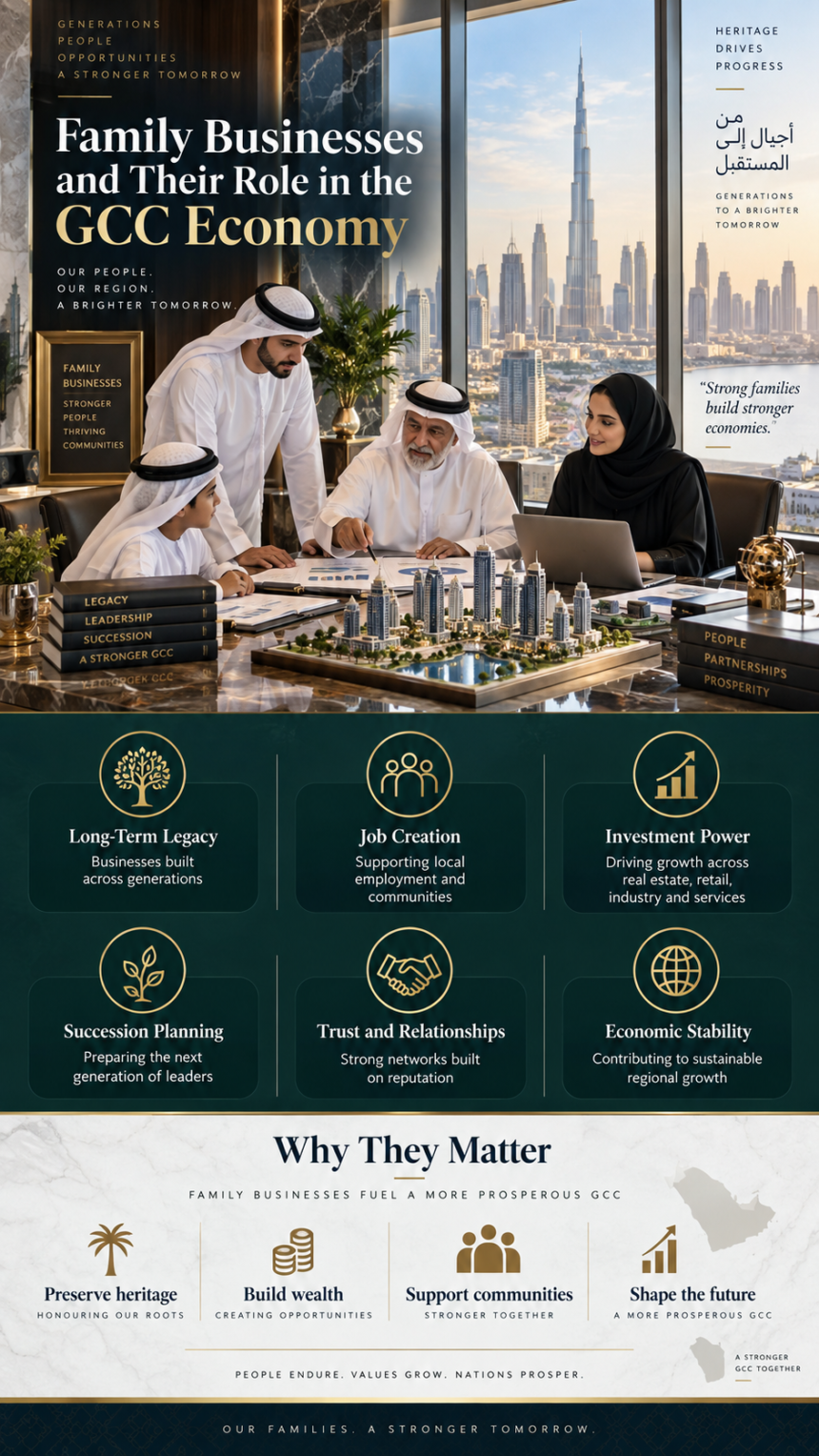
GCC Family Businesses are deeply connected with the development of the private sector across the UAE, Saudi Arabia, Qatar, Bahrain, Oman and Kuwait. Many began decades ago as trading houses, retailers, construction companies or service businesses before expanding into large groups with interests across real estate, hospitality, finance, manufacturing, logistics, automotive, healthcare and technology.
- GCC Family Businesses and Their Economic Importance
- Understanding the Family Business Model
- 1. Building a Strong Private Sector
- 2. Creating Employment Across the Gulf
- 3. Supporting Economic Diversification
- 4. Investing With a Long-Term Perspective
- 5. Developing Local Industries and Supply Chains
- 6. Expanding Into New Economy Sectors
- 7. Supporting International Trade
- 8. Strengthening Local Brands and Market Knowledge
- 9. Developing the Next Generation of Business Leaders
- 10. Professionalising Management and Governance
- 11. Creating Social and Community Value
- 12. Expanding Beyond the GCC
- Family Businesses in the UAE
- Family Businesses in Saudi Arabia
- Family Businesses in Qatar
- Family Businesses in Bahrain
- Family Businesses in Oman
- Family Businesses in Kuwait
- The Importance of Succession Planning
- Family Governance and Professional Management
- Family Offices and Wealth Management
- Technology and Digital Transformation
- Challenges Facing Gulf Family Businesses
- The Future of GCC Family Businesses
- GCC Family Business Growth Checklist
- Final Thoughts on GCC Family Businesses
Their importance goes beyond family wealth. Family-controlled companies employ large numbers of people, work with thousands of suppliers, invest capital across economic cycles and often maintain business relationships that extend across several generations. Qatar Chamber described family businesses in the Gulf as representing most private-sector companies and making a significant contribution to economic and social development.
The role of these companies is also changing. Gulf economies are moving rapidly into technology, advanced manufacturing, renewable energy, tourism, financial services and digital commerce. Family businesses that once concentrated on traditional trading and distribution are increasingly establishing investment companies, professional boards, family offices and new ventures designed for a more diversified economy.
This transformation creates both opportunity and pressure. The challenge is no longer simply preserving what the founder created. Family businesses increasingly need to combine their long-term relationships and local market knowledge with professional management, technology, governance and clear succession planning.
GCC Family Businesses and Their Economic Importance
Family businesses are important because they occupy a unique position between entrepreneurship and large institutional corporations. A company may begin with one founder but eventually develop into a group owned by dozens of family shareholders and managed partly or entirely by professional executives.
Their economic contribution appears in several areas:
| Economic Role | How Family Businesses Contribute |
|---|---|
| Employment | Operate companies across labour-intensive and specialist sectors |
| Investment | Reinvest profits into new businesses, property and industries |
| Diversification | Expand beyond oil-linked sectors into private enterprise |
| Trade | Maintain regional and international supplier networks |
| Entrepreneurship | Launch new companies and support younger founders |
| Local knowledge | Understand customers and regulations deeply |
| Capital formation | Build wealth that can finance future investment |
| Supply chains | Purchase from SMEs and specialist service providers |
| Innovation | Invest in technology and new business models |
| Community development | Support social, cultural and charitable initiatives |
The strength of the model often comes from patience. A publicly listed company may face pressure to demonstrate short-term quarterly performance, while a closely held family enterprise can sometimes make investment decisions over much longer periods.
That does not mean family ownership automatically produces better results. Informal decision-making, unresolved ownership disputes and weak succession plans can damage even highly successful companies. The economic value of family businesses therefore depends increasingly on how effectively they combine family ownership with institutional management.
Understanding the Family Business Model
A family business is generally a company in which members of one family hold significant ownership or control and influence major strategic decisions. Some companies are managed directly by family members, while others employ professional executives but remain owned by the founding family.
Several generations may eventually become involved. A founder might begin the business alone, the founder’s children may later manage separate divisions, and by the third generation the company may have dozens of shareholders with different careers, priorities and levels of involvement.
That creates an important distinction between ownership and management. A family member can own shares without working inside the company, while a professional CEO can manage the organisation without owning it.
The most sustainable family businesses tend to understand this difference clearly. They create systems determining who can join the company, how executives are appointed, how profits are distributed and how major strategic decisions are made.
The UAE’s current family-business framework reflects this institutional approach. Registration in the federal Family Businesses Registry can help companies organise ownership, formalise succession structures, create family holding entities and establish legally recognised governance arrangements.
1. Building a Strong Private Sector
Family enterprises have historically formed an important part of Gulf private-sector development. Before today’s large startup ecosystems, free zones and multinational regional headquarters, merchant families played major roles in trade, construction, retail and distribution.
Many of those businesses later diversified.
A trading company might enter property development. A distributor could establish manufacturing operations. An automotive company might expand into logistics, financial services or hospitality.
This ability to build several businesses under one ownership group has helped create some of the GCC’s largest private companies.
Saudi Arabia’s Ministry of Commerce has specifically described family companies as accounting for a major share of enterprises across different economic activities and has built provisions supporting their continuity into the country’s Companies Law.
A healthy economy needs both large institutional companies and entrepreneurial private businesses. Family companies can connect these two worlds because they often retain an entrepreneurial ownership culture even after becoming large employers.
2. Creating Employment Across the Gulf
Family companies support employment directly through their own operations and indirectly through suppliers, contractors and service providers.
A diversified family group can employ people in retail stores, construction projects, warehouses, hotels, restaurants, corporate offices, manufacturing plants and technology departments. Its procurement spending then supports accounting firms, logistics businesses, marketing companies and other SMEs.
The scale becomes particularly important in economies trying to increase private-sector employment.
Oman’s wider private-enterprise sector illustrates how important locally based companies can be to employment. Active private establishments employed more than 1.8 million people during the fourth quarter of 2025, with employment increasing especially strongly among small and medium-sized businesses.
Not all of those businesses are family owned, but many Gulf SMEs and larger private enterprises develop from family entrepreneurship. Successful family companies therefore contribute to the broader private-sector employment ecosystem.
The next stage is creating higher-value jobs. As family groups invest in technology, advanced manufacturing, finance and specialist professional services, they can provide careers requiring more technical and managerial expertise.
3. Supporting Economic Diversification
Economic diversification is one of the most important strategic priorities across the GCC.
Governments want larger non-oil sectors, stronger private companies and greater participation in industries such as tourism, manufacturing, logistics, technology and financial services.
Family businesses are well positioned to participate because many already possess capital, established management teams and local networks. They can invest in new sectors without building an entire organisation from zero.
A family group that historically focused on trading might invest in renewable energy. Another with property experience could enter hospitality or tourism. A retailer may develop e-commerce and logistics technology.
The contribution is important because diversification cannot depend entirely on government projects or foreign multinationals. Sustainable economic transformation also requires domestic private capital willing to build businesses over long periods.
Family companies can provide that capital while maintaining ownership and decision-making within the region.
4. Investing With a Long-Term Perspective
Family businesses often think about time differently from businesses controlled by short-term investors.
The owners may be concerned with what the company will look like in twenty or thirty years rather than only next year’s profit. That can encourage investments whose benefits develop gradually.
Long-term thinking can support:
- Industrial facilities
- Property development
- Employee training
- Technology upgrades
- New market entry
- Brand building
- Sustainability projects
This patience can become a competitive advantage during difficult economic periods. A financially strong family business may continue investing when other companies reduce spending.
However, long-term ownership works best when it is paired with financial discipline. Emotional attachment to a business division can sometimes prevent a family from closing or restructuring an operation that no longer makes economic sense.
Professional governance helps separate legacy from strategy.
5. Developing Local Industries and Supply Chains
Large family groups frequently sit at the centre of extensive supplier networks.
A hotel group purchases food, furniture, software, cleaning services and professional advice. A construction company works with subcontractors, engineers and materials suppliers, while a retail group depends on logistics and distribution businesses.
This creates economic activity far beyond the family company’s own payroll.
As GCC countries expand local manufacturing, family businesses can play an even larger role by moving from importing finished products to producing or assembling them domestically.
This transition can create:
- New factories
- Technical jobs
- Local procurement
- Export opportunities
- Research partnerships
Saudi Arabia and Oman are particularly focused on increasing domestic industrial capacity, while the UAE continues developing advanced manufacturing and technology sectors.
Established family groups with distribution experience can become natural partners in this transition because they already understand customers, international suppliers and regional logistics.
6. Expanding Into New Economy Sectors
Family businesses are sometimes viewed as traditional organisations, but many are actively investing in technology and innovation.
The shift is necessary because consumer behaviour and business models are changing rapidly. Retail has moved toward e-commerce, banking is becoming increasingly digital, logistics relies on real-time data and artificial intelligence is changing professional services.
Dubai’s family-business ecosystem is explicitly encouraging this evolution. The Dubai Centre for Family Businesses supports companies with governance, next-generation development and tools designed to help family enterprises adapt and remain competitive over the long term.
Technology investment can happen in two ways. A family company can digitally transform its existing operations, or the family can invest capital into completely new technology ventures.
Both approaches matter.
A decades-old distribution company using AI to forecast demand is innovating, even if it never becomes a technology startup.
7. Supporting International Trade
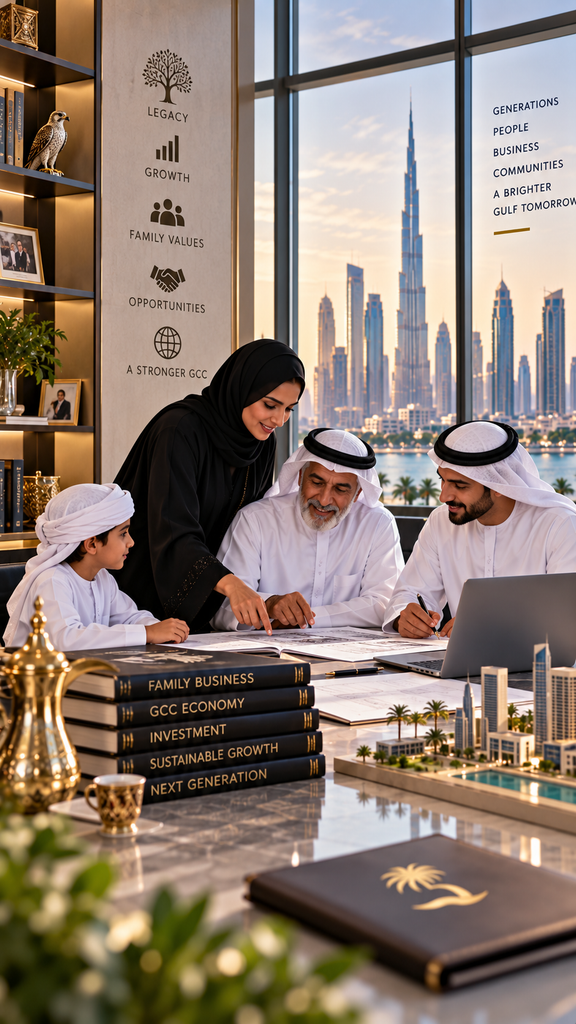
Many Gulf family businesses began in trade.
Their founders built relationships with manufacturers and suppliers abroad, importing goods into growing Gulf markets and gradually becoming distributors for international brands.
Those relationships helped connect the GCC with global commerce.
Today, the model has become more sophisticated. Large family companies may operate warehouses, logistics businesses, dealerships and international subsidiaries across several countries.
Bahrain Chamber’s recent trade data demonstrates the strength of regional private-sector connections. More than half of the Certificates of Origin it issued during the first half of 2026 were for exports destined for Saudi Arabia, the UAE and Kuwait.
Family businesses participate in these trade corridors as exporters, importers, distributors and investors.
Their ability to maintain relationships across decades can be particularly useful in markets where supplier trust and reputation matter.
8. Strengthening Local Brands and Market Knowledge
International companies often have capital and technology, but family businesses can possess something equally valuable: deep understanding of the local market.
A company operating for several decades can develop detailed knowledge about customers, suppliers, regulations and business culture.
This explains why international brands have historically worked with Gulf family groups as distributors, franchise operators and joint-venture partners.
The family partner may provide commercial infrastructure that would take years for an overseas company to build independently.
At the same time, more Gulf family companies are developing their own brands instead of operating primarily as distributors.
This represents an important economic shift. Local companies that create intellectual property, products and international brands can capture greater value than businesses relying only on imported products.
9. Developing the Next Generation of Business Leaders
One of the most important questions facing family businesses is what happens when the founder or current chairman eventually steps away.
The next generation may be highly educated and internationally experienced, but inheritance alone does not make someone qualified to manage a large company.
Strong family businesses therefore invest deliberately in leadership development.
Dubai’s Next-Gen Family Businesses Training Programme is one example. Its first 2026 cycle brought together 17 next-generation family-business members for training covering leadership, governance and entrepreneurship.
The objective should not necessarily be to make every family member an executive. Some may become board members, investors or shareholders while professional managers operate the company.
Preparing the next generation means helping them understand both ownership responsibility and commercial discipline.
That distinction can prevent the business from becoming a collection of jobs reserved for relatives.
10. Professionalising Management and Governance
As family businesses grow, informal management becomes increasingly risky.
A small company can sometimes function with decisions made around one table. A multinational group with thousands of employees cannot depend on undocumented arrangements between relatives.
Professional governance can include:
- Formal board structures
- Independent directors
- Family councils
- Shareholder agreements
- Clear executive authority
- Financial reporting
- Conflict-of-interest policies
- Family constitutions
Saudi Arabia’s Companies Law specifically allows family shareholders to establish a family charter governing ownership, management, employment of relatives, dividend distribution, share transfers and dispute resolution.
The UAE has moved in a similar direction through its Family Businesses Registry. Registered companies can adopt legally recognised succession and governance structures and use tools designed to reduce ownership fragmentation and disputes.
Professionalisation does not mean removing the family from the business. It means making the company strong enough to function beyond individual personalities.
11. Creating Social and Community Value
Family companies often have close relationships with the communities in which they developed.
That can lead to long-term investment in education, healthcare, charities, cultural initiatives and local entrepreneurship.
Corporate social responsibility is becoming more structured as well.
Qatar Chamber’s fourth Private Sector Social Responsibility Conference in 2026 focused specifically on sustainability and social responsibility in Arab family businesses. Speakers emphasised that family companies have important roles in balancing economic growth with social responsibility and long-term sustainability.
This creates an important opportunity.
Rather than treating charitable activity separately from business strategy, family groups can integrate sustainability, responsible employment and community investment into the way companies operate.
That can strengthen reputation while also producing measurable social value.
12. Expanding Beyond the GCC
A successful family company does not need to remain regional forever.
Many Gulf groups are increasingly investing internationally through acquisitions, partnerships, property, financial assets and operating companies.
KPMG’s recent family-business research found growing interest in mergers and acquisitions among family enterprises. Its study reported that nearly 500 surveyed family businesses had completed acquisitions in the previous three years, with those businesses showing stronger average performance than companies that had not undertaken acquisitions.
International expansion can help Gulf family businesses diversify both geographically and commercially.
However, overseas growth introduces new challenges involving governance, foreign management teams, tax, currencies and regulatory systems.
Companies that professionalise successfully at home are therefore better prepared to become global organisations.
Family Businesses in the UAE
The UAE has developed one of the region’s most structured family-business frameworks.
Federal Decree-Law No. 37 of 2022 created a dedicated legal framework for family companies, while the Unified Family Businesses Registry provides a formal system for eligible enterprises. The Ministry of Economy and Tourism says registration can support ownership stability, succession, asset protection and stronger institutional credibility.
The registry is continuing to expand. In July 2026, the Ministry registered Sell Force International as the first Indian family-owned company in the Unified Family Businesses Registry, highlighting that the framework is relevant to international families operating in the UAE as well as Emirati-owned companies.
Dubai has also established the Dubai Centre for Family Businesses under Dubai Chambers. During 2025, the centre carried out 78 family-business visits, launched three specialised advisory services and expanded governance and succession support.
These initiatives reflect the UAE’s ambition to become not only a place where family businesses operate but also a jurisdiction where international business families can manage ownership and generational succession.
Family Businesses in Saudi Arabia
Family companies are deeply embedded in Saudi Arabia’s private sector.
They operate across industries including retail, construction, manufacturing, automotive, hospitality, finance and real estate, with many developing from trading businesses established decades ago.
Saudi company law now provides specific tools designed to support their sustainability. Family shareholders can formally agree on charters covering management, governance, employment, dividend policies, ownership transfers and dispute resolution.
The legislation is important because family businesses often become more complicated as ownership passes from one generation to another.
Saudi Arabia’s broader economic transformation creates another opportunity. Vision 2030 is encouraging private investment in technology, tourism, logistics, manufacturing and other industries, providing established family groups with opportunities to diversify away from traditional business models.
The strongest Saudi family companies are likely to be those able to combine their market reputation and capital with institutional governance and professional talent.
Family Businesses in Qatar
Family enterprises remain an important part of Qatar’s private economy, particularly in trading, construction, real estate, hospitality and services.
Qatar Chamber has placed increasing attention on governance and sustainability. At its 2026 social responsibility conference, speakers described Gulf family businesses as major contributors to economic development while highlighting risks involving conflicts of interest, weak separation between management and ownership, and insufficient institutional structures.
These are not uniquely Qatari challenges. They appear wherever growing family enterprises move from founder leadership to multi-generational ownership.
For Qatar, the opportunity is to connect established family capital with the country’s growing focus on technology, logistics, advanced industries, tourism and financial services.
Family companies that move into these sectors can support diversification while building new sources of long-term family wealth.
Family Businesses in Bahrain
Family enterprise has long played an important role in Bahrain’s merchant and private-sector traditions.
In May 2026, Bahrain Chamber identified family-business sustainability and corporate governance as priorities, describing family enterprises as major pillars of the national economy and important drivers of growth, investment and commercial opportunity.
The Chamber also provides a Family Business Governance Guideline and support programmes focused on continuity and institutional development.
These initiatives are particularly relevant because Bahrain’s compact economy contains many long-standing privately held companies whose operations extend beyond the domestic market into Saudi Arabia and other GCC countries.
Succession and professionalisation can therefore influence not only the survival of individual companies but also the stability of important parts of Bahrain’s private-sector ecosystem.
Family Businesses in Oman
Oman’s private sector contains a mixture of established family groups and a rapidly expanding SME ecosystem.
The number of SMEs in Oman reached approximately 267,535 during the first half of 2026, demonstrating the scale of private entrepreneurship supporting the country’s diversification strategy.
Family-owned groups remain particularly visible in trading, construction, logistics, tourism, retail and industrial activity.
The opportunities are expanding as Oman Vision 2040 places greater emphasis on manufacturing, logistics, renewable energy, tourism and technology.
For established Omani families, these sectors offer ways to move capital from mature businesses into future-oriented industries.
Governance will become increasingly important as these companies grow across borders and bring new generations into ownership.
Family Businesses in Kuwait
Kuwait has one of the Gulf’s oldest merchant traditions, and family ownership remains important across retail, finance, property, trading and diversified conglomerates.
Succession is becoming a particularly important issue as businesses founded by earlier generations move toward increasingly complex ownership structures.
Research on Kuwaiti family-owned SMEs has examined how family relationships, social norms and emotional ownership influence succession and continuity, highlighting the importance of planning before leadership transitions become urgent.
KPMG Kuwait’s 2026 family-business research also reflects the broader transition facing family companies. It identifies succession, external talent and risk management as major challenges and describes a shift from businesses that are directly family run toward companies that remain family owned but operate through professional management and formal boards.
For Kuwait, stronger governance can help established business families protect legacy while preparing companies for regional competition and economic diversification.
The Importance of Succession Planning
Succession may be the single most important long-term challenge for a family business.
The founder often occupies several roles at the same time: shareholder, chairman, chief executive, negotiator and keeper of major customer relationships. If leadership changes suddenly without preparation, the business can face uncertainty even when it remains financially healthy.
Effective succession planning should answer several questions:
| Succession Question | Why It Matters |
|---|---|
| Who owns shares next? | Prevents ownership confusion |
| Who leads the company? | Protects operational continuity |
| Which family members can work inside the company? | Reduces employment disputes |
| How are executives selected? | Supports professional management |
| How are dividends decided? | Balances owners and business investment |
| Can shares be sold outside the family? | Protects ownership strategy |
| How are disputes resolved? | Reduces destructive conflict |
Recent Middle East research illustrates how important the issue remains. A 2025 succession study found that fewer than one in five surveyed Gulf family businesses had a comprehensive succession plan, even though confidence in next-generation leadership was generally high.
Succession should therefore begin while the current leadership is healthy and active, not after a crisis.
Family Governance and Professional Management
The strongest family companies increasingly separate three different systems: family, ownership and business management.
Family governance addresses relationships among relatives. Corporate governance addresses how the company is controlled and supervised. Executive management handles everyday commercial operations.
Confusing these functions creates problems.
A family member may be an owner but not the best person to lead a division. Another relative may be highly qualified and deserve a senior executive role. Professional systems create objective standards for making those decisions.
Useful governance structures can include a family council, formal board, independent directors, shareholder agreement and family constitution.
Dubai’s family-business advisory services now specifically include family constitution drafting, governance assessments and family-office planning, illustrating the move toward more institutional models.
Family Offices and Wealth Management
As family wealth becomes more diversified, some business families establish family offices.
A family office can coordinate areas such as investments, property, governance, estate planning and financial reporting separately from the operating company.
This becomes useful when the family’s wealth is no longer concentrated entirely in one business.
For example, a family might own a trading company while also holding real estate, private equity investments and international financial assets.
Separating family wealth management from operating-company management can improve transparency and reduce pressure to use the main company as the family’s personal investment account.
The structure needs to match the family’s actual complexity. Smaller businesses do not automatically need elaborate family-office systems.
Technology and Digital Transformation
Generational change is occurring at the same time as technological change.
This creates an opportunity because younger family members may bring experience in digital platforms, AI, international markets and modern investment strategies.
However, transformation needs to solve real business problems rather than becoming a symbolic project given to the next generation.
Technology can help family businesses improve:
- Customer experience
- Inventory management
- Financial reporting
- Cybersecurity
- E-commerce
- Supply-chain visibility
- Data analytics
- Artificial intelligence adoption
A traditional company can remain true to its values while changing how it operates.
The objective is not to erase the founder’s legacy. It is to ensure that the company remains commercially relevant enough for that legacy to survive.
Challenges Facing Gulf Family Businesses
Family ownership provides important strengths, but it also creates specific risks.
Succession uncertainty can appear when leadership plans are delayed. Ownership fragmentation can become more difficult as the number of heirs increases, while family disputes can move from private disagreements into commercial decisions.
Another challenge is attracting professional talent. Highly qualified executives need confidence that career advancement will be based on performance rather than family relationships.
Governance and risk management also need greater attention. KPMG’s 2026 global family-business report found that only around one-third of surveyed family companies had a comprehensive enterprise risk-management framework, while attracting external talent was identified as a major people challenge.
The solution is not to remove family influence. It is to create rules strong enough to protect the company when family interests and business interests do not perfectly align.
The Future of GCC Family Businesses
The next decade could become one of the most important periods in the history of Gulf family enterprise.
Many companies are moving from founder or second-generation leadership into more complex multi-generational ownership. At the same time, the economies around them are changing rapidly through AI, sustainability, tourism, advanced manufacturing and international investment.
Successful family businesses will likely become more institutional without necessarily becoming less family owned.
They may use professional CEOs, independent board members and formal investment committees while the family continues setting long-term ownership values and strategic direction.
Some will list parts of their businesses on stock exchanges while retaining control. Others may sell mature divisions and invest the proceeds into new industries.
The common theme will be adaptability.
Legacy alone cannot guarantee survival, but legacy combined with strong governance, capital and innovation can become a powerful competitive advantage.
GCC Family Business Growth Checklist
Family companies preparing for the next generation should review both commercial strategy and ownership structure.
- Create a documented succession plan before leadership change becomes urgent.
- Define clearly which family members can work inside the company.
- Separate shareholder rights from executive responsibilities.
- Establish a professional board appropriate to the company’s size.
- Consider independent directors where they add genuine expertise.
- Create clear dividend and reinvestment policies.
- Maintain audited and transparent financial information.
- Develop dispute-resolution mechanisms before disagreements occur.
- Protect important brands and intellectual property.
- Build cybersecurity and enterprise risk-management systems.
- Train younger family members before placing them in senior leadership roles.
- Recruit external executives when the required expertise does not exist within the family.
- Review whether a family holding company or family office would improve structure.
- Diversify carefully rather than entering unrelated sectors simply because capital is available.
- Develop a regional and international expansion strategy based on commercial opportunity.
- Preserve family values without allowing tradition to prevent necessary business change.
The goal is not simply transferring ownership successfully. It is transferring a business that remains competitive.
Final Thoughts on GCC Family Businesses
GCC Family Businesses remain one of the foundations of private enterprise across the Gulf. They have helped build industries, create employment, connect regional markets with international suppliers and accumulate private capital that can now support the next phase of economic diversification.
Their importance is increasingly recognised institutionally. The UAE has created a dedicated federal family-business framework and Unified Family Businesses Registry, while Dubai operates specialised governance, advisory and next-generation leadership programmes.
Saudi Arabia’s Companies Law provides formal mechanisms for family charters covering ownership, governance, employment, dividends and dispute resolution. Bahrain Chamber has placed family-business continuity and governance among its priorities, while Qatar Chamber continues highlighting the economic significance of family enterprises and the need for transparency and institutional structures.
Oman and Kuwait also demonstrate why the conversation increasingly needs to focus on the future rather than only the past. Large private and SME ecosystems are developing alongside new industries, while established family groups face the challenge of transferring leadership into generations operating in a more digital and internationally competitive economy.
The greatest risk for a successful family company is often assuming that the model that created its success will automatically preserve it.
A founder may build a company through instinct, personal relationships and direct control. A third-generation organisation with hundreds or thousands of employees requires clearer systems. Ownership needs rules, management needs accountability and succession needs to be planned before it becomes unavoidable.
The family businesses that manage that transition successfully can have an enormous advantage. They combine long-term capital, local knowledge, established reputations and deep commercial relationships with professional governance and modern technology.
That combination can allow them to remain influential not only for another business cycle, but for another generation.
For the GCC economy, their success matters because family-business continuity protects more than family wealth. It protects companies, jobs, investment, supplier networks, institutional knowledge and private-sector growth that have taken decades to build.
Do follow us on Instagram
Read More – Gulf Women Entrepreneurs: 12 Inspiring Ways Transforming the Economy