

Why Skills Matter More Than Ever in the GCC
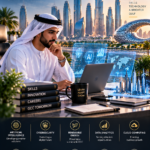
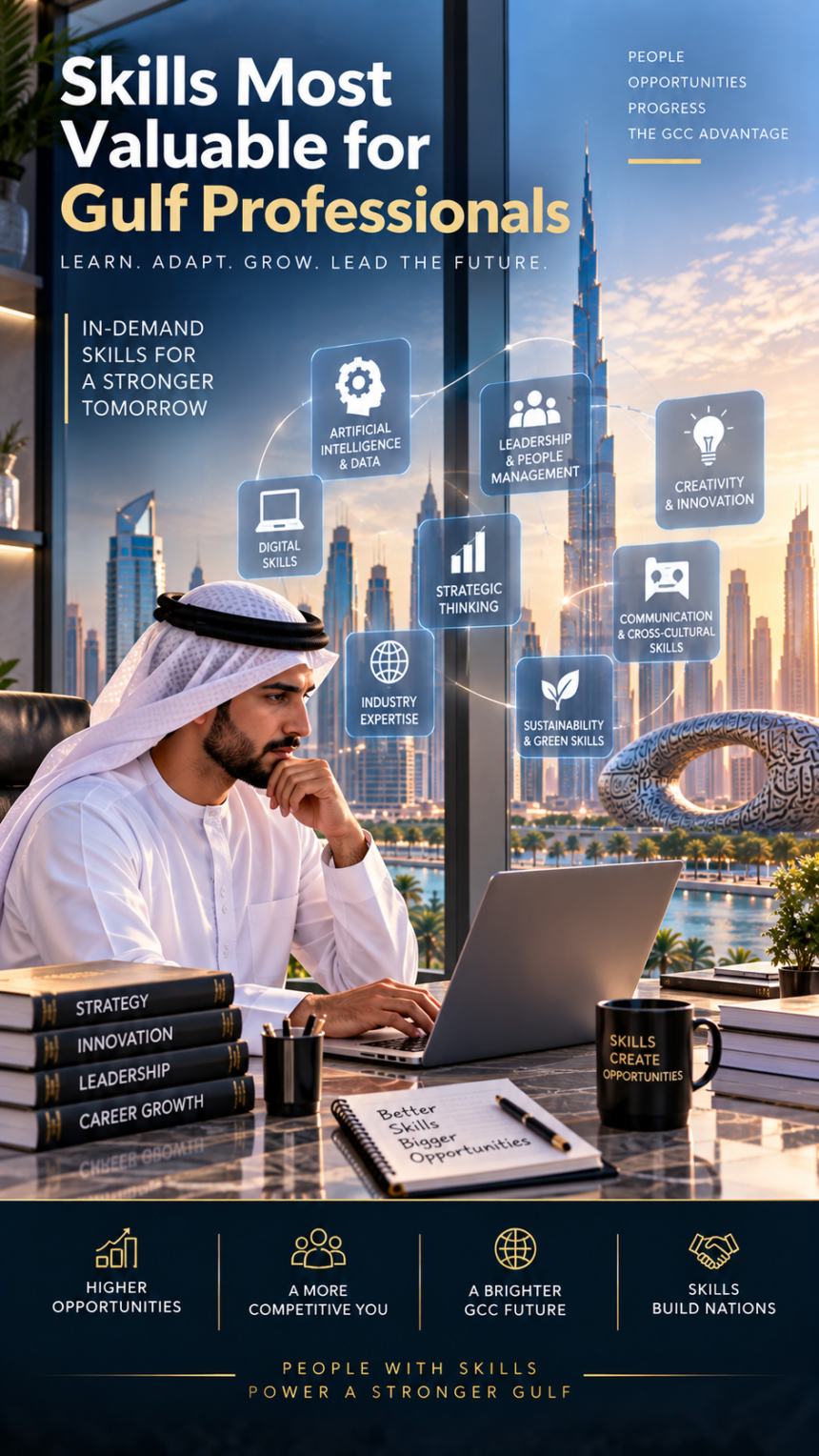
Gulf Professional Skills are changing as quickly as the economies of the UAE, Saudi Arabia, Qatar, Bahrain, Oman and Kuwait. Employers increasingly need professionals who can combine strong industry knowledge with artificial intelligence, data analysis, digital tools, communication, leadership and the ability to adapt as businesses transform.
- Gulf Professional Skills and the Changing Job Market
- Why Skills Matter More Than Ever in the GCC
- 1. Artificial Intelligence Literacy
- 2. Data Analysis and Analytical Thinking
- 3. Digital and Technology Literacy
- 4. Cybersecurity Awareness
- 5. Communication Skills
- 6. Leadership and People Management
- 7. Problem Solving and Critical Thinking
- 8. Adaptability and Resilience
- 9. Project Management
- 10. Commercial and Financial Awareness
- 11. Customer and Service Skills
- 12. Sustainability and ESG Knowledge
- 13. Cross-Cultural Communication
- 14. Negotiation and Relationship Building
- 15. Continuous Learning and Upskilling
- Valuable Professional Skills in the UAE
- Valuable Professional Skills in Saudi Arabia
- Valuable Professional Skills in Qatar
- Valuable Professional Skills in Bahrain
- Valuable Professional Skills in Oman
- Valuable Professional Skills in Kuwait
- Technical Skills vs Human Skills
- Skills Valuable Across Different GCC Industries
- How AI Is Changing Professional Skill Requirements
- How Expats Can Strengthen Their Gulf Careers
- Skills GCC Nationals Can Prioritise
- Common Professional Development Mistakes
- Gulf Professional Skills Development Checklist
- Final Thoughts on Gulf Professional Skills
A university degree remains valuable, but qualifications alone are becoming less likely to guarantee long-term career success. Companies are introducing automation, cloud systems, artificial intelligence and new business models, while Gulf governments are simultaneously expanding industries such as tourism, advanced manufacturing, logistics, technology, healthcare and financial services.
Global employment research supports this shift. The World Economic Forum’s Future of Jobs Report 2025 found that analytical thinking remained the most important core skill identified by employers, followed by resilience, flexibility, leadership and creative thinking. AI and big data, cybersecurity and technological literacy were among the skills expected to grow fastest through 2030.
The same pattern is visible across the GCC. Saudi Arabia has established sector skills councils covering areas including digital technology, finance, healthcare, logistics, manufacturing, consulting, tourism and cybersecurity, while the UAE is building its future economy around innovation, advanced technology and the attraction of specialised talent.
Professionals therefore need to think beyond one job title. The strongest careers will increasingly belong to people who develop a combination of technical, commercial and human capabilities that remain useful as industries change.
Gulf Professional Skills and the Changing Job Market
The most valuable professionals are rarely those who know only one software platform or one technical process. Employers increasingly want people who can understand information, work with technology, communicate clearly and solve problems independently.
| Skill | Why It Matters in the GCC |
|---|---|
| AI literacy | AI is entering almost every business function |
| Data analysis | Companies want better evidence-based decisions |
| Digital literacy | Most professional work is becoming technology-driven |
| Cybersecurity | Digital growth increases security risks |
| Communication | Multicultural workplaces require clarity |
| Leadership | Expanding companies need strong managers |
| Critical thinking | Automation increases the value of judgement |
| Adaptability | GCC industries are changing rapidly |
| Project management | Major projects remain central to Gulf growth |
| Commercial awareness | Employers value people who understand business impact |
| Customer service | Hospitality and service industries continue expanding |
| Sustainability | Green investment and ESG requirements are increasing |
| Cross-cultural skills | GCC workplaces are highly international |
| Negotiation | Relationships remain important in Gulf business |
| Lifelong learning | Skills can become outdated quickly |
The most important point is that technical and human abilities should not be treated as opposites. A cybersecurity specialist still needs to communicate with management, while a sales manager increasingly needs to understand customer data and digital systems.
The best professional profile is usually a combination rather than a single skill.
Why Skills Matter More Than Ever in the GCC
Gulf labour markets are becoming increasingly skills-focused because diversification requires more specialised employees.
Saudi Arabia’s current Skills and Training framework is designed specifically to align education and workforce development with present and future labour-market needs. Its sector councils cover major areas including manufacturing, energy, digital technology, financial services, health, logistics, consulting, tourism and cybersecurity.
The country’s new Skills Taxonomy goes even further. It currently maps 13,939 skills across 2,047 occupations, using labour-market information and modern technologies to identify professional requirements and future gaps.
Oman Vision 2040 similarly calls for a dynamic labour market with a skilled and productive workforce capable of adapting to economic, knowledge and technological changes. Its National Employment Program specifically focuses on closing knowledge and skills gaps so job seekers can meet market requirements.
The message for professionals is straightforward. Employers increasingly want evidence that someone can perform effectively, learn quickly and contribute to the organisation rather than simply hold a qualification.
1. Artificial Intelligence Literacy
AI literacy is rapidly becoming valuable far beyond technology departments.
An accountant may use AI to analyse financial information, a marketer can use it to research audiences, while managers may use intelligent systems to summarise documents or evaluate business data. Professionals do not necessarily need to become machine-learning engineers, but they increasingly need to understand what AI can and cannot do.
Useful AI literacy includes knowing how to:
- Give clear instructions to AI tools
- Evaluate AI-generated information
- Protect confidential information
- Recognise inaccurate outputs
- Automate suitable routine tasks
- Use AI ethically and responsibly
The World Economic Forum identifies AI and big data as the fastest-growing skill category expected through 2030. Qatar’s current technology investment programme also specifically prioritises AI, data analytics, cybersecurity, cloud services and other emerging technologies while requiring supported projects to create high-skilled employment locally.
The greatest professional advantage will not come from using AI for everything. It will come from understanding when it improves work and when human judgement remains essential.
2. Data Analysis and Analytical Thinking
Data is becoming part of almost every profession.
Managers need to understand performance dashboards, marketers analyse campaign results, financial professionals evaluate trends and logistics teams use forecasting to manage inventory and transportation.
The World Economic Forum ranks analytical thinking as the most important core workplace skill, with around 69% of surveyed employers identifying it as essential.
Professionals do not necessarily need advanced statistical programming skills. However, they should become comfortable interpreting information, questioning assumptions and understanding whether data actually supports a business conclusion.
Useful tools may include spreadsheets, business intelligence platforms and visualisation software. More technical professionals can add SQL, Python or advanced analytics depending on their sector.
The combination of data literacy and business knowledge can be particularly powerful because it allows professionals to move beyond producing reports and toward explaining what decisions should follow from them.
3. Digital and Technology Literacy
Digital literacy now means far more than knowing how to send emails or prepare presentations.
Professionals increasingly work through cloud systems, collaboration software, enterprise platforms, automated workflows and specialised industry applications. Someone who struggles with digital tools can become slower even when they possess excellent traditional knowledge.
Bahrain’s National Digital Economy Strategy illustrates this change. It includes initiatives to strengthen coding, AI, STEM education, digital upskilling and employment-linked technology training, showing how digital capability is becoming part of national workforce planning.
Kuwait has also launched digital skills initiatives focused on artificial intelligence, cloud computing and cybersecurity for national talent.
Professionals should therefore become comfortable learning new software rather than trying to master one platform permanently. Tools will change, but the ability to understand digital workflows will remain valuable.
4. Cybersecurity Awareness
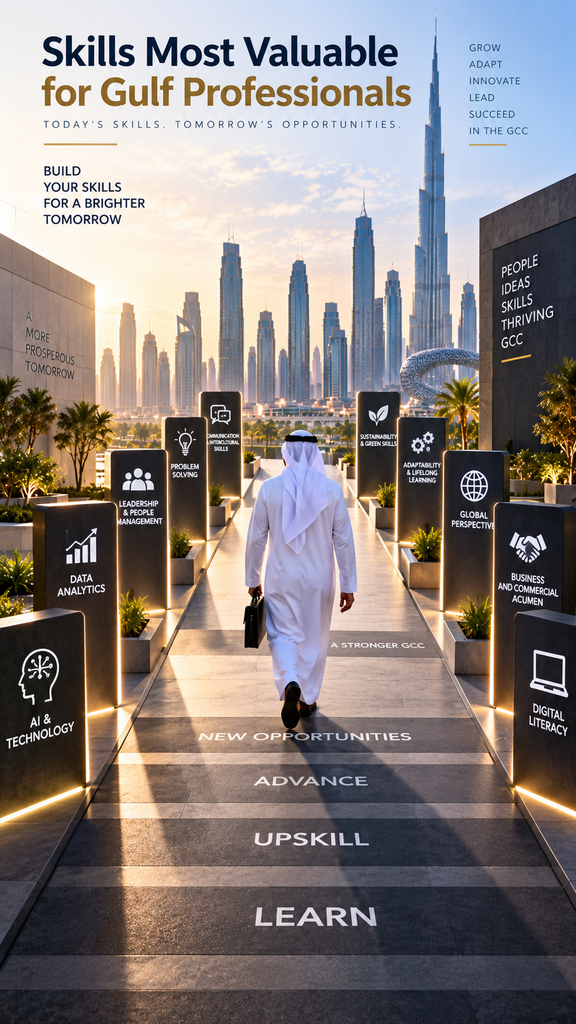
Cybersecurity should no longer be considered a skill only for IT employees.
Almost every professional handles valuable digital information. Email accounts, customer files, payment information and internal company systems can all become targets for cybercrime.
Employees need to recognise:
- Phishing emails
- Suspicious links
- Weak passwords
- Social engineering
- Unsafe file sharing
- Sensitive data exposure
Technical cybersecurity professionals require much deeper expertise, but basic security awareness is increasingly relevant to everyone.
Demand is also rising for specialist skills. The World Economic Forum places networks and cybersecurity among the fastest-growing skill categories, while Saudi Arabia operates a dedicated Sectoral Skills Council for Cybersecurity.
In Bahrain’s financial sector, cybersecurity, cloud computing, data flows and automated risk monitoring have also been identified as important emerging capabilities.
As Gulf economies digitise further, security knowledge will become part of normal professional competence.
5. Communication Skills
Technology can generate information quickly, but people still need to explain ideas clearly.
Strong communication includes writing useful emails, presenting recommendations, listening to clients, giving feedback and explaining complicated information to people who are not specialists.
This is especially important across the GCC because workplaces can include employees from dozens of nationalities. A manager may work with Emirati, Saudi, Indian, Egyptian, British, Filipino and Pakistani colleagues within the same organisation.
Clear communication reduces misunderstandings and improves teamwork.
Professionals should learn to adapt communication according to audience. A senior executive may need a short summary and recommendation, while a technical colleague might need detailed information.
Good communication is therefore not about using complicated language. It is about making information easy for the other person to understand and act upon.
6. Leadership and People Management
Leadership is becoming more valuable as Gulf companies grow and become more complex.
The World Economic Forum places leadership and social influence among the most important core workplace skills and among those expected to increase in importance toward 2030.
Good leadership involves more than holding a management title. Strong managers know how to set expectations, delegate work, resolve disagreements, develop employees and make decisions when information is incomplete.
People management becomes particularly important in multicultural Gulf workplaces because employees may have very different communication styles and expectations.
Future leaders will also need to manage teams that use AI and automation. Their job will increasingly involve deciding which tasks should be automated, which decisions require human oversight and how employees can develop as technology changes their roles.
The strongest managers will combine commercial understanding with emotional intelligence and accountability.
7. Problem Solving and Critical Thinking
Employers rarely need someone simply to identify a problem. They need people who can help solve it.
Critical thinking involves separating facts from assumptions, examining alternatives and understanding the consequences of decisions.
Imagine a company experiencing declining sales. A weak analysis might immediately blame marketing. A stronger professional would investigate pricing, product availability, customer behaviour, competitors, sales processes and economic conditions before recommending action.
AI actually makes this skill more valuable because information can now be produced instantly. Professionals need to determine whether the information is accurate and whether the conclusion makes sense.
The World Economic Forum’s current skills framework places analytical and creative thinking among the most important professional capabilities, reinforcing the importance of judgement alongside technology.
Professionals who consistently solve problems become valuable regardless of industry.
8. Adaptability and Resilience
The Gulf economy can change quickly.
New regulations, technological developments, localisation policies and major investment programmes can transform employment demand within only a few years.
A professional who insists on doing the same job in exactly the same way can become vulnerable.
The World Economic Forum ranks resilience, flexibility and agility as the second-most-important core skill category among surveyed employers. Oman Vision 2040 similarly emphasises a labour market capable of responding to demographic, economic, knowledge and technological changes.
Adaptability does not mean changing careers every year. It means recognising when your profession is evolving and upgrading your abilities before the market forces you to do so.
An experienced accountant who learns analytics and AI remains an accountant, but one prepared for a different financial workplace.
9. Project Management
The GCC remains one of the world’s most project-driven business environments.
Infrastructure, technology implementation, real estate, tourism, manufacturing and organisational transformation all require people capable of delivering complex projects.
Strong project-management skills include:
- Planning
- Budget management
- Scheduling
- Risk identification
- Stakeholder communication
- Resource allocation
- Progress monitoring
Formal certifications can be useful in industries where employers recognise them, but practical experience remains equally important.
A professional who can consistently move work from idea to completion creates measurable value. This is particularly important in organisations where several departments or external suppliers need to coordinate.
Project management becomes even more useful when combined with specialist knowledge. An engineer who understands project delivery or a technology specialist who can manage implementation may have stronger advancement opportunities than someone focused only on technical execution.
10. Commercial and Financial Awareness
Employees sometimes understand their department extremely well but have little understanding of how the company actually makes money.
Commercial awareness means understanding customers, costs, competition and profitability.
Professionals should ideally know the difference between:
- Revenue and profit
- Fixed and variable costs
- Cash flow and accounting profit
- Market share and profitability
- Growth and sustainable growth
This knowledge is valuable even outside finance departments.
A marketing manager should understand customer-acquisition costs. A project manager should understand budgets, while an operations professional should recognise how inefficiency affects profit.
Bahrain’s financial-sector skills research specifically identifies commercial awareness alongside data analytics and technology as increasingly important capabilities as financial business models change.
Employees who connect their work with business outcomes are easier for senior management to trust with greater responsibility.
11. Customer and Service Skills
The GCC’s growth in tourism, hospitality, retail, healthcare and professional services makes customer experience increasingly important.
Strong customer service is not simply about being polite. Professionals need to understand customer expectations, solve problems quickly and communicate effectively when something goes wrong.
The World Economic Forum identifies service orientation and customer service among the core skills employers value globally.
This capability can be particularly valuable in Gulf markets where competition is intense and customers often have several premium service options.
Technology will automate more routine support interactions, but difficult customer situations still require human judgement and empathy.
A company may use an AI chatbot to answer common questions, but a disappointed corporate client will still expect an experienced professional capable of understanding the situation and resolving it properly.
12. Sustainability and ESG Knowledge
Environmental knowledge is becoming increasingly relevant across the Gulf.
Renewable energy, sustainable finance, green buildings, carbon management and environmental reporting are creating new professional requirements.
The World Economic Forum lists environmental stewardship among the skills expected to rise in importance toward 2030. Oman Vision 2040 includes a national carbon-neutrality programme targeting net-zero carbon dioxide emissions by 2050, which will require skills across energy, industry and sustainability.
Professionals do not all need to become sustainability specialists. However, employees working in finance, construction, energy, manufacturing and corporate strategy can benefit from understanding basic environmental and ESG concepts.
Specialists may pursue areas such as carbon accounting, sustainable finance, environmental risk or energy management.
The green transition will increasingly overlap with traditional careers rather than existing as a separate industry.
13. Cross-Cultural Communication
Few major labour markets are as internationally diverse as those of the Gulf.
Professionals regularly work across nationalities, languages and business cultures. This creates enormous advantages for international companies, but it also requires cultural awareness.
Cross-cultural competence includes understanding that communication styles differ. Some professionals prefer very direct feedback, while others communicate disagreement more indirectly. Attitudes toward hierarchy, deadlines and meetings can also differ.
Language skills can provide an advantage. English remains widely used in international Gulf business, while Arabic can become particularly valuable for professionals dealing with government entities, local clients and regional decision-makers.
The goal is not to stereotype people according to nationality. It is to develop enough awareness to recognise that your preferred way of communicating is not automatically universal.
Professionals who can build trust across cultures become particularly valuable in regional roles.
14. Negotiation and Relationship Building
Relationships remain important across much of Gulf business.
A technically strong professional may struggle commercially if they cannot build trust, negotiate agreements or maintain professional networks.
Negotiation skills are useful when discussing:
- Contracts
- Salaries
- Pricing
- Deadlines
- Partnerships
- Supplier arrangements
Good negotiation does not mean being aggressive. The strongest negotiators understand both sides and search for an arrangement that protects important priorities while keeping the relationship productive.
Networking supports this skill. Gulf professionals can benefit from industry events, chambers of commerce, professional associations and LinkedIn relationships.
Over time, reputation becomes a professional asset. People who are known as reliable, knowledgeable and easy to work with frequently receive opportunities through recommendations before those opportunities are publicly advertised.
15. Continuous Learning and Upskilling
Perhaps the most valuable skill is the ability to keep learning.
The World Economic Forum estimates that roughly 39% of workers’ existing skills could change or become outdated between 2025 and 2030. It also identifies curiosity and lifelong learning as increasingly important workforce capabilities.
GCC governments are responding with major training programmes. Saudi Arabia’s Skills Accelerator is designed to raise private-sector workforce productivity through continuous training aligned with important sectors. Kuwait’s digital skills initiatives similarly provide training in AI, cloud technologies and cybersecurity.
Continuous learning does not mean collecting dozens of certificates.
A better approach is to identify which capabilities are becoming important in your actual profession, learn them and then apply them in real projects.
Practical ability should remain the goal.
Valuable Professional Skills in the UAE
The UAE’s economic strategy places strong emphasis on knowledge, innovation, entrepreneurship and advanced technologies. Its future-economy framework specifically identifies AI, biotechnology, advanced manufacturing and the attraction of exceptional talent as areas of strategic importance.
Professionals working in the UAE can therefore benefit particularly from skills in:
- AI and data
- Financial services
- Digital marketing
- Logistics
- Advanced technology
- Sustainability
- International business
Dubai’s highly international business environment also increases the value of communication and cross-cultural skills. Abu Dhabi provides strong opportunities connected with finance, energy, investment, technology and advanced industries.
Competition can be intense because employers can recruit internationally. Professionals therefore need to demonstrate capabilities rather than relying only on qualifications or years of experience.
Valuable Professional Skills in Saudi Arabia
Saudi Arabia has developed one of the region’s most structured approaches to skills development.
Its sectoral skills system currently covers digital technology, energy, finance, health, logistics, manufacturing, professional services, tourism, retail and cybersecurity, among other sectors.
The Saudi Skills Taxonomy now maps thousands of individual abilities and occupations to improve alignment between training and labour-market needs.
Professionals should pay particular attention to:
- Digital skills
- AI
- Cybersecurity
- Project management
- Tourism expertise
- Financial skills
- Manufacturing knowledge
- Healthcare skills
Saudi nationals may especially benefit from developing specialist capabilities in sectors where economic expansion and localisation are happening simultaneously.
Valuable Professional Skills in Qatar
Qatar is increasingly tying investment incentives to skilled job creation.
Its technology investment package supports AI, cybersecurity, data centres, cloud services, semiconductors and emerging digital technologies. Qualifying projects must create at least five high-skilled jobs locally.
This creates opportunities for professionals who understand technology but also for people working in finance, logistics and advanced industries.
Useful skill areas include:
- AI and analytics
- Cloud computing
- Cybersecurity
- Financial services
- Logistics
- Advanced manufacturing
- Project management
Because Qatar’s market is relatively concentrated, professionals who combine specialist expertise with strong professional networks may have an advantage.
Valuable Professional Skills in Bahrain
Bahrain’s established financial sector and growing digital economy make a hybrid of financial and technology capabilities particularly valuable.
The Kingdom’s National Digital Economy Strategy includes coding, AI, STEM education, digital reskilling and employment-based training among its workforce initiatives.
Skills Bahrain research also identifies demand in areas including:
- Data analytics
- Cybersecurity
- Cloud computing
- ESG
- Digital finance
- Coding
- Process improvement
Leadership and soft skills remain important as well. Technical knowledge creates value, but professionals need to communicate that knowledge effectively inside banks, fintech companies and other organisations.
Valuable Professional Skills in Oman
Oman Vision 2040 places skills, productivity and adaptability at the centre of future labour-market development. The strategy calls for a workforce capable of responding to economic, technological and knowledge changes while encouraging efficiency and innovation.
Professionals can benefit particularly from skills connected with:
- Logistics
- Manufacturing
- Renewable energy
- Digital technology
- Tourism
- Sustainability
- Project management
Oman’s National Employment Program also focuses directly on closing knowledge and skill gaps between job seekers and labour-market requirements.
This makes practical training and industry experience particularly important for young professionals entering the market.
Valuable Professional Skills in Kuwait
Kuwait is increasing attention on aligning qualifications and training with future labour-market needs.
In April 2026, the Public Authority for Manpower and the Public Authority for Applied Education and Training discussed coordinating education more closely with future employment requirements and priority sectors.
Digital capabilities are also becoming increasingly important. Kuwait’s Digital Skills Development initiative provides training in cloud computing, AI and cybersecurity, while the country’s oil sector is implementing a digital transformation programme built around data, innovation and artificial intelligence.
Professionals can therefore benefit from combining traditional expertise in finance, energy or administration with stronger digital capabilities.
Technical Skills vs Human Skills
Professionals sometimes assume future careers will depend entirely on technical skills. The evidence suggests otherwise.
| Technical Skills | Human Skills |
|---|---|
| AI | Leadership |
| Data analytics | Communication |
| Cybersecurity | Negotiation |
| Cloud computing | Critical thinking |
| Financial analysis | Emotional intelligence |
| Digital marketing | Creativity |
| Automation | Adaptability |
| ESG reporting | Relationship building |
The World Economic Forum’s current skills outlook shows both categories becoming important at the same time. AI, big data and cybersecurity are rising quickly, but so are creative thinking, resilience, leadership and lifelong learning.
This combination makes sense. Technology can produce information, but organisations still need people to interpret it, persuade others and make responsible decisions.
The strongest Gulf professionals should therefore build a skill stack rather than choosing between technical and human capabilities.
Skills Valuable Across Different GCC Industries
Different industries require different technical expertise, but several combinations stand out.
| Industry | Valuable Skill Combination |
|---|---|
| Banking | Finance + analytics + compliance |
| Technology | AI + cloud + communication |
| Healthcare | Clinical expertise + digital health |
| Logistics | Operations + analytics + automation |
| Tourism | Customer service + digital marketing |
| Construction | Engineering + project management + BIM |
| Energy | Engineering + sustainability + data |
| Retail | E-commerce + analytics + customer experience |
| Consulting | Analysis + communication + commercial awareness |
| Manufacturing | Automation + engineering + quality systems |
This approach makes career planning easier. Instead of asking which single course will guarantee employment, professionals can determine which combination of skills makes them more valuable within their chosen sector.
How AI Is Changing Professional Skill Requirements
AI will change many jobs without necessarily eliminating entire professions.
Accountants may spend less time manually processing transactions and more time analysing financial performance. Marketing professionals may create basic content faster but need stronger strategy and analytics skills, while lawyers may use AI for document review while remaining responsible for interpretation and advice.
The World Economic Forum estimates that almost 40% of skills required for work could change by 2030, with technology being the strongest driver of disruption.
Professionals should therefore ask two questions about their current role: which tasks can increasingly be automated, and which responsibilities become more valuable when automation handles routine work?
The second question is often more useful.
If technology handles repetitive tasks, human professionals can focus more on decisions, relationships, strategy and complex problem solving.
How Expats Can Strengthen Their Gulf Careers
GCC labour markets will continue requiring international expertise, but expatriate professionals should expect competition to become stronger.
Localisation policies are increasing employment opportunities for GCC nationals, while international recruitment means employers can choose from a global talent pool.
Expats can strengthen their position by developing specialist expertise that creates measurable value. Knowledge of Gulf regulations, regional customer behaviour and business culture can also make international experience more relevant locally.
Useful priorities include building regional experience, keeping technical skills current and developing a strong professional reputation. Learning basic Arabic can provide an additional advantage in certain client-facing and government-related roles, although requirements vary considerably by industry.
The goal should be to become difficult to replace because of expertise rather than simply because of years spent in the region.
Skills GCC Nationals Can Prioritise
For GCC nationals, the transformation of private-sector labour markets creates significant opportunities.
Saudi Arabia, Oman, Bahrain and Kuwait are all investing in programmes that align national talent with priority sectors and future skills.
Young nationals should particularly consider developing combinations such as technology plus business, engineering plus project management or finance plus analytics.
Strong English communication can also remain valuable in multinational organisations, while Arabic provides an important advantage in local and government-related business.
The strongest opportunity is to become a specialist rather than relying only on nationalisation policies. Professionals who combine local knowledge with internationally competitive skills can progress into leadership roles as Gulf economies continue expanding.
Common Professional Development Mistakes
Collecting certificates without practical experience is one of the most common problems. A qualification becomes more valuable when the professional can demonstrate how they applied the knowledge.
Learning every trending tool can also waste time. Professionals should prioritise skills relevant to their industry rather than constantly switching between fashionable technologies.
Another mistake is ignoring communication because the role is considered technical. Senior technical careers usually require more communication as responsibilities increase, not less.
Professionals should also avoid depending on one employer for all learning. Career development ultimately belongs to the individual, particularly when industries are changing quickly.
Finally, waiting until a skill becomes mandatory can leave someone behind competitors who started learning earlier.
Gulf Professional Skills Development Checklist
Professionals can use the following framework when planning the next stage of their careers:
- Identify the industries growing in your GCC market.
- Review the skills required for your desired next role.
- Develop one strong specialist area rather than becoming average at everything.
- Learn how AI is changing your profession.
- Improve data and analytical literacy.
- Strengthen written and verbal communication.
- Build practical project-management experience.
- Learn basic financial and commercial concepts.
- Develop cybersecurity awareness.
- Improve leadership before receiving a management title.
- Build a professional network within your industry.
- Gain practical experience through projects and internships.
- Learn relevant local regulations.
- Review skills every six to twelve months.
- Take certifications only when they support a clear career objective.
- Keep evidence of achievements and projects.
- Learn from managers and specialists with deeper experience.
- Remain willing to change tools as technology evolves.
Career development works best when it is continuous rather than something done only during unemployment.
Final Thoughts on Gulf Professional Skills
Gulf Professional Skills are becoming more valuable because GCC economies themselves are becoming more complex.
The UAE is building a knowledge-based future economy around innovation, AI, entrepreneurship and advanced technology, increasing demand for specialised and adaptable talent.
Saudi Arabia has developed an extensive skills framework covering major sectors and thousands of professional capabilities, demonstrating how closely labour-market policy is becoming connected with specific skills rather than only degrees.
Qatar is attracting technology investment while requiring supported projects to generate high-skilled employment, particularly in areas such as AI, cloud computing and cybersecurity.
Bahrain is strengthening digital talent through coding, AI, STEM and employment-linked training while identifying data analytics, cybersecurity and ESG among important emerging professional capabilities.
Oman is building a labour market designed to respond to technological and economic change, while Kuwait is aligning education more closely with future job requirements and expanding digital skills training.
Across all six countries, however, the same broad lesson applies. Technology skills alone are not enough, and traditional soft skills alone are no longer enough either.
The most valuable Gulf professional may be an engineer who understands data, a banker who understands AI, a marketer who can analyse performance, a cybersecurity expert who can explain risk to executives or a manager who understands both people and technology.
Employers increasingly need people who can think, adapt, communicate and use modern tools to produce measurable results.
That is why career development should focus less on collecting qualifications and more on building a combination of abilities that remains useful when jobs, industries and technologies change.
In the Gulf’s next stage of economic growth, the professionals who keep learning are likely to have the strongest advantage.
Do follow us on Instagram
Read More – Future Careers in the GCC: 15 Powerful Paths to Success