

Why Gulf Careers Are Changing
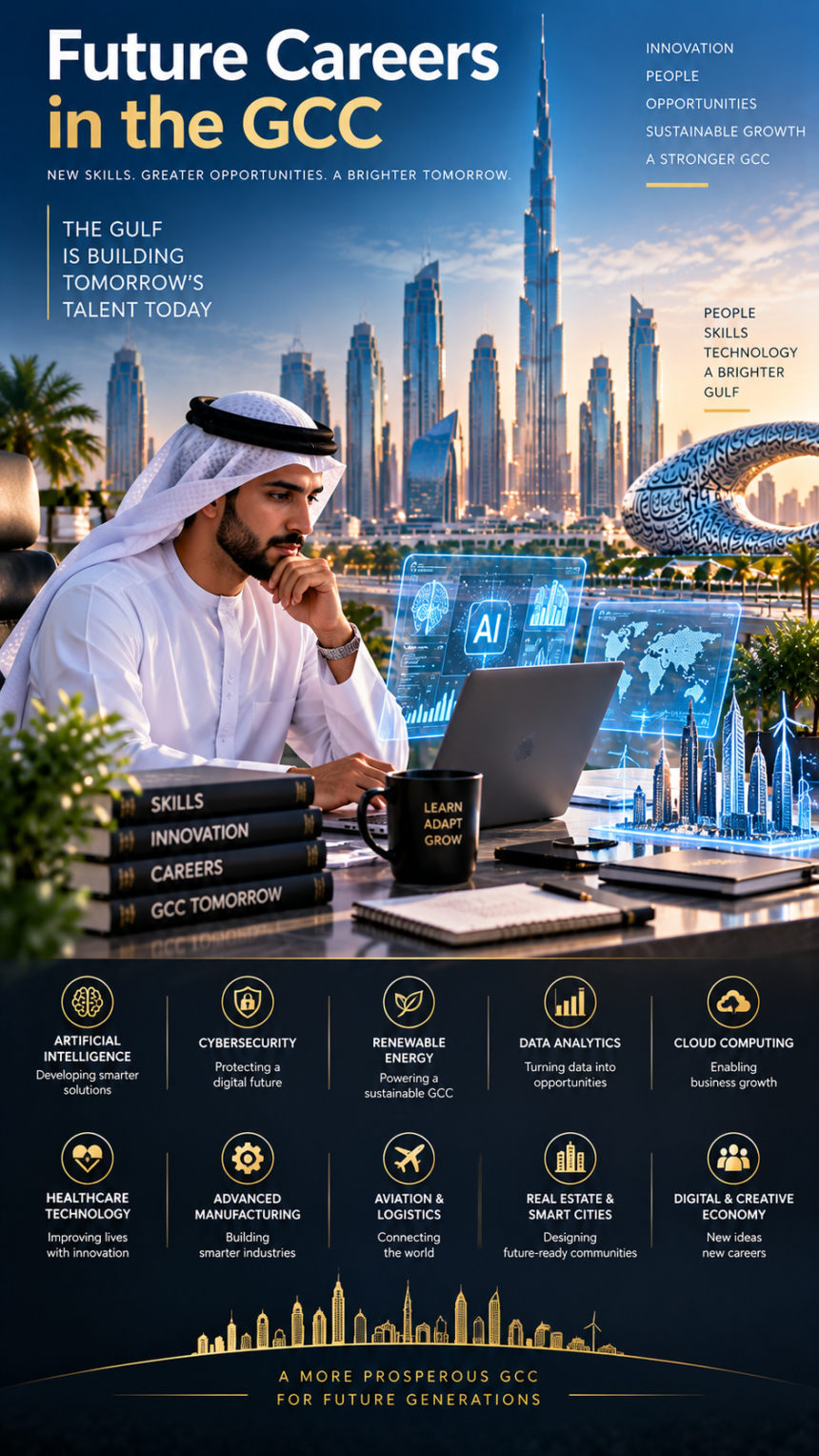
Future Careers in the GCC are being shaped by one of the fastest economic transformations the Gulf has experienced. The UAE, Saudi Arabia, Qatar, Bahrain, Oman and Kuwait are investing in artificial intelligence, digital infrastructure, renewable energy, advanced manufacturing, tourism, logistics, financial technology and other sectors designed to create economies that depend increasingly on knowledge and specialist skills.
- Future Careers in the GCC and the Changing Job Market
- Why Gulf Careers Are Changing
- 1. Artificial Intelligence and Machine Learning
- 2. Data Science and Business Analytics
- 3. Cybersecurity
- 4. Cloud Computing and Digital Infrastructure
- 5. Renewable Energy and Clean Technology
- 6. Sustainability and ESG
- 7. Robotics and Advanced Manufacturing
- 8. Logistics and Supply Chain Management
- 9. Fintech and Digital Financial Services
- 10. Healthcare and Digital Health
- 11. Tourism and Hospitality
- 12. Smart Cities, Construction and BIM
- 13. Digital Marketing and E-Commerce
- 14. Education and Professional Training
- 15. Risk, Compliance and Professional Services
- Future Careers in the UAE
- Future Careers in Saudi Arabia
- Future Careers in Qatar
- Future Careers in Bahrain
- Future Careers in Oman
- Future Careers in Kuwait
- Technical Skills That Will Matter Most
- Human Skills Technology Cannot Easily Replace
- Best Degrees for Future GCC Careers
- Future Careers for Expats in the Gulf
- Future Careers for GCC Nationals
- Jobs Most Likely to Change Because of AI
- How to Prepare for the GCC Job Market
- Future Careers in the GCC Comparison Table
- Final Thoughts on Future Careers in the GCC
This does not mean traditional professions will disappear. Accountants, engineers, doctors, marketers, lawyers, teachers and managers will continue to be needed, but many of these careers are changing. An accountant may increasingly work with automated financial systems, an engineer may use digital twins and AI, while a marketer may need data analytics and generative AI skills alongside traditional communication abilities.
Gulf governments are already preparing their labour markets for this transition. The UAE describes its future economy as one based on knowledge, innovation, entrepreneurship, artificial intelligence and advanced technology. Saudi Arabia’s current workforce strategy identifies sectors including energy, financial services, healthcare, logistics, manufacturing, consulting, tourism and cybersecurity as areas requiring specialised skills development.
The result is not one single “job of the future.” Instead, the strongest career opportunities are likely to emerge where technology, specialised industry knowledge and human skills come together.
Future Careers in the GCC and the Changing Job Market
The GCC labour market is moving away from a model where growth could be supported mainly by construction, public-sector employment and hydrocarbons. Those areas remain economically important, but diversification strategies are creating greater demand for specialised occupations.
| Career Area | Why Demand Could Grow |
|---|---|
| Artificial intelligence | Companies are automating and analysing more operations |
| Cybersecurity | More business activity is moving online |
| Cloud computing | Companies need scalable digital infrastructure |
| Renewable energy | GCC states are investing in cleaner energy systems |
| Advanced manufacturing | Governments want more high-value local production |
| Logistics | Gulf cities remain major trade and transport centres |
| Fintech | Banking and payments are becoming digital |
| Healthcare | Population growth and health technology are expanding demand |
| Tourism | Major destinations and hospitality projects are developing |
| Sustainability | Companies face environmental and reporting requirements |
| Data analytics | Businesses need better decisions from growing data volumes |
| Professional services | Regulation and complex investment create specialist demand |
Young professionals should therefore think less about choosing a permanent job title and more about developing a combination of capabilities that can remain valuable across different industries.
The professional who understands finance plus AI, logistics plus analytics, healthcare plus digital technology or engineering plus sustainability may have stronger long-term options than someone relying on one narrow skill.
Why Gulf Careers Are Changing
Several major forces are reshaping employment throughout the region.
The first is economic diversification. Governments want greater economic activity outside oil and gas and are actively developing new industries. The second is digital transformation, which is changing how almost every company operates. The third is local workforce development, as GCC countries increase opportunities for citizens in private-sector and specialist professions.
Saudi Arabia’s Ministry of Human Resources, for example, operates sector skills councils covering important areas including financial services, healthcare, manufacturing, logistics, tourism, professional services, energy and cybersecurity. The stated objective is to align education and training with current and future labour-market needs.
Oman Vision 2040 similarly calls for a labour market capable of responding to technological, economic and knowledge changes while developing a skilled and productive workforce.
The fourth force is artificial intelligence. AI will automate parts of many jobs while increasing demand for people who can develop, manage, verify and apply these systems responsibly.
The careers growing fastest may therefore not always have completely new names. Existing professions will evolve as technology changes the tasks people perform.
1. Artificial Intelligence and Machine Learning
Artificial intelligence is one of the clearest candidates for long-term career growth across the GCC.
Governments and major corporations are investing heavily in AI systems, cloud infrastructure, automation and data centres. This creates demand for professionals who can build AI models, integrate them into businesses and manage their performance.
Potential roles include:
- AI engineer
- Machine learning engineer
- AI product manager
- Generative AI specialist
- Natural language processing specialist
- AI solutions architect
However, opportunities will extend beyond people who write complex algorithms.
Companies also need consultants, project managers, designers, legal specialists and operations professionals who understand how AI should be used inside real businesses.
Saudi Arabia demonstrated the scale of its focus in 2026 by launching an AI Centre of Excellence initiative aimed at accelerating AI adoption among the workforce and developing skills aligned with future labour-market requirements.
For students entering university today, combining computer science, mathematics, engineering or business knowledge with practical AI skills could provide strong flexibility.
2. Data Science and Business Analytics

Artificial intelligence depends heavily on data, which makes data professionals equally important.
Every modern company generates information through customers, transactions, websites, equipment, employees and supply chains. Businesses need people who can organise this information and convert it into useful decisions.
Career opportunities can include data analysts, data scientists, business intelligence specialists, data engineers and analytics consultants. Someone working in this field might help a retailer forecast demand, allow a bank to understand customer behaviour or help an airline analyse operational performance.
The opportunity is not limited to technology companies. Data professionals can work in banking, healthcare, aviation, logistics, energy, government, real estate and retail.
Qatar’s current technology incentives specifically target AI and data analytics alongside cloud services, cybersecurity and other emerging technologies. The programme is designed partly to create high-skilled employment and strengthen digital talent.
Professionals who understand both analytics and a specific industry may become especially valuable because they can interpret what the numbers actually mean for the business.
3. Cybersecurity
As Gulf economies become more digital, cybersecurity becomes more important.
Banks, government agencies, hospitals, airlines, retailers and energy companies all store large quantities of sensitive information. A serious cyberattack can disrupt operations, expose customer data and cause significant financial damage.
Future cybersecurity roles could include:
- Security analyst
- Cybersecurity engineer
- Cloud security specialist
- Security architect
- Incident-response specialist
- Governance and risk specialist
Saudi Arabia already treats cybersecurity as one of the major sectors within its workforce skills framework. Bahrain’s financial-sector skills research similarly identifies cybersecurity among important emerging career areas as digitalisation expands.
Qatar is also actively targeting cybersecurity companies and investment through its technology programme.
Unlike some technology trends that may change quickly, cybersecurity demand is tied to a simple long-term reality: the more valuable activity moves online, the more organisations need people capable of protecting it.
4. Cloud Computing and Digital Infrastructure
Modern digital businesses increasingly depend on cloud computing rather than maintaining all technology on their own physical servers.
This creates career opportunities around:
- Cloud architecture
- Cloud engineering
- DevOps
- Data centres
- Infrastructure management
- Cloud security
Demand could grow further as Gulf states attract technology companies and build more local digital infrastructure.
Qatar’s technology incentive package explicitly targets data centres, cloud services, AI, cybersecurity and other emerging technologies while requiring qualifying projects to create high-skilled positions locally.
Saudi Arabia’s rapid investment in AI infrastructure similarly creates careers beyond software development. Data centres require engineers, electrical specialists, cooling experts, cybersecurity teams and operational managers.
This is a useful reminder that technology growth creates both digital and physical jobs.
5. Renewable Energy and Clean Technology
Energy will remain central to Gulf economies, but the type of energy expertise required is becoming more diverse.
Solar power, hydrogen, energy storage, carbon management and clean industrial technologies are creating new professional pathways alongside traditional oil and gas careers.
Potential roles include renewable energy engineers, solar project managers, energy analysts, hydrogen specialists, battery engineers and clean-technology consultants.
Oman Vision 2040 includes a national carbon-neutrality programme aimed at achieving net-zero carbon dioxide emissions by 2050. Similar clean-energy investments are developing elsewhere across the GCC.
Traditional energy expertise will still be valuable. A petroleum engineer, for example, may increasingly work alongside specialists focused on carbon reduction, automation and energy efficiency.
The future GCC energy professional may therefore require a broader combination of engineering, digital and sustainability skills.
6. Sustainability and ESG
Sustainability is creating careers beyond renewable-energy engineering.
Companies increasingly need professionals who can measure environmental performance, manage sustainability programmes and understand environmental, social and governance requirements.
Possible careers include:
- Sustainability manager
- ESG analyst
- Carbon accounting specialist
- Environmental consultant
- Sustainable finance specialist
- Climate risk analyst
Bahrain’s financial-services skills research identifies ESG reporting and risk specialists among emerging professional roles, reflecting increasing demand for sustainability information and risk management within financial organisations.
The UAE also connects green development with future economic activity and job creation, while encouraging cleaner industrial technologies as part of its future-economy strategy.
Professionals combining sustainability knowledge with finance, engineering or law may have particularly strong career options because businesses need people who can connect environmental goals with actual commercial decisions.
7. Robotics and Advanced Manufacturing
GCC countries want to manufacture more high-value products locally.
That requires more than traditional factory labour. Modern manufacturing increasingly uses robotics, automation, sensors, computer vision and artificial intelligence.
Future careers may include robotics engineers, automation specialists, industrial data analysts, manufacturing engineers and smart-factory managers.
Qatar’s current advanced-industries incentives specifically support manufacturing projects using advanced technologies, automation and smart-factory solutions. Qualifying projects must also create high-skilled jobs in the country.
Saudi Arabia identifies manufacturing as one of the major sectors within its workforce skills programme. Oman is similarly building a diversified economy based increasingly on technology, knowledge and innovation.
Engineers who understand both physical manufacturing processes and software-driven automation could therefore become increasingly valuable.
8. Logistics and Supply Chain Management
The Gulf’s location between Asia, Europe and Africa has made logistics one of its natural economic strengths.
Dubai, Abu Dhabi, Doha, Jeddah, Dammam, Bahrain, Sohar, Salalah and Duqm all participate in regional or international transport networks. Growth in e-commerce, manufacturing and global trade creates additional demand for logistics expertise.
Future careers include supply-chain analysts, warehouse automation specialists, procurement professionals, fleet managers and logistics technology specialists.
Saudi Arabia identifies transportation and logistics as an important skills sector. Qatar’s $1 billion investment incentives programme similarly treats logistics as one of four priority sectors alongside advanced industries, technology and financial services.
The strongest professionals may increasingly combine logistics knowledge with technology. Understanding AI forecasting, warehouse automation and supply-chain software can make a traditional operations career considerably more future-ready.
9. Fintech and Digital Financial Services
Banking across the Gulf is becoming more digital.
Consumers increasingly use mobile applications, digital wallets, instant transfers and online investment platforms. Businesses also require more sophisticated payment, compliance and financial-management technology.
This creates careers in fintech product management, digital banking, payments, blockchain infrastructure, financial data analytics and regulatory technology.
Qatar’s financial-services incentive package specifically supports fintech, asset management, wealth management and digital financial services while targeting the creation of high-skilled jobs.
Bahrain is another particularly important fintech market. Its skills research highlights shortages in capabilities including AI, automation, cybersecurity and data analysis within fintech and related sectors.
A finance graduate who learns data analytics, digital-product management or cybersecurity may therefore access very different career opportunities from someone relying only on traditional financial knowledge.
10. Healthcare and Digital Health
Healthcare demand is likely to remain strong across the Gulf because of population growth, expanding private healthcare and increasing investment in medical technology.
Doctors, nurses and pharmacists will continue to be important, but new opportunities will increasingly appear around the digital side of healthcare.
These could include health data analysts, medical AI specialists, telehealth managers, biomedical engineers and healthcare cybersecurity professionals.
Saudi Arabia currently identifies healthcare as one of its major sector skills priorities. Qatar’s advanced-industry strategy also supports pharmaceuticals as part of its effort to create more high-value industries and specialised employment.
Healthcare demonstrates why future careers should not be divided too simply into “technology” and “non-technology.” Some of the strongest opportunities may emerge when healthcare professionals understand technology or technology specialists understand healthcare.
11. Tourism and Hospitality
Tourism is becoming a much larger employment sector across several GCC markets.
Saudi Arabia is particularly ambitious in tourism development, while the UAE already operates one of the region’s most established hospitality economies. Qatar and Oman are also expanding tourism as part of their diversification plans.
Career opportunities can include hotel management, destination marketing, tourism development, event management, culinary leadership and revenue management.
Saudi Arabia began implementing the first phase of localisation requirements for 28 tourism professions in April 2026. Roles covered include hotel reception, tourism development, procurement, sales and hospitality positions.
The Ministry of Human Resources also identifies tourism and hospitality as a dedicated sector for future skills development.
Technology will increasingly influence these careers. Revenue management, digital booking, customer analytics and AI-powered guest services mean tomorrow’s hospitality professional will need stronger digital skills than previous generations.
12. Smart Cities, Construction and BIM
The Gulf will continue building cities, transport systems, industrial areas, tourism destinations and major infrastructure.
However, construction itself is becoming more digital.
Building Information Modelling, digital twins, smart-building technology and data-driven project management are changing how architects, engineers and construction professionals work.
Future opportunities may include:
- BIM manager
- Smart-building engineer
- Digital twin specialist
- Sustainable construction consultant
- Project controls analyst
Kuwait’s current development agenda includes major infrastructure activity alongside increasing emphasis on AI, green technologies and advanced construction methods as part of Vision 2035.
For architecture and engineering students, learning digital construction tools can therefore be as important as traditional technical knowledge.
13. Digital Marketing and E-Commerce
Gulf consumers are highly connected, making digital marketing and online commerce important career areas.
However, basic social media posting is unlikely to be enough for long-term career growth. Marketing is becoming more analytical.
Companies increasingly value people who understand:
- Performance advertising
- Search marketing
- E-commerce
- Customer analytics
- Conversion optimisation
- AI marketing tools
- Content strategy
Kuwait’s new digital-commerce framework introduced in 2026 reflects the wider growth of regulated online economic activity and is intended to encourage innovation and investment within the digital economy.
Marketing professionals who combine creativity with analytics may therefore have stronger prospects than people focused only on content production.
AI will automate some basic marketing tasks, but strategy, brand understanding and customer psychology remain strongly human capabilities.
14. Education and Professional Training
Rapid economic change creates another important industry: training people for the new economy.
Universities and schools will need instructors capable of teaching emerging technology, while companies increasingly require continuous professional training.
Potential careers include corporate trainers, instructional designers, digital learning specialists, STEM educators and professional certification instructors.
Saudi Arabia’s skills policy explicitly focuses on aligning education and training with labour-market demand. Oman Vision 2040 similarly emphasises bridging knowledge and skills gaps so job seekers can meet changing employment requirements.
Bahrain’s Digital Economy Strategy places significant emphasis on updating education for AI, coding and STEM while expanding reskilling programmes linked to employment.
A career in education therefore does not need to mean teaching the same subject in the same way for decades. The training industry itself is becoming more specialised and technology-driven.
15. Risk, Compliance and Professional Services
As Gulf economies become more sophisticated, companies also need more people who understand complex rules.
Growth in financial services, taxation, international investment, data protection, cybersecurity and sustainability creates demand for compliance and advisory professionals.
Possible careers include:
- Compliance officer
- Tax specialist
- AML professional
- Risk analyst
- Data privacy specialist
- Regulatory consultant
Saudi Arabia specifically identifies professional and consulting services among the important sectors within its national skills framework. Bahrain’s financial-sector skills work similarly identifies compliance, ESG and digital-risk roles as increasingly important.
These careers demonstrate that technology does not eliminate regulation. In many cases, technological complexity increases the need for trusted human professionals capable of interpreting rules and accepting responsibility.
Future Careers in the UAE
The UAE is positioning its future economy around knowledge, artificial intelligence, innovation and entrepreneurship. The Ministry of Economy and Tourism says the country is building economic sectors centred on advanced technologies while attracting specialised talent and skills.
That direction creates particularly strong possibilities in:
- Artificial intelligence
- Cybersecurity
- Digital finance
- Advanced technology
- Aviation
- Logistics
- Clean energy
- Tourism
- Professional services
Dubai is likely to remain especially important for technology, finance, e-commerce, logistics and regional corporate roles, while Abu Dhabi offers strong opportunities connected with energy, investment, finance, AI and advanced industries.
For professionals, the UAE’s international labour market creates both opportunity and competition. Employers can recruit globally, which means candidates increasingly need strong technical capabilities, experience and communication skills rather than relying only on academic qualifications.
Future Careers in Saudi Arabia
Saudi Arabia may offer some of the GCC’s largest employment transformations because of the scale of Vision 2030.
Its current skills framework covers energy, financial services, healthcare, logistics, manufacturing, professional services, tourism, retail and cybersecurity. This provides a useful indication of the range of sectors where workforce development is being prioritised.
AI is becoming especially important. Saudi Arabia designated 2026 as the Year of Artificial Intelligence, while the Ministry of Human Resources has emphasised responsible AI as an important part of the future labour market.
Tourism is another major area, with localisation already expanding across professional hospitality occupations.
Saudi nationals should pay particular attention to sectors where localisation and economic growth are happening simultaneously, because this combination can create significant career opportunities.
Future Careers in Qatar
Qatar is deliberately connecting investment incentives with high-skilled employment.
Its $1 billion incentives programme focuses on four major areas: advanced industries, logistics, technology and financial services. Projects receiving support are expected to create skilled local employment as part of their investment commitments.
Technology opportunities specifically include:
- Artificial intelligence
- Cybersecurity
- Cloud computing
- Data analytics
- Semiconductors
- Emerging digital technologies
Financial careers are also likely to evolve through fintech, asset management, wealth management and digital financial services.
For professionals in Qatar, combining technology with finance, logistics or industrial expertise could be particularly valuable because those are areas the country is actively attempting to expand.
Future Careers in Bahrain
Bahrain’s strongest future-career opportunities are closely linked with its digital economy and established financial-services sector.
The Kingdom’s Digital Economy Strategy includes plans to expand AI and coding education, digital upskilling, employment-based training and STEM specialisations aligned with market demand.
Bahrain has also set an ambition to train 50,000 Bahrainis in AI by 2030, covering leadership, workforce-level AI usage and specialist technical capabilities.
Potential growth areas include:
- Fintech
- Cybersecurity
- AI
- Data analytics
- Digital banking
- Compliance
- Cloud technology
Tamkeen’s Kawader platform already focuses specifically on connecting Bahraini technology talent with employers, illustrating the importance being placed on specialist ICT skills.
Future Careers in Oman
Oman Vision 2040 describes the future economy as one based on technology, knowledge and innovation while creating a labour market capable of attracting skilled talent and responding to technological change.
Several career areas are particularly relevant:
- Logistics
- Renewable energy
- Manufacturing
- Digital technology
- Tourism
- Mining
- Sustainability
Oman’s National Employment Program specifically aims to bridge skills gaps and prepare people for sustainable employment, while its digital-transformation and carbon-neutrality programmes create further demand for modern technical capabilities.
The Vision 2040 indicators also place emphasis on increasing the share of skilled workers in the private sector.
For young Omanis, careers combining technical qualifications with sectors where the country has natural advantages, particularly logistics, energy and industry, may be especially valuable.
Future Careers in Kuwait
Kuwait is increasingly trying to align education and employment with future private-sector requirements.
In April 2026, the Public Authority for Manpower and the Public Authority for Applied Education and Training discussed improving coordination around future labour-market needs and directing educational specialisations toward priority sectors.
Technology will be an important part of this transition. Kuwait continues accelerating digital transformation under Vision 2035, while its oil sector launched a programme involving 24 digital initiatives and greater use of AI and data-driven operating methods.
The government is also seeking to create more sustainable employment for Kuwaiti nationals in the private sector.
Potential future areas include digital technology, finance, cybersecurity, energy technology, construction, AI, e-commerce and private-sector professional services.
Technical Skills That Will Matter Most
Career titles change, but many technical skills can transfer between industries.
| Skill | Relevant Career Areas |
|---|---|
| Artificial intelligence | Technology, finance, marketing, healthcare |
| Data analytics | Almost every major industry |
| Cybersecurity | Banking, government, energy, healthcare |
| Cloud computing | Technology and digital operations |
| Programming | AI, software, fintech and automation |
| BIM | Construction and smart cities |
| Automation | Manufacturing and logistics |
| ESG reporting | Finance, energy and corporate sustainability |
| Digital marketing | Retail, tourism and e-commerce |
| Financial modelling | Investment, banking and consulting |
Professionals do not need to master every skill. The strongest strategy is usually to develop deep expertise in one career area while gaining enough digital knowledge to work effectively with modern technology.
An engineer does not need to become a full-time software developer, but understanding data and automation can strengthen an engineering career considerably.
Human Skills Technology Cannot Easily Replace
The rise of AI makes human skills more important, not less.
Companies still need people capable of understanding ambiguous problems, leading teams, building trust with clients and accepting responsibility for important decisions.
The most valuable transferable skills include:
- Clear communication
- Critical thinking
- Leadership
- Negotiation
- Creativity
- Problem solving
- Emotional intelligence
- Adaptability
Someone who combines these capabilities with strong technical knowledge can become difficult to replace.
For example, AI may prepare a financial analysis, but a senior adviser still needs to explain the implications to a client. Software can optimise a hotel price, but hospitality staff still create the experience that customers remember.
The future workforce is therefore likely to be more technology-assisted rather than completely technology-controlled.
Best Degrees for Future GCC Careers
Students choosing university programmes should avoid chasing one fashionable job title. Technology changes too quickly for that approach.
Degrees likely to remain useful include:
| Degree Area | Potential Career Direction |
|---|---|
| Computer science | AI, software and cloud computing |
| Cybersecurity | Information security and risk |
| Data science | Analytics and machine learning |
| Engineering | Energy, manufacturing and infrastructure |
| Finance | Banking, fintech and investment |
| Healthcare | Clinical and health technology roles |
| Environmental science | Sustainability and climate careers |
| Supply chain management | Logistics and procurement |
| Hospitality management | Tourism and hotel leadership |
| Business and economics | Consulting, strategy and entrepreneurship |
The degree itself should be combined with practical experience.
Internships, certifications, projects and actual experience using industry tools can distinguish graduates in competitive Gulf labour markets.
Future Careers for Expats in the Gulf
The GCC will continue requiring international talent, particularly in highly specialised professions.
However, the expatriate labour market is likely to change as nationalisation policies increase opportunities for GCC citizens.
Expats should therefore focus increasingly on roles where they provide specialist capabilities, international experience or technical expertise that employers genuinely need.
Promising areas may include AI, cybersecurity, healthcare, advanced engineering, investment management, specialist consulting and emerging technology.
Professionals should also recognise that Gulf labour markets are not identical. A career with strong demand in Riyadh may have a much smaller market in Muscat or Bahrain.
Country-specific research is essential.
Future Careers for GCC Nationals
For GCC nationals, private-sector opportunities are likely to become increasingly important.
Saudi Arabia, Bahrain, Oman and Kuwait are all developing policies that aim to align national talent more closely with private-sector and future-economy needs.
The strongest strategy is to focus on growing industries rather than simply seeking the safest traditional occupation.
Technical expertise combined with knowledge of local business culture can become a significant competitive advantage.
GCC nationals can also benefit from leadership and entrepreneurship opportunities as governments push more economic activity into the private sector.
Jobs Most Likely to Change Because of AI
AI will affect many careers, but impact does not automatically mean elimination.
| Career | Likely Change |
|---|---|
| Accounting | More automated transaction and report processing |
| Marketing | Faster content creation and analytics |
| Customer service | AI handles routine enquiries |
| Legal services | Faster document review |
| HR | More automated candidate screening and analytics |
| Programming | AI assists code generation |
| Consulting | AI accelerates research and analysis |
| Banking | Greater automation of compliance and fraud analysis |
| Healthcare | AI supports diagnostics and administration |
| Education | More personalised digital learning |
The biggest risk may be for professionals who refuse to use new tools rather than entire professions disappearing.
People who learn to use AI responsibly can often increase their productivity and take responsibility for higher-value work.
How to Prepare for the GCC Job Market
Preparing for the future does not require predicting exactly which profession will be most valuable ten years from now.
A better approach is to build adaptability.
Start with a strong professional foundation. Then continuously add digital and commercial skills.
A useful career-development approach includes:
- Choose an industry with long-term economic relevance.
- Develop one strong specialist capability.
- Learn how AI affects that profession.
- Build basic data literacy.
- Improve written and verbal communication.
- Complete practical internships.
- Build a professional LinkedIn profile.
- Earn certifications only when employers value them.
- Follow GCC localisation and labour-market policies.
- Learn the regulations affecting your industry.
- Develop regional business knowledge.
- Keep updating skills after graduation.
Professionals should also build evidence of ability. A real project, internship or portfolio can sometimes communicate more than a long list of online courses.
Future Careers in the GCC Comparison Table
Different Gulf economies are prioritising different areas, although substantial overlap exists.
| Country | Particularly Important Future Career Areas |
|---|---|
| UAE | AI, finance, technology, logistics, green economy, aviation |
| Saudi Arabia | AI, tourism, manufacturing, logistics, healthcare, cybersecurity |
| Qatar | Technology, fintech, logistics, advanced manufacturing |
| Bahrain | Fintech, AI, cybersecurity, digital services |
| Oman | Logistics, clean energy, manufacturing, tourism, technology |
| Kuwait | Digital technology, energy transformation, finance, infrastructure |
These should not be treated as guaranteed job forecasts. They reflect the sectors receiving significant current policy, investment and skills attention across each market.
Career demand will continue evolving as projects mature and technologies change.
Final Thoughts on Future Careers in the GCC
Future Careers in the GCC will be shaped by a combination of economic diversification, artificial intelligence, digitalisation, sustainability and the growing importance of specialised private-sector skills.
The UAE is building its future economy around knowledge, advanced technology, AI, innovation and green development. This creates opportunities for people working across digital technology, finance, clean energy, logistics and professional services.
Saudi Arabia has developed dedicated skills frameworks across industries ranging from cybersecurity and financial services to healthcare, manufacturing, logistics and tourism. Its decision to make 2026 the Year of Artificial Intelligence also illustrates how technology is becoming increasingly central to workforce development.
Qatar is directing investment toward advanced industries, logistics, technology and financial services while requiring supported projects to create high-skilled employment.
Bahrain is strengthening its digital workforce through AI, STEM, fintech and cybersecurity programmes and aims to train 50,000 Bahrainis in artificial intelligence by 2030.
Oman is building a labour market designed to respond to technological and economic change, with particular opportunities connected to logistics, sustainability, digital transformation and diversified industries.
Kuwait is similarly increasing attention on private-sector employment, digital transformation and better alignment between education and future labour-market requirements.
The biggest lesson for students and professionals is that choosing the correct job title today is less important than building a career capable of adapting tomorrow.
Artificial intelligence will change tasks. Sustainability will create new regulations and industries. Digitalisation will transform traditional sectors, while Gulf diversification will create careers that barely existed when many current professionals entered university.
The people best positioned for this environment will be those who combine specialist knowledge, digital skills and strong human capabilities.
An engineer who understands AI, a banker who understands fintech, a marketer who understands analytics or a logistics professional who understands automation can adapt as industries evolve.
That is likely to be the defining characteristic of successful Gulf careers in the years ahead: not simply knowing one profession, but knowing how to keep developing as the economy around that profession changes.
Do follow us on Instagram
Read More – AI in Gulf Business: 12 Powerful Changes Driving Success