



Redefining Plant Based Food From Jordan
There was a time when food innovation was closely associated with a handful of global cities. London, New York and Silicon Valley became symbols of new ideas, ambitious technology and consumer brands capable of changing industries. Georgiana Tudor believes that story is no longer complete.
- From an idea to a real food brand
- Taste had to come before the message
- Georgiana’s consumer first approach
- Making plant based food feel familiar
- The moment curiosity became loyalty
- Building a brand in Jordan
- From Jordan to international markets
- More than plant based food
- The pressure behind the ambition
- A new meaning for Made in Jordan
- What comes next for Georgiana Tudor
- From Amman to the world
From Amman, Jordan, Tudor and her fellow Amoria co founders Firas Kamourieh and Tala Kamourieh are building a different kind of food company. Their ambition is not simply to create another plant based brand. It is to show that sophisticated food innovation can be developed, manufactured and built in the Middle East, then taken to consumers far beyond the region.
Amoria has already moved from years of research and development into commercial retail and foodservice, with products appearing across Jordanian retail and hospitality channels. The journey has given Tudor something more valuable than a business achievement. It has given her the opportunity to help prove that Made in Jordan can stand confidently on an international shelf.
From an idea to a real food brand
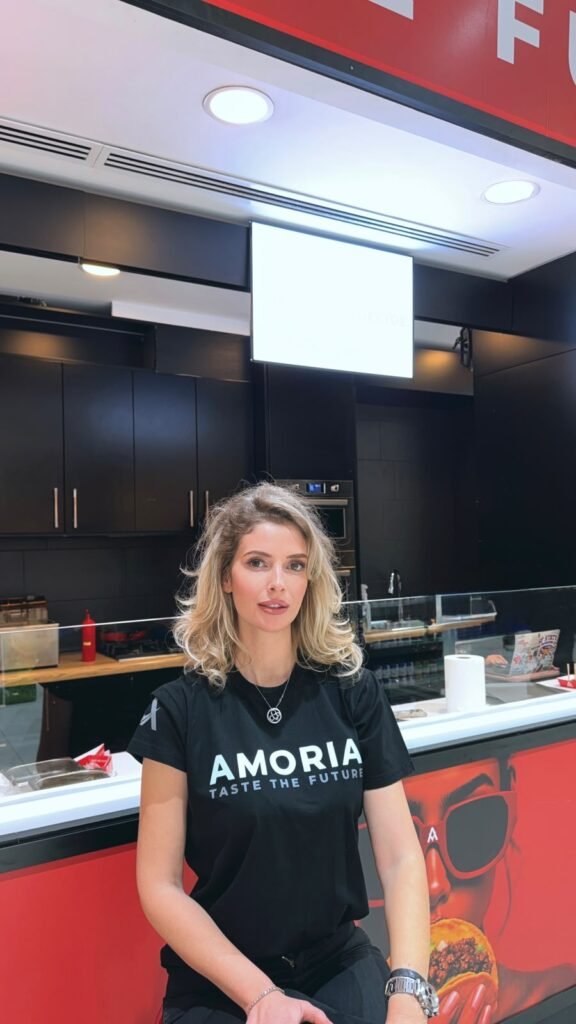
For Tudor, the Amoria journey has never been only about creating a product. It has been about understanding what makes people genuinely want to buy food.
The company spent years developing its products, including research and development work connected to the UK. But when it was time to turn that innovation into a commercial business, the founders chose Amman as the home for production.
That decision brought its own challenges.
Jordan has a strong and deeply rooted food culture. People know their flavours, understand their favourite dishes and have high expectations when it comes to food. Plant based alternatives were still unfamiliar to many consumers, making the founders’ task more complicated than simply introducing another supermarket product.
But Tudor saw an opportunity inside that challenge.
If consumers in Jordan could be convinced to choose Amoria because they genuinely enjoyed the food, rather than because they followed a particular diet, the brand could potentially speak to a much larger audience.
That philosophy became central to the company.
Taste had to come before the message
The plant based food category has often relied heavily on explaining why consumers should change their habits. Amoria took a different approach.
The team wanted the food to make the argument.
Tudor understands that a consumer standing in a supermarket does not necessarily want a long explanation about food technology. They want to know whether the product looks appealing, whether it fits their lifestyle and, most importantly, whether it tastes good.
As Tudor puts it, “The food still has to deliver.”
That simple belief has influenced how she approaches her role as Co Founder and Brand Director.
Rather than positioning Amoria as a brand exclusively for vegans and vegetarians, she sees an opportunity among everyday consumers who are open to eating differently without completely changing the way they live.
This makes the idea of plant based food much less restrictive.
The customer does not have to choose an identity. They simply have to choose a food they enjoy.
Georgiana’s consumer first approach
While Firas Kamourieh has focused heavily on entrepreneurship, innovation and the challenge of building the business, and Tala Kamourieh brings a strong culinary perspective through her work with desserts, Tudor occupies a different position within the founding team.
She thinks about the person standing on the other side of the shelf.
Does the packaging create curiosity?
Does the product make sense immediately?
Will the consumer want to try it?
And after that first experience, will they buy it again?
Those questions may sound simple, but they are critical when building a modern food brand.
Tudor understands that technology can create an impressive product, but technology alone does not create consumer loyalty. A successful brand has to earn attention, trust and repeat purchases.
That is particularly important for Amoria because its ambitions extend beyond simply selling plant based food.
It is trying to create a food brand that can become part of people’s everyday lives.
Making plant based food feel familiar
One of Amoria’s most interesting approaches is its understanding of culture.
Instead of expecting consumers to completely change how they eat, the company develops products that can work naturally within familiar meals.
Shawarma style products, mince and other versatile formats can be incorporated into dishes that consumers already know and enjoy.
This approach matters because food is rarely just nutrition. It is connected to family, culture, memories and social occasions.
For Tudor, successful food innovation therefore requires listening before changing.
“You cannot ignore the culture people already have around food,” is the thinking behind her consumer focused approach.
That philosophy could become increasingly important as Amoria moves into different international markets. A product that feels natural in Amman may need to be understood differently elsewhere, but the fundamental principle remains the same.
Make the food easy to understand, easy to use and enjoyable to eat.
The moment curiosity became loyalty
One of the most important stages in Tudor’s journey came when Amoria moved beyond development and into the hands of real consumers.
The brand has since expanded its presence across Jordanian retail. It has appeared at premium supermarkets including COZMO and Centro, while its wider partner network includes additional supermarkets, restaurants and hotels.
For a founder, seeing a product on a shelf is a milestone.
Seeing a customer return for it is something else entirely.
A first purchase can happen because someone is curious. A second purchase suggests the product has earned its place.
That distinction matters greatly to Tudor.
A consumer who already eats meat but chooses Amoria again provides an especially powerful signal. It suggests that the product is not being purchased simply because someone believes they should eat plant based food.
They are buying it because they want it.
That is the kind of consumer behaviour that can turn an experiment into a sustainable business.
Building a brand in Jordan
Amoria’s growth has also challenged the traditional idea of where global consumer brands can come from.
The company is building its products in Jordan, while developing an identity designed to speak to modern consumers.
Its current positioning focuses on convenience, nutrition, taste and plant based alternatives, with products designed to be prepared quickly. Amoria’s own platform describes its proposition around nutrient packed meals and convenience, reflecting the changing expectations of consumers who want food that fits into busy lives.
For Tudor, that creates a bigger opportunity than simply selling food.
It creates a chance to demonstrate that the region can be a creator of consumer brands, rather than only a destination for international brands.
That distinction sits at the heart of the Made in Jordan story.
From Jordan to international markets
Amoria’s next chapter is increasingly international.
Saudi Arabia and Estonia represent two very different markets and therefore two very different tests for the business.
Saudi Arabia offers a major regional opportunity, while Estonia gives the company exposure to a European environment where consumers are already familiar with alternative proteins.
For Tudor, the interesting question is not simply whether Amoria can enter another country.
It is whether the brand can create genuine demand once it gets there.
That is a much harder challenge.
International expansion can put a logo on a new shelf, but long term success depends on what happens after the launch. Consumers need to understand the product, enjoy it and eventually choose it again.
That is where Tudor’s consumer first philosophy will face its biggest test.
More than plant based food
The broader food industry has learned an important lesson over the past few years.
Being plant based is not enough.
Consumers expect taste. They expect convenience. They expect quality. Increasingly, they also want products that fit naturally into their lifestyles.
Amoria’s proposition reflects that reality.
The brand is not asking consumers to abandon everything they already enjoy. It is trying to expand the choices available to them.
That creates a much more inclusive vision of plant based food.
As Tudor’s philosophy suggests, “People don’t want a lecture with their dinner. They want food that tastes great.”
It is a powerful idea because it moves the conversation away from ideology and back toward enjoyment.
The pressure behind the ambition
The polished image of a growing food company can hide how difficult the journey has been.
Years of research and development come before consumers ever see a product. Manufacturing has to work consistently. Regulations have to be met. Retailers need to believe in the product. Consumers have to be convinced.
And founders have to keep adapting.
For Tudor, that means being involved far beyond the traditional boundaries of a brand director.
She has to think about packaging, consumer behaviour, communication, market expansion and feedback while remaining close to the actual food.
That constant movement is part of the reality of entrepreneurship.
“When you’re a founder, you never really stay inside your job description,” Tudor has reflected.
It is perhaps one of the most accurate descriptions of building a young consumer brand.
A new meaning for Made in Jordan
There is something particularly significant about Amoria’s story because of where it began.
Jordan is not usually the first place people mention when discussing global food technology. That makes the company’s ambition even more interesting.
Amoria is showing that innovation does not have to follow a traditional geographic map.
A company can research and develop sophisticated food products, manufacture them in Amman, establish relationships with retailers and restaurants, and then look toward international markets.
That is more than a commercial strategy.
It is a statement about what the region can create.
For Tudor, the words Made in Jordan carry the potential to represent quality, ambition and innovation rather than limitation.
The goal is not simply to export Jordanian products.
It is to build a Jordanian company capable of competing internationally.
What comes next for Georgiana Tudor
As Amoria moves forward, Tudor’s journey is entering a new stage.
The early questions were about whether the products could be created.
Then came the question of whether consumers would actually want them.
Now the challenge is much larger.
Can the brand scale while keeping its identity?
Can it enter different cultures without losing what made it attractive in the first place?
And can a company born in Amman become a recognisable name in food markets around the world?
Those questions will shape Tudor’s next chapter as much as they shape Amoria’s future.
Her journey demonstrates that building a modern food company is not only about having a clever idea. It is about persistence, listening to consumers, accepting difficult lessons and continuing to improve.
From Amman to the world
Georgiana Tudor’s story is ultimately about more than plant based food.
It is about changing perceptions of where innovation can begin.
Amoria has moved from years of development to real products, real customers and growing retail and foodservice presence in Jordan. Its next ambition is to take that foundation beyond the country’s borders.
For Tudor, the journey is still unfolding.
But the message behind it is already clear.
Great consumer brands do not have to be imported into the Middle East.
They can be imagined here, developed here, manufactured here and taken to the world.
For Georgiana Tudor and the Amoria team, Made in Jordan is not the end of the story.
It is where the story begins.
Follow Georgiana Tudor on Instagram
Read More – Tekha Selim Is Building a Healthier Future Through AI and Innovation