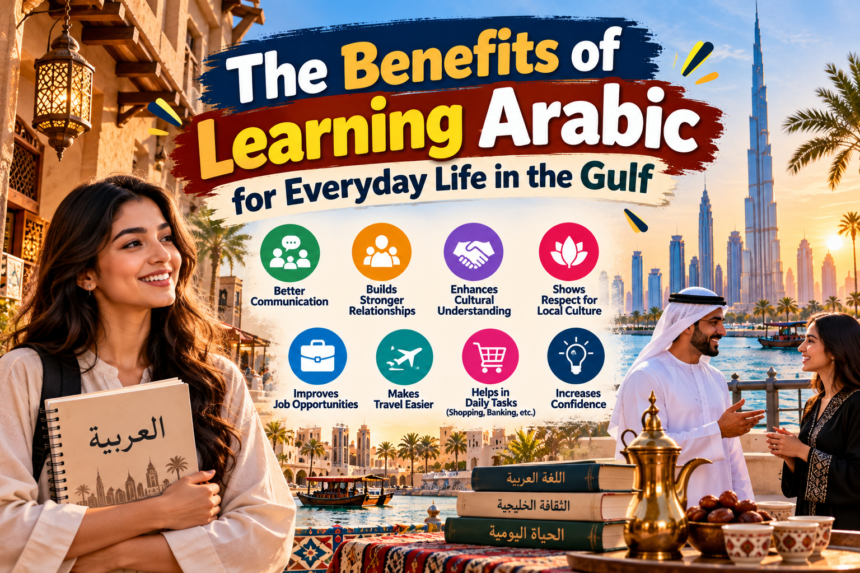
The Benefits of Learning Arabic for Everyday Life in the Gulf
Learning Arabic provides major advantages in career growth, global communication, and religious cultural depth, and cognitive development.
- 1. Makes Everyday Communication Easier
- 2. Helps You Understand Gulf Culture and Traditions
- 3. Creates Better Opportunities in the Workplace
- 4. Makes Shopping, Dining, and Travel More Convenient
- 5. Helps You Build Stronger Relationships With Local People
- 6. Makes Everyday Services and Official Information Easier to Understand
- 7. Helps You Understand Arabic Media, Literature, and Entertainment
- 8. Supports Personal Development and Learning Abilities
- 9. Helps You Feel More Independent While Living in the Gulf
- 10. Helps You Appreciate the Diversity of the Gulf Region
- 11. Modern Standard Arabic or Gulf Arabic: Which Should You Learn?
- 12. Useful Arabic Phrases for Everyday Life in the Gulf
- 13. Practical Ways to Learn Arabic While Living in the Gulf
- Conclusion: Arabic Can Make Everyday Life in the Gulf More Meaningful
- Frequently Asked Questions (FAQs)
Living in a Gulf country offers many opportunities to meet people from different backgrounds, explore new cultures, and experience a unique way of life. Cities such as Dubai, Abu Dhabi, Riyadh, Doha, Kuwait City, Manama, and Muscat are home to people who speak different languages and follow different traditions. English is widely used in many workplaces and public settings, but Arabic remains an important language for everyday life across the region.
Learning Arabic can make daily activities easier and help residents understand the culture, traditions, and communities around them. Even knowing a few common words can make a difference when ordering food, speaking with neighbours, visiting local markets, asking for directions, or greeting someone at work.
For expatriates, international students, tourists, and professionals, learning Arabic can also be a valuable way to show respect for the host country. It can help create meaningful connections and make daily experiences more comfortable.
You do not need to become fluent immediately. Starting with simple greetings, common expressions, numbers, and everyday questions can give you a useful foundation.
In this article, we explore important benefits of learning Arabic for everyday life in the Gulf, the difference between Modern Standard Arabic and spoken dialects, useful phrases for beginners, and practical ways to improve your language skills.
1. Makes Everyday Communication Easier
One of the biggest benefits of learning Arabic is that it makes everyday communication easier. Although English is commonly used in many Gulf cities, Arabic is the official language across Bahrain, Kuwait, Oman, Qatar, Saudi Arabia, and the United Arab Emirates.
Learning basic Arabic can help you communicate with local residents, shopkeepers, drivers, service workers, and people you meet in your neighbourhood.
For example, imagine visiting a traditional market in Muscat or walking into a small shop in Riyadh. Knowing how to say hello, ask a simple question, or thank the shopkeeper can make the interaction more comfortable.
You can start with these useful Arabic expressions:
| English | Arabic | Pronunciation |
|---|---|---|
| Hello | مرحباً | Marhaban |
| Good morning | صباح الخير | Sabah al-khair |
| Good evening | مساء الخير | Masa al-khair |
| Thank you | شكراً | Shukran |
| Please | من فضلك | Min fadlak |
| Yes | نعم | Na’am |
| No | لا | La |
| Goodbye | مع السلامة | Ma’a as-salama |
These expressions are useful starting points for basic communication. Pronunciation and everyday wording can vary between countries and communities, but many common greetings are widely recognised.
The more you practise, the easier it becomes to use Arabic naturally in everyday situations.
2. Helps You Understand Gulf Culture and Traditions
Language is closely connected to culture. Learning Arabic allows you to understand more than individual words. It also introduces you to local expressions, greetings, social customs, and ways of communicating.
The Gulf region has a rich cultural history shaped by trade, family relationships, hospitality, traditional crafts, poetry, and maritime life. Arabic plays an important role in preserving and sharing this heritage.
For example, hospitality is an important part of social life in many Gulf communities. Guests may be welcomed with Arabic greetings, coffee, dates, and friendly conversation. Understanding common expressions can help visitors and residents take part more comfortably.
Learning Arabic can also help you understand:
- Traditional greetings and expressions of welcome.
- The meaning of common cultural phrases.
- Local stories, poetry, and songs.
- Traditional food names and descriptions.
- Important cultural celebrations and events.
- Conversations about family and community life.
It is also helpful to understand that language varies across the region. The Arabic spoken in Kuwait may sound different from the Arabic spoken in Oman or the UAE. Listening to local speakers helps learners recognise these differences.
Learning the language is not about copying every local custom. It is about developing cultural awareness and showing genuine interest in the people and places around you.
3. Creates Better Opportunities in the Workplace
Arabic can be a useful professional skill for people working in Gulf countries. Many businesses operate in multilingual environments, where employees communicate with colleagues, customers, suppliers, and government organisations from different backgrounds.
English may be the main working language in some international companies, but Arabic can be valuable when dealing with Arabic-speaking customers and local organisations.
This is particularly relevant in fields such as:
- Customer service and hospitality.
- Retail and sales.
- Banking and financial services.
- Healthcare and patient support.
- Education and training.
- Tourism and travel.
- Real estate and property management.
- Government-related services.
- Business development and administration.
For example, an employee working at a hotel in Dubai may need to welcome guests from different countries. Knowing Arabic greetings and basic questions can improve communication with Arabic-speaking visitors.
Similarly, a customer service representative who understands basic Arabic may be able to help local customers more comfortably.
Learning Arabic does not guarantee employment or promotion. However, it can add another communication skill to your professional profile and may be useful in roles that involve regular interaction with Arabic-speaking people.
A practical approach is to learn vocabulary related to your job. Someone working in healthcare can focus on appointment-related terms, while someone in retail can learn product names, prices, sizes, and customer-service expressions.
4. Makes Shopping, Dining, and Travel More Convenient
Shopping and dining are part of everyday life in Gulf cities. From modern shopping malls to traditional souks, restaurants, and local food markets, residents regularly interact with people who may speak Arabic.
Knowing a few useful expressions can help you ask questions, understand prices, order meals, and communicate basic preferences.
Here are some phrases that beginners can practise:
| English | Arabic | Pronunciation |
|---|---|---|
| How much is this? | بكم هذا؟ | Bikam hatha? |
| I want this | أريد هذا | Ureed hatha |
| Where is the market? | أين السوق؟ | Ayna as-souq? |
| Where is the restaurant? | أين المطعم؟ | Ayna al-mat’am? |
| Water, please | ماء، من فضلك | Ma’, min fadlak |
| The bill, please | الحساب، من فضلك | Al-hisab, min fadlak |
| Delicious | لذيذ | Latheeth |
| How far is it? | كم يبعد؟ | Kam yab’ud? |
These are simplified learning phrases based mainly on standard Arabic forms. In everyday conversation, local speakers may use different expressions or pronunciations.
Arabic can also help you understand signs, menus, labels, and announcements. Even when an English translation is available, recognising Arabic words gives you another way to understand your surroundings.
For travellers, learning basic Arabic can be especially useful when visiting smaller towns, traditional markets, and areas where English is less commonly used.
5. Helps You Build Stronger Relationships With Local People
Learning another person’s language can make conversations feel more welcoming. Even a simple greeting in Arabic can show that you are interested in communicating and making an effort to understand the local environment.
For expatriates living in the Gulf, relationships with neighbours, colleagues, shopkeepers, and local residents can become an important part of everyday life.
Arabic can help you:
- Start friendly conversations.
- Greet people respectfully.
- Understand common responses.
- Participate in simple social interactions.
- Show interest in local traditions.
- Communicate more comfortably during community events.
For example, when meeting a neighbour, you could begin with “As-salamu alaykum” (السلام عليكم), a widely used greeting meaning “Peace be upon you”. A common response is “Wa alaykum as-salam” (وعليكم السلام).
You may also hear the expression “Shukran” (شكراً), meaning thank you, during everyday interactions.
These small efforts do not require advanced language knowledge. They can simply make communication warmer and help you become more comfortable in a new community.
It is important to be patient and respectful. People may speak quickly or use unfamiliar local expressions. Asking someone to repeat a phrase is a normal part of learning.
6. Makes Everyday Services and Official Information Easier to Understand
People living in Gulf countries regularly use services related to healthcare, transport, education, banking, housing, and government administration.
Many organisations provide information in English as well as Arabic, but understanding common Arabic terms can be helpful when reading signs, forms, notices, or messages.
For example, learning Arabic can help you recognise words related to:
- Hospitals and medical appointments.
- Police stations and emergency services.
- Government offices.
- Transport stations and directions.
- Schools and educational services.
- Banks and payment services.
- Public notices and instructions.
Here are a few useful words:
| English | Arabic | Pronunciation |
|---|---|---|
| Hospital | مستشفى | Mustashfa |
| Pharmacy | صيدلية | Saydaliyya |
| School | مدرسة | Madrasa |
| Police | شرطة | Shurta |
| Bank | بنك | Bank |
| Airport | مطار | Matar |
| Street | شارع | Shari’ |
| Entrance | مدخل | Madkhal |
| Exit | مخرج | Makhraj |
Understanding these terms can help you recognise important information, especially when travelling or visiting unfamiliar locations.
However, for official documents, legal matters, medical decisions, or government procedures, always rely on the relevant authority or a qualified translator when necessary. Knowing a few Arabic words should not replace professional interpretation of important information.
7. Helps You Understand Arabic Media, Literature, and Entertainment
Arabic is a major language of literature, television, music, journalism, and online entertainment. Learning the language gives you an opportunity to explore this content more directly.
Instead of depending entirely on subtitles or translations, you can gradually begin to understand words, expressions, and conversations.
You can explore:
- Arabic newspapers and online news.
- Television programmes and interviews.
- Gulf films and drama series.
- Arabic songs and poetry.
- Podcasts and educational videos.
- Books, stories, and historical writing.
Listening to local radio programmes or watching short Arabic videos can also help you become familiar with pronunciation and speaking speed.
The Gulf region has its own musical traditions, storytelling styles, and media content. Learning Arabic can help you understand expressions that may lose some of their meaning when translated.
For beginners, it is best to start with short videos, simple conversations, and content that includes subtitles. Try listening to the same material more than once and write down useful words.
Modern Standard Arabic can help with reading news and formal written material, while spoken dialects are important for understanding everyday conversations.
8. Supports Personal Development and Learning Abilities
Learning a new language takes patience, practice, memory, and concentration. It encourages learners to become comfortable with new sounds, sentence patterns, vocabulary, and ways of expressing ideas.
Arabic also introduces learners to a different writing system. Its letters are written from right to left, and many letters change shape depending on their position in a word.
At first, this may feel challenging, but learning the alphabet step by step can make reading and writing easier.
The learning process can help you develop:
- Better listening habits.
- Stronger memory for new vocabulary.
- Greater awareness of grammar and sentence structure.
- Patience and regular study habits.
- Confidence in trying unfamiliar tasks.
- Interest in other cultures and languages.
Research on additional language learning also examines possible educational, cognitive, and social benefits. A 2025 International Baccalaureate literature review, published in February 2026, reviewed hundreds of research sources and found that some studies report small cognitive advantages for multilingual people, although outcomes vary and should not be guaranteed for every learner.
The main benefit for an individual learner is practical progress: understanding more words, following conversations more easily, and becoming more comfortable communicating.
9. Helps You Feel More Independent While Living in the Gulf
Moving to a new country can involve several adjustments. You may need to find accommodation, understand transport routes, visit shops, arrange appointments, and communicate with people you have never met before.
If you do not know the local language, some activities may initially feel difficult.
Learning basic Arabic can make you more independent in everyday situations.
For example, you may be able to ask for directions, understand a simple announcement, read a street name, or greet someone without immediately switching to another language.
Shopping in local markets, handling grocery ingredients, dealing with utility setups, and visiting medical clinics become smooth and stress-free.
This is especially useful when exploring areas beyond major tourist and business districts.
Arabic learning can also help you feel more connected to your surroundings. Instead of seeing the language only on signs or official documents, you begin to recognise familiar words in daily conversations.
You will not need Arabic for every situation. Gulf cities are multilingual, and English and other languages are widely used in many communities. However, knowing some Arabic gives you another way to communicate and understand local life.
10. Helps You Appreciate the Diversity of the Gulf Region
The Gulf is not one single linguistic or cultural environment. Each country has its own local expressions, accents, traditions, and ways of speaking.
Learning Arabic helps you appreciate this diversity instead of assuming that everyone speaks exactly the same way.
For example:
- United Arab Emirates: Emirati Arabic is used in everyday conversations by local speakers, alongside other varieties used by residents.
- Saudi Arabia: Saudi Arabic includes several regional varieties, such as Najdi and Hejazi, as well as other local forms.
- Qatar: Qatari Arabic is part of the wider Gulf Arabic group.
- Kuwait: Kuwaiti Arabic has distinctive everyday expressions and pronunciation.
- Bahrain: Arabic varieties differ across communities and social settings.
- Oman: Omani Arabic includes regional varieties, and the country’s wider linguistic landscape is diverse.
Researchers at New York University Abu Dhabi study these varieties through the Gumar Gulf Arabic Corpus. The project shows that Gulf Arabic includes related but distinct varieties spoken across the GCC, and that regional differences are important for language research.
Learning a few expressions from the country where you live can make your language practice more useful.
It can also help you avoid assuming that one pronunciation or phrase is used by every Arabic speaker.
11. Modern Standard Arabic or Gulf Arabic: Which Should You Learn?
One of the first questions beginners ask is whether they should learn Modern Standard Arabic or a spoken Gulf dialect.
The answer depends on why you are learning.
Modern Standard Arabic (MSA)
Modern Standard Arabic is widely used in formal writing, news, books, education, and official communication. It is useful for learners who want to read Arabic, understand formal materials, and build a foundation that can be used across many Arabic-speaking countries.
MSA is not generally the everyday spoken variety used in casual conversations between family members and friends.
Gulf Arabic (Khaleeji)
Gulf Arabic is a broad term for related spoken varieties across parts of the Arabian Peninsula and Gulf region. It is useful for people who want to communicate in everyday situations with local Arabic speakers.
However, Gulf Arabic is not completely identical across countries. Emirati, Kuwaiti, Qatari, Bahraini, and eastern Saudi varieties have differences, while Oman and other parts of Saudi Arabia have additional regional forms.
The Gumar project at NYU Abu Dhabi documents these varieties and provides research material for studying Gulf Arabic.
Which one should a beginner choose?
| Your Goal | Suggested Starting Point |
|---|---|
| Everyday conversations in the Gulf | Local spoken dialect or general Gulf Arabic |
| Reading Arabic books and news | Modern Standard Arabic |
| Working with official written information | Modern Standard Arabic |
| Speaking with local neighbours and colleagues | Local spoken dialect |
| Understanding Arabic media | MSA plus the relevant spoken dialect |
| Long-term language learning | A combination of MSA and a spoken variety |
A practical approach is to learn basic MSA reading and vocabulary while also practising the spoken dialect used by the people around you.
The University of Wisconsin’s language-learning resource guide provides a useful starting point for learners interested in Gulf Arabic textbooks and self-study resources.
12. Useful Arabic Phrases for Everyday Life in the Gulf
Beginners can make progress by learning phrases that are used regularly. Focus on expressions that help you greet people, ask questions, understand common responses, and communicate simple needs.
| English | Arabic | Pronunciation |
|---|---|---|
| Hello | مرحباً | Marhaban |
| Peace be upon you | السلام عليكم | As-salamu alaykum |
| How are you? | كيف حالك؟ | Kayfa haluk? |
| I am fine | أنا بخير | Ana bikhair |
| Thank you | شكراً | Shukran |
| You are welcome | عفواً | Afwan |
| Please | من فضلك | Min fadlak |
| Excuse me | عذراً | Udhran |
| I don’t understand | لا أفهم | La afham |
| Speak slowly, please | تكلم ببطء من فضلك | Takallam bibut’ min fadlak |
| Where is this place? | أين هذا المكان؟ | Ayna hadha al-makan? |
| How much? | بكم؟ | Bikam? |
| Goodbye | مع السلامة | Ma’a as-salama |
These are beginner-friendly Modern Standard Arabic forms or widely recognised expressions. The exact wording can change in local conversations. For example, a speaker may use a Gulf dialect expression instead of the formal MSA question for “How are you?”
Try learning five phrases at a time. Use them in suitable situations, listen to how local speakers respond, and practise their pronunciation.
13. Practical Ways to Learn Arabic While Living in the Gulf
You do not need to study for several hours every day to begin learning Arabic. A regular routine with useful vocabulary and real conversation practice can help you make steady progress.
Start with the Arabic alphabet
Learn the letters, their sounds, and how they connect to form words. Begin with a few letters each day rather than trying to memorise everything at once.
Learn everyday vocabulary
Start with words related to your daily routine, including food, transport, shopping, family, work, directions, and greetings.
Listen to native speakers
Watch local interviews, short videos, television programmes, or Arabic learning lessons. Listen carefully to pronunciation and common expressions.
Practise with Arabic-speaking friends
Ask friends or colleagues to teach you simple phrases. Most importantly, explain that you are learning so they can correct you patiently.
Use language-learning apps
Apps can help with vocabulary, listening, pronunciation, and revision. Choose one that includes Arabic script and, if possible, the spoken variety you want to learn.
Join a language class
A teacher can help you understand grammar, pronunciation, sentence formation, and common mistakes. A spoken Arabic class may be especially useful for people who want to communicate in local settings.
Follow a daily practice routine
Even 15–20 minutes of regular learning can help you build a habit.
Here is a simple weekly plan:
| Day | Learning Activity | Goal |
|---|---|---|
| Monday | Learn five greetings | Improve basic conversation |
| Tuesday | Practise the Arabic alphabet | Understand letters and sounds |
| Wednesday | Learn food and shopping words | Use Arabic in shops and restaurants |
| Thursday | Listen to a short Arabic conversation | Improve listening |
| Friday | Practise simple questions | Build speaking confidence |
| Saturday | Revise the week’s vocabulary | Remember new words |
| Sunday | Have a short conversation | Use what you have learned |
The most important part is to practise what you learn. Remembering a word is useful, but using it in a real conversation makes the learning more meaningful.
Conclusion: Arabic Can Make Everyday Life in the Gulf More Meaningful
Learning Arabic is a useful step for anyone who wants to become more comfortable living, studying, working, or travelling in the Gulf region.
It can make daily communication easier, help you understand local traditions, support workplace interactions, and create opportunities to build relationships with Arabic-speaking people. It can also help you recognise signs, understand common expressions, explore Arabic media, and feel more independent in your surroundings.
You do not need to speak perfect Arabic to experience these benefits. Start with simple greetings, learn useful phrases, practise listening, and gradually develop your reading and speaking skills.
Remember that Arabic is not exactly the same in every Gulf country. Modern Standard Arabic is useful for formal communication and reading, while local spoken varieties are valuable for everyday conversations. Learning both over time can give you a broader understanding of the language.
Every new word is a small step towards better communication. By learning Arabic, you are not only learning a language; you are also opening a door to the culture, people, and everyday life of the Gulf.
Frequently Asked Questions (FAQs)
1. Why should expatriates learn Arabic in the Gulf?
Learning Arabic can help expatriates communicate with local residents, understand common signs and expressions, participate in social interactions, and become more familiar with Gulf culture.
2. Is Arabic difficult for beginners to learn?
Arabic may feel challenging at first because it uses a different alphabet and has several spoken varieties. However, beginners can make steady progress by learning common words, practising pronunciation, and studying regularly.
3. Should I learn Modern Standard Arabic or Gulf Arabic?
It depends on your goal. Modern Standard Arabic is useful for reading, formal writing, and news. Gulf Arabic is useful for everyday conversation with local speakers. Learning elements of both can be helpful.
4. Can learning Arabic help me find a job in the Gulf?
Arabic may be useful in jobs involving customer service, tourism, healthcare, retail, education, and communication with local clients. However, job requirements vary, and language ability does not guarantee employment.
5. How long does it take to learn basic Arabic?
The time depends on your learning routine, previous language experience, and opportunities to practise. With regular study, learners can gradually develop basic greetings, vocabulary, and simple conversations.
6. Which Arabic phrases should beginners learn first?
Start with greetings, thank-you expressions, basic questions, numbers, directions, and simple phrases such as “I understand” and “I don’t understand”. These are useful in many everyday situations.
7. Is English enough for everyday life in Gulf cities?
English is widely used in many Gulf workplaces, businesses, and public settings. However, Arabic can help you communicate with more people and better understand the local culture.
8. Can I learn Arabic without joining a language class?
Yes. You can begin with books, videos, audio lessons, mobile applications, and language exchange. A class or tutor may help with pronunciation and conversation practice, but it is not the only way to start.
Do follow us on Instagram
Read More – How Public Speaking Skills Can Help Students and Professionals