



Best Time to Visit the Gulf by Traveller Type
Understanding Gulf Weather and Seasons is one of the most important parts of planning a trip to the GCC. The region is famous for sunshine and high summer temperatures, but describing the entire Gulf as simply “hot and desert” misses a surprising amount of climatic variety.
- Understanding Gulf Weather and Seasons
- Gulf Weather and Seasons at a Glance
- Winter in the Gulf: November to February
- Spring in the Gulf: March to May
- Summer in the Gulf: June to September
- Autumn in the Gulf: September to November
- UAE Weather and Seasons
- Saudi Arabia Weather and Seasons
- Qatar Weather and Seasons
- Bahrain Weather and Seasons
- Oman Weather and Seasons
- Kuwait Weather and Seasons
- Why Coastal Humidity Changes How the Gulf Feels
- Rainfall and Thunderstorms Across the GCC
- Sandstorms, Dust and Strong Winds
- Mountain Weather in the Gulf
- Oman’s Khareef Season Explained
- Best Gulf Weather for Beaches
- Best Weather for Desert Camping and Safaris
- Best Weather for Hiking and Mountain Trips
- Best Months for a GCC Road Trip
- Gulf Weather Month by Month
- What to Pack for Every Gulf Season
- How Weather Can Affect Travel Plans
- Best Time to Visit the Gulf by Traveller Type
- Final Thoughts on Gulf Weather and Seasons
Winter evenings can become genuinely cool in Saudi Arabia and Kuwait. The UAE’s mountains are noticeably colder than Dubai or Abu Dhabi. Oman’s highlands can be around 15°C cooler than the lowlands, while southern Oman experiences the remarkable Khareef season, when summer monsoon conditions turn parts of Dhofar green while much of the rest of the Arabian Peninsula is experiencing extreme heat.
Qatar and Bahrain experience mild winters and very hot summers, while Kuwait has one of the strongest seasonal temperature contrasts in the GCC. Coastal cities across the region can also feel much more humid than inland desert destinations, meaning two locations showing the same air temperature may feel completely different.
For most first-time travellers interested in beaches, deserts, heritage districts, road trips and outdoor dining, November through March is the easiest overall period. But there are important exceptions. Summer is the season to experience Salalah’s Khareef, while marine activities, wildlife events and mountain escapes follow their own seasonal patterns.
Understanding Gulf Weather and Seasons
Most of the GCC has an arid or desert climate, but latitude, altitude, proximity to the sea and regional weather systems create significant differences.
Coastal destinations such as Dubai, Abu Dhabi, Doha, Manama and Jeddah can experience high summer humidity. Inland Riyadh generally has a drier continental desert climate, while Kuwait’s northern position creates hotter summers combined with noticeably colder winter periods.
Mountains add another layer. Jabal Akhdar and Jabal Shams in Oman can be dramatically cooler than Muscat, while high areas of Saudi Arabia and the UAE can also experience much lower temperatures than nearby coastal cities.
Oman is perhaps the clearest example of why travellers should not treat Gulf weather as uniform. Official tourism guidance says summer temperatures in lowland Oman generally range between 35°C and 45°C, yet Dhofar can experience temperatures of roughly 20°C to 28°C during Khareef. Jabal Akhdar and Jabal Shams can be up to approximately 15°C cooler than lowland areas.
This means the question should not simply be, “What is the weather like in the Gulf?” A better question is, “What is the weather like in this specific Gulf destination during the month I want to travel?”
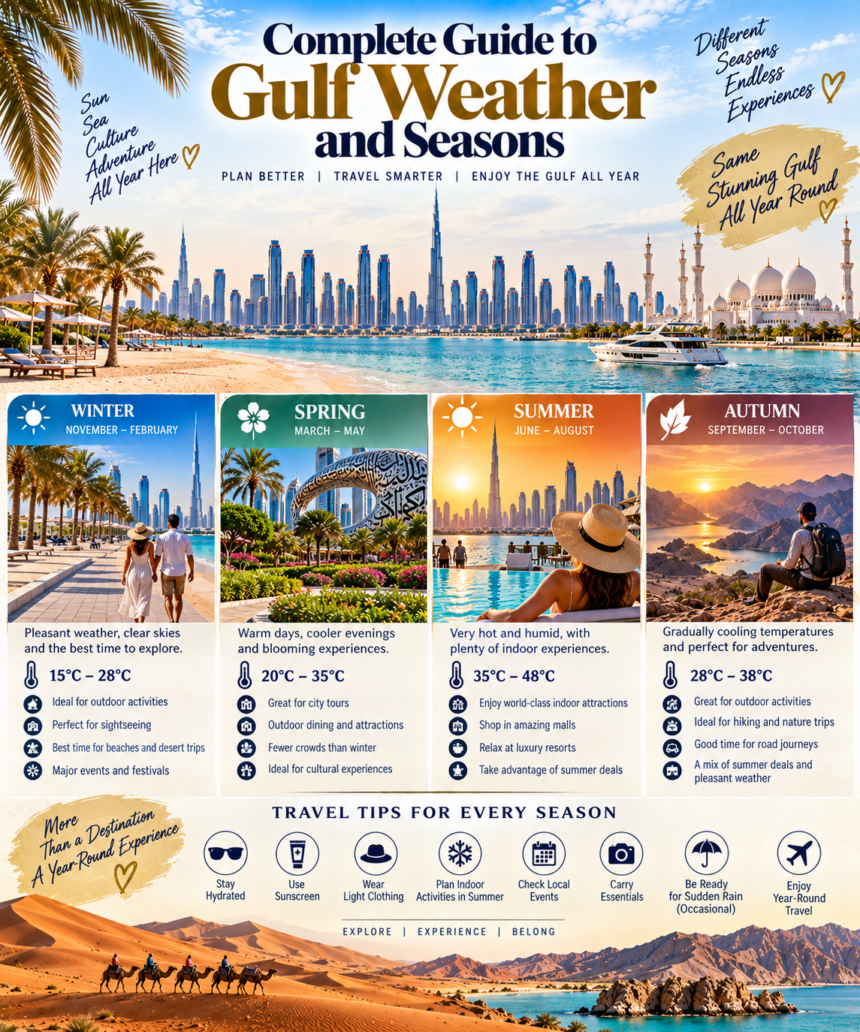
Gulf Weather and Seasons at a Glance
| Season | Approximate Period | Typical Gulf Conditions | Best For |
|---|---|---|---|
| Winter | November to February | Mild days, cool nights, occasional rain | Desert trips, sightseeing, camping |
| Spring | March to May | Warm to increasingly hot | Beaches, road trips, hiking early in season |
| Summer | June to September | Very hot, often humid near coast | Indoor attractions, resorts, Salalah |
| Autumn | September to November | Hot initially, gradually milder | Beaches, outdoor dining, late-season road trips |
These periods are a practical tourism guide rather than a strict meteorological definition. Individual countries describe their seasons differently.
Kuwait, for example, officially treats summer as an exceptionally long period from May into early November, while Qatar tourism presents November to February as winter and June to September as summer.
Winter in the Gulf: November to February
For most visitors, winter is the easiest Gulf season.
Sunny days remain common, but the temperature becomes much more suitable for walking, hiking, desert camping, outdoor restaurants, beaches and heritage sightseeing.
Qatar Tourism describes November to February as winter, with temperatures commonly around 15°C to 20°C. Abu Dhabi reports an average winter daytime temperature of approximately 25°C, with occasional rainfall.
Saudi Arabia becomes particularly interesting during this season because of its enormous geographic diversity. Riyadh’s current tourism data gives predicted winter temperatures of approximately 13°C to 23°C, while coastal Jeddah is warmer at around 19°C to 31°C.
Northern Saudi areas can become considerably colder, and Visit Saudi notes that snowfall can occasionally occur in northern regions and elevated areas.
Kuwait also feels much more seasonal than many visitors expect. Government climate information says winter temperatures can occasionally approach 0°C, although ordinary winter conditions are generally milder.
Winter is especially good for:
- Desert camping
- Outdoor restaurants
- Cultural walking tours
- Hiking
- Cycling
- Road trips
- Beach afternoons
- Mangrove kayaking
- Heritage areas
- Wildlife and birdwatching
Travellers should still pack a light jacket. Desert camps, mountains and northern GCC destinations can feel surprisingly cold after sunset.
Spring in the Gulf: March to May
Spring is a transition season across much of the GCC.
March can still feel almost like winter, particularly during mornings and evenings. By May, however, many destinations are already approaching serious summer heat.
Abu Dhabi describes spring as roughly mid-March through May, with temperatures rising progressively and occasional rainfall possible, particularly earlier in the season.
Saudi Arabia shows significant regional variation. Visit Saudi notes that spring nights can remain below 15°C in northern areas while central and southern regions are warmer. Riyadh is still suitable for activities such as hiking earlier in the season before temperatures climb.
Oman gives spring travellers something particularly distinctive. March to May is rose season in Jabal Akhdar, when mountain terraces produce the flowers used in traditional Omani rose-water production.
Kuwait’s spring is shorter and more unstable. Official government information warns that spring can bring weather fluctuations, thunderstorms, strong winds and rapidly rising temperatures before summer takes over.
For travellers, March and early April can be excellent. Late May requires much more careful daytime planning.
Summer in the Gulf: June to September
Summer is the season that shapes the Gulf’s international climate reputation.
Temperatures frequently exceed 40°C in several GCC countries, and direct afternoon sun can make long periods outdoors uncomfortable or potentially dangerous without proper planning.
Abu Dhabi reports average summer daytime highs ranging from approximately 38°C in June to 41°C in August, while its broader seasonal guidance says daytime temperatures can reach around 45°C or higher. Coastal humidity can also be substantial.
Qatar Tourism says average monthly temperatures range up to around 36°C in July, with summer highs sometimes exceeding 40°C. Its main summer period runs from June through September.
Bahrain Tourism describes typical summer temperatures as hovering around 45°C.
Riyadh’s predicted summer range is approximately 25°C to 43°C, while Jeddah’s is around 25°C to 41°C. The experience differs, however, because coastal Jeddah can feel more humid while Riyadh’s heat is typically drier.
Kuwait can be hotter still. Government climate information says temperatures sometimes reach 50°C, while a July 2026 official weather observation recorded 51°C at Kuwait Airport during an extremely hot period.
Summer does not mean tourism stops. Gulf cities are designed around air-conditioned environments, including museums, malls, theme parks, aquariums, restaurants and indoor entertainment.
The better summer strategy is to shift the day:
Early morning: Beach, walk or outdoor sightseeing.
Late morning to afternoon: Museums, malls and indoor attractions.
Evening: Restaurants, waterfronts and outdoor activities after temperatures begin to fall.
There is also one extraordinary Gulf exception: Salalah.
Autumn in the Gulf: September to November
Autumn begins hot across most GCC countries.
September can still feel fully like summer in Dubai, Doha, Bahrain or Kuwait, while October usually brings gradual improvement.
By November, outdoor tourism is returning strongly across much of the region.
Abu Dhabi treats September through December as autumn, with conditions becoming increasingly suitable for beaches and watersports as summer temperatures decline.
Saudi Arabia experiences a similar transition. Visit Saudi says early autumn daytime temperatures can remain above 30°C, although northern areas and southwestern highlands become more comfortable sooner and evenings begin to cool.
Oman reports average autumn temperatures around 28°C as conditions decline gradually from September through November.
October and November are therefore excellent compromise months. Visitors often gain good beach conditions without the strongest summer heat, while outdoor cafés, deserts and heritage areas become increasingly pleasant.
UAE Weather and Seasons
The UAE has a subtropical arid climate characterised by sunshine, hot summers and mild winters.
Abu Dhabi’s tourism authority reports winter from December to around mid-March, with an average daytime temperature of about 25°C. Summer runs from late May through September and can bring temperatures around 45°C alongside humidity that may reach 80 to 90 percent.
Rain is limited and falls mainly between November and March. Abu Dhabi reports average annual rainfall around 12 centimetres, with Al Ain receiving somewhat more because of its proximity to the Hajar Mountains.
Dubai follows a broadly similar seasonal pattern, although local conditions can differ depending on coastal humidity, wind and individual weather systems.
For most visitors:
| UAE Travel Type | Better Months |
|---|---|
| Desert safari | November to March |
| City sightseeing | November to April |
| Beach holiday | October to May |
| Hiking | November to March |
| Indoor attractions | Year-round |
| Summer hotel deals | June to September |
Mountain destinations such as Jebel Jais require separate preparation. Temperatures at elevation can be noticeably lower than those shown in Dubai or Abu Dhabi forecasts.
Saudi Arabia Weather and Seasons
Saudi Arabia has the most geographically varied climate of any GCC country simply because of its size.
Riyadh, Jeddah, AlUla, Tabuk, Abha and the Red Sea coast should not be treated as though they share one climate.
Riyadh’s official tourism data currently gives predicted seasonal temperatures of approximately:
| Season | Riyadh Temperature Range |
|---|---|
| Winter | 13°C to 23°C |
| Spring | 23°C to 38°C |
| Summer | 25°C to 43°C |
| Autumn | 18°C to 35°C |
Jeddah is warmer in winter and strongly influenced by the Red Sea:
| Season | Jeddah Temperature Range |
|---|---|
| Winter | 19°C to 31°C |
| Spring | 23°C to 39°C |
| Summer | 25°C to 41°C |
| Autumn | 23°C to 37°C |
Visit Saudi specifically recommends winter for camping, climbing, city exploration and AlUla, while summer travellers can seek cooler conditions around highland destinations such as Taif.
The lesson is simple: check your Saudi destination individually rather than relying on a national average.
Qatar Weather and Seasons
Qatar has a warm desert climate with abundant sunshine.
Tourism authorities divide the most obvious seasons into a mild winter from November to February and a hot summer from June to September. Winter temperatures are often around 15°C to 20°C, making this the strongest period for desert trips, outdoor dining and exploring Doha on foot.
Average monthly temperatures range from approximately 17°C in January to 36°C in July, although summer highs can exceed 40°C.
Rainfall is limited and largely concentrated in winter.
Humidity becomes important during the summer, particularly around coastal areas. The temperature on a weather application therefore does not always communicate how hot conditions actually feel.
Visit Qatar recommends outdoor travel between roughly October and May, with summer itineraries focused more heavily on indoor cultural and entertainment attractions.
Bahrain Weather and Seasons

Bahrain’s island geography gives it a subtropical climate strongly influenced by surrounding Gulf waters.
Bahrain Tourism describes autumn and winter conditions as pleasantly mild, with temperatures averaging around 25°C. Summer temperatures are described as hovering around 45°C.
Winter, early spring and late autumn are therefore the easiest periods for outdoor sightseeing.
These months work particularly well for:
- Bahrain Fort
- Muharraq heritage areas
- Outdoor dining
- Beaches
- Walking through traditional markets
- Motorsport and outdoor recreation
- Island trips
During summer, high temperature and humidity shift much of daily life towards air-conditioned spaces, water attractions and evening activities.
Because Bahrain is compact, visitors can also reduce heat exposure by using shorter transfers rather than spending long periods travelling outdoors.
Oman Weather and Seasons
Oman has the most unusual seasonal story in the GCC.
Northern lowland regions follow the familiar Gulf pattern of hot summers and mild winters. Official tourism guidance places typical lowland summer temperatures between 35°C and 45°C.
Winter runs from November to early March, with Muscat averaging around 26°C and providing excellent conditions for trekking, camping and outdoor sightseeing.
Mountains create much cooler microclimates. Jabal Akhdar and Jabal Shams can be approximately 15°C colder than lowland areas.
Then there is Dhofar.
From mid-June through September, the Khareef brings mist, cloud, drizzle and green landscapes to southern Oman. Temperatures can remain around 20°C to 28°C, creating one of the Arabian Peninsula’s most unusual summer escapes.
Few countries allow a traveller to experience intense desert summer and mist-covered green hills within the same national border.
Kuwait Weather and Seasons
Kuwait has one of the Gulf’s strongest continental climate patterns.
Government information describes the country as having a long, dry, hot summer and a short winter, with occasional rainfall. Temperatures can reach around 50°C during extreme summer conditions, while winter temperatures can occasionally approach freezing.
Kuwait’s official seasonal framework is more specific than the simple four-season tourism model:
| Season | Official Approximate Period |
|---|---|
| Winter | December 6 to February 15 |
| Spring | February 16 to May 20 |
| Summer | May 21 to November 4 |
| Autumn | November 5 to December 5 |
Summer also brings dust-producing winds. During a May 2026 weather event, Kuwait Meteorology forecast temperatures reaching 47°C to 49°C alongside northwesterly winds capable of reducing visibility.
Winter is therefore especially valuable for visitors interested in outdoor Kuwait.
Why Coastal Humidity Changes How the Gulf Feels
Temperature alone does not tell the whole story.
Coastal cities are influenced by surrounding warm water, meaning humidity can make summer conditions feel more intense than the recorded air temperature suggests.
Dubai, Abu Dhabi, Doha, Manama and Jeddah can all experience humid conditions.
Abu Dhabi reports summer humidity of roughly 80 to 90 percent during some periods.
Inland Riyadh can record similar or even higher temperatures while feeling different because the air is often drier.
Travellers should therefore check both temperature and humidity, especially when planning outdoor summer activities.
Rainfall and Thunderstorms Across the GCC
The Gulf is predominantly dry, but heavy rain is possible.
Rainfall is usually irregular rather than spread evenly across the year. A place may remain dry for long periods before receiving a substantial amount of rain during one weather system.
Abu Dhabi receives most of its limited rainfall between November and March. Qatar likewise says rainfall is limited and normally concentrated in winter.
Kuwait can experience spring thunderstorms, while Oman’s mountains and wadis require particular caution because rain falling far upstream can sometimes affect low-lying areas.
For travellers, the important point is that desert climate does not mean flood risk is impossible.
Never drive into moving floodwater or enter a wadi when severe weather warnings are active.
Sandstorms, Dust and Strong Winds
Dust is another Gulf weather factor that visitors may underestimate.
Strong winds can lift desert dust and sharply reduce visibility on highways. This is particularly relevant in Kuwait, Saudi Arabia and exposed desert areas elsewhere in the GCC.
Kuwait’s government climate information says dusty storms commonly occur during summer.
Qatar’s geography is also shaped by Al Shamal winds, which move across its desert plains.
During significant dust conditions:
- Reduce driving speed.
- Increase distance from other vehicles.
- Use appropriate vehicle lights.
- Avoid unnecessary outdoor exercise.
- Protect cameras and electronic equipment.
- Follow local weather and road advisories.
Travellers with respiratory conditions should take extra precautions and follow their clinician’s advice.
Mountain Weather in the Gulf
The mountains are the biggest exception to standard Gulf temperatures.
Oman Tourism says Jabal Akhdar and Jabal Shams can be as much as 15°C cooler than lowland areas.
Saudi Arabia’s southwestern mountains can also be considerably milder than Riyadh or Jeddah, while Fayfa reaches around 2,000 metres above sea level.
In the UAE, Jebel Jais similarly experiences cooler temperatures than coastal Ras Al Khaimah.
This means travellers heading into mountains during winter should carry layers even when departing from a warm city.
Altitude also increases the possibility of fog, rapidly changing visibility and local weather variation.
Oman’s Khareef Season Explained
Khareef is the Gulf climate phenomenon every regional traveller should know about.
From roughly mid-June through September, monsoon influence reaches the Dhofar region around Salalah. Cloud, fog and light rain transform hills that appear dry during other times of the year into green landscapes.
Official Oman tourism information gives typical Khareef temperatures of approximately 20°C to 28°C.
The contrast can be extraordinary.
While Muscat and other Gulf capitals experience summer heat above 40°C, Salalah may be surrounded by mist-covered hills, green vegetation and flowing seasonal water features.
Khareef is consequently one of the busiest periods for regional visitors to southern Oman, so accommodation and flights can become more competitive.
Best Gulf Weather for Beaches
The ideal beach season depends on whether you prefer warm or cooler water and how much heat you tolerate.
For most visitors, October through April provides an excellent balance across the UAE, Qatar and Bahrain.
Winter days can remain warm enough for beach time, particularly during midday, while the air is far more comfortable than in peak summer.
Jeddah and the Saudi Red Sea remain warmer through much of the year, while southern Oman follows a different seasonal pattern.
Summer beaches are still possible, but early morning and late afternoon are far more comfortable than midday.
Best Weather for Desert Camping and Safaris
Desert tourism is strongest in the cooler season.
November through February is ideal for most travellers, although October, March and early April can also work well.
Winter makes it possible to remain outside for longer, enjoy campfires and experience sunrise without immediately returning to air conditioning.
Night temperatures can fall sharply, especially inland.
Pack:
- Light jacket
- Warm layer for overnight camping
- Closed shoes
- Sunscreen
- Water
- Hat
- Sunglasses
The desert can be cold after dark and intensely sunny again only hours later.
Best Weather for Hiking and Mountain Trips
For UAE, Saudi and northern Oman hiking, November through March is generally the strongest period.
Spring can remain pleasant at altitude, especially in Oman.
Summer hiking at low elevation should be treated with extreme caution because temperature, sun exposure and dehydration risk can become serious.
Oman offers one important summer alternative: its high mountains are much cooler than lowlands, although conditions should still be checked before hiking.
Always examine the forecast for the actual mountain area, not the nearest coastal city.
Best Months for a GCC Road Trip
A multi-country road trip is easiest between November and March.
Drivers can stop at viewpoints, explore heritage districts and cross desert highways without dealing with the most intense summer heat.
March and November are particularly useful shoulder months because they combine generally pleasant conditions with slightly less winter peak-season pressure.
Summer road trips remain possible, but vehicle preparation becomes essential. Tyres, coolant, air conditioning, water supplies and fuel planning matter much more when external temperatures approach or exceed 45°C.
Gulf Weather Month by Month
| Month | General GCC Travel Conditions |
|---|---|
| January | Coolest overall month; excellent outdoors |
| February | Mild, good for deserts and cities |
| March | Warm days, excellent travel conditions |
| April | Increasing heat; still good for many outdoor trips |
| May | Hot; summer conditions beginning |
| June | Very hot across most GCC; Khareef begins in Dhofar |
| July | Peak heat in many areas; Salalah becomes popular |
| August | Very hot and often humid; Khareef continues |
| September | Still hot; Khareef winds down |
| October | Noticeable improvement; beaches and outdoor dining return |
| November | Excellent weather across much of the GCC |
| December | Mild days, cooler nights, peak outdoor season |
This is a regional overview rather than a forecast. Oman’s Dhofar region, high mountains and northern Saudi Arabia can behave very differently from the standard pattern.
What to Pack for Every Gulf Season
Packing should change according to both month and destination.
Winter: Carry lightweight daytime clothes plus a sweater or jacket. Add warmer layers for Saudi Arabia’s north, Kuwait, desert camping and mountain areas.
Spring: Choose breathable clothing, sun protection and one light evening layer. Hiking shoes remain useful in March and early April.
Summer: Prioritise loose lightweight clothing, sunscreen, hat, sunglasses and reusable water bottle. Keep a light layer for heavily air-conditioned malls and hotels.
Autumn: Pack primarily for warm conditions in September and October, adding a light jacket when travelling in November.
Year-round, modest clothing is useful for mosques and traditional cultural sites.
How Weather Can Affect Travel Plans
Gulf weather influences much more than clothing.
Extreme heat can shorten outdoor visits. Fog may affect roads and flights. Dust can reduce visibility, while rainfall can make wadis and low-lying roads unsafe.
Boat trips and diving can also be cancelled because of wind or sea conditions even when the sky appears clear.
For any activity involving mountains, desert, sea or remote roads, check weather conditions shortly before departure rather than relying on seasonal averages.
Seasonal averages tell you what is normal. They cannot tell you what will happen on one particular day.
Best Time to Visit the Gulf by Traveller Type
| Traveller Type | Recommended Period |
|---|---|
| First-time GCC visitor | November to March |
| Beach traveller | October to April |
| Desert camper | November to February |
| Hiker | November to March |
| GCC road trip | November to March |
| Indoor attraction holiday | Year-round |
| Budget summer traveller | June to September |
| Salalah Khareef visitor | Mid-June to September |
| Jabal Akhdar rose season | March to May |
| Outdoor family holiday | November to March |
| City and dining break | October to April |
There is therefore no single perfect Gulf travel month.
For the broadest range of outdoor activities, December through February is hard to beat. For a balance between pleasant weather and shoulder-season flexibility, March and November are excellent.
For something completely different, visit southern Oman during Khareef.
Final Thoughts on Gulf Weather and Seasons
A Complete Guide to Gulf Weather and Seasons needs to begin with one important idea: the GCC does not experience one identical climate.
The UAE combines hot, humid summers with very comfortable winters and cooler mountain conditions. Abu Dhabi’s average winter daytime temperature sits around 25°C, while summer temperatures can approach 45°C.
Saudi Arabia has the greatest variation. Riyadh can reach predicted summer highs around 43°C, Jeddah remains warmer during winter, northern regions can become genuinely cold and highland destinations provide a completely different climate.
Qatar has mild winters around 15°C to 20°C and intense summers, making November through February particularly attractive for outdoor tourism. Bahrain follows a similar pattern, with mild fall and winter conditions averaging around 25°C and summer temperatures around 45°C.
Kuwait experiences some of the strongest temperature extremes, with very hot summers, dust-producing winds and a short winter that can occasionally become surprisingly cold.
Then there is Oman, where geography transforms the climate completely. Muscat enjoys mild winter conditions, the Hajar Mountains can be around 15°C cooler than nearby lowlands, and Dhofar’s Khareef creates green, misty landscapes during the same months when much of the Gulf is experiencing peak summer heat.
For most travellers, the simplest rule is to choose November through March for outdoor Gulf travel. But travellers who understand the region’s microclimates can find worthwhile experiences in every month of the year.
That is what makes Gulf weather more interesting than the stereotype suggests. It is not simply a question of hot versus cool. The season can completely change where you should go, what you can do and even what the landscape looks like.
Do follow us on Instagram
Read More – Best Wildlife Experiences in the GCC: 12 Unforgettable Encounters