


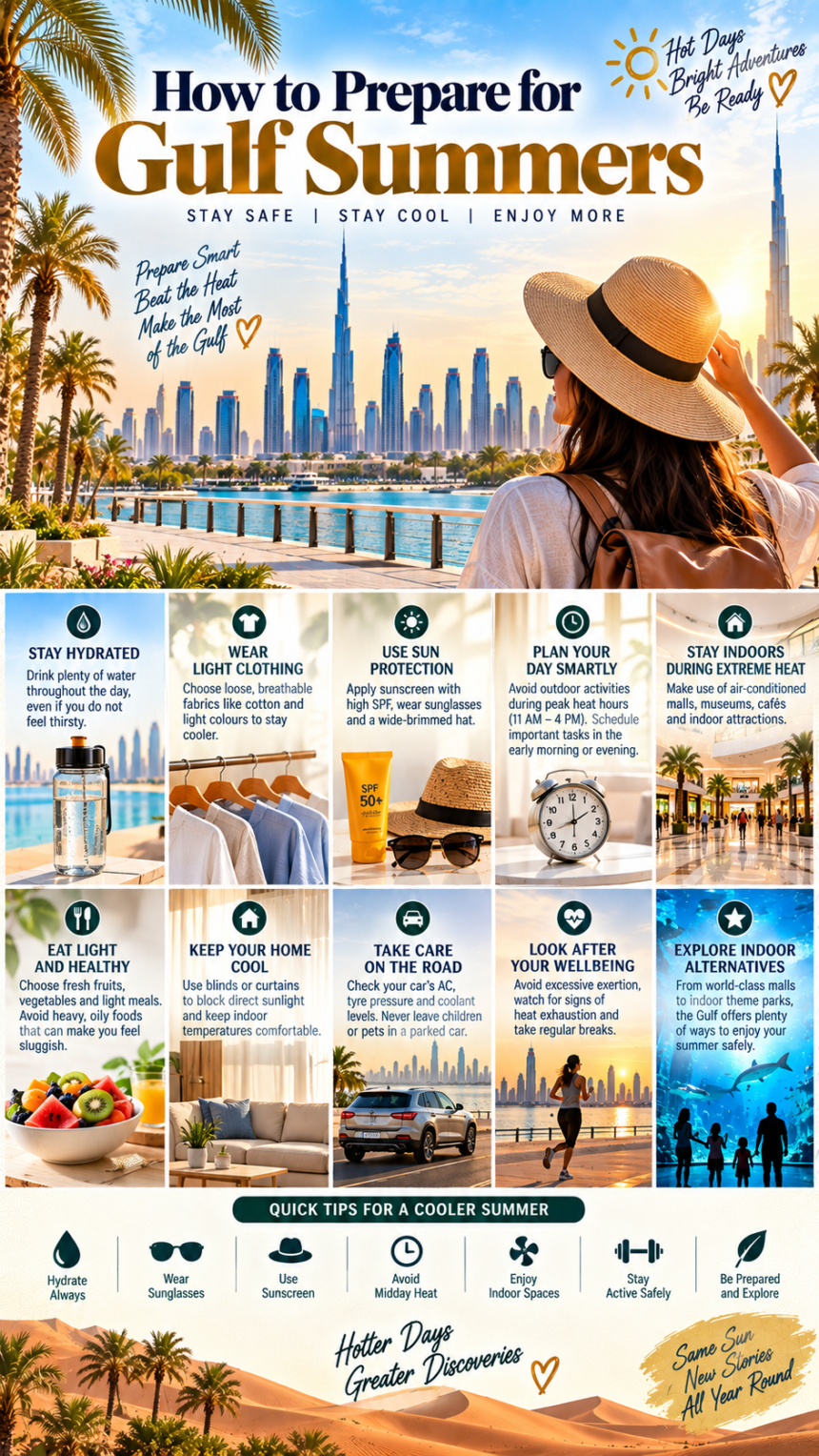
How to Prepare for Gulf Summer
Summer in the Gulf can be intense, but high temperatures do not automatically make the region impossible to visit. Dubai, Abu Dhabi, Doha, Riyadh, Jeddah, Manama, Muscat and Kuwait City are built around air-conditioned hotels, shopping centres, museums, restaurants and entertainment venues. The key is understanding that a Gulf summer requires a different travel routine from a winter holiday.
- Understand What Gulf Summer Actually Feels Like
- Change the Way You Plan Your Day
- Stay Hydrated Before You Feel Extremely Thirsty
- Know the Warning Signs of Heat Illness
- Choose Summer Clothing Carefully
- Protect Your Skin and Eyes
- Use Shade as Part of Your Route
- Be Careful With Parked Cars
- Prepare Your Car for Extreme Heat
- Plan Beaches and Pools Around the Heat
- Build Your Itinerary Around Indoor Attractions
- Understand Summer in the UAE
- Understand Summer in Saudi Arabia
- Understand Summer in Qatar
- Understand Summer in Bahrain
- Understand Summer in Kuwait
- Understand Summer in Oman
- Take Extra Care With Children and Older Travellers
- Prepare Differently If You Have a Medical Condition
- Do Not Underestimate Air Conditioning
- Prepare for Dust and Reduced Visibility
- Pack Specifically for Gulf Summer
- Make Summer Work for Your Budget
- Gulf Summer Preparation Checklist
- Final Thoughts on How to Prepare for Gulf Summers
Learning How to Prepare for Gulf Summers starts with respecting the climate rather than trying to ignore it. Abu Dhabi, for example, records average daytime highs of around 38°C in June and approximately 41°C in August, with significant coastal humidity. Qatar says summer temperatures can exceed 40°C, while Kuwait’s government notes that temperatures can sometimes reach around 50°C.
Saudi Arabia and Oman add important regional differences. Saudi travellers can escape some lowland heat in higher areas such as Taif and Al Baha, while Oman’s Jabal Akhdar and Jabal Shams can be up to approximately 15°C cooler than the lowlands. Southern Oman provides the biggest exception of all, with Dhofar’s Khareef bringing temperatures of roughly 20°C to 28°C during part of the Gulf summer.
A successful summer trip therefore does not mean spending every day indoors. It means choosing the right hours for outdoor activities, protecting yourself from sun exposure, drinking regularly, selecting appropriate clothing and knowing when heat has moved beyond simple discomfort into a health risk.
Understand What Gulf Summer Actually Feels Like
The first mistake many first-time visitors make is looking only at the number shown beside the temperature symbol.
Summer heat around the Gulf can feel very different depending on humidity, wind, altitude and whether you are standing in direct sunlight. Coastal cities such as Abu Dhabi, Dubai, Doha, Manama and Jeddah may combine high temperatures with humidity, while inland Riyadh generally experiences a drier type of heat.
Abu Dhabi’s tourism authority says summer runs from roughly June through September, with daytime highs around 38°C to 42°C and overnight temperatures still around 29°C to 32°C. Coastal humidity can reach 60 percent or more.
The World Health Organization also warns that temperatures experienced in direct sunshine can feel significantly hotter than official measurements taken in shade. This is why a short walk across an exposed car park can feel very different from sitting under a shaded terrace at the same official temperature.
| Summer Factor | Why It Matters |
|---|---|
| Air temperature | Determines the basic heat load |
| Humidity | Makes sweat evaporate less efficiently |
| Direct sunlight | Can make conditions feel considerably hotter |
| Wind | May help in moderate heat but can also carry hot air or dust |
| Altitude | Mountain areas are often cooler |
| Time of day | Midday and afternoon usually present the greatest heat |
| Surface type | Asphalt, concrete and parked vehicles absorb and radiate heat |
Checking the forecast should therefore include humidity, heat warnings, wind and dust conditions rather than temperature alone.
Change the Way You Plan Your Day
One of the simplest ways to prepare for Gulf summers is to stop thinking of 10am to 5pm as the main sightseeing period.
Abu Dhabi’s current summer tourism guidance recommends indoor attractions through the hottest part of the day and outdoor experiences in the morning or after temperatures begin to ease in the evening. The emirate specifically identifies mornings before around 9am and later evenings as more manageable periods for outdoor activity.
A practical summer day might look like this:
| Time | Better Summer Choice |
|---|---|
| 6am to 9am | Beach walk, photography, park, outdoor sightseeing |
| 9am to noon | Breakfast, museum or cultural attraction |
| Noon to 5pm | Mall, aquarium, indoor theme park, lunch, hotel |
| 5pm to 7pm | Rest, swimming where appropriate, indoor activity |
| After 7pm | Waterfront, outdoor restaurant, souq, evening attraction |
The exact hours change by destination and weather conditions, so this is a planning model rather than a safety guarantee.
This approach also prevents travel fatigue. Trying to walk around outdoor heritage districts at 2pm and then continue sightseeing until midnight is rarely an enjoyable summer itinerary.
Stay Hydrated Before You Feel Extremely Thirsty
Hydration becomes one of the most important daily habits during a Gulf summer.
Both the CDC and WHO recommend drinking regularly during hot weather and carrying water rather than waiting until you become noticeably thirsty. The CDC also recommends refilling a water bottle through the day and paying attention to possible signs of dehydration.
People exercising, working outdoors or sweating heavily may require different fluid and electrolyte strategies from someone moving between air-conditioned buildings. Travellers with heart, kidney or other medical conditions that affect fluid intake should follow their clinician’s advice rather than applying a generic water target.
Water should also remain accessible during road trips. A journey that looks straightforward on a map can become much more serious if a tyre problem or vehicle breakdown leaves passengers waiting outside in intense heat.
A reusable bottle is particularly useful. Abu Dhabi’s official packing guidance specifically recommends one alongside sunscreen and other practical summer items.
Know the Warning Signs of Heat Illness
There is a point where feeling hot is no longer merely uncomfortable.
The CDC lists symptoms associated with overheating that can include heavy sweating, muscle cramps, dizziness, headache, weakness, nausea and shortness of breath.
If these symptoms appear during outdoor activity, stop what you are doing, move somewhere cool, rest and begin cooling down.
Heat stroke is more serious. WHO identifies signs such as confusion or delirium, loss of consciousness, convulsions and dangerously abnormal body temperature as reasons to seek emergency medical help immediately. Cooling should begin while professional help is on the way.
Do not wait for someone to “walk it off” when their mental state has changed.
Travellers should also know the local emergency number of the country they are visiting before they need it.
Choose Summer Clothing Carefully
Loose, lightweight and breathable clothing generally works much better than heavy or tightly fitted outfits.
Visit Qatar recommends lightweight clothing during hot weather, while Bahrain Tourism advises breathable fabrics such as cotton and linen for summer. Abu Dhabi similarly recommends light, loose clothing and notes that visitors should still consider local cultural expectations when entering traditional or religious locations.
There is also a surprising Gulf summer problem: indoor cold.
Air conditioning can be powerful inside malls, hotels, cinemas and offices. A person dressed entirely for 43°C weather may suddenly feel uncomfortable after sitting in a strongly cooled restaurant for an hour.
A light overshirt, scarf or thin layer can therefore be useful even in July. Abu Dhabi’s tourism guidance specifically recommends carrying a light layer for air-conditioned buildings.
For religious sites, shoulders and legs may need to be covered depending on the location. Always check the specific venue’s requirements.
Protect Your Skin and Eyes
The fact that locals are accustomed to Gulf summers does not reduce the strength of the sun.
Visit Qatar recommends sunscreen, sunglasses, shade and lightweight protective clothing during sunny conditions. Abu Dhabi also specifically advises sunscreen when going outdoors in summer.
WHO recommends using sun protection and avoiding prolonged direct exposure during extreme heat.
A hat can help when moving between buildings, while good-quality sunglasses are useful against glare reflected from roads, buildings, sand and water.
Sunscreen should not be treated as permission to remain outdoors indefinitely. It helps protect against ultraviolet exposure, but it does not protect the body from overheating.
Use Shade as Part of Your Route
In a Gulf summer, two walking routes of the same distance can feel completely different.
A five-minute route beneath covered walkways may be manageable, while five minutes across an exposed car park can be unpleasant.
When comparing hotels, Metro stations and attractions, consider how much of the final journey is actually outdoors. A hotel advertised as “five minutes from the station” may still require crossing several large roads with little shade.
WHO recommends seeking shade and avoiding strenuous activity during the hottest part of the day.
This matters particularly for families with children, older travellers and anyone who moves more slowly.
Do not plan summer trips based purely on distance. Plan around shade, air conditioning and transfer time.
Be Careful With Parked Cars
Cars can heat rapidly when left in direct summer sunlight.
WHO specifically warns never to leave children or animals inside parked vehicles, even for a short period.
This rule should be absolute.
Drivers should also be careful when entering a vehicle that has been sitting in the sun. Metal seat-belt buckles, steering wheels and dark interior surfaces can become extremely hot.
Using shaded or underground parking when available makes a significant difference. Allow the air conditioning to begin reducing the cabin temperature before starting a long drive.
For rental vehicles, confirm that the air conditioning is working properly before leaving the rental location.
Prepare Your Car for Extreme Heat
Summer vehicle reliability becomes particularly important during long Gulf drives.
High temperatures place additional stress on tyres, batteries and cooling systems. A vehicle that seems acceptable for short city journeys may face very different conditions on a remote Saudi, Omani or UAE highway.
Before a long trip, check the cooling system, tyres, spare tyre, battery and air conditioning. Carry water and keep the fuel level comfortably above empty when travelling through remote regions.
Dust also matters. Kuwait’s government notes that dusty storms often occur during summer and that temperatures can sometimes reach 50°C.
If visibility deteriorates because of dust, slow down, increase following distance and follow local road and weather advice.
A summer road trip should have more contingency planning than a city-to-city winter drive.
Plan Beaches and Pools Around the Heat
Summer does not automatically eliminate beach time, but timing becomes essential.
Early morning often provides the most comfortable window. Late afternoon and evening can also work depending on the destination, water conditions and operating hours.
The middle of the day combines the strongest sunlight with high air temperature and hot sand or poolside surfaces.
Visit Saudi specifically promotes summer marine experiences such as snorkelling, sailing and diving, while Qatar continues to market its long coastline as part of summer tourism.
However, water does not remove heat risk. Swimming can create a false sense that the body is adequately cooled, particularly when long periods are spent in direct sun before and after entering the water.
Never swim alone, especially in unfamiliar conditions. WHO includes this advice within its heat-safety guidance.
Build Your Itinerary Around Indoor Attractions
One reason summer travel remains practical in the GCC is the enormous amount of climate-controlled entertainment.
Dubai and Abu Dhabi have indoor theme parks, aquariums, museums, malls and immersive attractions. Doha has museums and major shopping and entertainment centres. Riyadh, Jeddah, Manama, Kuwait City and Muscat all provide extensive indoor options.
Visit Qatar actively promotes museums, shopping and indoor experiences from June through September, while Abu Dhabi recommends shifting the middle of the day towards climate-controlled attractions.
This allows travellers to experience the region without spending six consecutive hours outside.
| Country | Strong Summer Strategy |
|---|---|
| UAE | Museums, theme parks, malls, aquariums, evening waterfronts |
| Saudi Arabia | Indoor city attractions plus mountain or coastal alternatives |
| Qatar | Museums, malls, indoor parks, evening dining |
| Bahrain | Malls, aquarium, indoor entertainment, evening waterfront |
| Oman | Muscat indoor attractions or cooler mountain and Dhofar trips |
| Kuwait | Museums, malls, indoor family attractions |
The strongest itinerary usually alternates indoor and outdoor experiences rather than choosing only one.
Understand Summer in the UAE
The UAE is extremely well adapted to high summer temperatures, but travellers still need to adjust their schedule.
Abu Dhabi reports summer daytime highs around 38°C to 42°C between June and September. Outdoor daytime activity is discouraged in its summer planning guidance, while indoor attractions and post-sunset experiences are emphasised.
Dubai follows a similarly hot pattern, and Visit Dubai’s city guide places average summer temperatures around 41°C.
For travellers, the UAE’s biggest summer advantage is infrastructure. Hotels, taxis, Metro systems, shopping centres and attractions are designed around air conditioning.
The challenge is the distance between those climate-controlled spaces. Plan transfers carefully rather than assuming an entire neighbourhood can comfortably be explored on foot.
Understand Summer in Saudi Arabia
Saudi Arabia’s size creates much greater summer variation than the smaller GCC countries.
Riyadh and other inland areas can become extremely hot. Coastal destinations such as Jeddah bring marine activities but also different humidity conditions.
The country also provides natural escapes. Visit Saudi promotes Taif, Aseer and Al Baha as part of its summer offering, alongside the Red Sea and Jeddah.
This means travellers do not need to spend the entire trip fighting lowland heat.
A smart Saudi summer itinerary can combine city attractions with higher-altitude landscapes or marine experiences.
Early mornings and evenings remain more suitable for outdoor urban exploration, while afternoons can be reserved for indoor attractions.
Understand Summer in Qatar
Qatar describes June through September as its main summer period and encourages travellers to use cultural attractions, shopping and indoor experiences during hotter weather.
Average monthly temperatures reach around 36°C in July, with summer highs sometimes exceeding 40°C.
Humidity can make coastal Doha feel more intense than the temperature alone suggests.
The Metro is particularly useful because it allows travellers to move between major areas without spending the entire day in taxis or walking outdoors.
Carry water, stay in the shade and use sunscreen. These recommendations are also specifically highlighted by Visit Qatar.
Understand Summer in Bahrain
Bahrain is compact, which can make summer itinerary planning easier because transfers between major areas are relatively short.
However, the island climate can be hot and humid. Bahrain Tourism recommends loose, breathable summer clothing such as cotton and linen, along with a hat, sunglasses and sunscreen.
The practical strategy resembles Doha and the UAE: move outdoor sightseeing towards the beginning and end of the day and reserve afternoon hours for indoor attractions.
Bahrain’s small size can actually become a summer advantage. Families can avoid several hours of road travel by grouping attractions within Manama and nearby districts.
Understand Summer in Kuwait
Kuwait has some of the Gulf’s most intense summer conditions.
The government describes its climate as having a long, dry and hot summer, with temperatures that sometimes reach around 50°C in the shade. Dust storms are also common during the summer months.
Visitors should therefore be particularly cautious about assuming that a short outdoor walk is harmless.
Plan direct transport between air-conditioned buildings wherever possible. Keep water available during road journeys and check forecasts for dust or reduced visibility.
Summer sightseeing should focus heavily on indoor attractions, restaurants, malls and cultural venues.
For extensive outdoor exploration, Kuwait’s cooler months are much more suitable.
Understand Summer in Oman
Oman proves that not every Gulf summer looks the same.
Lowland areas can experience temperatures of roughly 35°C to 45°C, but the country’s mountain areas are significantly cooler. Jabal Akhdar and Jabal Shams can be up to around 15°C colder than the lowlands.
Then there is Dhofar.
During Khareef, southern Oman experiences cloud, moisture, green hills and temperatures of roughly 20°C to 28°C.
This makes Salalah and Dhofar one of the strongest Gulf summer alternatives for travellers who actively want outdoor landscapes.
Weather conditions there create different considerations, including mist, wet roads and reduced mountain visibility. Summer preparation for Salalah can therefore involve a light rain layer rather than only sun protection.
Take Extra Care With Children and Older Travellers
Children and older adults can be more vulnerable during extreme heat, so family itineraries should be more conservative.
WHO advises keeping infants and children out of peak heat and never leaving them in parked vehicles. It also recommends checking on older people and others who may be more vulnerable during hot weather.
Families should keep outdoor periods short, schedule frequent air-conditioned breaks and make sure drinking water is always available.
Strollers need careful handling too. WHO warns that covering a stroller completely with dry fabric can trap heat rather than creating a cooler environment.
For older travellers or anyone with a health condition affected by heat, it is sensible to discuss travel plans with a healthcare professional before a trip involving extreme temperatures.
Prepare Differently If You Have a Medical Condition
Heat can place additional stress on the body.
The CDC notes that people with some chronic conditions can face greater health risks during very hot weather. WHO also identifies older people and people with conditions affecting the heart, lungs or kidneys among those requiring extra attention.
Some medicines can also affect hydration, sweating or heat tolerance.
Travellers who take regular medication should not change doses or fluid intake based on general internet advice. Speak with a doctor or pharmacist if you are unsure how heat could interact with a condition or medication.
Keep medicines within the temperature range specified by the manufacturer. Leaving medication inside a parked Gulf vehicle may expose it to temperatures far higher than ordinary room conditions.
Do Not Underestimate Air Conditioning
Air conditioning is essential across the Gulf, but repeatedly moving between extreme outdoor heat and aggressively cooled buildings can feel uncomfortable.
A light outer layer can help inside malls, cinemas, offices and restaurants. Abu Dhabi specifically recommends carrying something lightweight because indoor air conditioning can feel cold even during summer.
If staying in an apartment or villa, keep curtains or blinds closed against direct daytime sun where practical. WHO recommends reducing indoor heat gain by blocking sunlight and using cooling appropriately.
Fans alone should not be treated as equivalent to air conditioning in extreme temperatures. WHO cautions that fans become less useful for safely cooling the body when air temperatures are extremely high.
Prepare for Dust and Reduced Visibility
Summer is not only about temperature.
Dust and sand can reduce air quality and visibility, affect flights or road journeys and make outdoor exercise uncomfortable.
Kuwait is particularly known for summer dust events, but dust can affect Saudi Arabia, Qatar, the UAE, Bahrain and Oman as well.
When significant dust is forecast, move outdoor activities indoors, close windows and follow local health and weather guidance.
Drivers should avoid using cruise control in poor visibility, reduce speed and leave additional stopping distance.
People with asthma or other respiratory conditions should follow their personal medical plan and consider discussing travel during severe dust conditions with their healthcare provider.
Pack Specifically for Gulf Summer
A Gulf summer packing list should solve three problems at once: sun, heat and air conditioning.
Useful items include:
- Loose, breathable clothing
- High-protection sunscreen
- Sunglasses with good UV protection
- Wide-brimmed hat or cap
- Reusable water bottle
- Light overshirt, scarf or cardigan for air-conditioned spaces
- Comfortable sandals or breathable walking shoes
- Modest clothing for mosques and cultural sites
- Small day bag
- Portable charger
- Regular medications and supporting documentation
- Swimwear for hotels and beaches
- Moisture-resistant protection for electronics where needed
Abu Dhabi’s official summer packing advice similarly recommends sunscreen, a reusable bottle, light clothing and an extra layer for indoor air conditioning.
Avoid overpacking heavy clothing unless you are combining the trip with mountains or a Khareef stay in southern Oman.
Make Summer Work for Your Budget
Summer can also create financial opportunities.
Some Gulf destinations run seasonal promotions because demand patterns change when temperatures rise. Abu Dhabi currently promotes lower summer hotel rates and quieter attractions, while Visit Qatar advertises summer deals on accommodation, restaurants and experiences.
The saving is worthwhile only if the travel style fits the weather.
A traveller who loves museums, restaurants, indoor theme parks and resorts might enjoy excellent value in July.
Someone whose dream trip consists of hiking, outdoor markets, desert camping and all-day walking will probably get much better value from paying more for a winter trip.
Budget decisions should therefore account for experience quality, not just hotel price.
Gulf Summer Preparation Checklist
Before travelling or beginning a long summer day, check the following:
| Preparation | What to Do |
|---|---|
| Weather | Check temperature, humidity, dust and warnings |
| Schedule | Move outdoor activities to cooler hours |
| Water | Carry enough and refill regularly |
| Clothing | Wear loose, breathable fabrics |
| Sun protection | Use sunscreen, sunglasses and shade |
| Transport | Minimise long exposed walks |
| Car | Check tyres, coolant, battery and AC |
| Children | Plan frequent indoor breaks |
| Medication | Store correctly and carry enough supply |
| Outdoor tours | Confirm summer operating times |
| Hotel | Check transport and nearby indoor options |
| Phone | Keep charged for maps and emergencies |
| Road trips | Carry water and avoid running fuel too low |
| Dust | Monitor air and visibility conditions |
| Health | Know symptoms of heat illness |
A few minutes of preparation before leaving the hotel can prevent an uncomfortable day from turning into a medical problem.
Final Thoughts on How to Prepare for Gulf Summers
Knowing How to Prepare for Gulf Summers is primarily about changing your routine rather than cancelling your trip.
The UAE provides extensive air-conditioned infrastructure, but temperatures can rise above 40°C and coastal humidity makes outdoor daytime activity difficult. Planning mornings, indoor afternoons and evening activities is far more comfortable than trying to follow a winter sightseeing schedule.
Saudi Arabia requires regional planning. Riyadh can be extremely hot, while Taif, Aseer and Al Baha provide higher-altitude alternatives and the Red Sea opens opportunities for marine activities.
Qatar and Bahrain work well when travellers build the day around museums, shopping, indoor entertainment and evenings outdoors. Qatar specifically advises lightweight clothing, shade, sunscreen and regular hydration during sunny conditions.
Kuwait deserves particular respect because summer temperatures can approach 50°C and dust storms are common. Extensive outdoor exploration is much easier in cooler months.
Oman provides the region’s most interesting summer alternatives. Mountains such as Jabal Akhdar and Jabal Shams are cooler than the lowlands, while Dhofar’s Khareef can bring temperatures of approximately 20°C to 28°C and transform southern Oman into a green seasonal landscape.
Across every GCC country, the basic preparation remains consistent. Stay hydrated, seek shade, use sunscreen, wear appropriate clothing, avoid strenuous activity in peak heat and know the signs that your body is becoming overheated. WHO and CDC both emphasise staying cool, staying hydrated and taking heat symptoms seriously.
Gulf summer travel is therefore not about proving how much heat you can tolerate. It is about using the region the way it is designed to be used in summer: short outdoor periods, efficient transport, climate-controlled spaces, evenings outside and careful respect for the weather.
Do follow us on Instagram
Read More – Best Time of Year to Visit GCC Country: Essential 2026 Guide