


Why Gulf Heat Feels So Intense
Extreme summer heat is part of life across the Arabian Gulf. Dubai, Abu Dhabi, Doha, Riyadh, Jeddah, Manama, Muscat and Kuwait City can all experience periods when simply walking outdoors for long stretches becomes uncomfortable. Humidity in coastal destinations can make conditions feel even more intense.
- Why Gulf Heat Can Feel More Intense Than the Temperature Suggests
- Plan Your Day Around the Coolest Hours
- Use Air Conditioning Strategically
- Do Not Rely on a Fan Alone in Extreme Temperatures
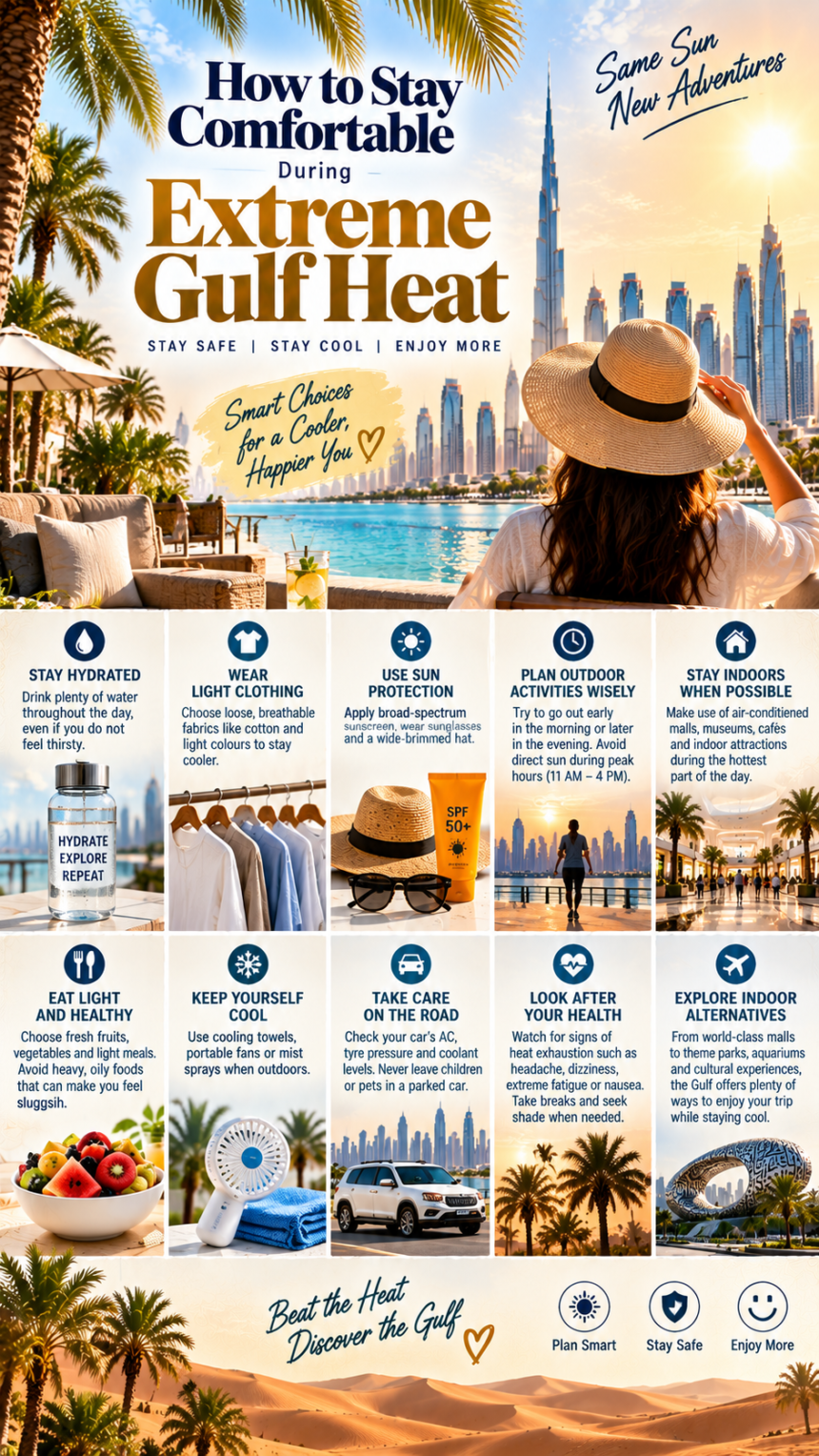
- Drink Regularly Instead of Waiting Until You Feel Very Thirsty
- Choose Water More Often Than Sugary or Alcoholic Drinks
- Wear Loose and Breathable Clothes
- Protect Yourself From Direct Sunshine
- Carry a Small Summer Comfort Kit
- Take Cool Showers After Outdoor Exposure
- Make Your Bedroom Comfortable Before You Sleep
- Reduce Unnecessary Walking Between Attractions
- Be Careful When Entering a Parked Car
- Use Extra Caution During Gulf Road Trips
- Treat Dust as Part of the Summer Climate
- Understand That Coastal Humidity Requires Different Planning
- Choose Indoor Attractions Without Feeling Like You Are Missing the Gulf
- Escape to Cooler Gulf Regions
- Make Exercise a Morning or Indoor Activity
- Know the Signs of Heat Exhaustion
- Recognise Heatstroke as an Emergency
- Take Extra Care With Babies and Children
- Older Adults and People With Health Conditions Need More Caution
- Make Beach Time an Early or Late Activity
- Eat for Comfort Rather Than Maximum Indulgence at Midday
- Extreme Heat Comfort Checklist
- Best Comfort Strategy for Each GCC Country
- Final Thoughts on How to Stay Comfortable During Extreme Gulf Heat
Knowing How to Stay Comfortable During Extreme Gulf Heat is therefore not simply about finding stronger air conditioning. The most effective approach combines smarter scheduling, hydration, shade, suitable clothing, efficient transport and awareness of the warning signs that heat is beginning to affect your health.
The temperatures can be significant. Abu Dhabi records average daytime highs of approximately 38°C in June and 41°C in August. Qatar says summer temperatures can exceed 40°C, while Kuwait’s government notes that temperatures can sometimes reach 50°C and that dust storms frequently occur during summer.
World Health Organization guidance also stresses that official temperature readings are measured in shade. In direct sunshine, perceived conditions can be around 10°C to 15°C hotter.
The goal during a Gulf summer should therefore never be to prove how much heat you can tolerate. It should be to minimise unnecessary heat exposure while still enjoying the destination.
Why Gulf Heat Can Feel More Intense Than the Temperature Suggests
Your weather app might display 40°C, but that number does not fully explain what your body experiences.
Extreme heat becomes more difficult when several factors occur together. High humidity reduces how efficiently sweat evaporates from the skin, direct sunlight adds radiant heat and hot surfaces such as asphalt and concrete release stored heat into the surrounding environment.
WHO explains that high temperature, humidity, weak airflow and thermal radiation can all reduce the body’s ability to eliminate heat. When the body cannot regulate its internal temperature effectively, the risks of heat exhaustion and heatstroke increase.
This is why coastal humidity matters. Doha or Abu Dhabi can sometimes feel more oppressive than an inland destination at a similar temperature because evaporation is less effective.
Before going outside, check more than the headline temperature. Look at humidity, heat warnings, wind, dust and the expected temperature during the specific hours you plan to be outdoors.
Plan Your Day Around the Coolest Hours
The easiest way to become more comfortable during a Gulf summer is to change your daily schedule.
Do not plan a summer itinerary as though you were travelling in January. The middle of the day should generally contain your most heavily air-conditioned activities, while outdoor experiences are better placed early or late.
Abu Dhabi’s tourism authority recommends shifting summer sightseeing towards indoor attractions during the hottest daytime hours. The emirate’s summer temperatures commonly remain intense from June through September.
A practical schedule could look like this:
| Time | Better Choice During Extreme Heat |
|---|---|
| Early morning | Walking, beach, photography, outdoor attractions |
| Late morning | Breakfast and short transfers |
| Midday to afternoon | Museum, mall, aquarium, hotel or indoor park |
| Late afternoon | Rest, pool or indoor activity |
| Evening | Souq, waterfront, restaurant or outdoor attraction |
| Night | Longer walks or outdoor dining when conditions allow |
WHO similarly recommends avoiding strenuous activity during the hottest portion of the day and using cooler morning hours when possible.
A summer Gulf trip becomes much easier once you stop trying to squeeze outdoor sightseeing into every hour.
Use Air Conditioning Strategically
Air conditioning is one of the main reasons Gulf cities remain practical during summer.
Hotels, malls, taxis, Metro systems, restaurants, cinemas and museums are generally heavily climate controlled. Abu Dhabi Tourism describes the emirate as a chain of air-conditioned destinations during summer, allowing travellers to continue sightseeing despite outdoor temperatures above 40°C.
However, comfort does not necessarily mean keeping every room freezing cold.
WHO recommends reducing indoor heat gain by closing curtains or shutters against strong daytime sunlight and turning off unnecessary electrical devices. It also recommends using cooler night air when outside conditions are actually cooler than indoors.
In an apartment or villa, closing curtains on the sunniest side of the property can make a noticeable difference.
If your accommodation cannot remain comfortably cool, WHO recommends spending part of the day in a cooled public environment such as an air-conditioned building.
Do Not Rely on a Fan Alone in Extreme Temperatures
A fan can make ordinary warm weather much more comfortable, but extreme heat is different.
WHO cautions that electric fans alone may not cool the body safely once temperatures become extremely high. Its current guidance advises particular caution around conditions near or above 40°C.
This is especially important in rooms without effective air conditioning.
If a bedroom or apartment becomes dangerously hot, moving to an air-conditioned environment is safer than simply sitting directly in front of a fan for hours.
Fans can still complement air conditioning and improve air movement, but they should not be considered a substitute for effective cooling during severe heat.
Drink Regularly Instead of Waiting Until You Feel Very Thirsty
Hydration has a direct effect on how well the body manages heat.
CDC guidance recommends carrying a water bottle, drinking throughout the day and refilling it regularly. Symptoms of overheating or dehydration can include muscle cramps, unusually heavy sweating, headache, dizziness, weakness and nausea.
WHO similarly recommends regular water intake during periods of extreme heat.
A useful habit is to keep water with you whenever you leave the hotel, even when travelling mostly by taxi or Metro. Unexpected delays, outdoor queues or long walks between buildings can increase heat exposure quickly.
People with heart, kidney or other medical conditions that require limits on fluid intake should follow their doctor’s individual advice rather than applying a general hydration target.
Choose Water More Often Than Sugary or Alcoholic Drinks
A cold soft drink may feel refreshing, but it should not become your main source of fluids.
WHO recommends drinking water regularly while limiting excessive alcohol and caffeine during periods of hot weather.
CDC also advises limiting drinks high in sugar, caffeine and alcohol when trying to remain hydrated during hot weather.
You do not have to eliminate coffee entirely. The more important point is that coffee, soft drinks or other beverages should not replace regular water during a long day in extreme heat.
For prolonged exercise or heavy sweating, individual electrolyte requirements can differ. Travellers with medical conditions or anyone uncertain about fluid replacement should seek personalised professional advice rather than relying on generic recommendations.
Wear Loose and Breathable Clothes
Summer comfort often starts with what you wear.
Loose, lightweight clothing allows air to move around the body and generally feels more comfortable than tight, heavy materials. WHO recommends light and loose-fitting clothing during periods of extreme heat.
Light-coloured fabrics can also be more comfortable in direct sunlight.
A practical Gulf summer wardrobe might include:
- Lightweight shirts
- Loose trousers
- Breathable dresses
- Comfortable sandals or walking shoes
- Wide-brimmed hat or cap
- Sunglasses
- Light overshirt or cardigan
- Modest clothing for religious sites
The light extra layer may sound unnecessary in 40°C heat, but powerful indoor air conditioning can make restaurants, cinemas and malls feel surprisingly cold.
Protect Yourself From Direct Sunshine
Shade can make one of the biggest differences to summer comfort.
WHO notes that direct sun can make perceived conditions around 10°C to 15°C hotter than temperatures measured in shade.
This means choosing the shaded side of a street, waiting beneath a covered taxi area or walking through a connected mall can substantially reduce heat stress.
WHO also recommends a hat, sunglasses and sun protection when going outside.
Sunscreen is important for protecting your skin, but remember that it does not prevent overheating. You can still develop heat illness while wearing excellent sunscreen.
Shade, shorter exposure and cooling breaks remain essential.
Carry a Small Summer Comfort Kit
A few lightweight items can make summer sightseeing noticeably easier.
A useful day bag can contain:
| Item | Why It Helps |
|---|---|
| Refillable water bottle | Makes regular hydration easier |
| Sunscreen | Protects exposed skin |
| Sunglasses | Reduces glare |
| Hat | Provides additional shade |
| Light layer | Useful inside strongly cooled buildings |
| Small towel | Helpful for sweat or cooling |
| Portable charger | Keeps navigation and transport apps working |
| Medication | Prevents unnecessary return trips |
| Tissues | Useful during dusty conditions |
Some people also find a small water mist bottle useful. WHO includes damp cloths, sprays and wetting the skin among simple methods that can help cool the body.
Avoid filling your day bag with unnecessary weight. Carrying a heavy backpack while walking outside increases physical effort and heat production.
Take Cool Showers After Outdoor Exposure
A cool shower can be one of the fastest ways to feel comfortable again after returning from intense outdoor heat.
WHO specifically recommends cool showers or baths as part of its heat-safety guidance. Wetting the skin with a damp cloth or spray can also help with cooling.
This can be particularly useful before sleeping if you have spent the evening outdoors.
Avoid thinking that the shower needs to be painfully cold. The objective is comfortable cooling, not turning the experience into another physical stress.
Light bedding and breathable sleepwear can also make nighttime conditions easier.
Make Your Bedroom Comfortable Before You Sleep
Extreme heat becomes especially tiring when it interferes with sleep.
Even in air-conditioned Gulf homes, a bedroom exposed to strong afternoon sunlight can absorb significant heat before evening.
Close curtains or blinds during the sunniest part of the day. Avoid leaving unnecessary heat-producing electronics running, and cool the room before bedtime.
WHO advises reducing daytime heat gain and using cooler night air where local conditions make this helpful.
Light bedding is usually much more comfortable than heavy blankets. At the same time, avoid setting air conditioning so cold that you repeatedly wake up uncomfortable.
Comfortable sleep matters because fatigue can make the following day’s heat feel even harder to tolerate.
Reduce Unnecessary Walking Between Attractions
Walking is one of the best ways to explore a destination in winter. In extreme Gulf heat, it sometimes becomes the least comfortable option.
A hotel may appear to be only 600 metres from a Metro station, but that walk can involve uncovered pavements, road crossings and radiant heat from buildings.
Plan door-to-door rather than looking only at distance.
Where practical, choose:
- Hotels directly connected to malls or Metro stations
- Covered walkways
- Underground parking
- Shaded taxi ranks
- Air-conditioned buses
- Metro rather than long street walks
- Ride-hailing for difficult final connections
This does not mean you must take a taxi everywhere. It means saving your outdoor energy for experiences you actually want rather than spending it crossing enormous exposed car parks.
Be Careful When Entering a Parked Car
Vehicles become extremely hot when left in direct sunlight.
Never leave children, dependent adults or animals inside a parked vehicle, even briefly. WHO repeatedly identifies parked vehicles as a serious heat hazard.
When possible, use underground or shaded parking.
Allow a very hot vehicle to begin cooling before starting a long journey, particularly if children or older adults are travelling with you.
Touch seat-belt buckles carefully as metal components can become extremely hot.
For rental cars, test the air conditioning before leaving the rental location. Discovering that cooling is weak after beginning a remote desert drive can turn a minor inconvenience into a genuine safety issue.
Use Extra Caution During Gulf Road Trips
Extreme heat changes how road trips should be planned.
Keep drinking water inside the vehicle and do not allow the fuel tank to become unnecessarily low on remote highways. Make sure tyres, battery, coolant and air conditioning are in good condition before long journeys.
Kuwait illustrates just how demanding Gulf summer driving can become. Government information describes a long, hot summer with dusty storms and temperatures sometimes reaching around 50°C.
A recent 2026 Kuwait forecast also showed temperatures between 47°C and 49°C alongside winds capable of raising dust and reducing visibility.
Saudi Arabia and Oman also have very long desert routes where services may be widely spaced.
Summer road-trip planning should assume that a mechanical problem could leave passengers waiting in extreme heat.
Treat Dust as Part of the Summer Climate
High temperatures are not the only environmental challenge.
Dust and sand can reduce visibility and make outdoor conditions unpleasant, particularly for people with respiratory sensitivities.
Kuwait officially identifies dust storms as common during summer.
When significant dust is forecast, reconsider unnecessary outdoor exercise and long-distance driving. Keep windows closed and use climate-controlled spaces when possible.
Drivers should reduce speed and increase following distance when visibility deteriorates.
Anyone with asthma or another respiratory condition should follow their existing medical plan and seek medical advice if symptoms worsen.
Understand That Coastal Humidity Requires Different Planning
Dry heat and humid heat do not feel the same.
Qatar notes that humidity can occur during summer, particularly in coastal areas. Its tourism authority advises lightweight clothing, shade, sunscreen, sunglasses and regular hydration.
High humidity makes sweating less effective at removing body heat, meaning a humid evening can sometimes feel surprisingly uncomfortable even after the temperature has fallen.
Do not assume sunset automatically makes conditions comfortable.
Check the temperature and humidity before deciding to spend several hours outdoors.
This is particularly useful when planning evening waterfront activities in Dubai, Abu Dhabi, Doha, Bahrain or Jeddah.
Choose Indoor Attractions Without Feeling Like You Are Missing the Gulf
Spending summer afternoons indoors does not mean wasting the holiday.
Gulf cities have developed enormous collections of indoor attractions precisely because of the climate.
Depending on the destination, summer travellers can visit:
- Museums
- Aquariums
- Indoor theme parks
- Snow parks
- Art galleries
- Shopping destinations
- Gaming centres
- Indoor climbing facilities
- Cultural exhibitions
- Cinemas
- Spas
- Restaurants and cafés
Qatar Tourism specifically recommends cultural attractions, shopping and indoor experiences during its June-to-September summer period.
The best summer itinerary might contain only one outdoor attraction before breakfast and another after dinner. Everything between them can still be a meaningful part of the trip.
Escape to Cooler Gulf Regions
Not every part of the GCC is equally hot.
Oman provides some of the clearest alternatives. Its official tourism authority says lowland summer temperatures generally range from 35°C to 45°C, while Jabal Akhdar and Jabal Shams can be up to 15°C cooler.
Southern Oman is even more distinctive.
During the Khareef season, Dhofar experiences temperatures of roughly 20°C to 28°C, together with cloud, mist and green landscapes.
Saudi Arabia also has higher-altitude destinations. Al Baha’s predicted summer range is approximately 22°C to 35°C, considerably milder than some lowland Saudi destinations.
If you have flexibility, changing destination can sometimes be more effective than trying to make 45°C weather comfortable.
Make Exercise a Morning or Indoor Activity
A normal outdoor workout can become much more demanding in extreme heat.
WHO recommends avoiding strenuous physical activity during the hottest part of the day.
During summer, consider moving running, cycling or long walks to early morning. Indoor gyms, swimming pools and climate-controlled sports facilities are another option.
Do not assume that being physically fit protects you from heat illness.
The body still has to manage the combined heat produced by exercise and absorbed from the environment.
Reduce intensity when conditions become unusually hot and stop if you experience dizziness, headache, unusual weakness, nausea or other warning signs.
Know the Signs of Heat Exhaustion
Comfort advice becomes secondary once the body begins showing symptoms of overheating.
CDC lists symptoms that may include:
- Muscle cramps
- Heavy sweating
- Dizziness
- Headache
- Weakness
- Nausea
- Shortness of breath
If this happens, stop physical activity, move into a cool environment and begin cooling and rehydrating.
Do not continue sightseeing simply because attraction tickets have already been purchased.
Persistent or worsening symptoms require medical attention.
Recognise Heatstroke as an Emergency
Heatstroke is different from simply feeling exhausted.
WHO warns that confusion, delirium, convulsions, loss of consciousness or dangerously abnormal body temperature can indicate a medical emergency. Emergency medical assistance should be called immediately while cooling begins.
Move the person away from heat and use cool wet cloths or other available cooling methods while professional help is being arranged.
Do not give food or drink to someone who is unconscious or unable to swallow safely.
The most important point is speed. Altered mental state during extreme heat should never be ignored.
Take Extra Care With Babies and Children
Children cannot always explain that they are becoming overheated.
WHO recommends keeping children away from peak heat and never leaving them inside parked vehicles. Lightweight clothing, shade and sun protection are particularly important.
There is also an important stroller warning.
WHO advises against completely covering a stroller with dry fabric because this can trap heat inside. Its guidance instead recommends approaches that allow cooling and airflow.
For family sightseeing, build in more indoor breaks than you think are necessary.
A three-hour museum followed by a hotel pool may create a better summer day than trying to complete six outdoor attractions.
Older Adults and People With Health Conditions Need More Caution
Heat does not affect everyone equally.
WHO identifies older adults, infants and people with certain heart, lung, kidney and other chronic conditions as groups that can be more vulnerable to extreme heat.
CDC also notes that chronic health conditions and some circumstances can increase heat-related risk.
Some medicines can affect hydration, sweating or temperature regulation.
Anyone with a significant medical condition should discuss extreme-heat travel with their doctor when appropriate, particularly if the trip involves outdoor work, hiking or long periods away from air conditioning.
Do not alter medication or fluid restrictions without professional advice.
Make Beach Time an Early or Late Activity
A beach can look inviting in summer, but midday may combine heat, strong ultraviolet exposure and scorching sand.
Move beach time towards early morning or later in the day when conditions permit.
Keep water available and use sun protection even when swimming.
Do not assume being in the sea eliminates overheating risk. Long periods exposed to direct sunlight before and after swimming still add heat stress.
WHO also advises never swimming alone.
Families should check sand and poolside surfaces before allowing young children to walk barefoot.
Eat for Comfort Rather Than Maximum Indulgence at Midday
Heavy meals can feel uncomfortable during extremely hot afternoons, especially when followed immediately by outdoor sightseeing.
Many travellers find smaller meals, fruit, salads and lighter foods easier to manage during daytime heat, saving larger restaurant experiences for the evening.
This is primarily a comfort strategy rather than a medical rule.
The more important requirement is maintaining appropriate fluids and not replacing water entirely with sugary drinks.
Gulf cities also make it easy to break long sightseeing days with café stops inside cooled buildings, giving the body time away from outdoor heat.
Extreme Heat Comfort Checklist
Before leaving your hotel or home during a very hot Gulf day, run through a quick checklist.
| Check | What to Do |
|---|---|
| Temperature | Review the hourly forecast |
| Humidity | Expect humid heat to feel more intense |
| Heat warning | Follow official local advice |
| Dust | Check visibility and air conditions |
| Water | Carry a refillable bottle |
| Clothing | Choose loose, lightweight fabrics |
| Sun | Use shade, hat, sunglasses and sunscreen |
| Transport | Reduce unnecessary exposed walking |
| Schedule | Put outdoor activities in cooler hours |
| Car | Make sure AC and vehicle condition are good |
| Children | Add frequent indoor breaks |
| Medication | Carry necessary medication correctly |
| Phone | Keep maps and emergency access available |
| Health | Watch for dizziness, nausea and confusion |
A small amount of planning can dramatically improve both comfort and safety.
Best Comfort Strategy for Each GCC Country
Although the same heat principles apply throughout the region, local conditions create slightly different priorities.
| Country | Summer Comfort Priority |
|---|---|
| UAE | Use connected indoor attractions and efficient transport |
| Saudi Arabia | Consider higher-altitude or coastal alternatives |
| Qatar | Use Metro, shade and indoor attractions |
| Bahrain | Keep outdoor transfers short and plan evening activities |
| Oman | Consider Jabal Akhdar, Jabal Shams or Dhofar |
| Kuwait | Minimise midday exposure and watch for dust |
Qatar’s tourism authority specifically promotes indoor attractions during its June-to-September summer, while Oman offers mountain and Khareef alternatives that can produce substantially milder conditions.
Kuwait requires particular caution because summer temperatures can occasionally approach 50°C and dust storms are common.
Final Thoughts on How to Stay Comfortable During Extreme Gulf Heat
Knowing How to Stay Comfortable During Extreme Gulf Heat comes down to working with the climate rather than fighting it.
Start outdoor activities early. Spend the hottest hours in cooled environments. Carry water and drink regularly. Choose loose clothing, sunglasses and shade. Reduce unnecessary walking and use efficient transport between attractions.
Inside your accommodation, block strong daytime sunlight, use air conditioning appropriately and keep sleeping areas comfortable. WHO recommends reducing indoor heat gain, cooling the body with showers or damp cloths and spending time in a cool place when home temperatures become difficult to manage.
Travellers also need to recognise when comfort has become a health issue. Dizziness, headache, weakness, nausea, heavy sweating and muscle cramps can indicate overheating. Confusion, convulsions or loss of consciousness during extreme heat should be treated as a medical emergency.
Finally, remember that not every Gulf destination experiences summer in the same way. Kuwait can approach 50°C, Qatar and the UAE combine strong heat with coastal humidity, and inland Saudi Arabia can become intensely hot. Oman provides important alternatives, with mountains up to around 15°C cooler than the lowlands and Dhofar experiencing Khareef temperatures of roughly 20°C to 28°C.
Extreme Gulf heat deserves respect, but it does not require spending the entire summer locked inside. With intelligent scheduling, regular cooling, proper hydration and realistic expectations, travellers and residents can remain considerably more comfortable while still enjoying the region.
Do follow us on Instagram
Read More – How to Prepare for Gulf Summers: Complete Heat-Safety Guide