


How Renewable Energy Could Change Gulf Economies
For decades, the Arabian Gulf has been one of the world’s most important centres for oil and gas. That position remains economically significant, but another energy story is now developing beside it.
- Why Renewable Energy Is Growing Across the Gulf
- Renewable Energy Projects Transforming the Gulf at a Glance
- Mohammed bin Rashid Al Maktoum Solar Park in Dubai
- Al Dhafra Solar PV Project in Abu Dhabi
- Abu Dhabi’s 24-Hour Solar and Battery Project
- Hatta Pumped-Storage Hydroelectric Plant
- Sudair and Saudi Arabia’s Expanding Solar Programme
- Dumat Al Jandal and the Rise of Gulf Wind Power
- NEOM Green Hydrogen Project
- Qatar’s Al Kharsaah Solar Power Plant
- Qatar’s New Solar Expansion at Mesaieed, Ras Laffan and Dukhan
- Oman’s Manah I and Manah II Solar Plants
- Oman Is Expanding Wind Power
- Green Hydrogen Could Transform Oman’s Energy Economy
- Bahrain Is Scaling Up Solar Power
- Kuwait Is Reviving Large-Scale Renewable Energy Development
- Why Battery Storage Is Becoming Essential
- How Renewable Energy Could Change Gulf Economies
- Challenges Facing Renewable Energy Across the GCC
- What Gulf Renewable Energy Could Look Like by 2030
- Final Thoughts on Renewable Energy Projects Transforming the Gulf
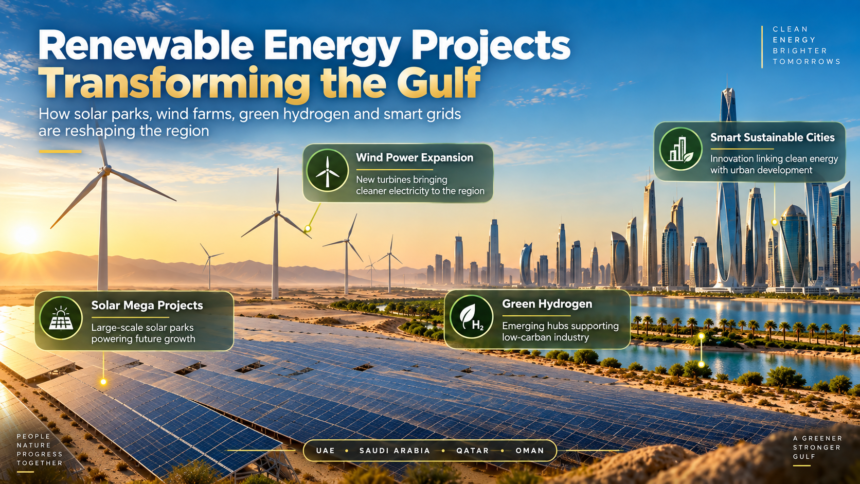
Renewable Energy Projects Transforming the Gulf are bringing enormous solar farms, wind turbines, battery-storage facilities, pumped hydro and green hydrogen plants to the UAE, Saudi Arabia, Qatar, Bahrain, Oman and Kuwait.
The scale has changed dramatically. Dubai’s Mohammed bin Rashid Al Maktoum Solar Park has reached 3,860MW of production capacity and is now targeted to exceed 8,000MW by 2030. Abu Dhabi is building a 5.2GW solar project paired with 19GWh of battery storage, designed to deliver up to 1GW of renewable electricity continuously around the clock. Saudi Arabia is combining utility-scale solar and wind with the giant NEOM green hydrogen project.
Qatar has moved from one major 800MW solar plant to a portfolio that includes new projects in Mesaieed, Ras Laffan and Dukhan. Oman brought 1GW of new solar capacity online through Manah I and Manah II in 2025 and is now expanding wind development. Bahrain has begun moving towards larger utility-scale solar projects, while Kuwait is again tendering gigawatt-scale renewable capacity.
The Gulf is therefore not abandoning hydrocarbons overnight. Instead, it is building a much broader energy system in which renewable power increasingly supports electricity demand, industrial growth, desalination, green hydrogen and long-term economic diversification.
Why Renewable Energy Is Growing Across the Gulf
At first glance, building massive solar farms in countries known for oil and gas might appear contradictory. In practice, the economics can make considerable sense.
The GCC has some of the world’s strongest solar resources, large areas of relatively open land and rapidly growing electricity demand. Air conditioning, desalination, industrial development, population growth and expanding cities all require significant power.
Using solar and wind for part of that demand can reduce the amount of natural gas or other fuel consumed in domestic electricity generation.
Renewables also support national climate and economic strategies. Dubai is working towards clean-energy goals under its 2050 strategies, Bahrain has committed to carbon neutrality by 2060, Oman is targeting a larger renewable contribution to electricity generation, and Saudi Arabia has placed renewable development within Vision 2030.
The result is an energy transition shaped as much by economic competitiveness and energy security as by climate policy.
Renewable Energy Projects Transforming the Gulf at a Glance
| Project | Country | Technology | Approximate Capacity |
|---|---|---|---|
| Mohammed bin Rashid Solar Park | UAE | Solar PV and CSP | 3,860MW operational, over 8,000MW targeted by 2030 |
| Al Dhafra Solar PV | UAE | Solar PV | 2GW |
| Abu Dhabi 24/7 Project | UAE | Solar plus batteries | 5.2GW solar, 19GWh storage |
| Hatta | UAE | Pumped hydro storage | 250MW, 1,500MWh |
| Sudair Solar | Saudi Arabia | Solar PV | 1.5GW |
| Dumat Al Jandal | Saudi Arabia | Wind | Around 400MW |
| NEOM Green Hydrogen | Saudi Arabia | Solar, wind and hydrogen | Up to 4GW renewable input |
| Al Kharsaah | Qatar | Solar PV | 800MW |
| Mesaieed and Ras Laffan | Qatar | Solar PV | 875MW combined |
| Dukhan | Qatar | Solar PV | 2GW under construction |
| Manah I and II | Oman | Solar PV | 1GW combined |
| Dhofar II | Oman | Wind | 125MW |
| First large Bahrain solar project | Bahrain | Solar PV | Around 150MW planned |
| Al Dur Solar | Bahrain | Solar PV | 100MW |
| Dibdibah and Shagaya expansion | Kuwait | Solar renewable projects | Multiple projects exceeding 1GW |
These projects are at different stages. Some are fully operational, while others are under construction, procurement or development.
Mohammed bin Rashid Al Maktoum Solar Park in Dubai
Dubai’s flagship renewable-energy project has become one of the defining solar developments in the region.
The Mohammed bin Rashid Al Maktoum Solar Park was launched in 2012. DEWA now says its production capacity has reached 3,860MW, with the target increased from the original 5,000MW to more than 8,000MW by 2030.
The scale is only part of the story.
Different phases use photovoltaic solar and concentrated solar power. The fourth phase includes 950MW of combined PV and CSP capacity and features a 263-metre-class solar tower and large thermal-energy storage capability.
The park is also moving increasingly towards storage.
DEWA’s seventh phase is planned to include around 2,000MW of photovoltaic capacity and 1,400MW of battery storage, with development scheduled across the second half of the decade.
This matters because the next challenge for Gulf solar is not simply producing large amounts of electricity at noon. It is storing enough energy to support the grid after sunset and during changing demand.
Al Dhafra Solar PV Project in Abu Dhabi
The Al Dhafra Solar PV plant demonstrates how dramatically utility-scale solar has expanded in the UAE.
Located around 35 kilometres from Abu Dhabi city, the project became fully operational in 2023 with a capacity of 2GW.
Masdar says the development uses almost four million bifacial solar panels and can generate enough electricity for approximately 200,000 UAE homes while avoiding around 2.4 million tonnes of carbon emissions each year.
Bifacial panels can capture sunlight on both sides rather than only the front, helping increase output from the intense desert solar resource.
Al Dhafra also shows another important characteristic of Gulf renewable energy: enormous projects are increasingly being delivered through partnerships between government-linked utilities, international developers and private capital.
That investment model is allowing capacity to scale far faster than small government-funded demonstration projects could achieve alone.
Abu Dhabi’s 24-Hour Solar and Battery Project
Solar power has one obvious limitation: the sun disappears at night.
Abu Dhabi is attempting to address that problem on an unprecedented scale.
Masdar and Emirates Water and Electricity Company are developing a project combining 5.2GW of solar photovoltaic capacity with a 19GWh battery energy storage system. The facility is designed to deliver up to 1GW of continuous renewable baseload power.
The project broke ground in October 2025 and reached financial close in July 2026, with the overall investment valued at about US$6.1 billion.
This may prove more significant than simply building another enormous solar farm.
If solar electricity can be stored economically at this scale and released according to grid demand, renewable generation becomes much easier to integrate into electricity systems traditionally built around controllable gas-fired power plants.
The Gulf’s renewable-energy competition may therefore increasingly become a storage competition as well.
Hatta Pumped-Storage Hydroelectric Plant
Battery storage is not the only option.
Dubai has also built the Gulf region’s first pumped-storage hydroelectric plant in Hatta.
The facility has a generation capacity of 250MW and can store up to 1,500MWh of energy. Water is pumped from the existing Hatta Dam to an upper reservoir when surplus electricity is available. When electricity is needed, the water flows back downhill through turbines.
The system can respond to electricity demand within around 90 seconds and has an expected operating life of up to 80 years.
Pumped hydro is common in mountainous parts of the world but much harder to build across the generally flat desert geography of the Gulf.
Hatta demonstrates how specific landscapes can provide storage opportunities that complement batteries.
Sudair and Saudi Arabia’s Expanding Solar Programme
Saudi Arabia has moved from individual renewable demonstration projects towards an increasingly large national portfolio.
The Sudair Solar project, with a capacity of approximately 1.5GW, is among the most significant projects in that expansion.
Saudi Vision 2030 material also identifies other major developments including Sakaka at roughly 300MW, Jeddah at 300MW, Rabigh at around 300MW and Dumat Al Jandal wind at approximately 400MW.
By 2025, Saudi Arabia’s Vision 2030 reporting described a rapidly expanding renewable portfolio covering solar, wind, hydrogen and storage.
The key change is scale.
Saudi Arabia has one of the largest electricity systems in the GCC. Meeting a meaningful share of its demand with renewables therefore requires projects measured in gigawatts rather than tens of megawatts.
The Kingdom’s desert geography provides substantial solar potential, while selected regions also offer suitable wind resources.
Dumat Al Jandal and the Rise of Gulf Wind Power
Solar receives most of the attention in Gulf renewable energy, but wind is becoming increasingly important.
Saudi Arabia’s Dumat Al Jandal wind farm has capacity of around 400MW and became one of the region’s landmark utility-scale wind developments.
Wind has an important advantage when combined with solar.
Solar generation is strongest during daylight hours. Wind production follows different patterns and can sometimes continue after sunset, helping diversify the electricity supply.
The UAE has also demonstrated that modern turbine technology can produce power economically from lower wind speeds. Masdar’s UAE Wind Program has approximately 103.5MW of capacity across several locations and is expected to supply the equivalent electricity use of more than 23,000 homes annually.
Oman is now preparing several additional wind developments as well, suggesting wind will become a larger part of the GCC renewable mix during the remainder of the decade.
NEOM Green Hydrogen Project
Saudi Arabia’s most ambitious renewable-energy project may not ultimately sell electricity at all.
The NEOM Green Hydrogen Project is being developed in Oxagon by NEOM Green Hydrogen Company, a joint venture between NEOM, ACWA Power and Air Products.
The plant is designed to integrate up to 4GW of solar and wind power to produce as much as 600 tonnes of green hydrogen per day. That hydrogen is intended primarily for export in the form of green ammonia.
NEOM has said the project could avoid up to five million tonnes of carbon emissions annually once fully operational.
Green hydrogen is produced by using renewable electricity to split water into hydrogen and oxygen through electrolysis.
Its attraction is that renewable electricity can then be converted into a fuel or industrial feedstock that can potentially be exported, stored or used in sectors where direct electrification is difficult.
This could allow Gulf countries to remain major energy exporters even as the global energy mix changes.
Qatar’s Al Kharsaah Solar Power Plant
Qatar entered utility-scale solar later than some neighbouring states but has expanded quickly.
The Al Kharsaah Solar PV plant began operating in 2022 with capacity of 800MW.
QatarEnergy says the facility can supply around 10 percent of Qatar’s peak electricity demand, making it a substantial contributor rather than a symbolic renewable project.
The project was particularly important because it established the foundation for much larger solar development.
Qatar has very high solar exposure and significant electricity demand, particularly because of cooling and industrial activity. The success of Al Kharsaah made further expansion a logical next step.
Qatar’s New Solar Expansion at Mesaieed, Ras Laffan and Dukhan
Qatar’s solar portfolio has grown rapidly beyond Al Kharsaah.
QatarEnergy’s November 2025 investor material states that the 417MW Mesaieed solar plant and 458MW Ras Laffan solar plant entered operation in 2025. Together they added 875MW of additional capacity.
The next step is considerably larger.
A 2,000MW Dukhan solar plant is under construction. QatarEnergy’s sustainability reporting says the project is intended to help raise Qatar’s photovoltaic capacity to around 4,000MW by 2030.
This expansion is particularly notable because Qatar remains one of the world’s leading LNG producers.
Its renewable programme therefore demonstrates how Gulf energy strategies can pursue both hydrocarbon exports and domestic renewable generation at the same time.
Oman’s Manah I and Manah II Solar Plants
Oman reached an important milestone in 2025 when Manah I and Manah II became operational.
Each project has a capacity of 500MW, creating a combined 1GW solar cluster in Ad Dakhiliyah.
Nama Power and Water Procurement lists commercial operation dates of March 1, 2025 for Manah I and May 1, 2025 for Manah II.
The two sites use more than two million bifacial solar panels across approximately 14.5 million square metres, according to Nama Group reporting.
Together, Manah I and II represent one of Oman’s largest renewable-energy steps so far.
They join the 500MW Ibri II solar project and the existing Dhofar wind farm, creating a more diversified renewable portfolio rather than relying on one flagship installation.
Oman Is Expanding Wind Power
Oman has some of the GCC’s strongest opportunities for wind generation, particularly in southern and coastal areas.
Nama PWP’s current project portfolio includes wind developments planned or under procurement at Dhofar, Duqm, Sadah, Mahout and Jalan Bani Bu Ali.
The Dhofar II Wind Power Project provides a clear example.
A 20-year power purchase agreement was signed in November 2025 for the 125MW development. Nama PWP estimates the project could supply electricity equivalent to around 18,000 homes and avoid roughly 158,000 tonnes of carbon dioxide emissions annually.
Oman’s renewable strategy is therefore increasingly balanced between solar and wind.
That mix can improve grid performance because wind generation does not follow exactly the same daily pattern as solar electricity.
Green Hydrogen Could Transform Oman’s Energy Economy
Oman is also positioning renewable electricity as the foundation of a future green hydrogen industry.
The concept is economically significant because Oman has extensive land, strong renewable resources, existing industrial experience and ports with access to international markets.
Instead of using all renewable power directly in the grid, very large solar and wind developments could supply electrolyser facilities producing hydrogen for industrial use or export.
That strategy could support sectors such as green ammonia, steel, shipping fuels and heavy industry.
The challenge will be cost.
Green hydrogen projects require enormous amounts of renewable electricity, water treatment, electrolysers, storage infrastructure and export facilities. The commercial market is still developing.
However, if global demand grows as expected, Oman could become one of the Gulf states best positioned to turn renewable resources into a new export industry.
Bahrain Is Scaling Up Solar Power
Bahrain has less available land than Saudi Arabia, Oman or the UAE, so its renewable-energy strategy naturally looks different.
Distributed solar on buildings and facilities already plays an important role.
Bahrain’s Electricity and Water Authority says hundreds of distributed renewable-energy projects have been completed or are in progress under its net-metering and net-billing system.
Utility-scale solar is now expanding as well.
In 2025, EWA launched plans for what it described as Bahrain’s first solar electricity plant developed with the private sector, with planned capacity of approximately 150MW. The project near Bilaj Al Jazayer is expected to supply electricity equivalent to around 6,300 homes and avoid more than 100,000 tonnes of emissions annually.
Separately, EWA lists an Al Dur Solar PV project with planned capacity of 100MW and around 135,000 solar panels.
For Bahrain, rooftop systems and carefully selected utility-scale sites are likely to develop together.
Kuwait Is Reviving Large-Scale Renewable Energy Development
Kuwait has enormous solar potential but its large-scale renewable rollout has progressed more slowly than several neighbouring GCC states.
That is beginning to change.
In November 2025, Kuwait’s Ministry of Electricity, Water and Renewable Energy announced bidding for a 500MW zone connected with the Dibdibah electricity-generation and Shagaya renewable-energy programme. The ministry said another zone with around 1,100MW had already been tendered earlier in the year.
Government reporting has also described the broader Shagaya renewable-energy vision as reaching around 3,000MW.
If delivered, these projects would represent a major acceleration.
Kuwait’s challenge is not a lack of sunlight. The more important issues are procurement, grid development, project execution and turning long-term renewable targets into operating capacity.
The latest tenders suggest that process is moving forward again.
Why Battery Storage Is Becoming Essential
The first phase of the Gulf renewable transition focused heavily on producing cheap solar electricity.
The next phase will increasingly focus on when that electricity is available.
Solar output can be enormous during the middle of the day, but Gulf electricity demand remains high into the evening because air conditioning continues after sunset.
Storage helps shift electricity from periods of strong generation to periods of stronger demand.
Abu Dhabi’s 19GWh battery project represents the most dramatic example, while Dubai’s seventh solar-park phase is also being designed with large battery capacity. Hatta adds pumped hydro to the mix.
By 2030, storage may be just as important to Gulf renewable-energy strategies as solar panels themselves.
How Renewable Energy Could Change Gulf Economies
Renewable energy is not only an environmental programme.
It can support several economic objectives at once.
Lower domestic fuel consumption: Using solar electricity can reduce the amount of valuable natural gas or other fuels needed for power generation.
New industries: Green hydrogen, battery technology, renewable engineering and clean manufacturing can create industries that barely existed in the Gulf two decades ago.
Private investment: Independent power producer models allow governments to attract international capital into infrastructure.
Technology development: Large-scale projects create demand for engineering, digital grid management, forecasting and storage expertise.
Future exports: Hydrogen and green ammonia could allow Gulf states to export renewable-derived energy alongside traditional hydrocarbons.
The transition could therefore broaden the meaning of an “energy economy” rather than simply replacing one fuel with another.
Challenges Facing Renewable Energy Across the GCC
The region still faces major technical and economic challenges.
Dust and extreme heat can reduce solar-panel performance and increase maintenance requirements. Large projects also require significant transmission infrastructure.
Solar and wind are variable, which makes storage and grid management increasingly important as renewable penetration rises.
Land availability varies significantly. Saudi Arabia and Oman have vast areas suitable for large projects, while Bahrain has much tighter geographic constraints.
Green hydrogen faces another difficulty: electricity from renewable sources may be inexpensive, but producing, storing, converting and transporting hydrogen still involves substantial cost.
There are also environmental questions. Desert land is not empty land. Large infrastructure developments can affect habitats and ecosystems if planning is poor.
Successful renewable-energy expansion therefore requires more than simply building record-breaking projects. Grid resilience, environmental assessment, storage and long-term economics matter just as much.
What Gulf Renewable Energy Could Look Like by 2030
By the end of the decade, renewable energy is likely to be much more visible in the GCC electricity mix.
Dubai now expects the Mohammed bin Rashid Solar Park alone to exceed 8GW by 2030.
Qatar is targeting around 4GW of solar PV capacity, supported by Al Kharsaah, Mesaieed, Ras Laffan and the giant Dukhan project.
Saudi Arabia’s renewable programme is expanding through a broad portfolio of solar, wind, hydrogen and battery projects, while the NEOM project could demonstrate whether green hydrogen can operate at global export scale.
Oman is adding solar and several new wind developments and has identified a national objective of generating around 30 percent of electricity from renewable sources.
Bahrain’s new solar projects and distributed-generation programme are expanding the role of renewables despite its limited land area, while Kuwait’s latest Shagaya and Dibdibah procurements could finally bring much larger renewable capacity into its electricity system.
The biggest difference from the early 2020s may be that renewable power will no longer feel experimental.
It will increasingly function as normal infrastructure.
Final Thoughts on Renewable Energy Projects Transforming the Gulf
Renewable Energy Projects Transforming the Gulf show how quickly the region’s energy landscape is broadening.
The UAE is combining some of the world’s largest solar farms with batteries, concentrated solar power and pumped hydro. Dubai’s solar park is now targeted to exceed 8GW by 2030, while Abu Dhabi’s 5.2GW solar and 19GWh battery project is attempting to provide renewable electricity continuously rather than only when the sun is shining.
Saudi Arabia is developing solar and wind on a national scale while using renewable electricity to build an entirely new hydrogen industry through NEOM.
Qatar has moved from the 800MW Al Kharsaah project to operating solar facilities at Mesaieed and Ras Laffan, with a much larger 2GW Dukhan project now forming the next stage of expansion.
Oman brought 1GW of Manah solar capacity into operation in 2025 and is preparing additional wind projects, giving the country one of the GCC’s most diversified renewable pipelines.
Bahrain is combining distributed rooftop solar with its first major utility-scale developments, while Kuwait is tendering new capacity through the Dibdibah and Shagaya programmes.
Oil and gas will remain important to Gulf economies for years. What is changing is the assumption that they must remain the region’s only major energy advantage.
The same Gulf countries that built global hydrocarbon industries are now using abundant sunlight, selected wind resources, investment capital and large infrastructure programmes to compete in the next generation of energy.
The transformation will take time, but the projects already operating and under construction show that renewable energy is no longer a side project for the GCC. It is becoming part of the region’s long-term economic and energy infrastructure.
Do follow us on Instagram
Read More – Smart City Technology Across the GCC: 15 Powerful Innovations