

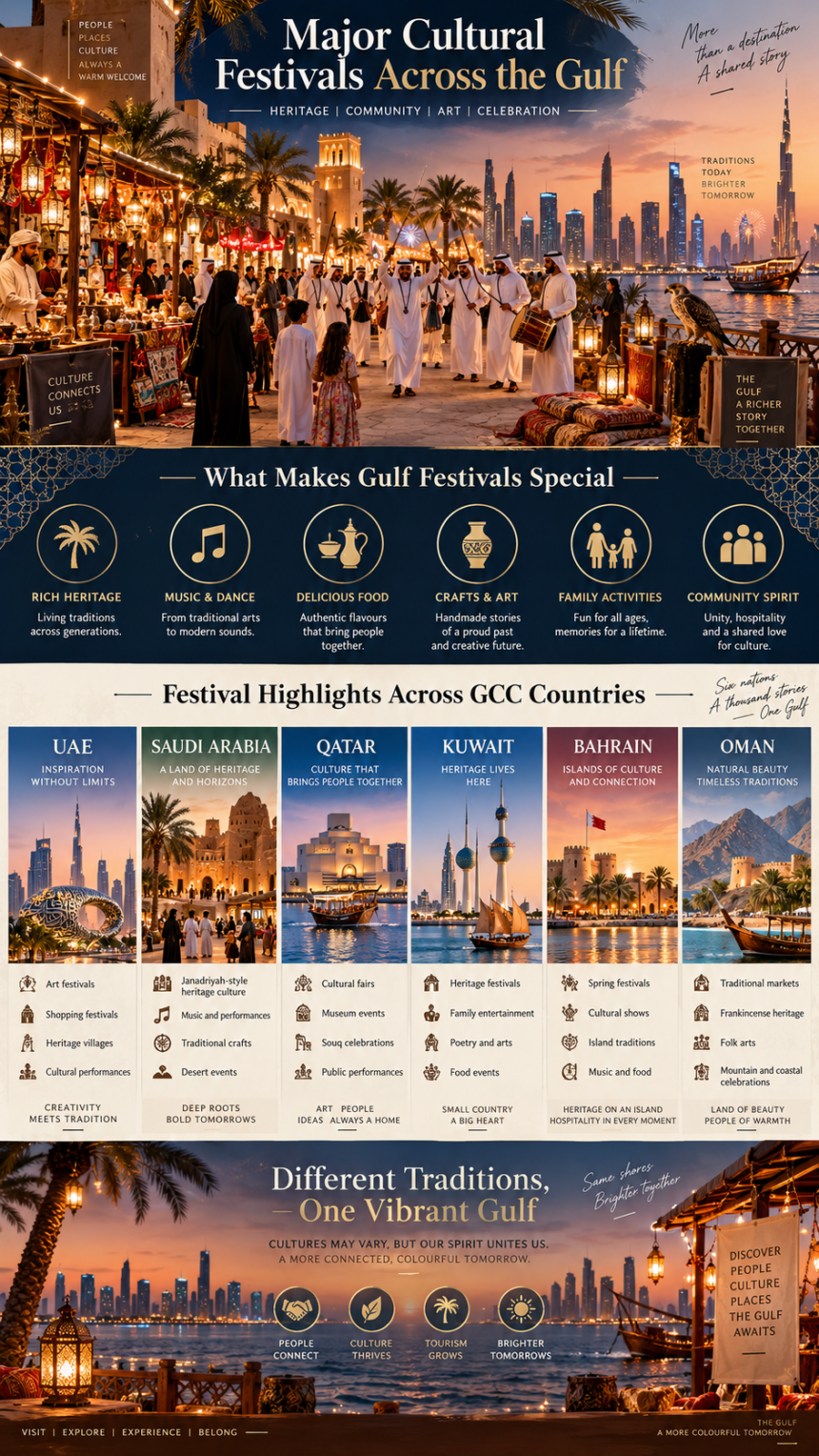
Major Cultural Festivals Across the Gulf
The Gulf’s cultural calendar offers much more than concerts and modern entertainment. Across the UAE, Saudi Arabia, Qatar, Bahrain, Oman and Kuwait, festivals continue to celebrate traditional crafts, maritime history, poetry, visual art, music, architecture, food and ways of life that existed long before the region’s modern skylines appeared.
- Why Cultural Festivals Matter Across the Gulf
- Major Cultural Festivals Across the Gulf at a Glance
- Sheikh Zayed Festival in Abu Dhabi
- Sharjah Heritage Days in the UAE
- Abu Dhabi Festival
- Winter at Tantora in AlUla
- AlUla Arts Festival
- Katara Traditional Dhow Festival in Qatar
- Senyar Festival and Qatar’s Pearl Diving Heritage
- Spring of Culture in Bahrain
- Muscat Nights in Oman
- Khareef Dhofar Cultural Events
- Qurain Cultural Festival in Kuwait
- Hala February Festival in Kuwait
- Best Gulf Festivals for Traditional Heritage
- Best Festivals for Art and Music
- Best Cultural Festivals for Families
- When Is Gulf Festival Season?
- How to Plan a Trip Around a Gulf Cultural Festival
- What Visitors Should Know Before Attending
- Final Thoughts on Major Cultural Festivals Across the Gulf
The Major Cultural Festivals Across the Gulf range from huge heritage celebrations in Abu Dhabi to contemporary art in AlUla, traditional dhow festivals in Qatar, months of performances across Bahrain and cultural seasons in Muscat and Kuwait.
Some festivals focus strongly on preserving national traditions. Others intentionally bring Gulf culture into conversation with artists and performers from around the world. The 2025-26 Sheikh Zayed Festival, for example, combined Emirati heritage with international cultural pavilions representing more than 22 countries, while Bahrain’s Spring of Culture has spent two decades connecting local heritage sites with international music, theatre, art and intellectual programmes.
For travellers, these events can offer a deeper understanding of the region than visiting landmarks alone. Instead of simply looking at a historic building or museum object, visitors can see crafts being produced, hear traditional music performed live and understand how heritage remains part of contemporary Gulf life.
Why Cultural Festivals Matter Across the Gulf
Rapid development has transformed GCC cities during the past few decades, making cultural festivals increasingly important as places where older traditions remain visible.
Traditional crafts are a good example. Skills such as weaving, pottery, boat building, perfume making and other forms of handicraft can easily become something visitors see only behind museum glass. Heritage festivals allow artisans to demonstrate those skills directly and often invite younger generations to participate through workshops.
Sharjah Heritage Days demonstrates the scale these programmes can reach. Its 23rd edition in 2026 brought together artisans, folk groups, cultural discussions and heritage activities across multiple cities in the emirate. The main programme included traditional crafts, folk chants, performances, workshops and educational activities intended to preserve both Emirati and international heritage.
Cultural festivals also give countries opportunities to tell their stories differently. Some use archaeological landscapes, some revive maritime history and others turn modern theatres and museums into spaces for cultural exchange.
Major Cultural Festivals Across the Gulf at a Glance
| Festival | Country | Main Focus | Typical Setting |
|---|---|---|---|
| Sheikh Zayed Festival | UAE | Emirati and international heritage | Al Wathba, Abu Dhabi |
| Sharjah Heritage Days | UAE | Crafts, folklore and heritage | Historic Sharjah |
| Abu Dhabi Festival | UAE | Music, art and performance | Cultural venues across Abu Dhabi |
| Winter at Tantora | Saudi Arabia | AlUla heritage, art and music | AlUla |
| AlUla Arts Festival | Saudi Arabia | Contemporary art and heritage | AlUla |
| Katara Traditional Dhow Festival | Qatar | Maritime heritage | Katara Cultural Village |
| Senyar Festival | Qatar | Pearl diving and seafaring | Qatar |
| Spring of Culture | Bahrain | Art, music, theatre and heritage | Venues across Bahrain |
| Muscat Nights | Oman | Omani culture, food and folk arts | Muscat |
| Khareef Dhofar Events | Oman | Dhofari culture and seasonal traditions | Salalah and Dhofar |
| Qurain Cultural Festival | Kuwait | Art, literature, music and theatre | Kuwait City |
| Hala February | Kuwait | Culture, music and national celebrations | Across Kuwait |
Festival calendars change from year to year, so travellers should confirm current dates before booking flights specifically around an event.
Sheikh Zayed Festival in Abu Dhabi
The Sheikh Zayed Festival at Al Wathba is one of the UAE’s largest cultural and heritage events.
Its central Heritage Village introduces visitors to Emirati customs, traditional markets, handicrafts and folklore while also explaining the role of the late Sheikh Zayed bin Sultan Al Nahyan in the development of the UAE.
The scale extends far beyond one heritage village. The 2025-26 season ran from November 1 through March 22 and incorporated international pavilions, family activities, performances, musical events, markets, fireworks and drone shows. More than 22 countries were represented through international cultural pavilions.
This international dimension makes the festival particularly interesting. Visitors can spend part of the evening learning about Emirati life before moving between pavilions presenting clothing, performances, food and crafts from other cultures.
For first-time Gulf visitors, Sheikh Zayed Festival provides a relatively accessible introduction to traditional culture without requiring a journey deep into a remote heritage region.
Best for: Families, first-time UAE visitors, crafts, traditional performances and evening festival atmosphere.
Sharjah Heritage Days in the UAE
For travellers who want to concentrate specifically on heritage rather than large-scale entertainment, Sharjah Heritage Days is one of the strongest options in the UAE.
The 2026 edition ran from February 4 to 15 and spread across several areas of Sharjah. Traditional performances, live craft demonstrations, heritage markets, educational programmes and discussions about cultural preservation formed the core of the programme.
The main Heritage Area in the Heart of Sharjah provides an especially suitable backdrop because visitors experience the festival among restored historic architecture rather than inside a modern exhibition hall.
The 2026 programme included more than 265 artisans presenting dozens of traditional crafts as well as Arab and international folk groups, educational activities, competitions and workshops. Performances featured Emirati forms including Al Ayala, Al Harbiya, Al Razha and Al Nadba.
Another interesting feature is cultural exchange. International guest countries present their own folklore, crafts and traditions alongside Emirati heritage, showing that preservation does not need to mean cultural isolation.
Best for: Emirati heritage, traditional crafts, folklore, photography and cultural learning.
Abu Dhabi Festival
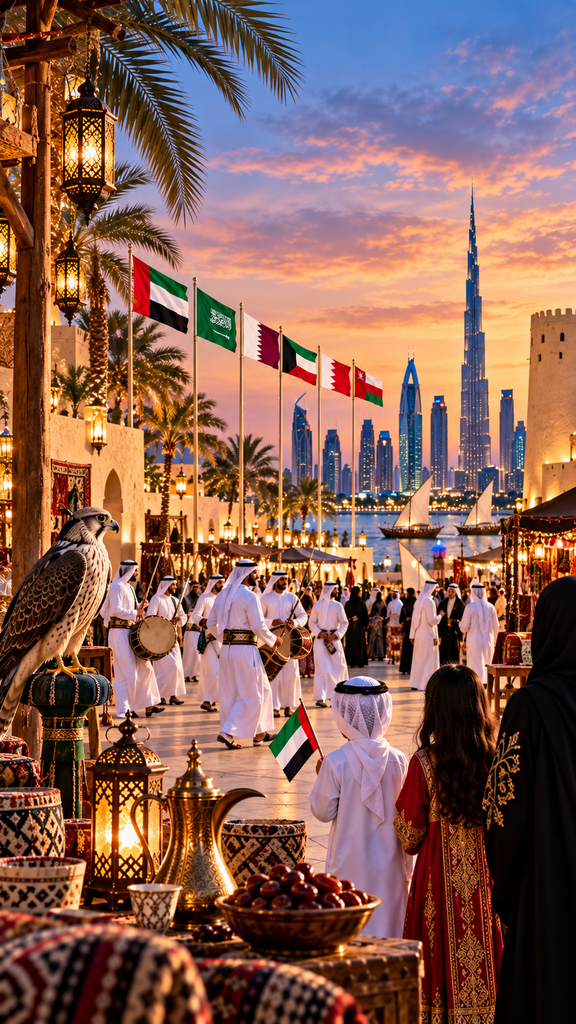
Not every important Gulf cultural festival is primarily about traditional heritage.
The Abu Dhabi Festival focuses on music, visual arts, major performances and international artistic exchange. Since its establishment in 2004, it has brought local and international artists together through concerts, premieres, exhibitions and specially commissioned works.
The 2026 programme was scheduled across major cultural venues including Louvre Abu Dhabi, Zayed National Museum, Emirates Palace Mandarin Oriental and Etihad Arena.
This gives the festival a different identity from an outdoor heritage village. A visitor might attend orchestral music one evening and explore an exhibition or contemporary artistic collaboration on another day.
The festival also reflects a wider shift in Gulf cultural tourism. Cities are no longer presenting culture only through historic objects. They are investing in contemporary art, global collaborations and new creative production.
Best for: Music, performance, contemporary arts and travellers interested in international cultural exchange.
Winter at Tantora in AlUla
Few Gulf cultural festivals have a setting as dramatic as Winter at Tantora.
The festival takes place in AlUla, where sandstone cliffs, archaeological landscapes and the oasis become part of the experience itself.
The festival takes its name from the traditional Tantora sundial in AlUla Old Town. Visit Saudi describes it as a winter celebration combining music, immersive installations, culinary experiences and artistic programming designed to connect visitors with AlUla’s heritage and landscape.
For the 2025-26 season, Winter at Tantora was scheduled from December 18 to February 13 as part of AlUla’s wider winter calendar.
The appeal is not simply the event programme. AlUla itself contains the archaeological legacy of ancient kingdoms, including Dadan, Lihyan and the Nabataeans.
That means cultural programming is layered onto a landscape where history is already physically present.
Best for: Couples, heritage travellers, music, premium cultural tourism and winter trips.
AlUla Arts Festival
The AlUla Arts Festival takes a more contemporary approach.
Visit Saudi describes it as an annual celebration combining heritage and contemporary art through immersive exhibitions, performances and artist residencies. The aim is not simply to place modern artworks in the desert but to create interaction between creativity, AlUla’s landscape and the region’s history.
Recent programmes have used historic districts and dramatic natural locations as spaces for installations and artistic experiences.
This makes AlUla particularly interesting for travellers who often separate “heritage tourism” from “contemporary art.” Here, the two increasingly overlap.
A traveller can spend one part of a trip exploring ancient tombs and another viewing installations by living artists responding to landscape, memory and identity.
Best for: Contemporary art, design, photography and culturally focused Saudi itineraries.
Katara Traditional Dhow Festival in Qatar
Before oil and gas transformed the Gulf economy, the sea shaped everyday life.
Fishing, pearl diving and dhow building connected Gulf communities with India, East Africa and other trading regions. Qatar’s Katara Traditional Dhow Festival keeps that maritime heritage visible.
Visit Qatar describes the annual festival as a family-friendly celebration that includes activities and competitions connected to pearl diving, rowing and traditional maritime skills.
The 15th edition was listed in Qatar’s 2025 events calendar from November 27 to December 18 at Katara Cultural Village.
Traditional wooden boats become the centre of the event rather than decorative background objects. Visitors can learn how maritime work shaped Gulf economies and social life before modern ports, airports and highways.
The setting at Katara also makes it easy to combine the festival with galleries, performances, restaurants and other cultural attractions.
Best for: Maritime heritage, families, photography and travellers interested in pre-oil Gulf history.
Senyar Festival and Qatar’s Pearl Diving Heritage
Qatar’s maritime culture is also preserved through the Senyar Festival.
Visit Qatar identifies Senyar as one of the events helping younger generations connect with the country’s seafaring past, with pearl-diving competitions forming part of the programme.
Pearling is particularly significant because it once supported communities throughout the Gulf. Divers endured difficult conditions in search of natural pearls that entered international trading networks.
Modern Qatar commemorates that history in museums, monuments and festivals. Visitors can also explore the country’s pearling story through Al Zubarah, abandoned coastal settlements and museum collections.
Senyar demonstrates an important characteristic of cultural festivals: they can transform history from something visitors read about into an activity that younger generations can watch and participate in.
Best for: Maritime history, traditional competitions and travellers interested in Gulf pearling culture.
Spring of Culture in Bahrain
Bahrain’s Spring of Culture is one of the Gulf’s longest-running multi-arts festival seasons.
Launched in 2006, it connects performances, exhibitions, music, theatre, lectures, workshops and heritage programmes at venues across the country. Bahrain’s Culture Authority describes it as a celebration combining Bahrain’s historical landmarks and cultural heritage with artists and creative work from around the world.
Its twentieth edition in 2026 was designed as a three-month programme running across cultural institutions, galleries and historic spaces. Activities included music, theatre, art exhibitions, poetry, lectures and educational programmes.
One of the festival’s strengths is location. Events are not restricted to one festival ground. Venues have included Bahrain National Museum, Bahrain National Theatre, the Pearling Path, traditional craft centres, galleries and archaeological sites.
This turns the island itself into part of the festival experience.
Best for: Arts lovers, heritage sites, music, theatre and longer cultural trips.
Muscat Nights in Oman
Muscat Nights combines entertainment with distinctly Omani cultural programming.
Experience Oman describes it as a festival showcasing culture, cuisine, folk arts and traditional crafts across several locations in the capital.
The 2026 programme included events across Qurum Natural Park, Al Amerat Park, Seeb Beach, Quriyat and other Muscat locations. Cultural exhibitions used both traditional content and newer technologies to introduce visitors to Omani history, important personalities and national identity.
The combination makes Muscat Nights particularly useful for families. Parents can experience crafts, exhibitions or traditional performances while children participate in interactive educational and entertainment activities.
Food is another important element. Like many Gulf festivals, Muscat Nights uses cuisine as part of cultural storytelling rather than treating food simply as a side attraction.
Best for: Families, Omani culture, food, folk arts and winter travel.
Khareef Dhofar Cultural Events
The Khareef season in Dhofar is primarily a natural phenomenon, but it has also developed into one of Oman’s largest seasonal tourism and cultural periods.
From roughly late June into September, monsoon influence transforms the landscape around Salalah. Green hills, mist and seasonal waterfalls attract visitors from across the GCC.
Cultural programming has become an important part of that season. Oman’s official news agency described the 2025 Khareef Dhofar programme as including diverse tourism and cultural experiences across multiple sites, beginning with the start of the astronomical Khareef season on June 21.
Traditional performances, concerts, markets, frankincense culture and family activities give visitors reasons to explore beyond the natural scenery.
The festival atmosphere also exposes travellers to a part of Oman with a distinct regional identity. Dhofari traditions, clothing, food and music are different enough from northern Oman to make the journey feel culturally distinctive.
Best for: Summer travel, regional culture, families and combining festivals with nature.
Qurain Cultural Festival in Kuwait
The Qurain Cultural Festival is one of Kuwait’s most important long-running arts events.
The festival began in 1994 and has developed into a broad programme covering music, literature, theatre, visual arts, cinema, lectures and cultural discussion.
The 31st edition opened in January 2026 at Sheikh Jaber Al-Ahmad Cultural Centre. Kuwait’s Minister of Information and Culture described the annual event as a meeting point between creativity, knowledge and cultural identity.
Earlier editions have included concerts, art galleries, theatrical and folklore performances, film screenings, workshops, seminars and intellectual discussions.
This makes Qurain particularly interesting for travellers who prefer a serious cultural programme over a conventional entertainment festival.
Kuwait has a long regional history of publishing, theatre and intellectual life, and Qurain reflects that cultural identity.
Best for: Literature, theatre, music, visual arts and Arab cultural dialogue.
Hala February Festival in Kuwait
February in Kuwait brings a very different type of cultural season through Hala February.
The annual festival coincides with Kuwait’s National and Liberation Day period and combines national celebration with shopping, music, cultural programmes and entertainment.
Kuwait Government Online describes the festival as lasting approximately one month and including concerts, poetry evenings, cultural seminars, visual arts exhibitions, sports activities and major shopping promotions.
The timing adds another advantage. February is one of Kuwait’s most comfortable weather months, making outdoor public events much easier than during the country’s extreme summer.
Hala February is therefore broader than a pure heritage festival. It combines patriotism, arts, retail and public entertainment, showing how contemporary Gulf festival culture can bring several types of activity together.
Best for: First-time Kuwait visitors, national celebrations, music, families and winter travel.
Best Gulf Festivals for Traditional Heritage
Travellers looking primarily for traditional culture should prioritise festivals where crafts, folklore and historic ways of life form the central programme.
Sheikh Zayed Festival is one of the strongest choices because its Heritage Village includes markets, crafts and folk performances while international pavilions add wider cultural diversity.
Sharjah Heritage Days goes even deeper into preservation, with craftspeople, heritage workshops, traditional chants, folk groups and historic architecture creating an environment strongly focused on tangible and intangible heritage.
In Qatar, the Katara Traditional Dhow Festival and Senyar Festival are particularly valuable for understanding maritime culture and pearling.
For Omani heritage, Muscat Nights provides a convenient introduction, while Dhofar’s seasonal events reveal a more regionally specific culture.
Best Festivals for Art and Music
Travellers more interested in contemporary creativity should look towards Abu Dhabi Festival, AlUla Arts Festival, Spring of Culture and Qurain Cultural Festival.
Each approaches culture differently.
Abu Dhabi Festival emphasises major international performances and artistic exchange. AlUla combines contemporary creativity with archaeological and natural landscapes. Bahrain spreads its programme across museums, heritage properties and performance spaces, while Kuwait brings literature, theatre and visual art into the same cultural calendar.
These festivals are particularly useful for travellers who want to understand the Gulf as a contemporary creative region rather than seeing culture only through its past.
Best Cultural Festivals for Families
Heritage festivals are often surprisingly easy to experience with children.
Sheikh Zayed Festival combines cultural education with family entertainment, while Sharjah Heritage Days incorporates workshops, traditional games and activities designed to introduce younger visitors to heritage.
Muscat Nights has also placed strong emphasis on interactive cultural content for younger visitors. Its 2026 exhibitions used educational games, digital storytelling and virtual reality to present Omani history and cultural figures.
The Katara Dhow Festival is another good option because boats, competitions and hands-on maritime activities can make history easier for children to understand than a conventional museum visit.
Families should still check event hours carefully. Many Gulf festivals become busiest after sunset and can continue late into the evening.
When Is Gulf Festival Season?
The strongest general festival period is roughly October through March.
There is a practical reason for this. Cooler Gulf weather allows outdoor heritage villages, concerts, markets and performances to operate for long periods without peak summer heat.
| Period | Cultural Festival Opportunities |
|---|---|
| January to February | AlUla arts, Sharjah heritage, Kuwait cultural season |
| March to May | Bahrain Spring of Culture and arts programming |
| June to September | Khareef Dhofar cultural season |
| October to December | Abu Dhabi, AlUla, Qatar and winter festival programmes |
The major exception is southern Oman, where the Khareef season creates a summer cultural calendar precisely because the weather around Salalah becomes cooler and greener.
Festival dates are not permanently fixed, so visitors should confirm each year’s programme before booking.
How to Plan a Trip Around a Gulf Cultural Festival
A festival should usually become part of the trip rather than the entire itinerary.
For example, travellers attending Sharjah Heritage Days can combine the festival with Heart of Sharjah museums and traditional markets. A Winter at Tantora trip can add Hegra, AlUla Old Town and Elephant Rock, while visitors attending the Katara Dhow Festival can explore Doha’s National Museum, Souq Waqif and Corniche.
Spring of Culture works particularly well with a wider Bahrain heritage itinerary because events occur at cultural locations throughout the island.
Similarly, Muscat Nights can sit inside an Oman trip that also includes Nizwa, the mountains and coastal areas.
This approach provides context. Seeing a traditional performance becomes more meaningful when visitors have already learned something about the history behind it.
What Visitors Should Know Before Attending
Festival hours, ticket requirements and venues can change substantially between editions.
Some heritage festivals offer free entry while concerts or specialised events within the same programme require paid tickets. Large events may also use multiple venues, making transport planning important.
Dress requirements are generally relaxed at family festivals, but modest clothing remains a useful choice at traditional heritage venues. Comfortable shoes are particularly important because festival grounds can require several hours of walking.
Photography is usually welcomed in public festival spaces, but visitors should ask permission before taking close portraits of craftspeople, performers or families.
Finally, do not judge the entire event by the headline concert or fireworks display. The most interesting experiences are often smaller: watching a craftsman work, listening to a traditional storyteller, tasting a regional dish or seeing younger generations learning a skill that their grandparents once practised daily.
Final Thoughts on Major Cultural Festivals Across the Gulf
The Major Cultural Festivals Across the Gulf demonstrate that the GCC’s cultural identity is not limited to museums or historic architecture.
The UAE offers some of the region’s broadest heritage programming through Sheikh Zayed Festival and Sharjah Heritage Days, while Abu Dhabi Festival connects the capital with international art and performance.
In Saudi Arabia, Winter at Tantora and AlUla Arts Festival use one of the region’s most extraordinary archaeological landscapes as a stage for heritage, music and contemporary creativity.
Qatar keeps its maritime history alive through the Katara Traditional Dhow Festival and Senyar Festival, where pearl diving and traditional seafaring remain central themes.
Bahrain’s Spring of Culture turns museums, galleries, theatres and heritage sites across the island into one connected cultural season, while Oman combines winter arts and heritage through Muscat Nights with the unique summer cultural atmosphere of Khareef Dhofar.
In Kuwait, Qurain Cultural Festival continues a tradition of literature, theatre, music and intellectual exchange, while Hala February connects culture with the country’s wider national celebration season.
What connects these festivals is not one particular dance, dish or style of music. It is the effort to keep culture active rather than frozen in the past.
Across the Gulf, festivals are increasingly becoming places where an old craft can sit beside digital art, a traditional dhow beside a modern skyline and a folk performance beside an international concert. That combination makes the region’s festival calendar one of the most accessible ways for visitors to understand how Gulf societies preserve their heritage while continuing to change.
Do follow us on Instagram
Read More – National Day Celebrations Across GCC Countries: 12 Amazing Traditions