

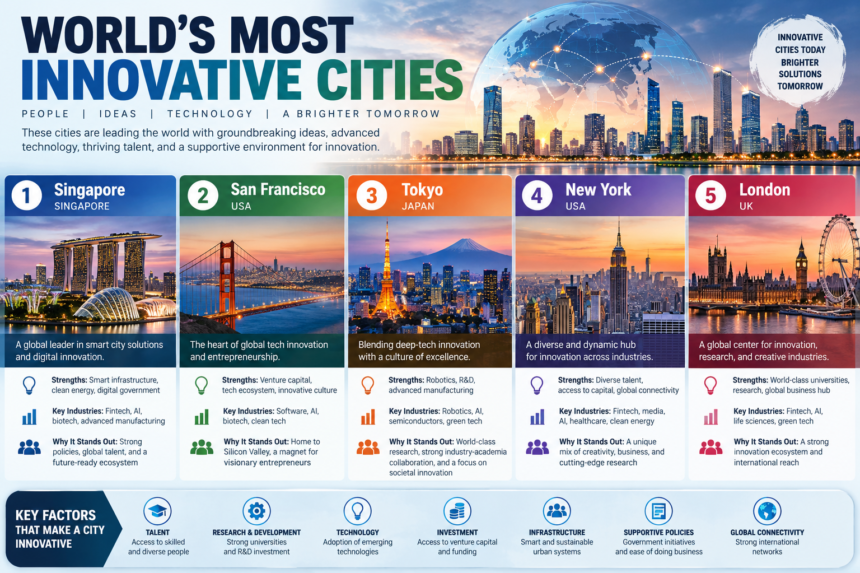
World’s Most Innovative Cities: 10 Global Hubs Shaping the Future
The world’s most innovative cities are no longer defined simply by how many technology companies have offices there. The strongest innovation hubs combine universities, scientific research, patents, venture capital, start-ups, advanced industries and the ability to turn new ideas into products that reach millions of people.
- World’s Most Innovative Cities: The Global Top 10
- Shenzhen, Tokyo and Seoul Show Why Asia Has Become an Innovation Powerhouse
- San Francisco, New York and Boston Represent Three Different American Innovation Models
- London Remains Europe’s Major Global Innovation Gateway
- Singapore, Bengaluru and Other Rising Innovation Cities Are Reshaping the Map
- What Separates an Innovative City From a Simply Wealthy City?
- How AI, Climate Tech and Advanced Manufacturing Could Change the Rankings
- What the World’s Most Innovative Cities Can Teach Other Urban Centres
- The Future of the World’s Most Innovative Cities
That makes innovation a much broader story than Silicon Valley alone. Asia now contains several of the world’s largest science and technology clusters, while cities such as New York and London remain powerful because of their access to capital, talent and global businesses. At the same time, places including Bengaluru, Singapore, Berlin and Riyadh are becoming increasingly important parts of the global innovation map.
One of the most useful ways to compare these hubs comes from the World Intellectual Property Organization’s Global Innovation Index. Its latest available innovation-cluster ranking combines patent activity, scientific publications and venture-capital deals, allowing researchers to measure both the creation of new knowledge and its ability to become commercially significant.
The 2025 methodology produced an important change at the top. Shenzhen-Hong Kong-Guangzhou became the world’s leading innovation cluster, followed by Tokyo-Yokohama and San Jose-San Francisco. Beijing and Seoul completed the top five, while New York, London and Los Angeles also entered the global top 10.
Technically, WIPO ranks innovation clusters rather than municipal city boundaries. That distinction matters because real innovation ecosystems frequently spread across several neighbouring cities, universities and industrial districts. For readability, this guide refers to them as cities and urban innovation hubs while keeping the official cluster names where appropriate.
From artificial intelligence and semiconductors to biotechnology, robotics and venture capital, these are some of the global urban centres shaping what the next decade could look like.
World’s Most Innovative Cities: The Global Top 10
The latest WIPO ranking provides a useful starting point because it does not measure innovation through reputation alone. It examines where patents are being created, where scientific research is being published and where venture capital is actively backing companies.
Those indicators reveal several different kinds of innovation city. Some are dominated by manufacturing and engineering, others by university research, and some by start-ups and investment.
Global Innovation Leaders
| Rank | Innovation Cluster | Country / Region | Key Strength |
|---|---|---|---|
| 1 | Shenzhen-Hong Kong-Guangzhou | China / Hong Kong | Hardware, telecoms, manufacturing, VC |
| 2 | Tokyo-Yokohama | Japan | Engineering, electronics, patents |
| 3 | San Jose-San Francisco | United States | AI, software, venture capital |
| 4 | Beijing | China | Research, AI, scientific output |
| 5 | Seoul | South Korea | Semiconductors, electronics, R&D |
| 6 | Shanghai-Suzhou | China | Research, manufacturing, biotech |
| 7 | New York City | United States | Fintech, AI, media, venture capital |
| 8 | London | United Kingdom | Fintech, AI, investment, universities |
| 9 | Boston-Cambridge | United States | Biotechnology, medicine, research |
| 10 | Los Angeles | United States | Entertainment technology, aerospace, VC |
WIPO says the world’s top 100 innovation clusters together account for roughly 70 per cent of global international patent filings and venture-capital deal activity, as well as around half of scientific publications. The top 10 alone generate about 40 per cent of PCT patent filings and roughly 35 per cent of VC activity.
That concentration shows why cities matter so much to innovation.
Countries can create national policies, but breakthroughs usually emerge from smaller geographic ecosystems where researchers, companies, investors and skilled workers interact repeatedly.
What actually makes an innovation city?
The strongest hubs usually combine several advantages rather than relying on one famous company.
These include:
- Leading universities and research institutes
- Access to venture capital
- Large pools of technical talent
- Strong patent activity
- Advanced manufacturing
- International connectivity
- Government support for research
- Start-up ecosystems
- Established global companies
- Infrastructure capable of supporting rapid growth
A city does not necessarily need to dominate every category. London and New York are particularly strong in venture capital, while Asian clusters dominate many measures of scientific publication and manufacturing-led innovation.
Shenzhen, Tokyo and Seoul Show Why Asia Has Become an Innovation Powerhouse
Perhaps the most striking feature of the global ranking is the strength of East Asia.
Four of the top six clusters are located in China, Japan or South Korea, demonstrating how research, manufacturing capacity and technology companies increasingly reinforce one another across the region.
1. Shenzhen-Hong Kong-Guangzhou
The Greater Bay Area cluster now occupies the top position in WIPO’s ranking.
This is not one conventional city ecosystem. It links Shenzhen’s enormous technology and manufacturing base with Hong Kong’s finance and research capabilities and Guangzhou’s universities, manufacturing and wider industrial economy.
WIPO says its rise to first place was helped particularly by the inclusion of venture-capital deal data in the 2025 methodology.
Shenzhen is especially important because it has developed one of the world’s strongest hardware ecosystems. Electronics companies can move from design to prototype and manufacturing unusually quickly because suppliers, engineers and factories are concentrated across the region.
Huawei is listed by WIPO as the leading patent applicant within the cluster, while Sun Yat-sen University is among its major research organisations.
The wider ecosystem is increasingly important in areas such as:
- Telecommunications
- Electric vehicles
- Batteries
- Drones
- Consumer electronics
- Artificial intelligence
- Advanced manufacturing
- Fintech
This combination of research, capital and physical production helps explain why the cluster has become difficult for other cities to replicate.
2. Tokyo-Yokohama
Tokyo-Yokohama remains one of the world’s largest research and patenting centres and placed second globally.
Japan’s capital region benefits from decades of expertise in automobiles, electronics, robotics, precision manufacturing and industrial engineering. Mitsubishi Electric is identified by WIPO as the leading patent applicant in the cluster, while the University of Tokyo is one of its leading research institutions.
Tokyo’s innovation model differs considerably from Silicon Valley’s.
Rather than being dominated by young software start-ups, much of its strength comes from large industrial companies conducting deep research over long periods.
That makes the region particularly strong in technologies that require significant engineering expertise, including:
- Robotics
- Automotive systems
- Electronics
- Advanced materials
- Industrial automation
- Medical technology
WIPO notes that Tokyo-Yokohama and Shenzhen-Hong Kong-Guangzhou together account for nearly one in every five international PCT patent applications globally, highlighting the extraordinary scale of innovation activity concentrated in these two Asian regions.
3. Seoul
Seoul ranks fifth globally and remains one of the world’s strongest centres for semiconductor and electronics research.
South Korea has developed an innovation model built around major technology groups, advanced manufacturing, strong university research and exceptionally high levels of R&D.
The city and wider metropolitan area benefit from industries including:
- Semiconductors
- Smartphones
- Displays
- Batteries
- Artificial intelligence
- Automotive technology
- Biotechnology
WIPO also identifies Seoul among the Asian clusters producing particularly high levels of scientific publications.
That balance between research and commercial manufacturing is one of Seoul’s strongest advantages.
Many cities can create promising start-ups, but fewer can combine software, component production, electronics manufacturing and global distribution within the same national ecosystem.
San Francisco, New York and Boston Represent Three Different American Innovation Models
The United States remains extraordinarily influential in global innovation, but its leading cities succeed for very different reasons.
WIPO’s 2025 ranking contains 22 American clusters in the global top 100, only slightly behind China’s 24.
The country’s strength is particularly visible in venture capital.
San Jose-San Francisco
The Bay Area remains the most recognisable technology ecosystem in the world and ranks third in WIPO’s overall cluster ranking.
Its influence stretches from San Jose and Silicon Valley to San Francisco, bringing together start-ups, giant technology companies, universities and one of the deepest pools of venture capital anywhere.
The area’s current strengths include:
- Artificial intelligence
- Cloud computing
- Semiconductors
- Software
- Autonomous systems
- Biotechnology
- Fintech
- Climate technology
Stanford University plays a central role in the region’s ecosystem, while companies such as Google have become major generators of intellectual property and technical research.
The Bay Area also performs exceptionally well after adjusting for population. WIPO places San Jose-San Francisco at the top of its innovation-intensity measure, which looks at patents, publications and VC deals relative to population.
That helps explain why Silicon Valley continues to produce disproportionately large numbers of global technology companies despite decades of predictions that another city will replace it.
New York City
New York represents a very different innovation model.
It ranks seventh globally in the latest cluster ranking and performs especially strongly in venture-capital activity. WIPO identifies New York alongside San Jose-San Francisco as one of the strongest VC centres in the world.
New York’s advantage comes from combining technology with existing industries.
Instead of operating as a technology economy separate from everything else, innovation is integrated into:
- Finance
- Advertising
- Media
- Fashion
- Healthcare
- Real estate
- Cybersecurity
- Artificial intelligence
That creates opportunities for companies building technology for industries that already have enormous customer bases inside the city.
A fintech founder, for example, can be surrounded by banks, investors and potential employees without leaving Manhattan.
The same logic applies to media technology, health tech and advertising platforms.
Boston-Cambridge
Boston-Cambridge ranks ninth overall but becomes even more impressive when innovation is measured relative to population.
WIPO identifies it among the world’s leading innovation-intensive clusters.
Its defining advantage is the concentration of universities, hospitals and research institutions.
Harvard, MIT and a network of medical institutions provide the scientific foundation for companies working in:
- Biotechnology
- Pharmaceuticals
- Medical devices
- Artificial intelligence
- Robotics
- Quantum technologies
- Life sciences
This gives Boston a research-driven ecosystem that feels very different from New York’s finance-heavy environment or Silicon Valley’s software and venture-capital culture.
Three American Innovation Models Compared
| Hub | Core Advantage | Typical Innovation Model |
|---|---|---|
| San Francisco Bay Area | Start-ups + venture capital | Build and scale technology companies |
| New York | Finance + industries + VC | Apply technology across major sectors |
| Boston-Cambridge | Universities + medicine | Turn scientific research into companies |
The lesson is that there is no single formula for becoming an innovative city.
London Remains Europe’s Major Global Innovation Gateway
London ranks eighth globally in WIPO’s latest cluster ranking and is the highest-ranked European urban ecosystem in the global top 10.
Its biggest strength is the combination of technology, finance, research institutions and international talent.
WIPO specifically highlights London’s performance in venture-capital deals, ranking it among the world’s leading VC centres.
This supports strong ecosystems in:
- Fintech
- Artificial intelligence
- Cybersecurity
- Climate technology
- Creative technology
- Health tech
- Financial services
London also benefits from its proximity to other major British research centres.
Cambridge and Oxford appear separately in WIPO’s global ranking and perform exceptionally well in innovation intensity, demonstrating the broader strength of the UK’s university ecosystem.
The result is a corridor in which scientific ideas, start-ups, investment and global financial markets can interact relatively closely.
Europe’s strength extends beyond London
Several European cities rank strongly even if they do not make the overall top 10.
WIPO places:
- Munich at 27th
- Berlin at 30th
- Copenhagen at 42nd
- Dublin at 71st
- Oslo at 85th
- Manchester at 94th
Germany alone has seven clusters in the global top 100.
When measured by innovation intensity rather than total scale, Helsinki and Eindhoven are among Europe’s standout performers, while Stockholm and Copenhagen also rank strongly.
This highlights an important difference between Europe and some Asian markets.
European cities may be smaller in absolute output but can still generate high levels of research and patents relative to their population.
Singapore, Bengaluru and Other Rising Innovation Cities Are Reshaping the Map
The top 10 does not tell the whole story.
Several cities outside the leading group are developing rapidly and could become even more influential over the next decade.
Singapore
Singapore’s innovation cluster reached 16th place in WIPO’s 2025 ranking, entering the global top 20.
The city-state combines a highly developed financial system with research universities, government technology programmes and strong infrastructure.
Its innovation economy includes:
- Semiconductors
- Biotechnology
- Fintech
- Artificial intelligence
- Smart-city technology
- Advanced manufacturing
- Logistics
Singapore is particularly interesting because it has built a global innovation ecosystem despite having a relatively small population and domestic market.
Companies use it as a regional base for Southeast Asia, while government investment helps connect research institutions with multinational corporations.
Bengaluru
India’s technology capital has risen sharply in global innovation rankings.
WIPO places Bengaluru at 21st globally, making it India’s leading innovation cluster. Delhi ranks 26th, Mumbai 46th and Chennai 84th.
Bengaluru’s historic strength in software and IT services is now expanding into:
- Artificial intelligence
- Fintech
- Software-as-a-service
- Deep technology
- Space technology
- Electric mobility
- Biotechnology
Its scale is supported by a huge engineering workforce and a growing venture-capital market.
India’s rising position illustrates how innovation is becoming more geographically distributed instead of remaining concentrated entirely in North America, Western Europe and East Asia.
Berlin
Berlin ranks 30th in WIPO’s current cluster table and remains one of Europe’s best-known start-up centres.
The German capital’s appeal comes partly from its international workforce and broad start-up culture.
It has developed strong communities around fintech, climate technology, software and mobility while remaining connected to Germany’s wider industrial economy.
Riyadh
The Gulf is also beginning to appear more prominently on the global innovation map.
WIPO places Riyadh at 101st, immediately outside the top 100 innovation clusters.
That position is worth watching because Saudi Arabia is investing heavily in digital infrastructure, artificial intelligence, smart cities, research and technology companies as part of its broader economic diversification agenda.
Riyadh therefore represents a different category from established hubs such as Tokyo or San Francisco. It is an emerging ecosystem attempting to accelerate innovation through investment, institutions and economic transformation.
Emerging Innovation Hubs to Watch
| City / Cluster | WIPO Position | Why It Matters |
|---|---|---|
| Singapore | 16 | Regional finance, biotech and technology hub |
| Bengaluru | 21 | India’s biggest technology ecosystem |
| Berlin | 30 | European start-up and software centre |
| Toronto | 33 | AI research and technology |
| Sydney | 36 | Australia’s leading cluster |
| Austin | 37 | Semiconductors and US tech expansion |
| Copenhagen | 42 | Life sciences and green technology |
| Mumbai | 46 | Finance, start-ups and technology |
| São Paulo | 49 | Latin America’s major innovation centre |
| Riyadh | 101 | Rapidly developing Gulf technology hub |
WIPO also added Mexico City, Dublin and Oslo to its top 100 for the first time under the updated methodology.
What Separates an Innovative City From a Simply Wealthy City?
Money certainly helps innovation, but wealth alone does not create a technology ecosystem.
The most successful innovation cities build connections between institutions that might otherwise operate separately.
A university can conduct excellent research, but innovation grows faster when its researchers can access entrepreneurs, investors, engineering talent and companies capable of commercialising that research.
The same applies to venture capital.
A city with plenty of investment money but little technical talent may produce financial activity without becoming a major scientific centre.
The strongest innovation loop looks something like this:
- Universities generate research.
- Skilled workers develop ideas.
- Start-ups test those ideas.
- Investors provide capital.
- Larger companies provide customers or acquisitions.
- Successful founders reinvest into new businesses.
- Talent is attracted from elsewhere.
- The ecosystem becomes increasingly self-reinforcing.
This helps explain why established hubs can remain powerful for decades.
Once thousands of engineers, investors and founders are concentrated in one place, new businesses have access to a network that would take years to recreate somewhere else.
Patents matter, but they are not everything
WIPO’s updated methodology is useful precisely because it no longer relies solely on scientific papers and patents.
The addition of venture-capital deal activity recognises that innovation also requires commercialisation.
That change helped New York and London enter the overall top 10 because both cities have exceptionally strong investment ecosystems.
It also explains why different rankings can produce different results.
A smart-city index might reward digital public services, while a start-up ranking focuses on founders and investment. WIPO’s cluster ranking focuses primarily on research, patents and venture capital.
There is therefore no single universally accepted definition of the world’s “most innovative city.”
How AI, Climate Tech and Advanced Manufacturing Could Change the Rankings
The innovation map is unlikely to remain static.
Artificial intelligence is already reshaping competition between cities because AI development requires several resources at once: computing infrastructure, specialised talent, research institutions and enormous investment.
Cities that can combine those resources may gain influence quickly.
Artificial intelligence
San Francisco remains unusually strong because of its concentration of AI companies, venture capital and engineering talent.
Beijing, Shenzhen, Seoul, London, Singapore and Bengaluru are also building major AI ecosystems.
The next stage of competition will increasingly involve more than software. It will include data centres, semiconductor supply chains, robotics and AI infrastructure.
Semiconductors
Semiconductors are becoming strategically important for almost every advanced economy.
Seoul, Tokyo and several Chinese clusters already benefit from deep electronics and manufacturing capabilities.
American cities such as Austin are also expanding their semiconductor presence.
Biotechnology
Boston-Cambridge demonstrates how scientific research can create an entire urban industry.
Cities with leading medical schools, laboratories and pharmaceutical investment may gain importance as biotechnology, personalised medicine and computational biology expand.
Climate technology
The global energy transition creates another opportunity.
Copenhagen, Stockholm, Singapore, London and several German cities have strong positions in climate-related technologies, while Chinese cities dominate significant parts of the electric-vehicle, battery and renewable-energy supply chains.
Advanced manufacturing
Manufacturing is becoming increasingly technological rather than simply labour intensive.
Robotics, AI, digital twins and additive manufacturing are bringing software and industrial production closer together.
That gives cities such as Shenzhen, Seoul, Tokyo, Munich and Shanghai an important advantage.
Technologies Likely to Shape Future Innovation Cities
| Technology | Cities Particularly Well Positioned |
|---|---|
| Artificial intelligence | San Francisco, Beijing, London, New York |
| Semiconductors | Seoul, Tokyo, Austin, Chinese tech clusters |
| Biotechnology | Boston, San Francisco, Singapore |
| Robotics | Tokyo, Seoul, Shenzhen |
| Fintech | London, New York, Singapore |
| Climate tech | Copenhagen, London, Stockholm, Shenzhen |
| Advanced manufacturing | Shenzhen, Tokyo, Munich, Shanghai |
| Space technology | Los Angeles, Bengaluru |
The strongest future cities may therefore be those capable of operating across several of these technologies rather than specialising in only one.
What the World’s Most Innovative Cities Can Teach Other Urban Centres
Innovation cannot simply be copied by building a technology park and calling it an innovation district.
Successful ecosystems usually develop through long-term relationships between education, research, business and investment.
The cities at the top of the global rankings provide several useful lessons.
Universities matter
Tokyo, Boston, San Francisco, Beijing and London all benefit from major research universities.
These institutions do more than educate workers. They produce intellectual property, scientific discoveries and companies.
Talent must be able to move between organisations
Innovation accelerates when engineers can leave a large company, join a start-up, start their own business and later become investors.
Cities with flexible labour markets and international talent networks often benefit from this movement.
Capital needs somewhere productive to go
Venture capital can accelerate innovation only when promising companies already exist.
That is why strong ecosystems require both investors and technical talent.
Infrastructure remains essential
Digital connectivity, public transport, reliable energy and airports may sound less exciting than AI start-ups, but they make innovative cities functional.
Researchers and companies still need to move people, goods and data efficiently.
Manufacturing can be a competitive advantage
Shenzhen demonstrates why the ability to build physical products can be just as important as software.
Ideas become more valuable when designers can prototype and manufacture them rapidly.
Five Building Blocks of an Innovation City
| Building Block | Why It Matters |
|---|---|
| Talent | Creates ideas and companies |
| Research | Produces new knowledge |
| Capital | Funds experimentation and scaling |
| Industry | Converts ideas into products |
| Infrastructure | Connects the ecosystem |
Cities that develop all five have a better chance of creating self-sustaining innovation rather than relying on temporary investment programmes.
The Future of the World’s Most Innovative Cities
The global innovation race is becoming increasingly competitive and increasingly international.
The United States remains exceptionally strong in venture capital and company creation. China has built enormous research, patenting and manufacturing clusters. Japan and South Korea continue to dominate important engineering and technology sectors, while London remains Europe’s leading global-scale innovation centre.
At the same time, the second tier is becoming more interesting.
Singapore has entered the global top 20. Bengaluru and Delhi are climbing. Berlin, Toronto, Austin and Copenhagen remain important regional hubs, while cities including Riyadh are attempting to build technology ecosystems at extraordinary speed.
The WIPO data also demonstrates that innovation is highly concentrated. The top 100 clusters account for around 70 per cent of international patent filings and venture-capital deal activity.
That concentration creates both opportunity and competition.
Cities want innovative companies because they create high-value jobs, attract skilled workers and generate industries that can grow for decades.
But building such an ecosystem requires patience.
Shenzhen’s manufacturing network, Tokyo’s engineering base, Boston’s universities and Silicon Valley’s venture-capital culture were not created overnight.
Each developed through years of accumulated knowledge, investment and relationships.
That may be the most important lesson from the world’s most innovative cities.
Innovation is not simply about installing smart traffic lights or attracting one famous technology company. It is about creating an environment where researchers, entrepreneurs, manufacturers, investors and universities can repeatedly turn new ideas into real-world products.
Today, Shenzhen-Hong Kong-Guangzhou leads the world’s largest innovation clusters, followed by Tokyo-Yokohama and San Jose-San Francisco. Tomorrow’s rankings could look different as artificial intelligence, biotechnology, clean energy and advanced manufacturing reshape the global economy.
What is unlikely to change is the role cities play.
The world’s biggest innovations may start inside laboratories and start-ups, but they grow fastest when an entire urban ecosystem is ready to support them.
Do follow us on Instagram
Read More – The Best Happy Hour Deals in Dubai Worth Checking Out This Week