


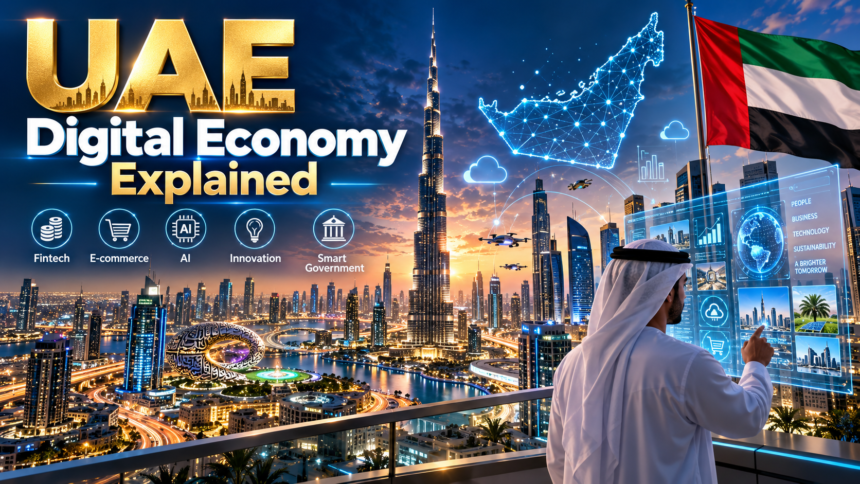
UAE Digital Economy: How Is the UAE Building a Future-Ready Digital Market?
What is the UAE digital economy, and why has it become an important part of the country’s economic development? The United Arab Emirates has been investing in digital infrastructure, technology, innovation, artificial intelligence, fintech, e-commerce, cloud computing, smart services, and digital skills to support the growth of a modern, technology-driven economy.
- What Is the UAE Digital Economy?
- Why Is the UAE Digital Economy Important?
- How Is the UAE Government Supporting the Digital Economy?
- How Does Artificial Intelligence Contribute to the UAE Digital Economy?
- How Is Fintech Transforming the UAE Digital Economy?
- Why Is E-Commerce Important to the UAE Digital Economy?
- How Is Digital Banking Supporting Economic Growth?
- How Are Smart Cities Contributing to the UAE Digital Economy?
- What Role Does Cloud Computing Play in the UAE Digital Economy?
- How Is Cybersecurity Protecting the UAE Digital Economy?
- How Is Blockchain Supporting the UAE Digital Economy?
- How Is Data Driving the UAE Digital Economy?
- How Can Small Businesses Benefit From the UAE Digital Economy?
- What Opportunities Does the UAE Digital Economy Create for Startups?
- What Digital Skills Are Needed for the UAE Digital Economy?
- How Is Digital Transformation Changing Traditional UAE Industries?
- What Challenges Could Slow the Growth of the UAE Digital Economy?
- How Can Businesses Prepare for the Future of the UAE Digital Economy?
- What Is the Future of the UAE Digital Economy?
- Why Is the UAE Digital Economy Important for Businesses and Professionals?
The UAE digital economy is not limited to technology companies. It includes the growing use of digital technologies across banking, retail, real estate, tourism, logistics, healthcare, education, government services, media, manufacturing, and other industries. Businesses are increasingly using digital platforms to reach customers, automate processes, analyze data, and develop new products and services.
With a strong technology ecosystem and an internationally connected business environment, the UAE is positioning digital activity as an important contributor to future economic growth. But what exactly does this digital economy include, and how is it changing opportunities for businesses and professionals?
What Is the UAE Digital Economy?
What does the term UAE digital economy actually mean? The digital economy refers to economic activity that depends on digital technologies, data, online platforms, digital infrastructure, and technology-enabled business models. In the UAE, this includes both businesses that are built around technology and traditional companies that increasingly depend on digital tools.
For example, an online retailer is part of the digital economy because its business model depends on digital platforms. A traditional retailer that introduces online ordering, digital payments, customer analytics, and automated inventory management is also participating in the digital economy.
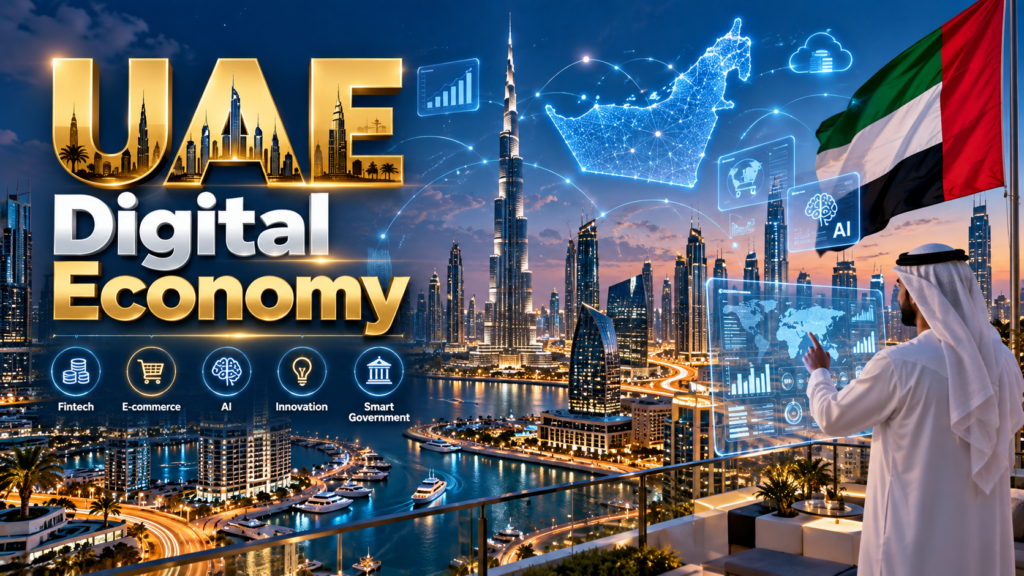
The UAE digital economy can therefore include:
- Artificial intelligence and machine learning
- Fintech and digital banking
- E-commerce and online marketplaces
- Cloud computing
- Cybersecurity
- Data analytics
- Blockchain applications
- Internet of Things (IoT)
- Digital government services
- Smart-city technologies
- Digital marketing
- Software and technology services
- Online education
- Digital healthcare
- Automation and robotics
These technologies are increasingly interconnected, creating new ways for organizations to operate and deliver value.
Why Is the UAE Digital Economy Important?
Why is the digital economy becoming so important to the UAE? Digital technologies can help businesses improve productivity, create new products, reach international customers, and respond more quickly to changing market conditions.
For the government, digital services can simplify interactions between public institutions, residents, businesses, and visitors. For consumers, digital platforms can provide faster access to financial services, shopping, entertainment, education, transportation, and other services.
The digital economy can also support economic diversification. Technology-enabled industries create opportunities beyond traditional sectors and can attract entrepreneurs, investors, skilled professionals, and international companies.
The importance of the UAE digital economy can be seen through several areas:
- Economic diversification
- Technology and innovation
- Business productivity
- Digital entrepreneurship
- International investment
- Smart government
- Job creation
- Digital infrastructure
- E-commerce growth
- Financial technology development
As technology becomes integrated into more industries, the digital economy increasingly overlaps with the wider economy.
How Is the UAE Government Supporting the Digital Economy?
How is the UAE government helping develop the country’s digital economy? Government policies and initiatives have focused on digital infrastructure, smart services, artificial intelligence, innovation, entrepreneurship, and the development of digital capabilities.
Government organizations have increasingly moved services online, reducing the need for physical paperwork and improving access to many administrative services. Digital identity systems, online portals, mobile applications, and electronic transactions are examples of how public services are becoming more technology-enabled.
Government support for the digital economy can involve:
- Digital government platforms
- Smart public services
- AI adoption
- Digital infrastructure
- Innovation programs
- Entrepreneurship support
- Technology-focused economic initiatives
- Digital skills development
- Cybersecurity measures
- Support for emerging technologies
This public-sector transformation can also create opportunities for private companies that provide software, cloud infrastructure, cybersecurity, consulting, data, and other technology services.
How Does Artificial Intelligence Contribute to the UAE Digital Economy?
What role does artificial intelligence play in the UAE digital economy? AI has become one of the most important technologies influencing businesses and government organizations. AI systems can analyze information, identify patterns, automate certain tasks, generate content, support customer service, and assist with decision-making.
Businesses across different sectors can explore AI for practical applications. Financial institutions may use AI for fraud detection and customer support. Retailers can use it to improve recommendations and demand forecasting. Logistics companies can apply data-driven systems to optimize operations.
AI can contribute to the digital economy by helping organizations:
- Automate repetitive work
- Analyze large datasets
- Improve customer experiences
- Personalize services
- Forecast demand
- Detect potential risks
- Optimize operations
- Develop new digital products
The growing use of AI also creates demand for professionals with skills in data science, machine learning, software development, AI governance, cybersecurity, and business strategy.
How Is Fintech Transforming the UAE Digital Economy?
How has financial technology, or fintech, contributed to the UAE digital economy? Fintech combines financial services with technology to create new ways of making payments, managing money, accessing financial products, and conducting transactions.
Digital banking, mobile payments, payment gateways, financial applications, online lending platforms, and other technology-enabled financial services are examples of fintech.
The UAE’s position as a major financial and business center provides a significant environment for fintech development. Startups and established financial institutions can use technology to develop services for consumers and businesses.
Key areas of fintech include:
- Digital payments
- Mobile banking
- Online financial services
- Payment processing
- Financial management applications
- Regtech
- Insurtech
- Digital investment platforms
- Fraud detection
- Financial data analytics
As financial services become increasingly digital, cybersecurity, consumer protection, data privacy, and regulatory compliance remain important considerations.
Why Is E-Commerce Important to the UAE Digital Economy?
How does e-commerce contribute to the UAE digital economy? Online shopping has changed the way consumers discover products, compare prices, place orders, make payments, and receive goods.
UAE businesses can use websites, mobile applications, online marketplaces, and social-commerce channels to reach customers. Digital tools also allow companies to manage inventory, analyze purchasing patterns, personalize marketing, and automate customer communication.
E-commerce can benefit businesses by providing:
- Access to online customers
- 24-hour sales opportunities
- Digital payment options
- Customer behavior insights
- Automated order management
- Online marketing opportunities
- Wider geographic reach
- Personalized shopping experiences
The growth of e-commerce also supports related industries, including logistics, payment processing, warehousing, digital advertising, software development, and customer support.
How Is Digital Banking Supporting Economic Growth?
Why is digital banking an important component of the UAE digital economy? Consumers increasingly expect financial services to be convenient, accessible, and available through digital channels.
Digital banking allows customers to perform many routine activities through websites and mobile applications. Businesses can also benefit from digital financial services that simplify payments, accounting, transactions, and financial management.
Digital banking may include:
- Mobile banking applications
- Online account management
- Electronic payments
- Contactless transactions
- Digital onboarding
- Automated customer support
- Digital financial documentation
The shift toward digital finance can improve convenience while also requiring financial institutions to strengthen authentication, fraud prevention, cybersecurity, and data protection.
How Are Smart Cities Contributing to the UAE Digital Economy?
How do smart cities support the development of the UAE digital economy? Smart-city systems use digital infrastructure, connected devices, sensors, data platforms, and automation to improve urban services.
Dubai and Abu Dhabi have invested in smart technologies across areas such as transportation, government services, infrastructure, and urban management. Smart-city initiatives can create demand for technology companies specializing in IoT, AI, cloud computing, cybersecurity, data analytics, and connected infrastructure.
Smart technologies can be applied to:
- Traffic management
- Smart parking
- Public transportation
- Energy management
- Connected buildings
- Environmental monitoring
- Digital public services
- Infrastructure management
Smart cities therefore represent more than urban technology. They can become platforms for innovation and technology-driven economic activity.
What Role Does Cloud Computing Play in the UAE Digital Economy?
Why is cloud computing important for businesses operating in the UAE? Cloud technology provides access to computing power, storage, databases, applications, and other IT resources through internet-based infrastructure.
Cloud computing can allow businesses to scale technology resources according to their requirements. It can also support remote work, collaboration, application development, data management, and digital service delivery.
Businesses may use cloud services for:
- Data storage
- Business applications
- Website hosting
- Software development
- Backup and recovery
- Artificial intelligence
- Data analytics
- Remote collaboration
- Business continuity
For UAE companies, cloud adoption can support digital growth, but organizations need to evaluate cybersecurity, privacy, compliance, data governance, and service reliability.
How Is Cybersecurity Protecting the UAE Digital Economy?
Why is cybersecurity essential for the UAE digital economy? As businesses and government services move online, the amount of valuable information stored and transferred digitally also increases.
Cyber threats can affect businesses of all sizes. Organizations may face risks from phishing, malware, ransomware, unauthorized access, data breaches, and compromised accounts.
A strong cybersecurity strategy can include:
- Multi-factor authentication
- Access management
- Employee security training
- Data encryption
- Regular software updates
- Security monitoring
- Backup systems
- Incident-response procedures
- Vulnerability assessments
- Third-party security reviews
Cybersecurity is not only an IT concern. It is increasingly a business and economic issue because serious security incidents can disrupt operations, damage customer trust, and create financial and regulatory consequences.
How Is Blockchain Supporting the UAE Digital Economy?
What role can blockchain play in the UAE digital economy? Blockchain is a distributed ledger technology designed to record transactions or information across a network. Its applications can extend beyond cryptocurrencies.
Businesses and government organizations may explore blockchain for document verification, supply chain tracking, financial transactions, and other processes where verifiable digital records are valuable.
Potential applications include:
- Supply chain management
- Digital document verification
- Transaction records
- Asset-related applications
- Identity-related solutions
- Financial technology
- Digital certification
Blockchain is not suitable for every business problem, so organizations need to consider practical requirements such as scalability, security, regulation, cost, and interoperability before implementation.
How Is Data Driving the UAE Digital Economy?
Why is data considered an important asset in the digital economy? Businesses generate and collect information through websites, applications, transactions, customer interactions, connected devices, and internal systems.
When properly managed, data can help companies understand their customers, identify market trends, improve products, monitor performance, and make better decisions.
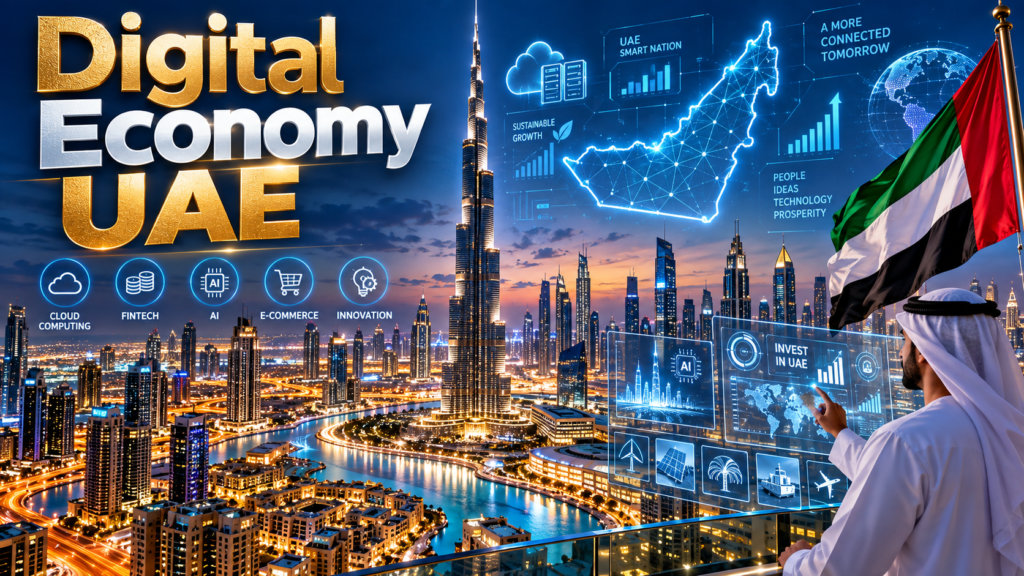
Data-driven businesses can use analytics to answer questions such as:
- Which products are performing best?
- What are customers searching for?
- Which marketing channels generate results?
- Where are operational problems occurring?
- How can inventory be optimized?
- What trends could affect future demand?
However, businesses must also consider data quality, privacy, cybersecurity, governance, and responsible use.
How Can Small Businesses Benefit From the UAE Digital Economy?
Can small and medium-sized businesses participate in the UAE digital economy? Absolutely. Digital transformation does not necessarily require a company to build a sophisticated technology platform from scratch.
A small business can begin with practical tools such as a professional website, online payment system, cloud accounting, customer relationship management software, digital marketing, or e-commerce functionality.
Small businesses can consider:
- Building an online presence to make products and services easier to discover.
- Introducing digital payments to improve transaction convenience.
- Using cloud software to manage business operations.
- Adopting digital marketing to reach targeted audiences.
- Using analytics to understand customers and sales.
- Automating routine tasks to save employee time.
- Strengthening cybersecurity to protect business information.
Starting with clearly defined business needs can help smaller companies avoid unnecessary technology investments.
What Opportunities Does the UAE Digital Economy Create for Startups?
How does the UAE digital economy create opportunities for startups? New technology companies can develop solutions for businesses, consumers, governments, and specialized industries.
Startups can build products around emerging technologies or solve traditional business problems using digital tools. The country’s international business environment can also provide opportunities for companies looking to serve customers across regional and global markets.
Potential startup areas include:
- Fintech
- AI applications
- E-commerce
- Cybersecurity
- Health technology
- Education technology
- Logistics technology
- Property technology
- Cloud services
- Business software
- Digital marketing
- Smart-city solutions
For startups, technology alone is not enough. Understanding customer needs, regulations, competition, funding requirements, and sustainable business models is equally important.
What Digital Skills Are Needed for the UAE Digital Economy?
What skills will become increasingly valuable as the UAE digital economy develops? Businesses need professionals who can work with technology as well as people who understand how to apply technology to practical business challenges.
Technical skills can include:
- Artificial intelligence
- Machine learning
- Data science
- Software development
- Cloud computing
- Cybersecurity
- Database management
- Automation
- IoT
- Digital analytics
At the same time, organizations need non-technical capabilities such as:
- Digital project management
- Business analysis
- Product management
- Digital marketing
- Strategic planning
- Communication
- Problem-solving
- Creativity
- Change management
The future workforce will likely require a combination of technical awareness and strong human skills.
How Is Digital Transformation Changing Traditional UAE Industries?
Is the digital economy limited to technology companies? No. One of its defining characteristics is that digital technology is transforming traditional sectors.
In real estate, digital platforms can help customers search for properties and access information online. In tourism, mobile applications and digital booking platforms have changed how travelers plan experiences. Logistics companies use tracking and data systems to manage deliveries.
Other sectors experiencing digital change can include:
- Construction
- Manufacturing
- Healthcare
- Education
- Tourism
- Real estate
- Logistics
- Retail
- Financial services
- Professional services
This means that companies do not need to identify themselves as “technology companies” to participate in the digital economy.
What Challenges Could Slow the Growth of the UAE Digital Economy?
What challenges could businesses encounter as the digital economy expands? Technology adoption can create significant opportunities, but organizations also need to manage risks and implementation difficulties.
Some common challenges include:
- Shortage of specialized digital talent
- Cybersecurity threats
- Data privacy concerns
- High technology costs
- Integration with older systems
- Employee resistance to change
- Regulatory complexity
- Vendor dependence
- Digital skills gaps
- Difficulty measuring return on investment
Addressing these challenges requires planning, employee education, strong governance, and a focus on measurable business outcomes.
How Can Businesses Prepare for the Future of the UAE Digital Economy?
How can UAE businesses prepare for continued digital economic development? Companies can begin by identifying the areas where technology can provide measurable improvements rather than adopting technology simply because it is new.
A practical digital strategy can involve:
- Assessing current technology systems
- Identifying operational weaknesses
- Setting clear digital objectives
- Training employees
- Improving cybersecurity
- Developing a data strategy
- Evaluating AI opportunities
- Moving appropriate workloads to the cloud
- Improving customer-facing digital channels
- Measuring performance and return on investment
Businesses should also review their digital strategy regularly because technologies, customer expectations, regulations, and market conditions can change.
What Is the Future of the UAE Digital Economy?
What will the future of the UAE digital economy look like? Digital technology is likely to become increasingly integrated into everyday economic activity. AI, automation, cloud computing, connected devices, data analytics, digital finance, and cybersecurity are expected to remain important areas of development.
The next phase may involve greater integration between these technologies. An organization could combine AI with cloud computing, data analytics, automation, and IoT to create an interconnected digital operating environment.
Future opportunities may emerge in:
- AI-powered business solutions
- Advanced fintech
- Smart infrastructure
- Digital healthcare
- Intelligent logistics
- Automated business operations
- Cybersecurity services
- Digital commerce
- Data-driven decision-making
- Emerging technology startups
At the same time, responsible technology use will become increasingly important. Businesses and institutions will need to balance innovation with security, privacy, transparency, governance, and human oversight.
Why Is the UAE Digital Economy Important for Businesses and Professionals?
Why should businesses and professionals pay attention to the UAE digital economy? Because digital technology is no longer limited to specialist IT departments. It increasingly affects marketing, finance, operations, customer service, human resources, logistics, and strategic planning.
For businesses, understanding digital trends can help identify opportunities for improving efficiency and developing new services. For professionals, building digital skills can support career development across a wide range of industries.
The digital economy can create opportunities for people with different backgrounds, including technology specialists, entrepreneurs, marketers, analysts, designers, managers, consultants, and industry professionals who understand how to apply technology effectively.
Conclusion: What Does the UAE Digital Economy Mean for the Future?
What does the UAE digital economy mean for the country’s future? It represents a broad transformation in the way businesses, government institutions, consumers, and professionals create and exchange value. Digital infrastructure, artificial intelligence, fintech, e-commerce, cloud computing, cybersecurity, data analytics, blockchain, and smart technologies are all contributing to this evolving economic environment.
The UAE’s digital economy extends across traditional industries as well as technology-focused businesses. Companies can use digital tools to improve productivity, reach customers, automate operations, and develop new products. Entrepreneurs can explore opportunities in emerging technology sectors, while professionals can develop skills aligned with changing workplace requirements.
However, sustainable digital growth requires more than technology adoption. Businesses need effective strategies, skilled employees, secure systems, responsible data management, and a clear understanding of customer needs.
As digital technologies continue to develop, the UAE digital economy is likely to remain an important part of the country’s broader economic transformation. For businesses and professionals, understanding these changes can help them identify opportunities, prepare for new challenges, and participate more effectively in an increasingly connected digital marketplace.
Do follow Gulf Prime on Instagram
Read More – UAE Digital Government Services