


Understand Your Business Activity Before Choosing a UAE Free Zone
Choosing where to establish a company can be one of the most important decisions an entrepreneur makes in the UAE. With numerous free zones offering different licences, office options, visa packages, industry ecosystems and regulatory frameworks, the cheapest or most popular option is not automatically the right one. The right UAE free zone for your business should match what your company actually does, who your customers are, where you need to operate and how you expect the business to grow.
- Understand Your Business Activity Before Choosing a UAE Free Zone
- Compare Location, Customers and Market Access
- Compare UAE Free Zones by Industry and Business Model
- Calculate the Real Cost of Setting Up and Running the Company
- Check Office, Visa and Staffing Requirements
- Understand Corporate Tax, VAT and Compliance Responsibilities
- Consider Banking, Reputation and Long-Term Growth
- A Practical Checklist for Choosing the Right UAE Free Zone
A freelancer providing digital services will have very different requirements from a company importing physical products, running a warehouse or operating in financial services. Some businesses may prioritise affordable licensing and flexible workspace, while others need access to ports, specialist infrastructure, investors or a particular regulatory environment. Understanding these differences before applying can prevent unnecessary costs and complications later.
The UAE’s free-zone landscape also continues to evolve, particularly around corporate tax and regulatory requirements. A free-zone licence by itself does not automatically mean that every company’s income is taxed at 0%. The Federal Tax Authority explains that a Qualifying Free Zone Person can benefit from a 0% corporate tax rate on Qualifying Income only when the relevant conditions are satisfied.
This guide explains how to compare UAE free zones based on business activity, location, licence requirements, operating costs, office needs, visas, taxation and future expansion so you can make a more informed decision.
Understand Your Business Activity Before Choosing a UAE Free Zone
The first question should not be “Which free zone is cheapest?” It should be “Which free zone allows and supports the activities my company needs to perform?”
Every free zone has its own list of permitted business activities and licence categories. Your chosen activity determines what your company is legally permitted to do, so it is important to describe your business model accurately before applying.
For example, activities may fall into areas such as:
- Professional services
- Consultancy
- E-commerce
- Software and technology
- Marketing and media
- General trading
- Commodity trading
- Manufacturing
- Logistics
- Financial services
- Education
- Healthcare
- Food businesses
- Import and export
- Holding companies
Some free zones support a very broad range of activities, while others have developed specialist ecosystems around particular industries.
DMCC, for example, says its community includes businesses operating across more than 1,000 licensed activities and has more than 26,000 registered companies. ADGM, meanwhile, offers structures and permitted activities spanning areas such as financial services, wealth and asset management, capital markets, digital assets, fintech, professional services, holding companies and technology startups.
Match the licence to what you actually sell
Consider a company that plans to offer management consultancy today but expects to add e-commerce next year. Before choosing a free zone, the founder should check whether both activities can eventually sit under the same licence or company structure.
ADGM notes, for example, that a non-financial commercial licence can contain more than one activity where those activities are complementary and form a logical business proposition. Other authorities may apply their own rules.
This is why simply comparing package prices can be misleading.
A package may look inexpensive but become unsuitable if you later discover that:
- Your intended activity is unavailable.
- An additional licence is required.
- External approvals are needed.
- Multiple activities cannot be combined.
- Your chosen activity requires physical premises.
- Your business model is regulated differently than expected.
Questions to ask before applying
- What exactly will the company sell?
- Will it provide services or physical products?
- Will goods be imported or exported?
- Will customers be inside or outside the UAE?
- Is the activity regulated?
- Will several activities be needed?
- Could the business add new activities later?
Answering these questions first makes comparing free zones much easier.
Compare Location, Customers and Market Access
Location matters even when much of your business is digital.
A consultant working remotely may care more about licence costs and visa eligibility than physical location. A logistics company, however, may need efficient access to major roads, ports, industrial areas or airports.
Businesses should therefore consider where their customers, suppliers, employees and facilities will be located.
Think about your actual operating model
A free-zone location may be particularly important if your business requires:
- Frequent customer meetings
- Warehousing
- Import and export operations
- Manufacturing
- Staff commuting every day
- Physical deliveries
- Retail activity
- Access to airports or ports
- Specialist industry infrastructure
For remote businesses, location may be less significant, although accessibility can still affect employee recruitment, client meetings and office costs.
Dubai versus Abu Dhabi and other emirates
Dubai has a wide range of free zones serving sectors including commodities, technology, media, logistics and professional services.
Abu Dhabi also offers several important business hubs. ADGM positions itself as an international financial centre with a legal framework based on English common law principles. KEZAD provides free-zone solutions that may be particularly relevant for companies considering logistics, industrial operations, warehouses and broader supply-chain infrastructure.
The best emirate therefore depends on the operating needs of the business rather than simply the prestige of the address.
Understand where you intend to sell
Free-zone companies can conduct international business, but entrepreneurs should understand the rules affecting transactions with mainland UAE customers and other jurisdictions.
Do not assume that every free-zone structure provides identical access to every market.
Before selecting a jurisdiction, confirm:
- Whether you will sell mainly internationally.
- Whether mainland UAE clients will be important.
- Whether physical goods will enter the mainland.
- Whether additional registrations or arrangements may be required.
- Whether your business will operate mainly online or through physical facilities.
The right structure depends on how revenue will actually be generated.
Compare UAE Free Zones by Industry and Business Model
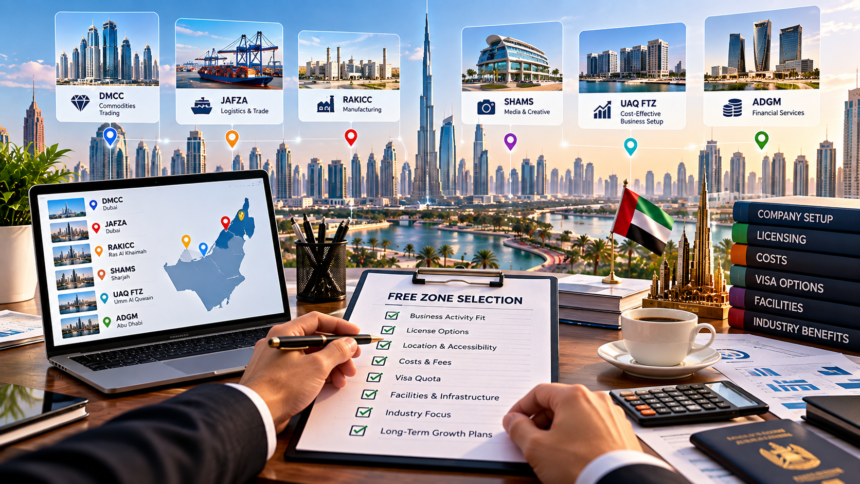
A useful way to narrow your options is to compare free zones according to the type of business you want to operate.
There is no single UAE free zone that is automatically best for every entrepreneur.
| Business Type | Factors to Prioritise |
|---|---|
| Consultancy | Licence activity, low overhead, flexible office |
| Technology startup | Startup ecosystem, workspace, investors, scalability |
| E-commerce | Trading permissions, fulfilment, logistics access |
| Import/export | Customs processes, warehousing, ports and transport |
| Financial services | Regulatory framework and approvals |
| Manufacturing | Industrial land, warehouses, utilities and logistics |
| Holding company | Legal structure, administration and compliance |
| Media company | Relevant media activities and creative ecosystem |
Professional and consulting businesses
Consultants, marketers, designers and other service-based companies may not require warehouses or large offices.
For these businesses, priorities may include:
- Affordable licence renewal
- One or two residency visas
- Flexible office arrangements
- Easy digital administration
- Ability to add related activities
- Convenient location
Paying significantly more for industrial infrastructure that the business will never use would make little sense.
Trading businesses
A trading company has different requirements.
It may need to understand:
- Approved trading activities
- Customs procedures
- Storage
- Warehousing
- Product approvals
- Import documentation
- Shipping
- Distribution arrangements
A free zone close to major logistics infrastructure can be more valuable than one offering only a cheaper licence.
Financial and regulated businesses
Companies operating in regulated sectors should focus heavily on the relevant authority and approval requirements.
ADGM, for example, distinguishes between financial, non-financial and retail activities. Financial activities such as banking, money services, wealth management, capital markets and certain digital-asset businesses can involve financial regulatory authorisation before incorporation stages are completed.
This makes regulatory suitability much more important than promotional setup prices.
Industrial businesses
Manufacturing and industrial businesses should consider infrastructure from the beginning.
Questions may include:
- Is industrial land available?
- Are warehouses available?
- What utility capacity is offered?
- Can heavy vehicles access the site?
- How close are ports?
- Are customs facilities nearby?
- Can the facility expand?
A company planning physical production should choose a free zone based on its long-term operational footprint rather than a basic entry package.
Calculate the Real Cost of Setting Up and Running the Company

One of the most common mistakes when comparing UAE free zones is looking only at the advertised licence price.
The first figure you see is not necessarily the total amount required to start and operate the company.
Actual expenses can include several components.
Common business setup costs may include:
- Company registration
- Trade licence
- Establishment card
- Office or flexi-desk
- Residency visas
- Medical examinations
- Emirates ID processing
- Immigration services
- Investor or employee visas
- Additional business activities
- Regulatory approvals
- Document attestation
- Corporate services
- Insurance
- Licence renewal
- Accounting and tax compliance
The structure varies between free zones.
DMCC, for example, currently offers multiple business setup packages rather than one universal price. Its published packages can include components such as a company licence, flexi-desk or co-working access and visa allowances. KEZAD similarly publishes packages with different prices according to duration and visa allocations.
These examples show why founders should request a detailed quotation for their particular business instead of relying on a headline price.
First-year cost versus renewal cost
Always ask for both.
Some packages are attractive because of introductory discounts, but renewal fees may differ. Other expenses might also appear after the first year.
Create a three-year estimate rather than comparing only initial setup fees.
| Cost Area | Year 1 | Year 2 | Year 3 |
|---|---|---|---|
| Licence | Check | Check | Check |
| Office | Check | Check | Check |
| Visas | Check | Renewal | Renewal |
| Establishment services | Check | Check | Check |
| Additional approvals | If required | If required | If required |
| Accounting/compliance | Check | Check | Check |
This gives you a more realistic picture of the cost of ownership.
Do not automatically choose the cheapest option
Saving a few thousand dirhams during incorporation may not help if the jurisdiction does not support your activity, banking needs, expansion plans or physical operations.
Think in terms of value and suitability rather than price alone.
Check Office, Visa and Staffing Requirements
Many entrepreneurs choose a UAE free zone partly because they want residency visas for themselves, partners or employees.
Visa requirements should therefore be considered before purchasing a package.
A low-cost package may offer fewer visa allocations than the business eventually requires.
Questions about visas
Ask the free zone:
- How many visas are included?
- How many visas can the company obtain?
- Does visa capacity depend on office size?
- Can additional visas be purchased?
- What are the visa processing costs?
- What are the renewal costs?
- Are employee visa requirements different?
- What happens when the team grows?
A founder planning to hire 10 employees should not choose a company structure designed primarily for a solo consultant without understanding the upgrade path.
Understand office requirements
Workspace options can vary substantially.
They may include:
- Virtual or registered address solutions
- Flexi-desks
- Shared workspaces
- Coworking offices
- Dedicated offices
- Warehouses
- Retail units
- Industrial land
DMCC, for instance, provides office options ranging from shared solutions for entrepreneurs and SMEs to larger commercial spaces.
ADGM generally requires entities to maintain a physical presence within its jurisdiction, with specific exceptions such as certain Special Purpose Vehicles.
This illustrates why office requirements should be confirmed before incorporation.
Plan for growth
Imagine that your company begins with two employees but could reach 15 employees within three years.
Ask whether the free zone allows you to move from a flexi-desk to a larger office without unnecessarily restructuring the company.
Scalability can save considerable administrative effort later.
Understand Corporate Tax, VAT and Compliance Responsibilities
Tax treatment is one of the most misunderstood areas of UAE free-zone company formation.
A common assumption is that a business established in a free zone automatically pays no corporate tax. That is too simplistic.
The Federal Tax Authority states that the free-zone corporate tax regime allows a Qualifying Free Zone Person to benefit from a 0% corporate tax rate on Qualifying Income, subject to the applicable conditions.
This means founders need to understand both their company’s status and the type of income it earns.
Do not make decisions based only on the phrase “0% tax”
A business should consider:
- Whether it qualifies as a Qualifying Free Zone Person
- Whether its income is Qualifying Income
- Whether any income falls outside the qualifying regime
- Corporate tax registration requirements
- Accounting requirements
- Transfer-pricing obligations where applicable
- VAT obligations
- Record-keeping requirements
Professional tax advice may be appropriate when business structures, international transactions or multiple jurisdictions are involved.
Small Business Relief is not the same as the free-zone regime
The FTA’s published corporate tax guidance states that Qualifying Free Zone Persons cannot elect for Small Business Relief.
This is another reason why businesses should not assume that every tax incentive can be combined.
Maintain proper financial records
Even small companies should establish organised accounting processes early.
Keep records of:
- Revenue
- Expenses
- Invoices
- Contracts
- Bank transactions
- Salaries
- Business assets
- Tax filings
Good records make tax compliance easier and help founders understand how the business is actually performing.
Beneficial ownership and compliance
Corporate administration does not end when the licence is issued.
For example, DMCC states that companies must provide and maintain Ultimate Beneficial Owner information in line with applicable UAE AML/CFT requirements.
Depending on your activity and jurisdiction, additional regulatory or compliance requirements may apply.
Consider Banking, Reputation and Long-Term Growth
Opening a corporate bank account is another important consideration.
A free-zone licence does not by itself guarantee that a particular bank will approve an account. Banks carry out their own due diligence and may request information about shareholders, customers, expected transactions, business activities and sources of funds.
Before incorporating, think about what you may need to demonstrate.
Prepare for banking requirements
Common business information may include:
- Company formation documents
- Trade licence
- Shareholder identification
- Business plan
- Expected turnover
- Customer information
- Supplier contracts
- Proof of business activity
- Source of funds
- Office information
Requirements differ between banks and companies.
A clear, credible business model can make the process easier than incorporating a company first and trying to explain its purpose later.
Evaluate the ecosystem
Some free zones offer much more than a licence.
They may provide:
- Networking events
- Industry communities
- Investor connections
- Accelerators
- Workshops
- Business support
- Coworking communities
- International trade connections
DMCC says its community includes more than 26,000 companies from more than 180 countries, illustrating the scale of the ecosystem that can develop around a major business district.
A startup may value access to other founders and investors, while a commodity trader may care more about industry-specific networks.
Think three to five years ahead
Ask yourself:
- Will I hire employees?
- Will I need a warehouse?
- Will I open another office?
- Will I bring in investors?
- Will I expand into mainland UAE?
- Will I add new activities?
- Will I enter regulated markets?
- Will I need larger visa quotas?
Choosing a jurisdiction that can accommodate growth may be more valuable than selecting the absolute lowest-cost option today.
A Practical Checklist for Choosing the Right UAE Free Zone
By this stage, you should have enough information to compare potential jurisdictions systematically.
Rather than relying on advertisements, create a shortlist and score each option against your actual business requirements.
Business activity
Confirm that your exact business activity is available. If multiple activities will be required, check whether they can operate under one company and licence.
Location
Consider customers, staff, suppliers, airports, ports and other infrastructure.
Total cost
Request an itemised quotation that includes registration, licence, office, visas, immigration services and renewal expenses.
Workspace
Confirm whether a flexi-desk is sufficient or whether your activity requires dedicated premises.
Visa capacity
Choose a structure capable of supporting your expected workforce.
Banking
Research what documents and business substance may be needed when applying for a corporate bank account.
Tax
Understand corporate tax, Qualifying Free Zone Person requirements and VAT obligations rather than assuming that a free-zone company automatically receives blanket tax exemption.
Regulation
Check whether your industry requires approvals from financial, healthcare, education, food, media or other regulators.
Growth potential
Think beyond the first year. Ask whether you can upgrade offices, add visas and expand business activities.
Here is a simple comparison framework:
| Factor | Free Zone A | Free Zone B | Free Zone C |
|---|---|---|---|
| Required business activity available | Yes/No | Yes/No | Yes/No |
| Setup cost | Compare | Compare | Compare |
| Annual renewal | Compare | Compare | Compare |
| Visa allocation | Compare | Compare | Compare |
| Office options | Compare | Compare | Compare |
| Industry ecosystem | Compare | Compare | Compare |
| Location | Compare | Compare | Compare |
| Regulatory requirements | Compare | Compare | Compare |
| Expansion options | Compare | Compare | Compare |
The right choice is the free zone that best matches the combination of these factors, not necessarily the one with the strongest advertising campaign or lowest starting price.
Choosing the right UAE free zone for your business requires understanding what your company needs today and what it may need in the future. Start with the business activity, then compare location, facilities, licences, visas, operating costs, tax obligations, banking considerations and growth options.
A solo consultant may benefit from a simple structure with flexible workspace and limited visa requirements. A trading company may prioritise logistics and customs access. A financial business may need a specialist regulatory environment, while a manufacturer could care most about industrial infrastructure and warehousing.
Before paying any registration fee, obtain current information directly from the relevant free-zone authority. Confirm that your activity is permitted, request a complete cost breakdown and understand the requirements for renewals, visas, offices and regulatory approvals.
Taking the time to compare these details before incorporation can make company formation smoother and reduce the risk of discovering later that your chosen jurisdiction does not support the way you actually want to do business.
Do follow us on Instagram
Read More – Money and Everyday Finance: A Practical Guide to Managing Your Money Better