



Teaching Jobs in Gulf Offering Exciting Career Opportunities
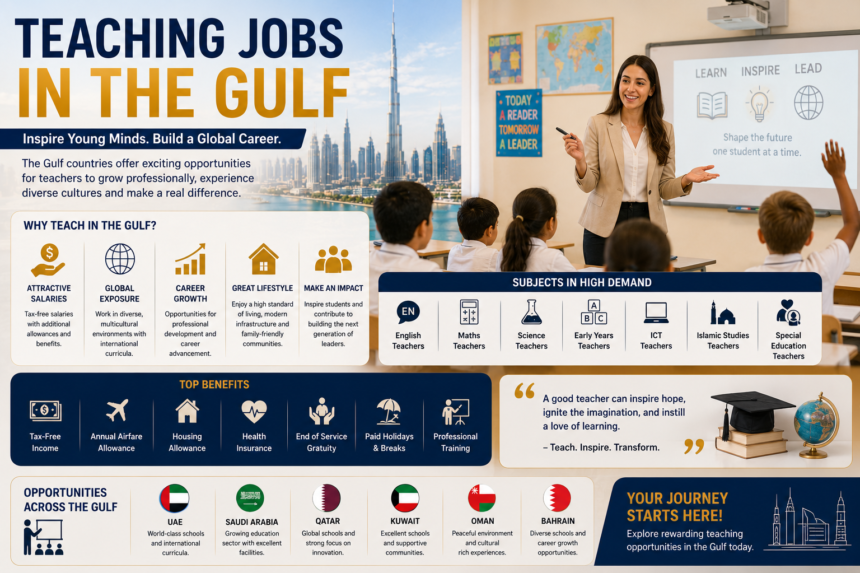
The Gulf has become one of the world’s most attractive regions for internationally mobile teachers. From large school networks in Dubai and Abu Dhabi to expanding education markets in Riyadh, Doha and other GCC cities, schools continue recruiting teachers who can bring strong subject knowledge, classroom experience and international curriculum expertise.
- Why Teaching Jobs in Gulf Continue to Attract Educators
- 1. Primary School Teachers
- 2. Mathematics Teachers
- 3. Science Teachers
- 4. English Teachers
- 5. Computer Science and Technology Teachers
- 6. Early Years Teachers
- 7. Special Education and Inclusion Teachers
- 8. Business and Economics Teachers
- 9. Arts and Music Teachers
- 10. Arabic Teachers
- 11. School Counsellors and Student Support Professionals
- 12. Academic Leaders and Principals
- Teaching Jobs in Gulf at a Glance
- UAE Is One of the Most Popular Teaching Destinations
- Saudi Arabia Is Becoming a Major Teaching Market
- Qatar Remains Highly Attractive to International Teachers
- Kuwait Offers a Longstanding International School Market
- Oman Offers Teaching Careers With a Different Lifestyle
- Bahrain Provides a Compact International School Market
- What Qualifications Do Gulf Schools Usually Want
- Curriculum Experience Can Be Extremely Valuable
- Teaching Salaries Across the Gulf
- Housing Can Change the Real Value of a Teaching Job
- School Fee Benefits Are Important for Teachers With Children
- Early Years and STEM Are Important Areas in 2026
- Digital Skills Are Becoming More Important for Teachers
- Safeguarding Is Essential
- Fresh Graduates Can Find Teaching Opportunities, but Competition Is Strong
- Experienced Teachers Should Demonstrate Results
- Leadership Experience Can Open Better Opportunities
- When Is the Best Time to Apply
- Where to Find Teaching Jobs in Gulf Countries
- How to Build a Strong Gulf Teaching CV
- Avoid Teaching Recruitment Scams
- Which Gulf Country Is Best for Teaching
- The Future of Teaching Jobs in Gulf
- Frequently Asked Questions
- Conclusion
For educators exploring Teaching Jobs in Gulf, opportunities extend far beyond traditional classroom positions. Schools need primary teachers, mathematics and science specialists, early years educators, computer science teachers, inclusion professionals, counsellors and experienced academic leaders.
International interest in the region remains strong. An analysis of more than 120,000 applications from UK based teachers seeking overseas work in 2025 found that the UAE was the most popular destination, Qatar ranked second, Saudi Arabia fifth and Kuwait tenth. Four of the top ten destinations were Gulf countries.
Hiring also remains active in 2026. UAE schools have been recruiting for the 2026 to 2027 academic year, with particular demand for teachers in STEM, artificial intelligence related learning and Early Years education.
For teachers, however, choosing the Gulf is not simply about finding a vacancy. Qualifications, curriculum experience, school reputation, visa requirements, accommodation and the complete employment package all matter.
Why Teaching Jobs in Gulf Continue to Attract Educators
Gulf education has several characteristics that make it different from many other international teaching markets.
The first is the size of the expatriate population.
Families from around the world live across the GCC, creating demand for schools following international curricula.
The second is investment.
Governments and private education groups continue opening campuses, expanding school networks and introducing new programmes.
The third is curriculum diversity.
Teachers can find schools offering:
British curriculum
American curriculum
International Baccalaureate
Indian curriculum
French curriculum
and other national systems.
The fourth advantage is professional exposure.
A teacher working in the Gulf may teach students from many nationalities within one classroom.
That experience can strengthen adaptability, communication and international education knowledge.
1. Primary School Teachers
Primary school teaching is one of the largest career areas across international schools.
Primary educators generally teach several subjects and play an important role in establishing a child’s academic foundation.
Responsibilities can include:
English
Mathematics
Science
Humanities
Classroom projects
Primary teachers need strong classroom management and an understanding of child development.
They may also need to differentiate instruction because students in one class can have very different academic and language abilities.
Current Saudi school vacancies illustrate ongoing demand. International Schools Group has advertised elementary teaching positions for international and GCC candidates during 2026.
Best for: Qualified educators who enjoy broad classroom teaching and working closely with younger students.
2. Mathematics Teachers
Mathematics remains one of the most important subject areas across Gulf schools.
Schools may recruit teachers for:
Middle school mathematics
GCSE mathematics
A Level mathematics
IB mathematics
Advanced placement programmes
Current recruitment in Saudi Arabia continues to show vacancies for mathematics teachers alongside other core academic subjects. Saud International Schools advertised mathematics teaching positions for its 2026 recruitment cycle.
Strong mathematics teachers need more than the ability to solve problems.
They need to explain difficult concepts clearly and build student confidence.
Exam preparation experience can also become particularly valuable in British and international curriculum schools.
3. Science Teachers
Science teachers are another major recruitment category.
Demand can include specialists in:
Physics
Chemistry
Biology
General science
Schools often prefer candidates who understand practical laboratory learning and international assessment systems.
A 2026 recruitment notification from International Indian Public School Riyadh specifically sought senior secondary teachers in Physics, Chemistry and Mathematics with relevant postgraduate qualifications, a BEd and at least five years of experience.
Saudi International School recruitment also included chemistry teaching vacancies during 2026.
For teachers with strong STEM backgrounds, Gulf schools can therefore offer useful career opportunities.
4. English Teachers
English is central to many international school systems.
Teachers may work across:
English language
English literature
English as an additional language
Academic writing
Current Saudi international school vacancies have included English language and literature teaching positions across senior school levels.
English teachers working in Gulf schools may encounter students with extremely different linguistic backgrounds.
Some students may speak English fluently.
Others may need significant academic language support.
That requires teachers to adapt lessons without reducing expectations.
Strong reading, writing and analytical skills remain essential.
5. Computer Science and Technology Teachers
Technology education is becoming increasingly important.
Schools need teachers who can introduce students to:
Programming
Computer science
Digital literacy
Robotics
Artificial intelligence
UAE schools recruiting for the 2026 to 2027 academic year have specifically highlighted strong demand for STEM and AI related teaching expertise.
Saudi schools have also been recruiting computer science teachers, including senior school positions.
Teachers who can support extracurricular coding clubs, robotics competitions or technology projects may have an additional advantage.
6. Early Years Teachers
Early childhood education is another important part of the Gulf school market.
Teachers working with young children need specialised knowledge of:
Child development
Play based learning
Early literacy
Language development
Social skills
Classroom routines
UAE recruitment reporting in 2026 identifies Early Years education as one of the areas where schools continue to seek qualified teachers.
Saudi schools have also advertised preschool homeroom positions during the current recruitment cycle.
Early years teaching can appear simple from the outside.
In reality, it requires patience, careful observation and excellent communication with families.
7. Special Education and Inclusion Teachers
Inclusive education is becoming an increasingly important school priority.
Career positions can include:
Special education teacher
Learning support teacher
Inclusion specialist
EAL support teacher
Professionals may work with students who experience:
Learning difficulties
Communication challenges
Autism
Attention related needs
Physical disabilities
Current Saudi international school recruitment has included EAL support teaching positions, reflecting the importance of differentiated support in multicultural school environments.
Inclusion teachers often work closely with classroom educators, counsellors and families.
This makes collaboration one of the most important professional skills.
8. Business and Economics Teachers
The Gulf’s strong connection with entrepreneurship, finance and international business makes business education increasingly relevant.
Schools may recruit teachers for:
Business Studies
Economics
Entrepreneurship
Accounting
Saudi International School advertised Business Studies teaching positions for the 2026 recruitment period.
Teachers who can connect theory with real commercial examples may create more engaging lessons.
The Gulf itself provides many useful case studies involving tourism, aviation, technology, trade and energy.
9. Arts and Music Teachers
International schools also need creative educators.
Career areas can include:
Visual arts
Music
Drama
Media
Design
Current International Schools Group vacancies in Saudi Arabia include art and music related teaching positions.
Creative subjects contribute to a student’s wider development.
These teachers may also support:
School productions
Exhibitions
Performances
Competitions
Clubs
For applicants, a strong portfolio and evidence of extracurricular involvement can improve employability.
10. Arabic Teachers
Arabic is an important school subject across the Gulf.
Schools may need teachers for:
Arabic as a first language
Arabic as an additional language
Language development
National curriculum requirements
Arabic teachers need to understand that students may enter the classroom with completely different proficiency levels.
A native Arabic speaker may need advanced language and literature.
A non native speaker may be learning basic communication.
The teaching methods must therefore differ significantly.
11. School Counsellors and Student Support Professionals
Modern education involves much more than academic performance.
Students may need support with:
Wellbeing
Academic stress
Career planning
University applications
Social challenges
School transitions
International schools often serve families who move frequently between countries.
Children may therefore need help adjusting to new cultures, schools and friendship groups.
School counsellors can play an important role in helping students navigate these changes.
Career counsellors may also help older students understand universities and emerging employment paths.
12. Academic Leaders and Principals
Experienced teachers may eventually move into leadership.
Career roles can include:
Head of Department
Academic Coordinator
Assistant Principal
Vice Principal
Principal
Current Saudi international school hiring includes academic supervisors and assistant principal positions, showing that the Gulf market recruits leadership talent as well as classroom teachers.
School leaders need a much broader skill set.
They must understand:
Teaching quality
Curriculum
Safeguarding
Staff development
Parent communication
Operations
School strategy
Strong leadership careers generally require substantial classroom and management experience.
Teaching Jobs in Gulf at a Glance
| Career | Strong Skills |
|---|---|
| Primary Teacher | Classroom management and child development |
| Mathematics Teacher | Numeracy and exam preparation |
| Science Teacher | Subject knowledge and practical learning |
| English Teacher | Literacy and communication |
| Computer Science Teacher | Programming and digital skills |
| Early Years Teacher | Early childhood development |
| Inclusion Teacher | Individualised learning |
| Business Teacher | Commercial and economic knowledge |
| Arts Teacher | Creativity and extracurricular activities |
| Arabic Teacher | Language teaching |
| School Counsellor | Student support |
| Principal | Leadership and school strategy |
UAE Is One of the Most Popular Teaching Destinations
The UAE remains one of the strongest Gulf markets for international teachers.
Dubai and Abu Dhabi offer large private education sectors with schools following multiple international curricula.
The UAE ranked first among destinations attracting UK based teachers applying for overseas roles in 2025.
Current hiring is also active.
Schools preparing for the 2026 to 2027 academic year have been recruiting in response to rising enrolment, new school openings and curriculum expansion.
In Dubai specifically, private school teacher appointments are regulated through KHDA requirements covering qualifications, experience and professional conduct.
This means teachers targeting Dubai should check eligibility before relocating.
Saudi Arabia Is Becoming a Major Teaching Market
Saudi Arabia offers one of the Gulf’s largest and fastest growing education markets.
International schools operate across:
Riyadh
Jeddah
Al Khobar
Dammam
Jubail
Current August 2026 listings show vacancies spanning primary teaching, English, computer science and academic leadership.
Some schools recruit international teachers, while certain positions may prioritise Saudi or GCC nationals.
Candidates should therefore read eligibility requirements carefully.
Saudi Arabia can be particularly attractive for teachers seeking experience in rapidly expanding schools and international curricula.
Qatar Remains Highly Attractive to International Teachers
Qatar was the second most popular destination for UK based teachers applying overseas in 2025.
Doha contains a significant international school sector serving expatriate families.
Opportunities can exist across:
British schools
American schools
IB schools
Bilingual schools
The market is smaller than the UAE or Saudi Arabia.
That means the number of openings can be more limited even when compensation packages are strong.
Teachers should ideally secure an offer before relocating.
Kuwait Offers a Longstanding International School Market
Kuwait ranked among the top ten overseas destinations for UK teacher applicants in the international recruitment analysis.
The country has a long established network of international and private schools.
Career opportunities may include:
Primary teaching
Secondary subjects
English
Science
Mathematics
School leadership
Kuwait can appeal to teachers who want Gulf experience but prefer a smaller market than Dubai or Riyadh.
Oman Offers Teaching Careers With a Different Lifestyle
Oman has a smaller education employment market.
However, international schools in Muscat and other locations continue to recruit qualified teachers.
For some educators, Oman’s lifestyle can become part of the attraction.
The country is generally associated with a quieter pace than some larger Gulf cities.
Candidates should still check current Omanisation policies and the requirements of each school carefully.
Specialist international curriculum experience can improve competitiveness.
Bahrain Provides a Compact International School Market
Bahrain has a smaller population, so naturally it has fewer teaching vacancies.
However, international and private schools create opportunities in:
Primary education
Secondary subjects
Early Years
School leadership
Teachers with strong experience may appreciate the smaller market and Bahrain’s established expatriate community.
A targeted application strategy is particularly important because the total number of schools is lower than in the UAE or Saudi Arabia.
What Qualifications Do Gulf Schools Usually Want
Requirements vary by country and school.
However, international schools commonly look for:
Bachelor’s degree
Teaching qualification
Relevant subject qualification
Teaching experience
Professional references
Background checks
The exact teaching qualification may depend on curriculum and country.
Examples can include:
BEd
PGCE
QTS
State teaching licence
Other recognised professional education credentials
Saudi school recruitment provides a useful example. A 2026 Riyadh school recruitment notice for senior secondary teachers required a relevant postgraduate degree, BEd and at least five years of experience for specific positions.
Always check the exact vacancy.
Curriculum Experience Can Be Extremely Valuable
International schools do not all teach the same way.
British curriculum experience can be useful for schools offering:
GCSE
IGCSE
A Levels
American school experience can help with US curriculum roles.
IB experience can be especially valuable for schools offering:
Primary Years Programme
Middle Years Programme
Diploma Programme
A teacher already familiar with the curriculum requires less training and may adapt more quickly.
This can strengthen negotiating power.
Teaching Salaries Across the Gulf
There is no reliable single Gulf teacher salary.
Pay depends on:
Country
School
Curriculum
Experience
Subject
Leadership level
Qualifications
Benefits
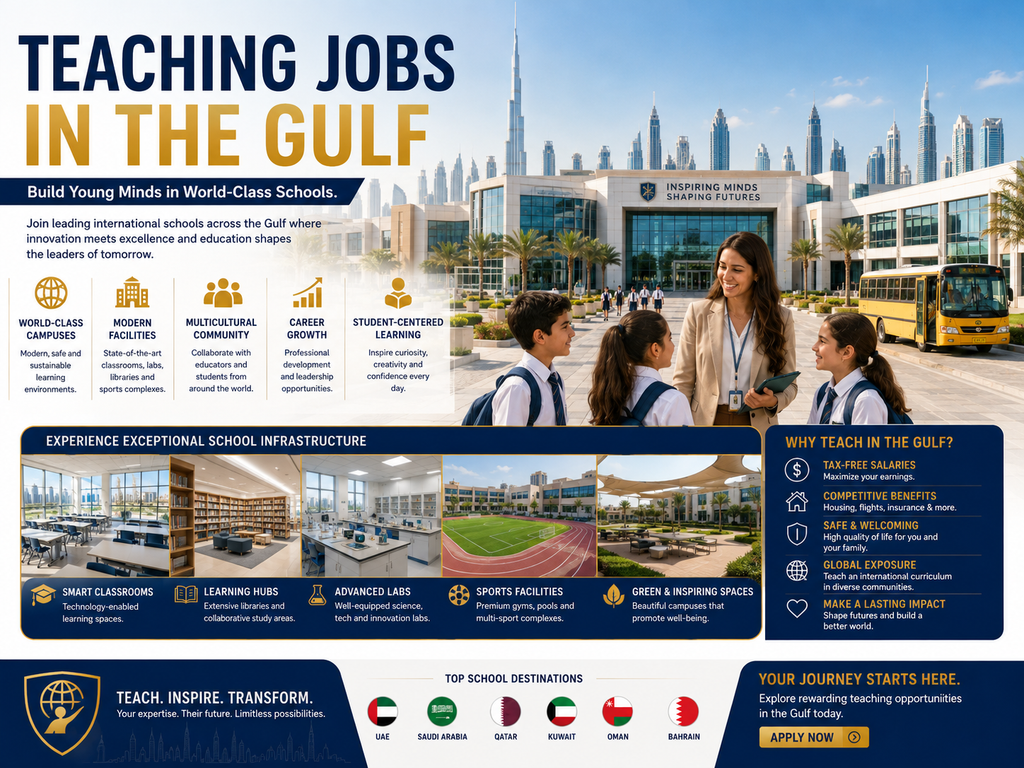
International schools may offer packages containing:
Basic salary
Housing
Medical insurance
Annual flights
Tuition support
End of service benefits
A large salary number should therefore never be considered alone.
Housing Can Change the Real Value of a Teaching Job
Accommodation is one of the most important benefits.
Some schools provide staff housing.
Others provide a housing allowance.
Some expect teachers to arrange everything themselves.
This can dramatically affect savings.
A lower salary with good accommodation may sometimes produce a better financial result than a higher salary in an expensive city.
Before accepting an offer, calculate realistic monthly expenses.
School Fee Benefits Are Important for Teachers With Children
Teachers moving with families should ask about school fee support.
International schooling can be expensive.
Some employers offer:
Free places
Partial discounts
Reduced tuition
But the benefit may apply only to a limited number of children.
It may also exclude registration, transport or other charges.
Ask for the exact terms in writing.
Early Years and STEM Are Important Areas in 2026
UAE recruitment reporting highlights Early Years, STEM and AI related education as particularly active hiring areas for the 2026 to 2027 academic year.
Saudi recruitment also shows current demand for mathematics, chemistry, computer science and English teachers.
This suggests that teachers with strong technical or specialised subject backgrounds may find useful opportunities.
Digital Skills Are Becoming More Important for Teachers
Schools increasingly use:
Learning management systems
Digital assessments
Interactive displays
AI tools
Online learning resources
Teachers do not need to become software developers.
But they need confidence with education technology.
The strongest educators understand when digital tools improve learning and when a simpler teaching method works better.
Technology should support pedagogy rather than replace it.
Safeguarding Is Essential
International schools place strong emphasis on safeguarding and child protection.
Teachers should expect questions about:
Professional boundaries
Reporting concerns
Student wellbeing
Safe classroom practices
Background checks
Dubai’s KHDA framework specifically emphasises due diligence, professional conduct and safer recruitment for private school appointments.
Candidates should therefore maintain accurate employment records and professional references.
Fresh Graduates Can Find Teaching Opportunities, but Competition Is Strong
The Gulf is generally easier for teachers who already have classroom experience.
However, some schools recruit newly qualified educators.
Fresh graduates should strengthen their profiles through:
Teaching placements
Supervised classroom experience
Strong references
Curriculum knowledge
Safeguarding training
Dubai’s current framework allows certain newly qualified teachers to enter roles under supervised professional development conditions when requirements are satisfied.
But international candidates should never assume qualification alone guarantees a job.
Experienced Teachers Should Demonstrate Results
Experienced educators should show more than years of employment.
Highlight:
Student progress
Exam results
Curriculum development
Leadership
Mentoring
School improvement
Extracurricular activities
Instead of writing:
Taught Grade 9 Science
consider:
Taught Grade 9 Science across mixed ability classes and developed targeted intervention plans to improve examination readiness.
Specific achievements make a stronger impression.
Leadership Experience Can Open Better Opportunities
Teachers who have already served as:
Head of Department
Year Leader
Curriculum Coordinator
Assistant Principal
may find broader career opportunities.
Current Saudi vacancies include assistant principal and academic supervisor roles, confirming active demand for experienced education leaders.
School leadership can also offer stronger compensation, but responsibility increases considerably.
When Is the Best Time to Apply
Many Gulf international schools recruit between January and April for the next academic year, although vacancies appear throughout the year.
A current regional education guide similarly identifies January to April as a major hiring season for Saudi schools.
Unexpected resignations and new school openings can create opportunities later.
The best strategy is to begin preparing early.
Update documents.
Contact references.
Research schools.
Then apply strategically.
Where to Find Teaching Jobs in Gulf Countries
Teachers can search through:
School career pages
International teaching portals
Specialist education recruiters
School group websites
Professional networks
Direct applications can be especially effective.
Current Saudi school websites, for example, publish vacancies directly for teachers and administrators.
Apply through official channels whenever possible.
How to Build a Strong Gulf Teaching CV
Your CV should quickly explain:
What you teach
Which age group
Which curriculum
How experienced you are
Then show achievements.
Include:
Teaching qualification
Degree
Curriculum experience
Subjects
Year groups
Leadership responsibilities
Safeguarding training
Extracurricular work
Keep formatting clear.
School recruiters may review many applications.
Make the important information easy to find.
Avoid Teaching Recruitment Scams
International applicants can become targets for fraudulent recruiters.
Warning signs include:
Guaranteed teaching positions
No proper interview
Requests for large placement fees
Unrealistic salaries
Pressure to pay visa fees immediately
Emails that do not match the school’s official domain
Verify vacancies through the school directly.
Do not resign from your current position based only on an informal message.
Which Gulf Country Is Best for Teaching
There is no universal answer.
UAE
Best for a large international school market and curriculum diversity.
Saudi Arabia
Strong for expanding school networks and large scale opportunity.
Qatar
Popular among international teachers and potentially attractive for specialist packages.
Kuwait
Long established private and international school sector.
Oman
Smaller market with a different lifestyle.
Bahrain
Compact but established international education market.
The strongest choice depends on your subject, family situation and career goals.
The Future of Teaching Jobs in Gulf
Gulf education will continue changing.
Schools are increasingly interested in:
Technology
AI literacy
STEM
Inclusion
Student wellbeing
Critical thinking
International curriculum quality
This does not mean traditional teaching skills are becoming less important.
They are becoming more important.
Technology can produce content instantly.
Teachers need to help students understand, question and use that information responsibly.
The future teacher therefore needs both digital confidence and strong human judgement.
Frequently Asked Questions
Are Teaching Jobs in Gulf in demand in 2026?
Yes. UAE schools are actively recruiting for the 2026 to 2027 academic year, while Saudi schools continue advertising positions across mathematics, English, science, computer science and primary education.
Which Gulf country is best for teachers?
The UAE is one of the most popular destinations and has a large international school market. Saudi Arabia offers significant scale, while Qatar remains highly attractive to internationally mobile teachers.
Which teaching subjects are in demand?
Current recruitment indicates strong opportunities in STEM, AI related learning, Early Years, mathematics, science, English and computer science.
Can foreign teachers work in Saudi Arabia?
Yes. International schools recruit overseas teachers, although eligibility varies by school and some positions may be restricted to Saudi or GCC nationals.
Do Gulf teaching jobs include accommodation?
Many international school packages include housing or housing allowances, but arrangements vary. Always check the complete contract.
Do teachers need a professional qualification?
Most reputable international schools expect recognised teaching qualifications alongside an appropriate degree. Requirements differ by country, school and curriculum.
When should I apply for Gulf teaching jobs?
Recruitment often begins several months before the academic year, with January to April being particularly active in many markets.
Conclusion
Teaching Jobs in Gulf remain attractive to educators who want international experience, multicultural classrooms and opportunities within rapidly developing education systems.
The UAE continues to be one of the strongest destinations. It ranked first among overseas destinations attracting UK teacher applications in 2025, while schools remain active in 2026 recruitment as enrolment and campus capacity increase.
Saudi Arabia is building another major opportunity base, with current vacancies spanning primary teaching, English, mathematics, science, computer science and school leadership.
Qatar, Kuwait, Bahrain and Oman provide smaller but established markets for educators whose qualifications and curriculum experience match employer needs.
For teachers, however, a Gulf move should never be based only on a headline salary.
Check your qualifications.
Research the school.
Understand the curriculum.
Compare housing, flights, medical insurance and family benefits.
Prepare strong references.
And make sure the employer follows proper recruitment and visa procedures.
The teachers most likely to succeed will be those who combine strong subject knowledge, classroom skill, safeguarding awareness, cultural adaptability and the ability to keep learning as education itself changes.
The Gulf may offer the opportunity to teach abroad.
The real career value comes from what that international classroom experience helps you become as an educator.
follow us on Instagram
Read More – Hospitality Jobs in Gulf: 12 Amazing Careers for 2026