



How Rising US Treasury Yields Could Affect Gulf Investment Strategies
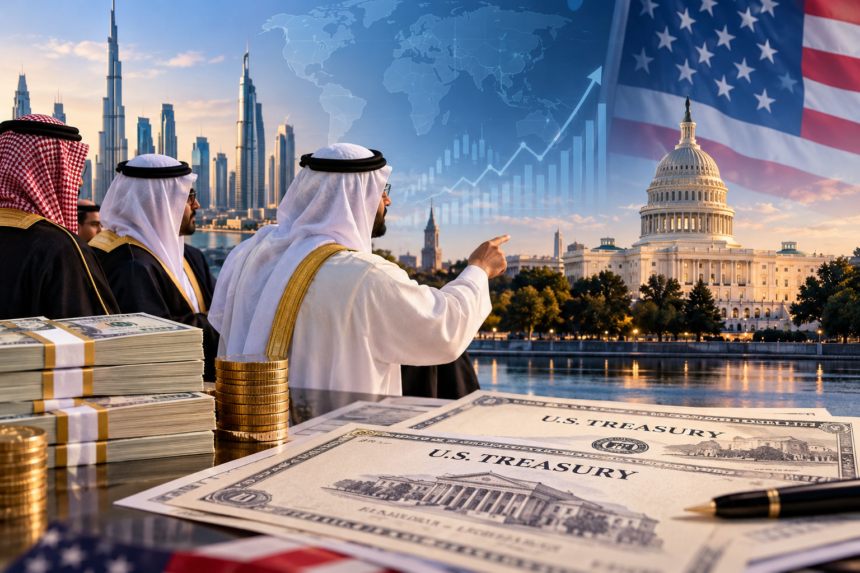
UAE and Gulf investors in US Treasuries continue to hold hundreds of billions of dollars in American government debt, highlighting the deep financial links between the Gulf economies and the United States.
- How Much Do UAE and Gulf Investors Hold in US Treasuries?
- Why US Treasuries Remain Attractive to Gulf Investors
- The Dollar Link Makes Treasuries Particularly Important in the Gulf
- Kuwait Is Emerging as One of the Strongest Gulf Buyers
- Saudi Arabia Remains the Largest Arab Treasury Holder
- The UAE Is Diversifying Even While Holding More Than $100 Billion in Treasuries
- Higher US Yields Have Changed the Investment Calculation
- What Gulf Treasury Buying Means for the United States
- Why Gulf Investors Are Unlikely to Abandon Treasuries Completely
- What Could Change Gulf Demand for US Treasuries?
- A Closer Look at the Gulf Treasury Numbers
Latest data from the U.S. Treasury Department show that Saudi Arabia held about $142.4 billion in U.S. Treasury securities at the end of July 2026, while the UAE held approximately $110.1 billion. Kuwait’s holdings reached a record $69.2 billion, taking the combined holdings of these three Gulf economies to more than $321 billion.
The figures are significant because U.S. Treasuries are among the world’s largest and most liquid financial assets. Governments, central banks, sovereign institutions, banks and other investors use them for reserve management, liquidity and income.
The latest numbers also show that the Gulf’s Treasury exposure is not moving in one direction every month.
Saudi Arabia’s holdings eased marginally from $142.5 billion in June to $142.4 billion in July. The UAE reduced its position from $114.8 billion to $110.1 billion over the same period. Kuwait, however, increased its holdings from about $68.8 billion to $69.2 billion and reached a new record.
The broader year-on-year picture is stronger.
In July 2025, Saudi Arabia held $131.6 billion and the UAE held $107.7 billion. Kuwait’s holdings were about $58.1 billion. By July 2026, their combined exposure had risen by more than $24 billion.
That raises an important question.
Why do Gulf investors continue to place such large amounts of money into U.S. government securities even as they diversify more aggressively into equities, infrastructure, technology, real estate, private markets and investments across Asia and Europe?
The answer involves much more than simply chasing returns.
U.S. Treasuries play a unique role in global finance. They provide liquidity, scale, dollar exposure and a relatively easy place for large institutions to deploy substantial amounts of capital.
For Gulf economies whose currencies, trade flows and financial systems remain closely connected to the U.S. dollar, these characteristics can be particularly important.
How Much Do UAE and Gulf Investors Hold in US Treasuries?
The clearest picture comes from the U.S. Treasury Department’s Treasury International Capital data.
At the end of July 2026:
| Gulf Economy | US Treasury Holdings |
|---|---|
| Saudi Arabia | $142.4 billion |
| UAE | $110.1 billion |
| Kuwait | $69.2 billion |
| Combined | About $321.7 billion |
Saudi Arabia remained the largest Arab holder of U.S. Treasury securities among the countries individually listed in the Treasury’s major-holder table. The UAE followed with more than $110 billion.
Kuwait’s July position was especially notable.
Its holdings reached approximately $69.23 billion, up from $68.82 billion in June and $58.12 billion a year earlier. That represents year-on-year growth of roughly 19%.
Most of Kuwait’s Treasury holdings are also concentrated in longer-dated securities.
At the end of July:
- Long-term Treasury securities: about $66.9 billion
- Short-term Treasury securities: about $2.3 billion
That means long-term securities represented the overwhelming majority of Kuwait’s reported Treasury exposure.
Saudi Arabia’s holdings have also increased compared with a year earlier.
The Kingdom held:
- $131.6 billion in July 2025
- $142.4 billion in July 2026
That represents an increase of about $10.8 billion over 12 months.
The UAE’s position moved from:
- $107.7 billion in July 2025
- $110.1 billion in July 2026
That is a smaller annual increase, but the country’s position has fluctuated considerably during the period.
The UAE reached $120 billion in February 2026 before easing back to $110.1 billion by July.
These movements show why monthly Treasury figures should not automatically be interpreted as a major shift in Gulf investment strategy.
Large reserve and institutional portfolios are constantly adjusted.
Why US Treasuries Remain Attractive to Gulf Investors
U.S. government securities occupy a special place in global financial markets.
They are supported by one of the world’s deepest bond markets and can usually be bought or sold in extremely large volumes.
For a small investor, liquidity may not feel particularly important.
For an institution managing tens or hundreds of billions of dollars, it is critical.
Large amounts can be deployed
A sovereign institution cannot always move billions of dollars into a smaller asset class without influencing prices.
The Treasury market offers considerably more capacity.
Treasuries can be sold relatively easily
Liquidity matters when institutions need to rebalance portfolios or raise cash.
A private infrastructure investment may take months or years to exit.
Treasuries can generally be traded much more easily.
They generate income
Treasuries pay interest, and higher U.S. yields have made government debt more attractive from an income perspective than during the extremely low-rate period that followed the global financial crisis.
However, higher yields also mean bond prices can be volatile.
They provide dollar exposure
This is particularly relevant in the Gulf.
Several Gulf currencies maintain fixed or closely managed relationships with the U.S. dollar.
That makes dollar-denominated financial assets highly relevant for reserve and liquidity management.
For institutions handling dollar-linked obligations, holding dollar assets can reduce certain currency mismatches.
The Dollar Link Makes Treasuries Particularly Important in the Gulf
The Gulf’s connection to U.S. financial markets is not only an investment story.
It is also connected to how regional monetary systems operate.
The UAE dirham and several other Gulf currencies are linked to the U.S. dollar through fixed or tightly managed exchange-rate arrangements.
Oil and gas exports have also traditionally been priced largely in dollars.
This creates structural demand for dollar assets across the region.
When Gulf economies earn large amounts of dollar revenue, some of those funds can ultimately move into international financial assets.
U.S. Treasuries provide one place to store part of that liquidity.
That does not mean every Treasury listed under the UAE or Saudi Arabia belongs directly to a central bank or sovereign wealth fund.
The U.S. Treasury itself warns that country-level data are based largely on reporting from U.S. custodians and broker-dealers.
Securities held through custody accounts in other jurisdictions may not always be attributed to the ultimate beneficial owner. Therefore, the country figures should not be treated as a perfect map of who ultimately owns every bond.
This is an important limitation.
The figures show reported holdings associated with a country, not necessarily the complete foreign-asset portfolio of its government.
Kuwait Is Emerging as One of the Strongest Gulf Buyers
Among the latest Gulf data, Kuwait stands out most clearly.
Its Treasury holdings reached a record $69.2 billion in July 2026.
That was an increase of approximately:
- $416 million from June
- $11.1 billion from July 2025
The annual increase was roughly 19%.
Long-term Treasury securities accounted for about $66.9 billion of Kuwait’s holdings in July, while short-term securities were only around $2.3 billion.
That composition suggests reported holdings were heavily tilted toward longer maturities rather than short-term Treasury bills.
Longer-term securities can provide higher income depending on the yield curve, but they can also be more sensitive to changes in interest rates.
If U.S. yields rise:
Bond prices generally fall.
If yields decline:
Existing fixed-rate bonds can rise in value.
Large institutional investors therefore manage not only the amount of Treasury exposure but also the maturity of the bonds they hold.
Kuwait’s financial relationship with the United States also extends well beyond Treasury securities.
U.S. data show large reported Kuwaiti holdings of American equities as well.
Foreign portfolio holdings of U.S. equity securities associated with Kuwait stood at more than $412 billion in July 2026.
This demonstrates why focusing only on Treasury bonds gives an incomplete picture of Gulf investment in the United States.
Treasuries are one piece of a much broader portfolio.
Saudi Arabia Remains the Largest Arab Treasury Holder
Saudi Arabia continues to be a major holder of U.S. government debt.
Its position stood at $142.4 billion in July 2026.
That was slightly below June’s $142.5 billion but comfortably above the $131.6 billion reported in July 2025.
Saudi Arabia’s holdings have moved considerably during 2026.
They reached:
- $134.8 billion in January
- $160.4 billion in February
- $152 billion in March
- $140.1 billion in April
- $140.3 billion in May
- $142.5 billion in June
- $142.4 billion in July
These swings demonstrate an important point.
A large Treasury portfolio is actively managed.
Monthly increases or decreases can reflect:
- Liquidity needs
- Maturity changes
- Reserve management
- Bond-price changes
- Portfolio rebalancing
They do not necessarily represent a major political or strategic change.
In June, Saudi Arabia’s Treasury position consisted of roughly $108.6 billion in long-term securities and about $34 billion in short-term holdings.
The Kingdom’s overall foreign investment strategy is much broader.
Saudi Arabia is simultaneously directing capital toward domestic transformation under Vision 2030 while investing globally through large public and institutional portfolios.
U.S. Treasuries can function as a liquid component alongside investments in:
- Equities
- Technology
- Infrastructure
- Real estate
- Private companies
- International strategic assets
The UAE Is Diversifying Even While Holding More Than $100 Billion in Treasuries
The UAE is one of the world’s most active international investment centres.
Its investment institutions have exposure across:
- Technology
- Infrastructure
- Real estate
- Private equity
- Credit
- Public markets
- Renewable energy
Against that backdrop, more than $110 billion in U.S. Treasuries represents a significant but far from complete part of the country’s financial relationship with the United States.
The UAE held $110.1 billion of Treasury securities at the end of July 2026.
Its holdings had stood at $114.8 billion in June and $120 billion in February.
This means the UAE was not simply buying Treasuries every month.
Its reported holdings have moved up and down as portfolios were rebalanced.
The broader trend, however, shows continued large-scale exposure to American assets.
U.S. Treasury-linked data also indicate that total foreign portfolio holdings of all U.S. long-term securities associated with the UAE were about $320 billion in June 2026.
This distinction matters.
Treasuries are only one category.
UAE institutions also allocate capital to:
- U.S. equities
- Corporate debt
- Investment funds
- Private investments
So a decline in Treasury holdings does not automatically mean Gulf money is leaving America.
Capital may simply be moving to another U.S. asset class.
Higher US Yields Have Changed the Investment Calculation

One reason government bonds have attracted renewed attention globally is the level of U.S. interest rates and Treasury yields.
For many years after the global financial crisis, investors received relatively low returns from high-quality government debt.
That environment changed dramatically as inflation and monetary tightening pushed interest rates higher.
By late September 2026, the U.S. 10-year Treasury yield had moved above 5% amid inflation pressure and geopolitical uncertainty, reaching levels not seen for many years.
Higher yields create a different investment environment.
Government debt becomes more competitive
If high-quality bonds offer stronger returns, investors may not need to take as much risk in equities or private markets to generate income.
But higher yields also create risk
Bond prices and yields move in opposite directions.
An investor buying a long-term Treasury today can experience mark-to-market losses if yields rise further.
Short-term securities can become attractive
When policy rates are high, Treasury bills can offer meaningful income while limiting duration risk.
Institutional investors therefore continuously decide how much of their Treasury exposure should sit in:
- Short-term bills
- Intermediate notes
- Long-term bonds
The ideal balance depends on liquidity needs and expectations for interest rates.
What Gulf Treasury Buying Means for the United States
Foreign investors play a major role in financing the U.S. government.
At the end of July 2026, foreign investors held about $9.25 trillion in U.S. Treasury securities, according to official Treasury data.
Japan remained the largest foreign holder with more than $1.1 trillion.
The United Kingdom followed with nearly $1 trillion.
China held about $618 billion.
Against those numbers, individual Gulf economies are smaller holders.
However, Gulf investment remains strategically important because the region controls large pools of global capital.
Saudi Arabia, the UAE, Kuwait and other Gulf states have accumulated substantial financial assets through:
- Energy exports
- Sovereign wealth funds
- Government reserves
- Pension and institutional investment systems
That capital is increasingly influential across international financial markets.
For the United States, Gulf demand contributes to the broad global investor base supporting Treasury markets.
At the same time, the Gulf is becoming more diversified.
Regional investors are expanding exposure to:
- Asia
- Europe
- Emerging markets
- Domestic infrastructure
- Artificial intelligence
- Energy transition
- Private credit
This means U.S. Treasuries compete with an increasingly wide range of investment opportunities.
Why Gulf Investors Are Unlikely to Abandon Treasuries Completely
Discussions about Gulf diversification sometimes create the impression that regional investors are moving away from the United States.
The data suggest a more complicated picture.
Diversification does not necessarily mean replacement.
A sovereign portfolio can simultaneously increase investments in:
China
India
Europe
technology
domestic projects
while still holding large quantities of U.S. Treasuries.
Different assets serve different purposes.
Treasuries provide liquidity
A private infrastructure project cannot easily be sold overnight.
Treasuries can.
Treasuries support reserve management
Central banks and other public institutions need highly liquid assets.
Dollar exposure remains useful
Gulf economies continue to have substantial dollar-linked trade and monetary relationships.
The U.S. market is difficult to replace at scale
Other government bond markets exist, including:
- Europe
- Japan
- United Kingdom
But the U.S. Treasury market remains unusually large and liquid.
That gives it an important role even for investors seeking greater geographic diversification.
What Could Change Gulf Demand for US Treasuries?
Large Treasury portfolios are not fixed forever.
Several factors can influence Gulf demand.
US interest rates
Higher yields can make Treasuries more attractive from an income perspective.
Lower yields may encourage investors to look elsewhere for return.
Oil revenues
Higher energy income can increase the amount of capital available for reserve accumulation and investment.
Lower revenues may reduce new capital flows.
Domestic investment
Gulf economies are spending heavily on their own economic transformation.
More capital may increasingly be directed into:
- Infrastructure
- Tourism
- Technology
- Manufacturing
- Renewable energy
This could affect the amount available for overseas financial assets.
Currency policy
The region’s dollar-linked monetary systems currently strengthen the strategic relevance of dollar assets.
A major change in currency arrangements could eventually alter reserve strategy, although such decisions would carry wide economic consequences.
Geopolitics
Political relations can affect investment patterns, but large sovereign portfolios are generally managed around multiple financial and strategic considerations rather than one issue alone.
A Closer Look at the Gulf Treasury Numbers
The latest data provide a useful snapshot.
| Country | July 2025 | July 2026 | Approx. Annual Change |
|---|---|---|---|
| Saudi Arabia | $131.6bn | $142.4bn | +8.2% |
| UAE | $107.7bn | $110.1bn | +2.2% |
| Kuwait | $58.1bn | $69.2bn | +19.1% |
| Combined | $297.4bn | $321.7bn | +8.2% |
The table shows why describing the trend simply as Gulf investors “pouring money” into Treasuries needs context.
The combined position of these three economies is substantially higher than one year earlier.
But month-to-month movements are mixed.
Between June and July 2026:
- Saudi Arabia was almost unchanged.
- UAE holdings fell by about $4.7 billion.
- Kuwait added roughly $400 million.
That is normal for large institutional portfolios.
The bigger story is that Gulf investors continue to maintain very large positions in U.S. government securities even while expanding investments elsewhere.
The Gulf’s financial relationship with the United States is therefore not disappearing.
It is becoming broader.
U.S. Treasuries remain part of that relationship because they provide something that is difficult to reproduce at the same scale: deep liquidity, dollar exposure and the ability to deploy enormous amounts of capital quickly.
Saudi Arabia held about $142.4 billion in Treasuries at the end of July 2026, the UAE held $110.1 billion and Kuwait held a record $69.2 billion. Together, the three accounted for roughly $322 billion.
Kuwait has been the clearest recent buyer, with holdings rising about 19% from a year earlier.
Saudi Arabia’s position is also considerably higher than in July 2025.
The UAE remains above $100 billion despite reducing holdings from recent highs.
For investors and policymakers, the message is clear.
Gulf capital is diversifying.
But diversification does not mean abandoning the world’s largest government bond market.
U.S. Treasuries continue to play a central role in how major Gulf institutions manage reserves, liquidity, dollar exposure and international portfolios.
Do follow us on Instagram
Read More – 1 Billion Followers Summit: Dates, Venue, Creators and What to Expect