Why Dubai Schools Are Tightening Photography Rules
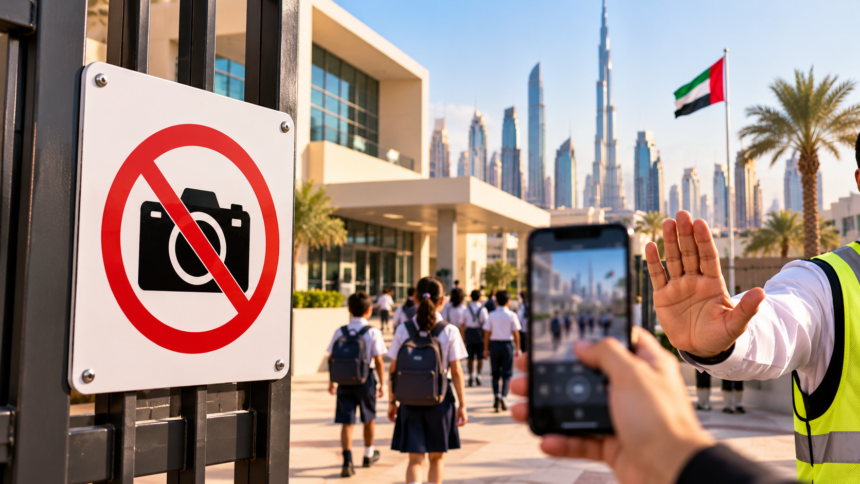
Dubai schools tighten photography rules as private schools remind parents that taking a picture of their own child on campus does not automatically give them permission to photograph other students or share those images online.
- Why Dubai Schools Are Tightening Photography Rules
- What UAE Privacy Law Says About Personal Data and Consent
- Why WhatsApp Groups and Social Media Create Extra Risk
- Can Parents Still Photograph Their Own Children?
- What Schools Are Doing During Events and Celebrations
- How KHDA Rules Connect Photography With Student Safeguarding
- Could Parents Face Fines for Privacy Violations?
- What Parents Should Do Before Posting a School Photo
- Photography Rules Also Apply to Staff and Schools
- A Practical Photography Checklist for Dubai School Parents
Fresh school circulars sent to families in Dubai and Sharjah have asked parents and visitors to avoid taking photographs or videos on school premises when other students or staff members could be captured without appropriate consent. The guidance can apply across classrooms, corridors, playgrounds, assemblies and even school drop-off and pick-up areas.
Parents are also being warned not to upload or circulate photographs containing other children through social media, WhatsApp groups or other digital platforms without consent.
The move reflects a wider emphasis on student privacy and safeguarding in UAE schools rather than a simple attempt to stop families from recording important moments.
Schools can still create designated opportunities for parents to photograph their own children during events such as concerts, assemblies or sports days. Official school photography can also continue under the institution’s established consent and safeguarding procedures.
The issue has become particularly important because photographs are now much easier to distribute beyond the original audience.
A picture taken casually at a school event can move within minutes from:
A parent’s phone
to
a WhatsApp group
to
social media
to
an audience the child or family never agreed to.
UAE privacy rules already provide protections around personal data and private life, while Dubai schools also have specific responsibilities for student safety and protection.
Understanding what the new reminders mean can help parents continue capturing their children’s milestones without unintentionally creating privacy problems for other families.
Why Dubai Schools Are Tightening Photography Rules
The latest school reminders are primarily about privacy.
A parent may attend a:
- Sports day
- Concert
- Assembly
- Graduation
- School celebration
and naturally want to photograph their own child.
The problem starts when other children become clearly identifiable in the same image or video.
A recent circular reported by Khaleej Times asked parents and visitors to avoid taking photographs or videos on school premises where other students or staff could be captured without consent.
The guidance reportedly covers:
- Classrooms
- Corridors
- Playgrounds
- Assemblies
- Drop-off areas
- Pick-up areas
This matters because school privacy does not stop at the classroom door.
A child waiting outside the school gate or standing in a playground can still be identifiable.
The concern becomes bigger after sharing
A photograph kept privately on one parent’s device is different from an image uploaded to a public social-media account.
Once a picture is shared digitally, it can potentially be:
- Downloaded
- Forwarded
- Screenshotted
- Reposted
- Stored indefinitely
That makes it difficult for the original photographer to control where the image eventually appears.
Schools are trying to create clearer boundaries
The recent approach is therefore not necessarily:
“No photographs ever.”
It is closer to:
“Photograph your own child only when the school permits it, and do not capture or share other children without consent.”
That distinction is important.
What UAE Privacy Law Says About Personal Data and Consent
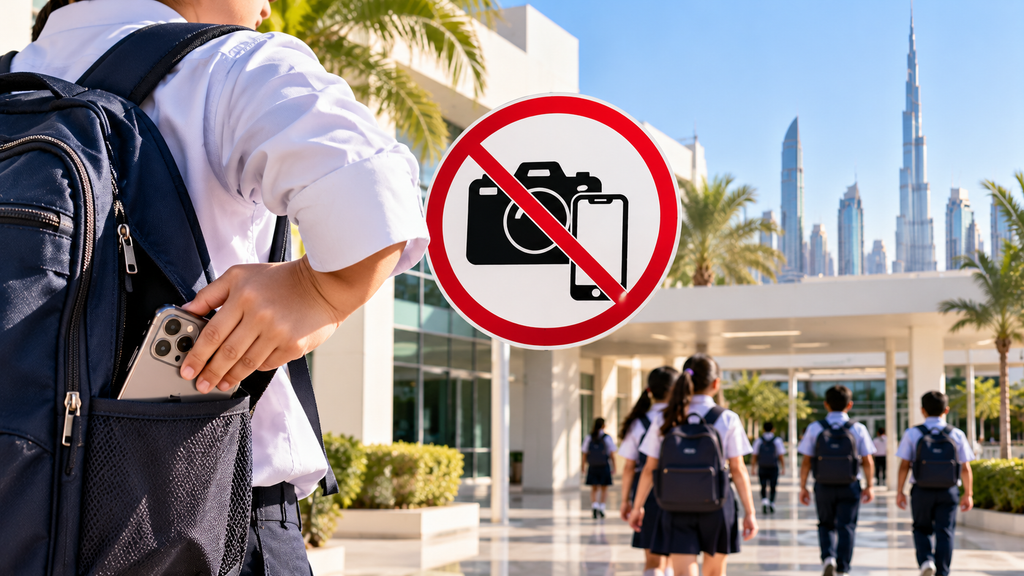
The wider legal background comes partly from the UAE’s Personal Data Protection Law.
Federal Decree-Law No. 45 of 2021 created a national framework for the protection of personal data and privacy.
The UAE Government describes the law as an integrated framework designed to protect the confidentiality of information and regulate how personal data is collected, processed and protected.
Under the law, personal data generally should not be processed without the consent of the person concerned unless a recognised legal exception applies.
A photograph can contain personal data
If a child is clearly identifiable in an image, that photograph may contain personal information linked to that individual.
The privacy concern becomes more significant when the photograph is:
- Stored
- Published
- Shared
- Distributed
through digital systems.
Consent matters
This is why schools commonly ask families to approve how children’s images can be used.
Consent arrangements may cover:
- School website
- Social media
- Marketing
- Yearbooks
- Event photography
Different schools can have different consent procedures.
Parents should therefore read the school’s photography and media policy rather than assuming every school uses the same rules.
There are legal exceptions
The Personal Data Protection Law contains circumstances where processing without consent can be lawful, such as certain public-interest, legal or health-related situations.
However, casual parent photography at a school event should not automatically be assumed to fall within those exceptions.
Why WhatsApp Groups and Social Media Create Extra Risk
One of the biggest areas of concern is not necessarily taking the photograph.
It is what happens next.
Many school communities use WhatsApp groups for:
- Class updates
- Birthday information
- Homework reminders
- Event coordination
- Parent communication
Parents may therefore assume that a private WhatsApp group is a safe place to share photographs.
That assumption can be risky.
Gulf News reported on October 6, 2026, that legal experts warned parents that sharing another child’s image in a private WhatsApp group is not automatically exempt from UAE privacy requirements.
Private group does not mean private forever
Even in a group containing only parents, another person can:
- Download the image
- Forward it
- Save it
- Repost it elsewhere
Once that happens, control is lost.
Social-media accounts create even greater exposure
An Instagram post can potentially reach:
- Followers
- Friends of followers
- Search engines
- Other platforms
depending on privacy settings.
Even accounts labelled “private” should not be treated as completely controlled environments.
Children cannot always control their own digital footprint
This is one reason schools are becoming more careful.
A child may not want photographs of:
- School performance
- Sports activity
- Uniform
- Classroom
circulated online.
Parents of that child may also have their own privacy reasons for avoiding public images.
Can Parents Still Photograph Their Own Children?
Yes, depending on the school’s rules and the specific event.
The latest circulars reported in Dubai do not appear to be designed to stop parents from ever photographing their own children.
Instead, schools are moving toward controlled and designated photography opportunities.
For example, a school may say:
Photography is allowed after the performance in a particular area.
Or:
Parents may photograph their own child during the event but should avoid capturing other students.
Follow event-specific instructions
Before taking out your phone, check whether the school has provided guidance through:
- App
- Event programme
- Staff announcement
Do not assume last year’s rules still apply.
Frame photographs carefully
If photography is permitted, try to keep other children out of the image.
Move closer to your child rather than using a wide group shot.
Avoid filming entire groups
A video of a full school performance may contain dozens of identifiable children.
That creates a much more complicated privacy situation than one close-up photograph of your own child.
Ask when unsure
If the school has not made the rule clear, ask a member of staff before photographing.
That is much easier than dealing with a complaint afterward.
What Schools Are Doing During Events and Celebrations
School events are where the balance between family memories and student privacy becomes most difficult.
Parents naturally want photographs from:
- Graduation
- Sports day
- School concerts
- Prize ceremonies
- Cultural events
Schools therefore need a system that protects children while still allowing families to capture important moments.
Recent school circulars indicate that designated events may include specific photography opportunities.
Official school photography can continue
Schools may use:
- Approved photographers
- Staff photographers
- Official video teams
These images can then be managed under existing parental consent procedures.
Why official photography is different
The school can control:
- Who takes the image
- Where it is stored
- How it is published
- Which children have consent
A parent recording hundreds of children from the audience does not have access to that same consent information.
Some schools may create family photo zones
Schools can make designated areas where:
- Parents photograph their child
- Backgrounds are controlled
- Other students are less likely to appear
This allows families to keep memories without creating unnecessary privacy problems.
Expect policies to vary
One school may allow limited photography during a sports day.
Another may ask parents not to photograph until the end.
Another may rely almost entirely on official photography.
Parents should therefore follow the policy of the individual institution.
How KHDA Rules Connect Photography With Student Safeguarding
Dubai’s private-school regulator already places clear responsibilities on schools to protect students.
Executive Council Resolution No. 2 of 2017 requires private schools to maintain and implement a student safety and protection policy approved by KHDA.
Schools are responsible for protecting students during the school day, on school premises, on school buses and during school-organised activities.
This creates a wider safeguarding context for photography policies.
Photography can become a safeguarding issue
KHDA’s current private-school reopening and emergency protocols specifically state that photographing students in vulnerable situations violates their privacy.
The protocols also prohibit photographing or publishing information about emergency incidents through uncontrolled channels.
This is particularly important during:
- Medical emergency
- Evacuation
- Accident
- Distress
- Safety incident
Parents and staff should not take photographs simply because something dramatic is happening.
Why vulnerable situations are different
A child experiencing an emergency may be:
- Injured
- Frightened
- Crying
- Receiving medical treatment
Publishing those images can create serious privacy and dignity concerns.
Schools control official communication
KHDA’s emergency protocols emphasise controlled communication and identify school leadership as the appropriate official source during incidents.
That helps prevent:
- Rumours
- Misleading images
- Panic
- Privacy breaches
Photography rules are therefore part of a much larger school-safety framework.
Could Parents Face Fines for Privacy Violations?
Potential legal consequences can be serious depending on what happens.
Parents should not assume that every accidental background photograph will automatically produce a major fine.
Whether an offence has occurred depends on the facts and applicable law.
However, UAE cybercrime legislation contains significant penalties for certain invasions of privacy.
Article 44 of Federal Decree-Law No. 34 of 2021 on Countering Rumours and Cybercrimes addresses invasion of privacy using information technology.
It provides penalties that can include imprisonment and fines ranging from AED 150,000 to AED 500,000 for specified privacy violations carried out without consent in circumstances covered by the law.
Legal experts cited by Gulf News in connection with the latest school-photography reminders said parents could potentially face fines of up to AED 500,000 where conduct is reported and authorities determine that it constitutes an offence.
Do not interpret this as an automatic photography fine
This distinction is essential.
There is not a simple rule saying:
“Take one photograph at school = AED 500,000 fine.”
The penalty depends on the legal circumstances.
The safest approach is therefore not to focus only on the maximum fine.
The practical rule for parents is much simpler:
Do not photograph or distribute identifiable images of other children without appropriate permission.
What Parents Should Do Before Posting a School Photo
Before sharing anything from a school event, pause for a few seconds.
Look at the entire image.
Not just your own child.
Check the background
Ask:
Can I clearly identify another child?
If yes, do not automatically post it.
Crop the image
A simple crop may remove other children.
Blur faces
If your phone supports face blurring or editing, this can sometimes help.
However, blurring should not be used as an excuse to ignore the school’s rules.
If photography itself was prohibited, editing afterward does not change that.
Check school logos and location
Parents may also want to consider whether the photograph reveals:
- School name
- Uniform
- Location
- Classroom
Some families prefer not to publish details showing exactly where their child studies.
Do not tag other children
Avoid including:
- Names
- Social accounts
- Location information
without permission.
Be careful with group photographs
Group photographs create the highest likelihood that another family has not agreed to public sharing.
If you want to post one, make sure consent has been properly obtained.
Photography Rules Also Apply to Staff and Schools
Privacy responsibility does not fall only on parents.
Schools and staff also need appropriate procedures when photographing children.
Private schools commonly obtain parental consent covering how student images can be used.
Possible purposes can include:
- Website
- Social media
- Newsletter
- Yearbook
- Promotional material
Consent should be meaningful
Parents should understand:
- What images may be taken
- How they may be used
- Where they may appear
Schools need secure systems
Images containing students should be managed carefully.
This includes considering:
- Storage
- Access
- Publication
The UAE Personal Data Protection Law requires organisations handling personal information to maintain confidentiality and privacy protections.
Emergency situations require even stricter controls
KHDA’s current protocols prohibit staff from photographing or publishing information about incidents through unofficial channels.
This reinforces the principle that student privacy should remain protected even when an event appears newsworthy or unusual.
A Practical Photography Checklist for Dubai School Parents
Parents do not need to stop taking family photographs completely.
They simply need to be more careful.
Before taking a photo
- Check whether the school allows photography
- Listen for event-specific instructions
- Keep your own child as the main subject
- Avoid photographing other students
Before filming
- Check whether video is permitted
- Avoid recording large groups
- Do not film in restricted areas
- Do not record vulnerable situations
Before sharing
- Check the background
- Crop other students out
- Avoid posting without consent
- Check WhatsApp groups before sending
- Avoid public social-media sharing if unsure
During emergencies
- Do not photograph
- Do not film
- Follow school instructions
- Rely on official communication
Quick guide
| Situation | Safer Approach |
|---|---|
| Photographing your child alone | Follow school rules |
| Other children visible | Avoid or obtain consent |
| WhatsApp group | Do not assume private sharing is exempt |
| Public Instagram post | Check every identifiable child |
| School concert | Follow designated photography instructions |
| Emergency | Do not photograph |
| Official school photographer | Governed by school consent procedures |
The latest reminders that Dubai schools tighten photography rules reflect a broader change in how schools, parents and regulators think about children’s privacy in the digital age.
A photograph that once stayed inside a family album can now be shared with hundreds or thousands of people within seconds.
That makes consent much more important.
Recent circulars from schools in Dubai and Sharjah ask parents not to photograph students or staff without appropriate consent and not to circulate those images through WhatsApp or social media.
Dubai schools already operate within a safeguarding framework that requires them to protect students, while KHDA’s current emergency protocols explicitly recognise photography of children in vulnerable situations as a privacy violation.
UAE personal-data and cybercrime laws also create a wider legal framework protecting privacy.
For parents, the safest rule is straightforward.
Take photographs only where the school permits them.
Keep your own child as the focus.
Avoid capturing identifiable images of other children.
And never assume that sharing in a private group is automatically harmless.
Schools are not trying to remove every family memory.
They are trying to make sure one family’s photograph does not come at the expense of another child’s privacy.
Do follow us on Instagram
Read More – Free Things to Do in Dubai: 15 Amazing Experiences That Cost Nothing