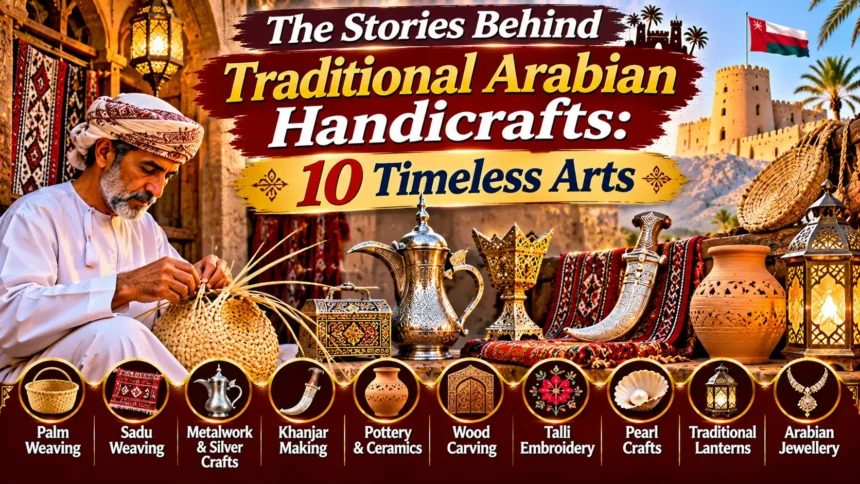
The Stories Behind Traditional Arabian Handicrafts: Exploring Ancient Skills, Cultural Traditions and Artistic Heritage
Traditional Arabian handicrafts are more than beautiful objects made by hand. They tell stories about the people, places and traditions of the Arabian Peninsula. Every woven carpet, silver ornament, clay pot and decorated piece of clothing reflects the skills and creativity of generations of craftspeople.
- 1. Al Sadu Weaving: A Story Woven Through Generations
- 2. Al-Qatt Al-Asiri: Colourful Wall Art from Saudi Arabia
- 3. The Omani Khanjar: A Symbol of Identity and Heritage
- 4. Palm-Leaf Weaving: Turning Natural Materials into Everyday Items
- 5. Traditional Pottery: The Art of Shaping Clay
- 6. Silver Jewellery and Traditional Metalwork
- 7. Traditional Embroidery: Beauty in Every Thread
- 8. Dhow Building: A Craft Connected with the Sea
- 9. Arabic Calligraphy: Turning Writing into Art
- 10. The Stories Behind Traditional Crafts
- 11. How Traditional Arabian Handicrafts Are Changing Today
- 12. Why Traditional Arabian Handicrafts Still Matter
- Conclusion
- Frequently Asked Questions (FAQs)
For centuries, people across Arabia used locally available materials to create products for their homes, clothing, travel and everyday needs. Desert communities worked with wool, camel hair and palm leaves, while coastal communities used their knowledge of wood, boats, shells and metal. These materials became the foundation of many traditional crafts that are still recognised today.
Traditional Arabian handicrafts help keep old skills, family traditions, and local culture alive.
These crafts are often passed down from mothers to daughters through generations. Everyday items such as tents, clothes, and jewellery reflect how people lived in the desert and along the coast.
Countries such as Oman, Saudi Arabia, the United Arab Emirates, Qatar, Kuwait and Bahrain have their own special handicrafts. Some are connected with desert life, while others developed through trade, fishing, pearl diving and traditional architecture.
Today, these crafts are an important part of Arabian cultural heritage. They can be seen in museums, heritage festivals, traditional markets and modern homes. Let’s explore the stories behind some of the most interesting traditional Arabian handicrafts and discover why they continue to hold cultural value.
1. Al Sadu Weaving: A Story Woven Through Generations
Al Sadu is one of the best-known traditional handicrafts of the Arabian Peninsula. It is a form of handweaving closely connected with Bedouin communities, particularly in Saudi Arabia, Kuwait, Qatar and the United Arab Emirates.
In the past, desert communities needed strong and useful materials for everyday life. Families used wool from sheep, as well as hair from goats and camels, to make durable textiles. These materials were cleaned, spun into yarn and woven using a traditional ground loom.
Al Sadu was traditionally practised mainly by Bedouin women. They created tents, carpets, cushions, bags and decorative items for animals. The finished textiles were useful in desert life because they were strong and could be made from materials available within the community.
One of the most attractive features of Al Sadu is its geometric patterns. Red, black, white, brown and orange are among the traditional colours used in the designs. The patterns often reflect the surrounding environment and the artistic knowledge of the weaver.
The craft is also connected with family life. Older women taught younger generations by showing them how to prepare wool, spin yarn and operate the loom.
Bedouin Weaving:
- The Craft: Traditional weaving using camel hair, goat hair, and sheep’s wool on a simple ground loom.
- The Story: Bedouin families used this weaving to make tents, rugs, blankets, and camel accessories needed for desert life. The designs often feature simple geometric patterns and natural colours inspired by the desert. These patterns also reflect family and tribal traditions.
In 2020, UNESCO inscribed traditional Al Sadu weaving practiced in Saudi Arabia and Kuwait on its Representative List of the Intangible Cultural Heritage of Humanity. Qatar was added through an extension in 2025. This recognition highlights the shared cultural value of the craft across these countries.
2. Al-Qatt Al-Asiri: Colourful Wall Art from Saudi Arabia
Al-Qatt Al-Asiri is a traditional decorative art from the Asir region of southwestern Saudi Arabia. Unlike handicrafts that are mainly made as separate objects, this art is used to decorate the interior walls of homes.
Traditionally, men were responsible for building and maintaining the outside of Asiri homes, while women decorated the interiors.
Before weddings, Eid celebrations, or special gatherings, women invite their female relatives and neighbours to help paint the walls. They spend time together, singing traditional songs and sharing stories while decorating the homes.
For generations, women in Asir have created colourful designs on the walls of reception rooms and other important spaces. The patterns often include geometric shapes, lines and plant-inspired designs. Bright colours make the artwork stand out against the walls.
The designs are usually made with simple tools and traditional techniques. Artists carefully arrange shapes and colours to create balanced patterns. Each decorated wall reflects the creativity and personal style of the person who makes it.
In traditional homes, the decorated reception room was an important place for welcoming guests. Beautiful wall designs therefore represented hospitality, pride and the artistic taste of the household.
Al-Qatt Al-Asiri was added to UNESCO’s Representative List of the Intangible Cultural Heritage of Humanity in 2017. The recognition helped bring more attention to the work of women artists and the importance of protecting this traditional skill.
Today, Al-Qatt designs can also be seen on decorative panels, souvenirs, clothing and modern interior products. This allows the traditional art to reach new audiences while keeping its original identity.
3. The Omani Khanjar: A Symbol of Identity and Heritage
The Omani khanjar is one of the most recognisable traditional objects in Oman. It is a curved dagger worn by men as part of traditional clothing during national celebrations, weddings, religious occasions and important cultural events.
Boys traditionally receive a khanjar when they grow up. Wearing it is a symbol of respect, hospitality, and social status. In the past, beautifully decorated khanjars were also considered valuable possessions that could be used as a form of wealth or security.
Although it is often admired for its appearance, the khanjar also carries a deeper cultural meaning. It represents Omani identity, craftsmanship and traditions passed down through generations.
Making a traditional khanjar requires several skills. Different parts, including the handle, blade, scabbard, covering and belt, are carefully prepared and brought together. Craftspeople may work with silver, wood, leather and cloth to create the finished piece.
Silver decoration is an especially important feature of many Omani khanjars. Skilled artisans use engraving and other metalworking techniques to add detailed patterns. The quality of the work depends on the experience and patience of the craftsperson.
The khanjar has been worn in Oman for centuries and is also featured on the country’s national emblem. UNESCO recognised the traditional craft skills and social practices associated with Al-Khanjar in 2022.
Even today, the Omani khanjar remains an important symbol of cultural pride and is sometimes presented as a special gift to honour guests.
4. Palm-Leaf Weaving: Turning Natural Materials into Everyday Items
Palm-leaf weaving is another traditional craft found across different parts of the Arabian Peninsula. It is especially connected with communities where date palms have been an important part of daily life.
Artisans cut green date palm leaves, remove the small leaves from the main stem, and leave them in the sun to dry until they turn a light beige colour.
People traditionally used dried palm leaves to create practical household products. Instead of wasting these natural materials, craftspeople turned them into useful items through simple but skilled weaving techniques.
In Qatar, this craft is known as Al Khous. Palm fronds are used to make baskets, mats, food covers, fans and other household objects. The products were valued because they were lightweight, useful and made from materials found in the local environment.
The weaving process requires patience and careful preparation. Palm leaves are collected, dried and sometimes coloured before being arranged into different patterns. The strength and appearance of the finished product depend on how tightly the leaves are woven.
Traditional palm-leaf products include:
- Baskets: Used for carrying or storing household items.
- Mats: Used for sitting, resting and covering floors.
- Food covers: Designed to protect meals from insects and dust.
- Hand fans: Used to create airflow in warm weather.
- Date containers: Used for storing one of the region’s most important foods.
Palm-leaf weaving shows how traditional communities used natural resources in practical and creative ways. Today, the craft is also being adapted into decorative products and souvenirs.
5. Traditional Pottery: The Art of Shaping Clay
Pottery is one of the oldest handicraft traditions in the Arabian region. For thousands of years, communities have used clay to make cooking vessels, storage containers, water jars and decorative objects.
Bahrain has a particularly long pottery tradition. According to Bahrain Tourism, pottery-making on the island dates back more than 4,000 years, reaching into the time of the ancient Dilmun civilisation.
Traditional pottery starts with the preparation of clay. Craftspeople shape the material by hand or on a pottery wheel, depending on the local technique and the type of object being made.
The shaped item is then dried before being fired to make it stronger. Some pieces are left with a simple natural finish, while others receive decorative designs or surface treatment.
In the past, pottery played an important role in everyday life. Families needed containers for storing water, grains, dates and other supplies. Cooking pots were also essential in traditional kitchens.
Today, pottery continues to be made for both practical and decorative purposes. Visitors can find handmade clay pots, bowls, vases and other products at cultural markets and craft centres.
The story of Arabian pottery shows how a simple natural material became an important part of household life, trade and artistic expression.
6. Silver Jewellery and Traditional Metalwork
Silver jewellery has a long history across the Arabian Peninsula. Skilled metalworkers have created necklaces, bracelets, rings, earrings and other ornaments for generations.
Before modern banks existed, Arabian silver jewellery and metal items were more than just decorations. People wore them as valuable possessions, believed they offered protection, and used them to show hospitality.
Skilled craftsmen used silver, copper, brass, and old trade coins to create beautiful pieces. These items were treasured by families and passed down from one generation to the next.
Different communities developed their own styles and designs. Some pieces feature detailed engraving, while others include decorative patterns, stones or small metal elements.
In Oman, silverwork is particularly well known for its connection with traditional dress and the manufacture of khanjars. Silver artisans also create jewellery and decorative objects inspired by local culture.
Metal engraving is not limited to silver. Craftspeople across the region have worked with gold, copper and other metals to produce objects for personal use, celebrations and household decoration.
UNESCO recognised the wider skills and practices associated with engraving on metals, including gold, silver and copper, through a multinational cultural heritage inscription in 2023.
Traditional metalwork requires careful control of tools and materials. Even small decorative details can take considerable time to complete.
These objects are valued not only for their appearance but also for the knowledge and experience behind their creation.
7. Traditional Embroidery: Beauty in Every Thread
Embroidery is another important part of Arabian handicraft traditions. It has been used to decorate traditional clothing, scarves, head coverings and special garments.
In Qatar, one recognised technique is known as Al-Naqdah. It involves decorating women’s garments and headscarves with gold or silver threads. This detailed needlework adds shine and beauty to traditional clothing.
Embroidery is usually completed by hand, with artisans carefully placing threads to create patterns across the fabric. Some designs are simple, while others include detailed shapes and repeated decorative lines.
In the past, women often prepared and decorated garments at home. Traditional clothing was an important part of family celebrations, weddings and other social occasions, making embroidery a valued skill.
The designs and materials used can vary between communities. Some garments feature colourful threadwork, while others use metallic thread for a more decorative appearance.
Today, traditional embroidery continues to inspire clothing designers and fashion businesses. Many modern garments combine traditional patterns with contemporary cuts and materials.
8. Dhow Building: A Craft Connected with the Sea
The Arabian Peninsula has a long maritime history. Coastal communities depended on fishing, trade and pearl diving, and traditional wooden boats played an important role in their lives.
One of the most familiar types of traditional Arabian vessels is the dhow. Different designs were built for different purposes, including fishing, transporting goods and travelling between ports.
Building a wooden boat requires considerable knowledge of materials, measurements and construction techniques. Boatbuilders select suitable timber, shape the wooden parts and join them carefully to create a strong vessel.
Bahrain has a historic connection with dhow building. According to Bahrain Tourism, different boats were designed for specific activities, including vessels used for pearl diving, fishing and carrying goods across the Gulf.
These boats once connected communities across the Arabian Gulf and supported trade with other parts of the world.
Although modern boats have replaced many traditional wooden vessels, the craft remains an important part of maritime heritage. Traditional dhow-building skills are also preserved through heritage sites, workshops and cultural programmes.
9. Arabic Calligraphy: Turning Writing into Art
Arabic calligraphy is one of the most recognised art traditions across the Arab world. It combines beautiful writing with artistic design, turning letters and words into decorative compositions.
Calligraphy became especially important in Islamic artistic traditions. The writing of the Quran encouraged the development of carefully designed Arabic scripts, with artists paying close attention to the shape, balance and arrangement of letters.
Over time, calligraphy appeared on manuscripts, buildings, tiles, carpets, wall decorations and other objects. Its use was not limited to religious settings; it also became a popular form of artistic expression.
In Qatar, Arabic calligraphy can be found on paper, tiles, carpets, wall hangings and carved inscriptions.
Traditional calligraphers use special tools and different writing styles to create their work. The size, spacing and movement of each letter help form the overall design.
Today, Arabic calligraphy is also used in modern graphic design, branding, home decoration and fashion. It provides a link between traditional artistic knowledge and contemporary creativity.
10. The Stories Behind Traditional Crafts
Every traditional handicraft has a story connected with the people who created it. These objects often began as practical solutions to everyday needs before becoming recognised symbols of culture and identity.
For example, Al Sadu textiles helped Bedouin communities prepare tents and household items. Palm-leaf weaving turned natural materials into useful products, while pottery supported food preparation and storage.
Metalwork and jewellery were connected with traditional clothing, celebrations and personal decoration. Dhow building supported fishing, pearl diving and trade, while calligraphy brought beauty to writing and architecture.
These crafts also tell us about the natural environment of different regions. Desert communities used wool, camel hair and goat hair, while coastal communities developed skills connected with boats, fishing and maritime trade.
Understanding these connections makes traditional handicrafts more meaningful. They are not simply decorative objects but records of how people lived, worked and expressed their creativity.
11. How Traditional Arabian Handicrafts Are Changing Today
Modern lifestyles have changed the way many traditional crafts are made and used. Factory-produced products, modern materials and changing consumer habits have reduced the everyday need for some handmade items.
However, many crafts are finding new ways to remain relevant. Artisans are creating products for tourists, collectors, home decoration and modern fashion.
Cultural centres, museums, workshops and heritage festivals also help introduce traditional skills to younger generations. These programmes give craftspeople opportunities to demonstrate their work and teach others.
UNESCO recognition has helped bring international attention to several traditions, including Al Sadu weaving, Al-Qatt Al-Asiri and the Omani khanjar craft. Such recognition also highlights the importance of the communities and artisans who keep these skills alive.
Some important ways to support traditional handicrafts include:
- Buying handmade products from local artisans.
- Visiting cultural markets and craft workshops.
- Learning how traditional objects are made.
- Supporting exhibitions and heritage festivals.
- Encouraging younger people to learn traditional skills.
- Choosing authentic local products instead of imitation goods.
The future of these crafts depends on more than preserving old objects. It also depends on supporting the people who know how to make them.
12. Why Traditional Arabian Handicrafts Still Matter
Traditional Arabian handicrafts remain important because they connect the present with the past. They help people understand the history, skills and values of the communities that developed them.
Each craft also represents a different kind of knowledge. Weaving requires an understanding of fibres and patterns. Pottery depends on working with clay and heat. Metalwork needs patience and control, while dhow building requires knowledge of wood and construction.
These skills cannot be fully understood by looking at finished products alone. They are best appreciated by watching artisans work, learning about their materials and listening to the stories behind their designs.
Handicrafts also create opportunities for local businesses and cultural tourism. Visitors who purchase authentic handmade products can help support artisans and encourage the continuation of traditional skills.
Most importantly, these crafts remind future generations that cultural heritage is not only found in historic buildings and museums. It also lives in the knowledge, creativity and daily work of skilled people.
Conclusion
The stories behind traditional Arabian handicrafts reveal the creativity and knowledge of communities across the Arabian Peninsula. From Al Sadu weaving and Al-Qatt Al-Asiri wall art to Omani silverwork, pottery, palm-leaf products and wooden dhow building, each craft reflects a different part of regional history.
These traditions developed from everyday needs, local materials and skills passed from one generation to another. Over time, they became important symbols of cultural identity and artistic heritage.
Although modern lifestyles have changed the role of many handmade products, traditional crafts continue to find a place in today’s world. Supporting local artisans, visiting craft centres and learning about traditional techniques can help keep these valuable skills alive.
Behind every handmade object is a story of patience, creativity and cultural pride. That is what makes traditional Arabian handicrafts worth protecting and celebrating.
Frequently Asked Questions (FAQs)
1. What are some famous traditional Arabian handicrafts?
Some well-known traditional handicrafts include Al Sadu weaving, Omani khanjar making, Al-Qatt Al-Asiri wall art, palm-leaf weaving, pottery, silver jewellery, embroidery and traditional dhow building.
2. What is Al Sadu weaving?
Al Sadu is a traditional handweaving technique practised by Bedouin communities. It uses natural fibres such as sheep’s wool, goat hair and camel hair to create textiles with colourful geometric patterns.
3. What is Al-Qatt Al-Asiri?
Al-Qatt Al-Asiri is a traditional decorative art from Saudi Arabia’s Asir region. Women traditionally used bright colours and geometric patterns to decorate the interior walls of their homes.
4. What does the Omani khanjar represent?
The Omani khanjar is a traditional curved dagger that represents Omani cultural identity and heritage. It is worn during important occasions and is recognised as an important part of traditional dress.
5. Which natural materials are used in Arabian handicrafts?
Traditional crafts use materials such as wool, camel hair, goat hair, palm leaves, clay, wood, silver, gold and cotton. The choice of material often depends on the local environment and the purpose of the product.
6. Why are traditional Arabian handicrafts important?
They preserve local history, artistic skills and cultural traditions. They also support artisans, encourage cultural tourism and help younger generations learn about their heritage.
7. Where can visitors see traditional Arabian handicrafts?
Visitors can explore traditional handicrafts at heritage markets, museums, cultural centres, craft workshops and festivals across countries such as Oman, Saudi Arabia, Qatar, the UAE, Kuwait and Bahrain.
Do follow us on Instagram
Read More – The Hidden Beauty of Oman’s Desert Landscapes