


Which Sustainable Development Goals Matter Most to Modern Businesses?
The Sustainable Development Goals in business are changing how companies approach growth, investment, innovation and long-term responsibility. Businesses are increasingly expected to consider not only how much profit they generate but also how their operations affect employees, communities, natural resources and the environment.
- How the Sustainable Development Goals in Business Are Changing Corporate Strategy
- Which Sustainable Development Goals Matter Most to Modern Businesses?
- How Sustainability Is Changing Business Models and Product Innovation
- How the SDGs Are Influencing Investment and Corporate Reporting
- Why Employees, Customers and Supply Chains Matter to Sustainable Business
- Sustainable Development Goals in the UAE and GCC Business Environment
- How Small and Large Businesses Can Integrate the SDGs Into Their Strategy
- Challenges, Greenwashing and the Future of Sustainable Business
The United Nations introduced the 17 Sustainable Development Goals, commonly known as the SDGs, in 2015 as part of the 2030 Agenda for Sustainable Development. These goals address major global challenges, including poverty, inequality, education, clean energy, responsible consumption, climate change and economic development.
Although governments play a central role in achieving these objectives, businesses have become important participants. Companies influence employment, supply chains, technology, energy consumption, investment and the availability of essential goods and services.
The importance of business participation has become even clearer as the world approaches 2030.
According to the United Nations Sustainable Development Goals Report 2026, progress has been made in areas such as access to drinking water, electricity, sanitation and healthcare. However, the overall pace remains insufficient to achieve many targets by the 2030 deadline.
For modern companies, sustainability is therefore becoming more closely connected with everyday business decisions.
Manufacturers are examining how products are made and how much waste they produce. Property developers are considering energy efficiency and sustainable construction. Banks and investment firms are assessing environmental and social risks, while technology companies are developing solutions to improve healthcare, education and resource management.
In the UAE and wider GCC, these changes are particularly relevant as governments pursue economic diversification, cleaner technologies, infrastructure development and long-term sustainability strategies.
However, adopting the SDGs does not mean that every business must focus equally on all 17 goals. The most effective approach is to identify the areas where a company has the greatest influence and connect them with measurable business objectives.
This guide explains how the Sustainable Development Goals are shaping modern business, which goals matter most to companies, how businesses can use them in their strategies and what challenges they should consider.
How the Sustainable Development Goals in Business Are Changing Corporate Strategy
For many years, corporate sustainability was largely associated with charitable donations, community projects and occasional environmental campaigns.
That approach is changing.
Today, businesses increasingly connect sustainability with:
- Corporate strategy
- Financial planning
- Risk management
- Product development
- Supply chain operations
- Employee policies
- Investment decisions
- Business reputation
The SDGs provide a common international framework that helps companies identify where their activities intersect with broader economic, environmental and social challenges.
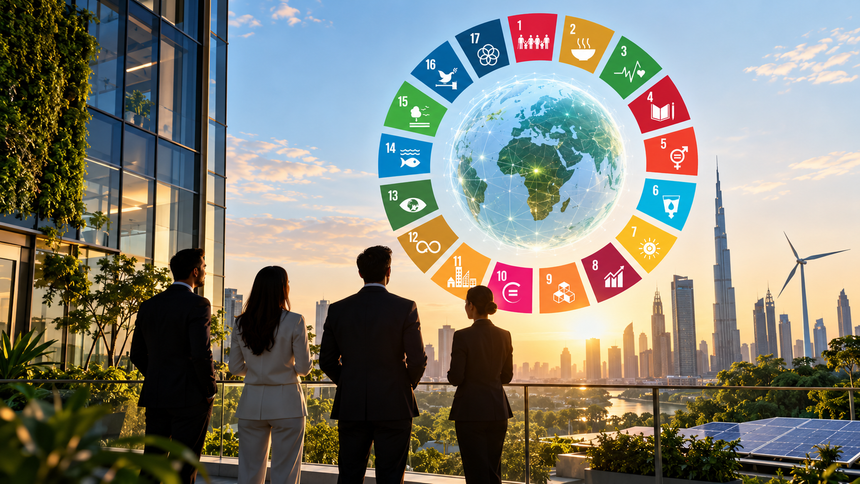
What are the 17 Sustainable Development Goals?
The goals cover three interconnected dimensions of sustainable development:
Economic development
Creating employment, encouraging innovation, improving infrastructure and supporting inclusive economic opportunities.
Social development
Improving health, education, equality, working conditions and access to essential services.
Environmental protection
Reducing pollution, protecting ecosystems, addressing climate change and improving the use of natural resources.
The United Nations describes the goals as an integrated framework for improving human wellbeing while protecting the planet.
Why companies are paying attention
The SDGs can help businesses think beyond short-term financial performance.
For example, a company may be profitable today but face future challenges because of:
- High energy consumption
- Water shortages
- Dependence on vulnerable suppliers
- Poor employee retention
- Environmental liabilities
- Changing customer expectations
Addressing these issues may improve operational resilience.
Sustainability and profitability are not necessarily opposites
Reducing unnecessary electricity consumption can lower utility expenses.
Improving workplace safety can reduce accidents and operational disruption.
Developing longer-lasting products may strengthen customer confidence.
However, sustainability investments can also involve substantial upfront costs, and financial benefits are not guaranteed.
The business case should therefore be evaluated realistically rather than assuming every sustainability initiative will automatically increase profits.
Sustainability should influence important decisions
A meaningful SDG strategy is more than adding colourful goal icons to an annual report.
It should help management answer questions such as:
- Where does the company create positive value?
- Where does it cause environmental or social harm?
- Which risks could affect future operations?
- What improvements are commercially and operationally achievable?
The UN Global Compact’s SDG Compass recommends that companies identify priorities, set goals, integrate sustainability into operations and report their progress.
Which Sustainable Development Goals Matter Most to Modern Businesses?
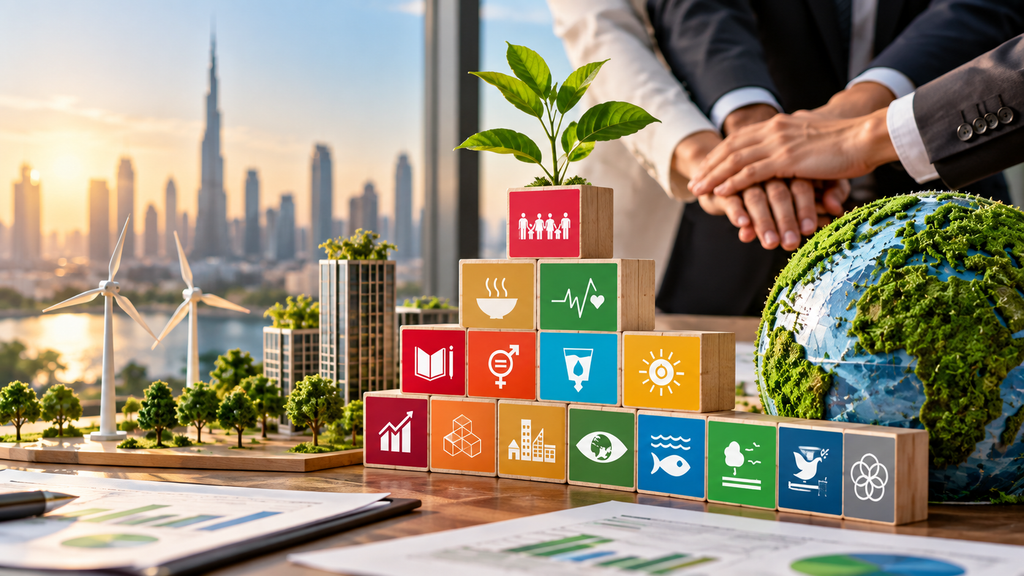
All 17 goals are important, but their relevance varies by industry.
A construction company will have different priorities from a hospital, technology startup or food manufacturer.
The following goals are particularly relevant to many businesses.
| SDG | Main Focus | Business Application |
|---|---|---|
| SDG 3 | Good Health and Well-being | Workplace health and safety |
| SDG 4 | Quality Education | Employee training and skills development |
| SDG 5 | Gender Equality | Fair employment and leadership opportunities |
| SDG 6 | Clean Water and Sanitation | Water efficiency and wastewater management |
| SDG 7 | Affordable and Clean Energy | Renewable energy and energy efficiency |
| SDG 8 | Decent Work and Economic Growth | Fair labour practices and job creation |
| SDG 9 | Industry, Innovation and Infrastructure | Technology and sustainable infrastructure |
| SDG 12 | Responsible Consumption and Production | Waste reduction and circular business models |
| SDG 13 | Climate Action | Emissions reduction and climate resilience |
| SDG 16 | Peace, Justice and Strong Institutions | Anti-corruption and responsible governance |
| SDG 17 | Partnerships for the Goals | Collaboration across sectors |
The UN Global Compact identifies these goals as areas where business operations, responsible conduct and partnerships can contribute to sustainable development.
SDG 8: Decent Work and Economic Growth
This goal is particularly relevant because businesses are major employers.
Companies can contribute by improving:
- Employee safety
- Fair recruitment
- Working conditions
- Skills development
- Employment opportunities
For example, a logistics company might invest in better driver training and workplace safety systems.
SDG 12: Responsible Consumption and Production
This goal addresses how resources are used and how products are produced.
Businesses can focus on:
- Reducing packaging
- Minimising waste
- Improving material efficiency
- Extending product life
- Responsible sourcing
A food company could measure how much food is wasted during storage and distribution.
SDG 13: Climate Action
Companies contribute to climate action by understanding and managing emissions, energy use and exposure to climate-related risks.
For example, a manufacturing business may improve energy efficiency while evaluating how extreme weather could affect suppliers.
SDG 9: Industry, Innovation and Infrastructure
Technology and infrastructure businesses may contribute through innovations that improve:
- Transport
- Manufacturing efficiency
- Digital connectivity
- Resource management
The important point is that companies should select goals according to their actual operations and impacts.
Trying to claim contributions to every SDG without supporting evidence can weaken credibility.
How Sustainability Is Changing Business Models and Product Innovation
One of the most significant effects of the SDGs is their influence on business innovation.
Companies are increasingly exploring products and services that address environmental or social problems while creating commercial value.
This can involve developing entirely new businesses or improving existing operations.
Clean energy solutions
Businesses are investing in technologies that support cleaner electricity generation and more efficient energy use.
Examples include:
- Solar technology
- Energy management software
- Efficient cooling systems
- Battery storage
- Smart buildings
These innovations connect closely with SDG 7 and SDG 13.
Circular economy business models
Traditional production often follows a linear system:
Raw materials
→ Manufacturing
→ Consumption
→ Disposal
Circular business models attempt to extend the useful life of products and materials.
Companies may introduce:
- Repair services
- Refurbished products
- Reusable packaging
- Product take-back programmes
- Recycling systems
For example, an electronics company could offer refurbishment services instead of encouraging customers to replace every device immediately.
This may create additional revenue opportunities while reducing waste.
Technology for social development
Innovation is also connected with education, healthcare and financial inclusion.
Examples include:
- Online learning platforms
- Digital healthcare services
- Accessible financial products
- Agricultural technology
- Affordable digital infrastructure
A startup providing low-cost educational technology may contribute to SDG 4 while operating as a commercially sustainable business.
Innovation must solve a genuine problem
Not every product advertised as sustainable creates a meaningful improvement.
Businesses should examine the full environmental or social effect.
For example, replacing one packaging material with another may reduce plastic use but increase transportation emissions or water consumption.
A proper assessment should consider the complete product life cycle.
Innovation can improve competitiveness
Companies that use fewer resources, respond to customer needs and manage environmental risks may develop advantages over competitors.
However, the financial outcome depends on implementation costs, customer demand and market conditions.
Sustainability should therefore be treated as part of commercial strategy rather than a guaranteed shortcut to growth.
How the SDGs Are Influencing Investment and Corporate Reporting
Sustainability is also influencing how investors evaluate businesses.
Traditional investment analysis focuses on areas such as:
- Revenue
- Profitability
- Cash flow
- Debt
- Growth potential
These remain essential.
However, investors may also consider whether environmental and social issues could affect future financial performance.
What is ESG?
ESG refers to:
- Environmental
- Social
- Governance
These categories help businesses and investors assess different aspects of corporate risk and management.
Although ESG and the SDGs are connected, they are not identical.
SDGs describe global development objectives.
ESG describes categories used to evaluate business practices, risks and performance.
For example, a company’s energy consumption may relate to SDG 7 and SDG 13 while also appearing in its environmental reporting.
Sustainability reporting is becoming more structured
Companies are increasingly expected to support sustainability claims with measurable information.
The Global Reporting Initiative and UN Global Compact provide guidance for integrating the SDGs into corporate reporting.
Their approach encourages businesses to identify relevant impacts, set objectives, select meaningful indicators and explain progress.
International reporting standards
The International Sustainability Standards Board has developed two important standards:
- IFRS S1: General Requirements for Disclosure of Sustainability-related Financial Information
- IFRS S2: Climate-related Disclosures
These standards focus on sustainability-related risks and opportunities that may affect a company’s financial prospects.
They cover governance, strategy, risk management, metrics and targets.
However, the standards are not automatically mandatory for every company worldwide.
Individual jurisdictions determine whether and how to adopt them.
The IFRS Foundation’s September 2026 update shows that countries are following different approaches, including mandatory adoption, voluntary use and phased implementation.
Why reporting matters
Good reporting allows businesses to:
- Identify risks
- Track improvements
- Communicate with investors
- Support management decisions
- Explain environmental and social performance
For example, a property developer might report:
- Energy use across buildings
- Water consumption
- Construction waste
- Workplace safety incidents
These indicators can be more useful than simply stating that the company supports sustainable development.
Why Employees, Customers and Supply Chains Matter to Sustainable Business
Business sustainability is not limited to energy and emissions.
The social dimension can be equally important.
A company may operate an energy-efficient building but still face problems involving:
- Unsafe working conditions
- Unfair recruitment
- Poor treatment of suppliers
- Limited employee development
That is why the SDGs encourage a broader perspective.
Employee wellbeing
SDG 3 and SDG 8 are particularly relevant to workplace policies.
Businesses can improve employee wellbeing through:
- Safe workplaces
- Appropriate working hours
- Health support
- Skills development
- Fair employment practices
A hospitality business, for example, may focus on workplace safety, training and employee accommodation.
Gender equality and opportunity
SDG 5 encourages progress toward gender equality.
Businesses can assess:
- Recruitment
- Promotion practices
- Pay structures
- Leadership opportunities
- Workplace discrimination
The goal should be meaningful fairness rather than simply publishing impressive-looking statistics.
Responsible supply chains
A company’s impacts do not stop at its own office or factory.
Suppliers may contribute significantly to its environmental and social footprint.
For example, a clothing company may need to examine:
- Textile production
- Factory working conditions
- Water use
- Waste
- Transportation
A food business may evaluate:
- Agricultural practices
- Packaging
- Cold-chain efficiency
- Food waste
Supplier standards
Businesses can establish clear expectations covering:
- Labour practices
- Health and safety
- Environmental management
- Ethical conduct
However, issuing supplier policies is only the beginning.
Companies also need proportionate monitoring and meaningful corrective action.
Partnerships can support progress
SDG 17 recognises the importance of cooperation.
Businesses may work with:
- Universities
- Governments
- Suppliers
- Industry associations
- Community organisations
For example, a technology company could partner with an educational institution to provide digital skills training.
The UN Global Compact encourages businesses to extend sustainability efforts across their value chains and build partnerships that support measurable outcomes.
Sustainable Development Goals in the UAE and GCC Business Environment
The Sustainable Development Goals are particularly relevant to the UAE and GCC as countries pursue economic diversification and long-term development.
Across the region, governments and businesses are investing in sectors such as:
- Renewable energy
- Advanced manufacturing
- Technology
- Logistics
- Education
- Healthcare
- Sustainable infrastructure
These activities overlap with several SDGs.
The UAE’s national approach
The UAE established its National Committee on Sustainable Development Goals in January 2017.
The committee coordinates national efforts, monitors progress and encourages cooperation between government entities and other stakeholders.
The UAE Government identifies private-sector participation as an important part of the national SDG framework.
Private-sector engagement
According to the UAE Government, private-sector participation is supported through mechanisms including:
- Private Sector Advisory Council
- UN Global Compact local network
These platforms support dialogue and help companies consider how the SDGs can be incorporated into their business activities.
Opportunities for UAE companies
Different sectors can contribute in different ways.
| UAE Business Sector | Relevant SDGs | Practical Actions |
|---|---|---|
| Real estate | SDG 7, 11, 13 | Energy-efficient buildings |
| Hospitality | SDG 8, 12 | Reduce food waste and improve employment practices |
| Logistics | SDG 9, 13 | Improve fleet efficiency |
| Banking | SDG 8, 9, 13 | Support responsible financing |
| Technology | SDG 4, 9 | Develop accessible digital solutions |
| Retail | SDG 12 | Reduce packaging and waste |
| Healthcare | SDG 3 | Improve access and service quality |
| Manufacturing | SDG 6, 7, 12 | Improve resource efficiency |
Sustainability in Dubai business
Dubai’s international business environment creates both opportunities and challenges.
Companies operating across different markets may face different expectations relating to:
- Environmental performance
- Supplier standards
- Product information
- Corporate reporting
For example, an e-commerce business selling to several GCC countries may need to consider packaging efficiency, delivery operations and local consumer requirements.
A construction company may focus on energy efficiency, water management and safer worksites.
Small businesses also have a role
Sustainable development is not exclusively for large corporations.
A small Dubai restaurant can contribute by:
- Reducing food waste
- Improving energy efficiency
- Managing water use
- Training employees
A service company may focus on employee development, ethical business practices and responsible procurement.
The key is choosing actions that match the company’s size and resources.
How Small and Large Businesses Can Integrate the SDGs Into Their Strategy
Companies do not need to redesign their entire operations immediately.
A practical approach begins with understanding where the business already has the greatest impact.
The UN Global Compact’s SDG Compass provides a five-step framework for connecting the goals with corporate strategy.
Step 1: Understand the SDGs
Begin by learning what the 17 goals cover.
Do not assume all of them are equally relevant.
A software company and a construction company will have very different impacts.
Step 2: Identify business priorities
Review the company’s activities.
Consider:
- Energy
- Water
- Waste
- Employees
- Products
- Customers
- Suppliers
- Communities
Identify the areas with the greatest potential positive and negative impacts.
Step 3: Establish a baseline
Before setting targets, understand current performance.
For example:
Annual electricity use: 500,000 kWh
Annual water consumption: 8,000 cubic metres
Annual waste: 100 tonnes
These figures are illustrative.
Actual measurements should come from company records.
Step 4: Set measurable targets
Vague goal:
“We want to become more sustainable.”
Better goal:
“Reduce electricity consumption per unit of production by 15% within three years.”
A measurable target makes progress easier to evaluate.
Step 5: Integrate the goals into daily operations
Sustainability should influence actual decisions.
For example:
A purchasing team might evaluate supplier environmental performance.
An operations team might monitor waste.
HR might track employee training.
Management should assign responsibility and review performance regularly.
Step 6: Measure and communicate results
Companies can publish progress through:
- Annual reports
- Sustainability reports
- Company websites
- Investor communications
However, published claims should reflect actual evidence.
Example: A small UAE business
Imagine a Dubai-based food company.
Its initial priorities might be:
SDG 8: Decent Work and Economic Growth
SDG 12: Responsible Consumption and Production
SDG 13: Climate Action
A simple action plan could include:
| Priority | Business Action | Measurement |
|---|---|---|
| Reduce food waste | Improve stock management | Kilograms wasted monthly |
| Improve energy efficiency | Upgrade equipment | Electricity per unit produced |
| Employee development | Provide regular training | Training hours per employee |
| Reduce packaging | Redesign packaging | Material used per order |
| Improve delivery efficiency | Optimise delivery routes | Fuel use per delivery |
This approach creates a direct connection between international goals and everyday business operations.
A practical SDG checklist
- Understand the 17 goals
- Identify relevant business impacts
- Select priority goals
- Establish baseline measurements
- Set realistic targets
- Assign responsibility
- Involve employees and suppliers
- Track progress
- Publish evidence-based results
- Review targets regularly
The objective is continuous improvement rather than claiming perfection.
Challenges, Greenwashing and the Future of Sustainable Business
Although interest in sustainability has increased, implementing the SDGs is not always straightforward.
Companies face practical and financial challenges.
Implementation costs
Some improvements require substantial investment.
For example:
- Energy-efficient equipment
- Renewable power systems
- Wastewater treatment
- Supply chain monitoring
Smaller businesses may not have the same financial resources as multinational corporations.
That makes prioritisation important.
Difficulty measuring impact
Some sustainability outcomes are easier to measure than others.
Electricity consumption can be tracked through utility records.
However, measuring broader effects on community wellbeing or inequality may be more complicated.
Businesses should choose indicators that accurately reflect what they can influence.
Greenwashing
Greenwashing occurs when environmental claims create a misleading impression about a product, service or company.
Examples might include:
- Calling a product environmentally friendly without evidence
- Making broad sustainability claims based on one minor improvement
- Hiding significant environmental impacts
- Using unclear or exaggerated language
Why greenwashing creates business risk
Misleading sustainability claims can damage customer confidence.
They may also create legal or regulatory exposure depending on the market and applicable rules.
Companies should support their statements with:
- Reliable data
- Clear explanations
- Appropriate comparisons
- Independent verification where useful
Avoid treating the SDGs as a marketing exercise
A company should not assume that displaying SDG icons proves meaningful contribution.
The goals should be connected to measurable actions.
For example, a company supporting SDG 13 should explain how it is addressing emissions or climate-related risks.
The challenge of balancing short-term and long-term priorities
Businesses often operate under financial pressure.
Management must balance:
- Profitability
- Cash flow
- Investment
- Customer demand
- Sustainability improvements
Some sustainability actions deliver immediate savings.
Others may require several years before financial benefits become apparent.
The most effective approach is to integrate sustainability into financial planning rather than treating it as a separate activity.
What the UN’s 2026 findings mean for business
The Sustainable Development Goals Report 2026 makes clear that global progress remains uneven.
The report highlights improvements achieved since 2015, including nearly one billion additional people gaining access to safely managed drinking water and 1.2 billion gaining access to safely managed sanitation.
However, the UN also warns that progress is not fast enough to meet many of the goals by 2030.
This creates an important challenge for businesses.
Companies can contribute through responsible operations and innovation, but they cannot solve every development challenge independently.
Government policy, infrastructure, public investment and international cooperation remain essential.
The future of sustainable business
Over the coming years, companies are likely to face continued pressure to explain how they manage environmental and social risks.
The extent of that pressure will vary by industry and jurisdiction.
Sustainability reporting frameworks may become more widely used, while technology could make certain types of environmental measurement easier.
Businesses may also discover new opportunities in:
- Cleaner energy
- Resource efficiency
- Sustainable construction
- Digital education
- Healthcare technology
- Circular economy services
However, the strongest strategies will be those that combine commercial viability with measurable positive outcomes.
Final takeaway
The Sustainable Development Goals are shaping modern business by encouraging companies to consider how financial performance connects with environmental protection, social responsibility and long-term economic development.
The goals are influencing corporate strategy, product design, investment decisions, supply chains and reporting practices.
For large corporations, this may involve complex sustainability programmes and detailed disclosures.
For smaller businesses, progress may begin with practical improvements such as reducing waste, improving employee training or using energy more efficiently.
The UAE and GCC provide relevant examples of how sustainable development can connect with economic diversification, technology and infrastructure investment.
But sustainable business should not be reduced to marketing claims.
Companies need clear priorities, measurable targets and credible reporting.
As the world moves closer to 2030, businesses that understand their environmental and social impacts will be better positioned to identify relevant risks, respond to changing expectations and develop solutions that support both long-term commercial performance and wider sustainable development.
The goal is not simply to appear responsible.
It is to make responsible business practices part of how a company operates, makes decisions and plans for the future.
Do follow us on Instagram
Read More – ARTBAT Dubai 2026: UPPERGROUND Comes to Ushuaïa Dubai Harbour