

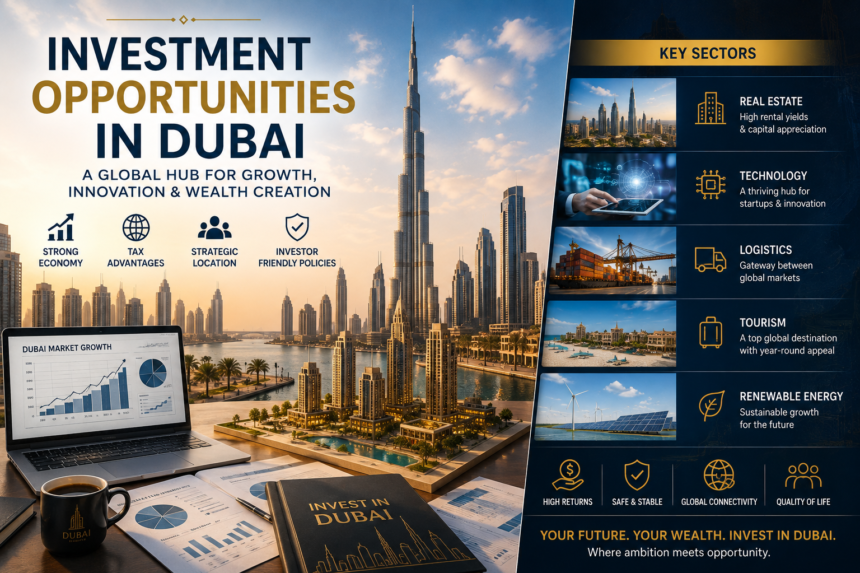
10 Fast-Growing Dubai Sectors Investors Should Not Ignore
Dubai has spent decades building a reputation around trade, tourism, aviation and real estate. In 2026, however, the city’s investment story is considerably broader. Artificial intelligence, financial technology, logistics, advanced manufacturing, healthcare, digital commerce and environmental technology are becoming increasingly important parts of the economy.
- Why Investment Opportunities in Dubai Continue to Expand
- 1. Real Estate Investment
- Residential Property
- Commercial Property
- 2. Artificial Intelligence and Technology
- 3. Startups and Venture Capital
- 4. Financial Services and FinTech
- FinTech Opportunities
- 5. Logistics and Warehousing
- 6. Advanced Manufacturing
- 7. Tourism and Hospitality
- 8. E-commerce and Consumer Businesses
- 9. Healthcare and Life Sciences
- 10. Green Economy and Environmental Technology
- Investment Opportunities in Dubai at a Glance
- Dubai’s Economy Is Becoming More Diversified
- Should You Invest in Dubai Real Estate or Stocks?
- What About Sukuk and Fixed Income?
- Which Areas Are Best for Startup Investment?
- Free Zones and Business Investment
- Dubai’s Capital Markets Are Becoming More Accessible
- Foreign Investors Continue to View Dubai as a Regional Base
- Risks Investors Should Understand
- Avoid Investing Only Because Everyone Else Is
- How to Evaluate an Investment Opportunity
- Diversification Is Still Important
- Who May Prefer Dubai Real Estate?
- Who May Prefer Listed Investments?
- Who May Prefer Business Investment?
- Common Dubai Investment Mistakes
- FAQs About Investment Opportunities in Dubai
- Conclusion
That expansion is creating a wider range of Investment Opportunities in Dubai for entrepreneurs, companies, institutional investors and individuals searching for exposure to the emirate’s long-term growth.
Dubai ranked No. 1 globally for greenfield foreign direct investment projects for the fifth consecutive year in 2025, recording 1,253 announced projects, up 10.5% from the previous year. The city attracted about AED 32.43 billion in greenfield FDI capital and those projects supported almost 39,000 jobs.
The wider UAE also attracted a record AED 177.3 billion in FDI inflows during 2025, while the country remained second globally for the number of greenfield investment projects.
Those numbers show strong investor interest, but growth alone does not make every opportunity attractive.
Successful investing still requires understanding demand, valuation, risk, regulation and the purpose of the investment.
Why Investment Opportunities in Dubai Continue to Expand
Dubai’s biggest advantage is diversification.
The emirate is no longer dependent on one major industry.
Investment activity now stretches across:
- real estate,
- finance,
- logistics,
- technology,
- manufacturing,
- tourism,
- healthcare,
- e-commerce,
- professional services,
- environmental technology.
Dubai also retained the world’s No. 1 ranking in 2025 for greenfield FDI projects across several strategic clusters, including ICT and electronics, creative industries, professional services, life sciences, financial services and environmental technology. It also ranked first globally for manufacturing FDI projects for the first time.
This diversity matters because investors can participate in Dubai’s growth through several very different asset classes.
Someone interested in property has a different opportunity from a venture-capital investor.
A logistics company has different priorities from someone buying listed equities.
Dubai offers room for all of them.
1. Real Estate Investment
Real estate remains one of the most visible Investment Opportunities in Dubai.
The attraction comes from several factors:
- population growth,
- international wealth migration,
- tourism,
- new business formation,
- long-term residency options,
- international demand for residential property.
Real estate accounted for around 7% of UAE greenfield investment capital expenditure in 2025, supported partly by continuing migration of international wealth and talent.
But investors should avoid treating the whole Dubai property market as one investment.
Performance varies by:
- location,
- property type,
- developer,
- supply,
- service charges,
- rental demand,
- purchase price.
A studio in a high-demand rental area has a different investment case from a luxury villa or off-plan apartment.
Residential Property
Residential real estate is popular with individual investors because it is easy to understand.
Potential returns can come from:
Rental income
and
capital appreciation
But both require careful analysis.
Before buying, calculate:
- realistic annual rent,
- service charges,
- maintenance,
- vacancy,
- agent fees,
- financing cost,
- transaction expenses.
Gross rental yield can look attractive while net return is much lower.
Commercial Property
Dubai’s growth as a business centre can also create demand for:
- offices,
- warehouses,
- retail,
- industrial units.
Commercial real estate can produce attractive income, but tenant quality and lease structure matter greatly.
A vacant office generates no rent regardless of how impressive the building looks.
2. Artificial Intelligence and Technology
Artificial intelligence is becoming one of the most important investment themes in the UAE and Dubai.
Dubai retained the global No. 1 ranking for AI-related greenfield FDI projects for the fourth consecutive year in 2025.
This is significant because AI investment extends far beyond chatbots or consumer apps.
The opportunity includes:
- enterprise software,
- data analytics,
- cybersecurity,
- automation,
- cloud infrastructure,
- robotics,
- machine learning,
- AI consulting.
Dubai’s economic zones are also investing heavily in future technology infrastructure. In August 2026, Dubai Integrated Economic Zones Authority reported continued investment in innovation, including the AED 11 billion District IO development designed to support research, development and future technologies.
For investors, that means AI can be approached through several layers.
You could invest in:
technology companies
or
the infrastructure those companies need.
3. Startups and Venture Capital
Dubai’s startup ecosystem is moving beyond the earliest stage of development.
Across the UAE, average startup funding rounds reached approximately $9.2 million in 2025, almost double the previous level, suggesting that companies are increasingly moving from formation toward scaling.
Dubai offers startups access to:
- international talent,
- venture capital,
- free zones,
- regional customers,
- corporate partners,
- accelerators,
- global connectivity.
Strong startup themes include:
- FinTech,
- AI,
- e-commerce,
- HealthTech,
- logistics technology,
- SaaS,
- cybersecurity.
However, startup investing carries much greater risk than deposits or diversified public-market investments.
Many startups fail.
Investors should examine:
- founders,
- product-market fit,
- revenue,
- customer acquisition cost,
- competition,
- cash burn,
- exit possibilities.
A fashionable sector does not automatically create a good company.
4. Financial Services and FinTech
Dubai has developed one of the region’s strongest financial ecosystems.
Traditional finance, capital markets and FinTech increasingly overlap.
Dubai ranked first globally for financial-services greenfield FDI projects in 2025.
Meanwhile, Dubai Financial Market’s market capitalisation has surpassed AED 1 trillion. The exchange’s general index increased 17.2% during 2025, while average daily trading value exceeded AED 1 billion. Over four years, DFM facilitated AED 47 billion in capital raising through 12 IPOs and attracted more than 465,000 new investors.
This creates investment opportunities through:
- listed shares,
- IPOs,
- sukuk,
- bonds,
- private companies,
- FinTech businesses.
Nasdaq Dubai also continues to strengthen the city’s position in debt markets. It recorded 33 new fixed-income listings worth $13.8 billion from the beginning of 2026 through the reporting period, while outstanding listed sukuk reached $98.6 billion.
FinTech Opportunities
Technology is changing financial services through:
- digital payments,
- remittances,
- wealth platforms,
- lending,
- open finance,
- Islamic FinTech,
- RegTech.
Dubai’s large expatriate population and international business environment create real demand for these services.
The strongest companies will likely solve genuine financial problems rather than simply recreate existing banking apps.
5. Logistics and Warehousing
Dubai’s geography has always been one of its major economic strengths.
The emirate sits between Asia, Europe and Africa while offering:
- major airports,
- Jebel Ali Port,
- free zones,
- warehousing,
- cargo infrastructure.
Dubai ranked No. 1 globally for transportation and warehousing greenfield FDI projects in 2025.
Momentum remained strong in 2026.
Jebel Ali Free Zone attracted more than AED 854 million in new investment commitments during the first four months of 2026, including manufacturing, warehousing, healthcare logistics, vehicle handling and heavy-equipment businesses.
Potential opportunities include:
- warehousing,
- freight forwarding,
- cold storage,
- fulfilment,
- last-mile delivery,
- automotive logistics,
- supply-chain technology.
The growth of e-commerce makes this sector even more important.
Every online purchase eventually becomes a physical logistics problem.
6. Advanced Manufacturing
One of the most interesting changes in Dubai’s investment profile is manufacturing.
In 2025, Dubai ranked first globally for greenfield manufacturing FDI projects for the first time.
Manufacturing opportunities can include:
- food production,
- electronics,
- industrial equipment,
- medical products,
- automotive components,
- metals,
- building materials.
Jafza’s 2026 investment activity already shows this diversity, with commitments involving steel, food products, furniture and other industrial businesses.
Manufacturing also creates opportunities around the factory itself.
Every production facility needs:
- logistics,
- software,
- maintenance,
- packaging,
- energy,
- equipment.
That means industrial expansion can benefit a wider network of companies.
7. Tourism and Hospitality
Tourism remains an important part of Dubai’s economic identity.
But tourism investment does not mean only buying a hotel.
Potential opportunities include:
- restaurants,
- attractions,
- travel technology,
- wellness,
- event management,
- entertainment,
- short-term accommodation,
- tourism services.
Dubai’s continuing destination campaigns highlight the size and diversity of its leisure economy, from beaches and hotels to indoor attractions and family entertainment.
Tourism businesses benefit from Dubai’s international aviation connectivity and global brand.
But competition is intense.
A new hospitality or restaurant concept needs a clear reason to exist.
Location, customer segment and operational quality matter enormously.
8. E-commerce and Consumer Businesses
Dubai ranked first globally in e-commerce greenfield FDI projects during 2025.
The sector benefits from:
- high internet penetration,
- digital payments,
- wealthy consumers,
- strong logistics,
- multicultural population.
Opportunities can include:
- online retail,
- marketplaces,
- fulfilment,
- retail technology,
- subscription businesses,
- direct-to-consumer brands.
However, e-commerce is not automatically easy money.
Customer acquisition can be expensive.
Consumers have many choices.
Margins can become thin after:
- advertising,
- delivery,
- returns,
- discounts,
- marketplace fees.
The strongest businesses usually combine a clear product advantage with efficient logistics and strong customer retention.
9. Healthcare and Life Sciences
Healthcare demand tends to rise with:
- population,
- ageing,
- income,
- insurance coverage,
- medical tourism.
Dubai ranked No. 1 globally in life sciences and healthcare-related FDI clusters in 2025.
Investment opportunities can include:
- clinics,
- specialist centres,
- diagnostics,
- medical technology,
- telemedicine,
- pharmacies,
- healthcare software.
Dubai’s international population can create particularly strong demand for specialist services.
Healthcare also has a structural advantage.
People do not stop needing medical care when consumer trends change.
However, healthcare is heavily regulated, so investors need to understand licensing and professional requirements before entering.
10. Green Economy and Environmental Technology
Environmental technology is another increasingly important Dubai investment theme.
Dubai ranked first globally for greenfield FDI projects in environmental technology in 2025.
Potential areas include:
- solar technology,
- energy efficiency,
- recycling,
- water management,
- green buildings,
- electric mobility,
- sustainable logistics.
This sector is particularly interesting because sustainability requirements are beginning to influence traditional industries.
Real estate developers need energy-efficient buildings.
Transport companies need lower-emission fleets.
Factories need more efficient production.
Hotels increasingly respond to sustainability expectations.
So green investment is becoming less of a standalone niche and more of an economic layer across multiple sectors.
Investment Opportunities in Dubai at a Glance
| Sector | Main Opportunity |
|---|---|
| Real Estate | Residential, commercial and logistics property |
| AI | Software, automation and infrastructure |
| Startups | FinTech, SaaS, HealthTech and e-commerce |
| Financial Services | Equities, sukuk, IPOs and FinTech |
| Logistics | Warehousing, freight and fulfilment |
| Manufacturing | Industrial production and supply chains |
| Tourism | Hospitality, attractions and travel services |
| E-commerce | Digital retail and consumer platforms |
| Healthcare | Clinics, diagnostics and HealthTech |
| Green Economy | Clean technology and sustainable infrastructure |
Dubai’s Economy Is Becoming More Diversified
Dubai’s economy reached AED 232 billion in the first quarter of 2026, representing year-on-year growth of 2.4%.
More importantly, the investment data show activity across multiple sectors rather than one narrow growth engine.
In 2025, Dubai attracted strong FDI activity in business services, hotels and tourism, transportation and warehousing, consumer products, real estate, software and IT, and financial services.
Diversification can help reduce dependence on any single sector.
For investors, it creates more ways to participate in growth.
Should You Invest in Dubai Real Estate or Stocks?
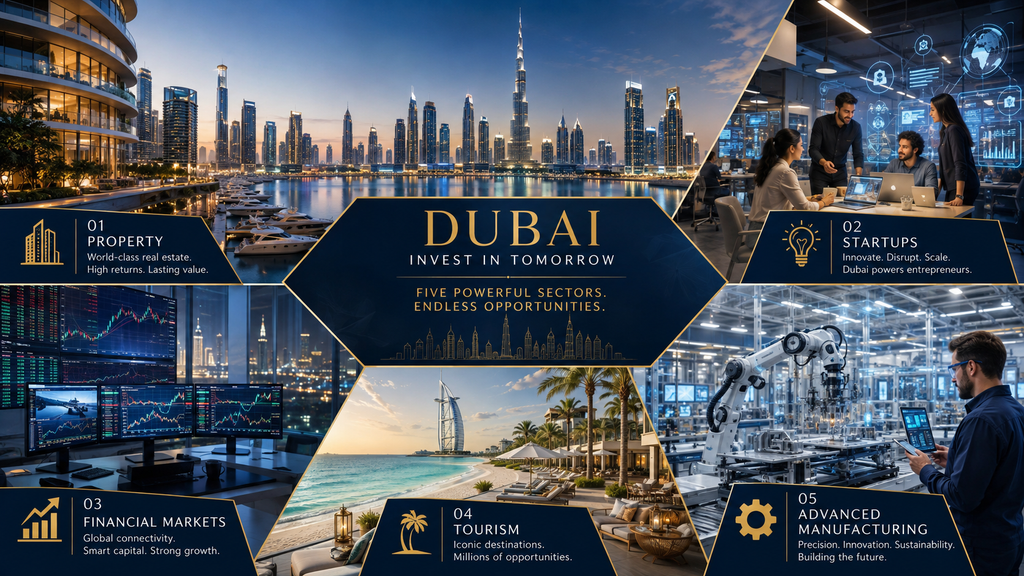
There is no universal answer.
Real Estate
Potential advantages:
- rental income,
- tangible asset,
- leverage through mortgage finance,
- exposure to population growth.
Potential risks:
- illiquidity,
- service charges,
- maintenance,
- market cycles,
- concentration.
Stocks
Potential advantages:
- liquidity,
- easier diversification,
- lower entry cost,
- access to multiple industries.
Potential risks:
- market volatility,
- company-specific risk,
- changing valuations.
Some investors use both rather than choosing only one.
What About Sukuk and Fixed Income?
Dubai is also important in global Islamic capital markets.
Nasdaq Dubai’s outstanding listed sukuk reached about $98.6 billion in 2026 according to the latest Dubai media briefing.
Sukuk may appeal to investors looking for:
- income,
- lower volatility than equities in some cases,
- Sharia-compliant structures.
But credit risk still matters.
A fixed-income instrument is only as reliable as the issuer’s ability to meet its obligations.
Which Areas Are Best for Startup Investment?
Potential high-growth areas include:
AI
Strong government and corporate demand.
FinTech
Dubai’s position as a financial centre creates customers and infrastructure.
Logistics technology
Connected directly to trade and e-commerce.
HealthTech
Healthcare is becoming more digital.
Enterprise SaaS
Businesses increasingly want cloud-based solutions.
The strongest startup opportunities tend to solve practical problems for Dubai businesses rather than relying only on hype.
Free Zones and Business Investment
Dubai’s free zones are a major part of the investment environment.
Different zones specialise in different industries.
They can provide advantages around:
- company formation,
- ownership,
- sector ecosystems,
- infrastructure,
- licensing.
However, the best jurisdiction depends on what the business actually does.
Do not select a free zone solely because it offers the cheapest setup package.
Consider:
- permitted activity,
- customers,
- office needs,
- visas,
- banking,
- mainland trading requirements.
A slightly more expensive structure may be more useful operationally.
Dubai’s Capital Markets Are Becoming More Accessible
One development worth watching is the continuing expansion of Dubai’s public and private capital-market ecosystem.
DFM’s Arena platform is designed to support private companies and SMEs seeking capital while connecting them with a large investor base.
This matters because investment opportunities in Dubai may increasingly sit between traditional stock-market investing and private venture capital.
Investors could gain access to growing businesses before conventional public listings, although private-market investments can be less liquid and carry higher risk.
Foreign Investors Continue to View Dubai as a Regional Base
Dubai remains attractive partly because companies can use the city as a base for markets beyond the UAE.
Dubai Chambers highlighted this positioning in 2026 when presenting the city to UK businesses, emphasising its role as a hub for expansion into regional and international markets.
This is a major part of Dubai’s investment case.
The city is not only a domestic consumer market.
It acts as a gateway linking:
- GCC,
- Africa,
- South Asia,
- Europe.
That makes regional headquarters, logistics and professional services particularly important sectors.
Risks Investors Should Understand
Dubai offers strong opportunities, but no investment market is risk-free.
Important risks include:
- real estate corrections,
- interest-rate changes,
- geopolitical developments,
- business competition,
- valuation risk,
- regulatory changes,
- illiquidity,
- startup failure.
The most dangerous assumption is:
“Dubai is growing, so any Dubai investment will grow.”
That is not how investing works.
Economic growth and investment returns are related, but they are not identical.
A great business bought at an unreasonable valuation can still produce poor returns.
Avoid Investing Only Because Everyone Else Is
FOMO is particularly dangerous in fast-growing markets.
When property prices rise quickly, people rush to buy.
When AI becomes popular, investors rush toward AI startups.
When a successful IPO attracts attention, investors may chase the next listing.
Ask:
Would I still buy this investment if nobody on social media was talking about it?
If the answer is no, you may be responding to excitement rather than analysis.
How to Evaluate an Investment Opportunity
Before investing, consider seven questions:
- What exactly am I buying?
- How does it generate returns?
- What could make the investment lose value?
- How much competition exists?
- What fees and costs apply?
- How easily can I exit?
- Does it fit my broader portfolio?
These questions apply whether the investment is:
- apartment,
- startup,
- share,
- sukuk,
- business.
Diversification Is Still Important
Someone who lives in Dubai, owns Dubai property, works for a Dubai company and keeps all investments in Dubai-listed assets has significant exposure to one economy.
Diversification can involve:
- other countries,
- global equities,
- bonds,
- different industries,
- cash,
- property.
Dubai can be one important part of a portfolio without becoming the entire portfolio.
Who May Prefer Dubai Real Estate?
Real estate may appeal to investors who:
- understand the local property market,
- want rental income,
- have a long holding period,
- can manage property-related expenses.
Who May Prefer Listed Investments?
Stocks and sukuk can appeal to people who:
- want liquidity,
- have smaller investment amounts,
- prefer easier diversification,
- do not want property management responsibilities.
Who May Prefer Business Investment?
Private businesses and startups may suit investors willing to accept:
- higher risk,
- lower liquidity,
- longer time horizons.
Potential returns can be high, but losses can also be substantial.
Common Dubai Investment Mistakes
Avoid these:
- Buying property based only on developer marketing
- Ignoring service charges
- Investing emergency savings
- Putting all money into one sector
- Following social-media tips
- Ignoring liquidity
- Assuming startup growth guarantees profit
- Buying only because of residency benefits
- Ignoring business licensing requirements
- Not calculating total fees
The strongest investment decisions usually look less exciting than speculative ones.
FAQs About Investment Opportunities in Dubai
What are the best Investment Opportunities in Dubai in 2026?
Major areas include real estate, AI, financial services, logistics, manufacturing, tourism, e-commerce, healthcare, startups and environmental technology. Dubai ranked first globally for greenfield FDI projects in several of these sectors during 2025.
Is Dubai still attracting foreign investment?
Yes. Dubai retained the No. 1 global ranking for greenfield FDI projects in 2025, with 1,253 projects and approximately AED 32.43 billion in greenfield investment capital.
Is Dubai real estate a good investment?
It can be, but results depend on purchase price, location, rental demand, supply, financing and ownership costs. Investors should calculate net rental yield rather than relying only on expected appreciation.
Is Dubai good for AI investment?
Dubai ranked first globally for AI-related greenfield FDI projects for the fourth consecutive year in 2025, showing strong investor activity in the sector.
What investment opportunities exist in Dubai logistics?
Warehousing, fulfilment, freight, automotive logistics and supply-chain technology are important areas. Jafza attracted more than AED 854 million in investment commitments in the first four months of 2026.
Can individuals invest in Dubai’s stock market?
Dubai Financial Market provides access to listed companies, while Nasdaq Dubai offers additional securities including sukuk and fixed-income products. DFM’s market capitalisation has surpassed AED 1 trillion.
Is manufacturing growing in Dubai?
Yes. Dubai ranked No. 1 globally for manufacturing greenfield FDI projects for the first time in 2025.
Are Dubai startups good investments?
Some may be, but startup investing is high risk. Investors should evaluate revenue, management, competition, cash requirements and realistic exit possibilities before investing.
Conclusion
The strongest Investment Opportunities in Dubai in 2026 reflect a city that is becoming much more economically diversified.
Real estate remains important, but it is no longer the entire investment story.
Artificial intelligence is attracting international capital.
Dubai ranked first globally for AI-related greenfield projects in 2025.
Manufacturing reached a major milestone by taking the top global ranking for greenfield project numbers.
Logistics continues to benefit from Dubai’s position as an international trade hub.
Financial markets are growing, with DFM surpassing AED 1 trillion in market capitalisation and Nasdaq Dubai strengthening its position in global sukuk and fixed-income markets.
Tourism, healthcare, e-commerce and environmental technology create additional opportunities.
Meanwhile, Dubai’s wider investment environment remains strong. The city retained the global No. 1 ranking for greenfield FDI projects for the fifth consecutive year in 2025, attracting 1,253 projects and billions of dirhams in new capital.
But investors should separate two ideas:
Dubai is a strong investment destination.
and
Every Dubai investment is a strong investment.
The first can be supported by economic and FDI data.
The second is never guaranteed.
The best opportunities are usually those where real demand, sensible valuation, strong management and long-term economic trends come together.
That means researching the sector, understanding the risks, calculating the costs and knowing how the investment will eventually generate a return.
Dubai may provide the opportunity.
Good investment discipline still determines whether that opportunity becomes wealth.
follow us on Instagram
Read More – Best Vegetarian Foods Around the World: 15 Amazing Dishes