


Traditional Omani Dishes You Should Know at a Glance
The traditional Omani dishes you should know reflect a cuisine shaped by trade, geography, hospitality and centuries of contact with India, East Africa, Persia and the wider Arabian Peninsula. Omani food is often aromatic rather than aggressively spicy, with rice, meat, fish, dates, cardamom, saffron, dried lime and slow cooking playing important roles.
- Traditional Omani Dishes You Should Know at a Glance
- Shuwa Is One of Oman’s Most Important Traditional Foods
- Majboos Shows Oman’s Love of Rice, Meat and Aromatic Spices
- Oman’s Coastal Cuisine Includes Fish, Mashuai and Seafood
- Mishkak Is One of the Best Casual Omani Foods to Try
- Harees, Local Breads and Everyday Omani Comfort Food
- Omani Halwa Is More Than Just a Dessert
- Kahwa and Dates Are at the Heart of Omani Hospitality
- How Omani Cuisine Reflects Trade and Regional Influences
- Where Visitors Can Look for Traditional Omani Food
- How to Eat Traditional Omani Food Respectfully
- Common Mistakes Visitors Make When Trying Omani Food
- Traditional Omani Dishes You Should Know on a First Visit
Oman’s Ministry of Heritage and Tourism identifies Shuwa and Majboos among the country’s signature foods. Shuwa is marinated lamb traditionally slow-cooked in an underground oven for as long as 48 hours, while Majboos combines spiced rice with chicken or lamb. Coffee and dates are equally important because they represent the hospitality offered to guests across the Sultanate.
Food also changes as you travel around Oman. Coastal areas naturally have strong seafood traditions, while inland communities developed substantial meat, rice and bread dishes. Dhofar has culinary influences that differ from Muscat and northern Oman, while celebratory dishes such as Shuwa can require communal preparation over many hours.
Visitors therefore should not approach Omani cuisine by searching for one national dish and stopping there. A better introduction combines slow-cooked meat, spiced rice, fish, breads, sweets and the coffee ritual that often begins or ends a traditional meal.
Traditional Omani Dishes You Should Know at a Glance
Omani cuisine includes large celebration meals as well as simple everyday foods. Some dishes are strongly associated with Eid and family gatherings, while others can be found more easily in restaurants throughout the year.
| Dish | What It Is | Best Known For |
|---|---|---|
| Shuwa | Spiced meat slow-cooked underground | Eid and celebrations |
| Majboos | Spiced rice with meat or chicken | Everyday and family meals |
| Mashuai | Fish served with rice and sauce | Coastal cuisine |
| Mishkak | Grilled meat skewers | Casual food and evening stalls |
| Harees | Wheat and meat cooked until smooth | Traditional comfort food |
| Omani bread | Thin or thicker local breads | Breakfast and everyday meals |
| Omani halwa | Sweet aromatic dessert | Hospitality and celebrations |
| Kahwa | Cardamom-scented coffee | Welcoming guests |
| Dates | Local fruit served with coffee | Hospitality tradition |
| Laban | Fermented or cultured milk drink | Meals and hot weather |
The dishes available can vary by restaurant and region, so visitors should ask what is locally prepared instead of expecting every restaurant to carry the same menu.
Shuwa Is One of Oman’s Most Important Traditional Foods
Shuwa is arguably the dish most closely associated with major Omani celebrations. Oman’s official tourism platform describes it as marinated lamb cooked in an underground oven for up to 48 hours.
Traditional preparation is far more elaborate than ordinary roasting. Meat is seasoned with a spice mixture and wrapped before being placed into a specially prepared underground oven, or tanoor.
Times of Oman describes the traditional process as coating the meat with spices, wrapping it in banana or similar leaves, placing it inside a palm-leaf bag and lowering it into a pit containing hot embers. The sealed pit allows the meat to cook slowly for approximately 12 to 24 hours in many preparations, although longer methods also exist.
Why Shuwa tastes different
Long cooking makes the meat exceptionally tender. The spice mixture varies between households and regions, but can contain ingredients such as chilli, cloves and other aromatic seasonings.
Because recipes may be handed down within families, there is no single formula every Omani household follows.
When is Shuwa traditionally eaten?
It is particularly associated with Eid and major family celebrations. Times of Oman describes it as an important festival and wedding food and a central part of Omani culinary tradition.
This means visitors may encounter restaurant versions throughout the year, but experiencing homemade Shuwa during a celebration has a different cultural meaning.
How is it served?
The tender meat is commonly served over rice on a large platter. In traditional settings, several people may share the same dish.
Visitors who can try only one major Omani meat preparation should strongly consider Shuwa because the cooking process itself tells a story about community, patience and celebration.
Majboos Shows Oman’s Love of Rice, Meat and Aromatic Spices
Majboos is another of Oman’s signature dishes. The Ministry of Heritage and Tourism describes it as spiced rice served with chicken or lamb.
It belongs to a wider family of Gulf rice dishes, so travellers who have eaten machboos or kabsa elsewhere in the Arabian Peninsula may notice similarities. However, individual recipes, spice combinations and accompaniments can vary.
What goes into Majboos?
Typical versions use long-grain rice with meat or chicken and aromatic seasonings. Depending on the recipe, flavours may come from ingredients such as cardamom, cinnamon, cloves, black pepper and dried lime.
The rice absorbs the meat stock and spices during cooking, creating a deeply flavoured dish without necessarily becoming very hot from chilli.
What is served with it?
Restaurants may offer accompaniments such as tomato-based sauces, salad or yoghurt.
Presentation also varies. Some versions place the meat directly over the rice, while others arrange the components separately.
Majboos versus Shuwa
These dishes are very different despite both often involving meat and rice. Majboos is fundamentally a seasoned rice dish, while Shuwa is defined by its underground slow-cooking method.
Trying both helps visitors understand two different sides of Omani cooking.
Oman’s Coastal Cuisine Includes Fish, Mashuai and Seafood
Oman has an extensive coastline along the Arabian Sea, Gulf of Oman and Strait of Hormuz, so seafood naturally plays a major role in local food.
Fishing communities have historically relied on species available along the coast, and fish remains an everyday ingredient in many households.
Mashuai
Mashuai is often described as a traditional Omani fish dish consisting of roasted or grilled fish served with rice and a sauce, frequently involving lemon or other sour flavours.
Kingfish is commonly associated with the dish, although the exact fish used can vary according to availability and restaurant.
For travellers who prefer seafood to lamb or chicken, Mashuai can provide a useful introduction to local flavours.
Grilled local fish
Not every traditional seafood meal needs a complicated recipe. Fresh fish simply grilled and served with rice, salad or sauce is widely enjoyed.
When eating near coastal areas, ask what fish is locally available that day.
Why seafood matters to understanding Oman
Focusing only on Shuwa and Majboos can create the impression that Omani cuisine is dominated by meat. Coastal food demonstrates the importance of fishing, maritime trade and the sea to Omani history.
Muscat, Sur and coastal towns are particularly suitable places to explore this side of the cuisine.
Mishkak Is One of the Best Casual Omani Foods to Try
Not every traditional Omani meal requires a formal restaurant or large family gathering.
Mishkak is a much simpler experience. It consists of pieces of marinated meat cooked on skewers over charcoal or an open grill.
Depending on the vendor, the skewers may contain:
- Beef
- Lamb
- Chicken
The marinade can include spices and tangy ingredients that give the meat a distinctive flavour.
Where do people eat Mishkak?
It is associated with casual outdoor eating and can be especially popular during evenings, festivals and public gatherings.
Visitors may find vendors near beaches, markets or busy social areas rather than only inside conventional restaurants.
Why travellers should try it
Mishkak provides a contrast to large rice platters. It is quick, informal and easy to sample without committing to a large meal.
It can also be a useful option for travellers who want to explore Omani food at a lower cost.
Check food handling
As with street or informal food anywhere in the world, choose busy vendors that appear to prepare food fresh and maintain good hygiene.
Freshly grilled skewers served hot are generally preferable to food that has been sitting for long periods.
Harees, Local Breads and Everyday Omani Comfort Food
Some traditional Omani foods are much simpler than the celebration dishes visitors tend to see in tourism photographs.
Harees is one example. It combines wheat and meat cooked for a long period until the ingredients become soft and almost porridge-like.
Similar dishes exist elsewhere in the Gulf, but they remain important within Omani food traditions as well.
Harees
The texture is smooth and substantial rather than rice-like. It can be seasoned simply, allowing the wheat and meat to dominate.
Harees is particularly associated with traditional meals and religious or family occasions.
Omani bread
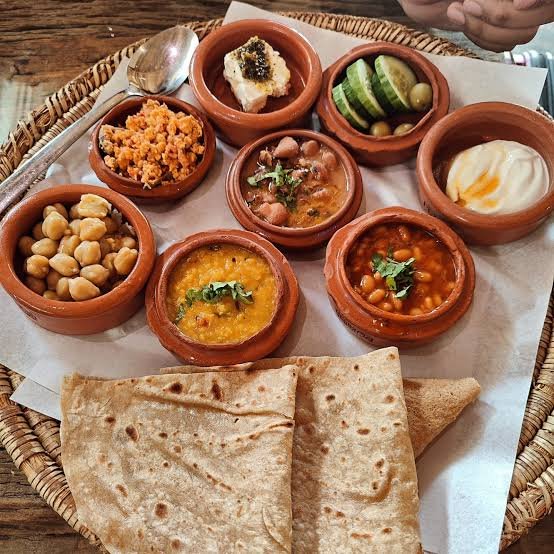
Bread appears in several forms in Oman. Some varieties are extremely thin and crisp, while others are thicker and softer.
Traditional bread may be eaten:
- With eggs
- With cheese
- With honey
- Alongside meat dishes
- With curries or stews
Breakfast is often a good time to discover these everyday foods.
Why breakfast matters
Travellers frequently concentrate on large dinner dishes, but breakfast can reveal a more ordinary side of Omani eating.
A simple breakfast involving local bread, eggs, honey, cheese and tea may provide a more realistic view of daily food habits than another large restaurant feast.
Omani Halwa Is More Than Just a Dessert
Omani halwa is one of the Sultanate’s most distinctive sweets and is closely associated with hospitality, celebrations and important gatherings.
Experience Oman describes halwa as a traditional sweet containing ingredients such as sugar, semolina, ghee, saffron, almonds and rosewater. It is commonly enjoyed with kahwa.
Times of Oman describes versions made with ghee, tapioca flour and water, with cardamom, nuts, saffron and rosewater contributing to the flavour. Historically, dates could also be used as a sweetener.
The precise recipe therefore varies between halwa makers.
What does Omani halwa taste like?
It is rich, sticky and aromatic. Depending on the recipe, flavours can include:
- Saffron
- Rosewater
- Cardamom
- Nuts
The texture is very different from flour-based halwa found in some South Asian cuisines.
How is it served?
Halwa may arrive in a communal bowl and is often shared alongside small cups of coffee.
Oman’s official tourism guide explains a traditional way of eating it using the right hand, although visitors may also be provided with a spoon.
Where to buy it
Dedicated halwa shops are common in Oman, and some families buy particular varieties for guests or special occasions.
It can also make an appropriate food souvenir when packaged for travel.
Kahwa and Dates Are at the Heart of Omani Hospitality
Visitors may remember Omani coffee as strongly as any main course.
Experience Oman describes kahwa as aromatic coffee flavoured with cardamom and served from a metal coffee pot into small cups called finjan. It is offered as a symbol of hospitality and commonly accompanied by dates.
Times of Oman similarly describes kahwa, dates and halwa as central parts of Omani culture and traditional welcoming customs.
The coffee is usually served in small amounts
Do not expect a large café-style cup.
A host may repeatedly refill the small cup as part of the hospitality ritual.
How do you signal that you have finished?
Experience Oman advises gently shaking the cup when you have had enough and saying “Bas, shukran,” meaning “enough, thank you.”
This is a small piece of etiquette worth remembering because otherwise the host may continue offering refills.
Why dates accompany coffee
Their sweetness balances the coffee’s aromatic and slightly bitter character.
Different date varieties can have different textures and levels of sweetness, so visitors interested in food should try more than one type if possible.
Accepting hospitality
When someone offers coffee during a cultural visit, hotel welcome or private gathering, accepting a small amount is generally considered polite.
The ritual is about welcoming the guest as much as it is about drinking coffee.
How Omani Cuisine Reflects Trade and Regional Influences
Oman’s geographic position helped shape its food.
For centuries, Omani merchants and sailors travelled between the Arabian Peninsula, East Africa, Persia and the Indian subcontinent. These connections brought ingredients, spices and techniques that gradually became part of local cooking.
This helps explain why Omani dishes may include aromatic spices familiar to travellers from South Asia while still retaining distinctly Gulf cooking methods.
Spices
Common flavouring influences can include:
- Cardamom
- Cinnamon
- Cloves
- Saffron
- Dried lime
- Black pepper
The goal is often fragrance and depth rather than extreme chilli heat.
East African influence
Oman’s historical relationship with Zanzibar and the East African coast also influenced food, particularly in certain families and regions.
Coconut, rice dishes and spice combinations can reveal some of these historical connections.
Indian Ocean trade
Rice and spices became increasingly important through trade.
This is one reason Omani cuisine can feel familiar to visitors from India or other parts of the Gulf while still being clearly distinctive.
Regional variation
Food in Muscat may differ from food in Dhofar, Al Dakhiliyah or the coastal communities farther north and east.
Travellers who explore more than one region should ask about local specialties rather than ordering the same dishes everywhere.
Where Visitors Can Look for Traditional Omani Food
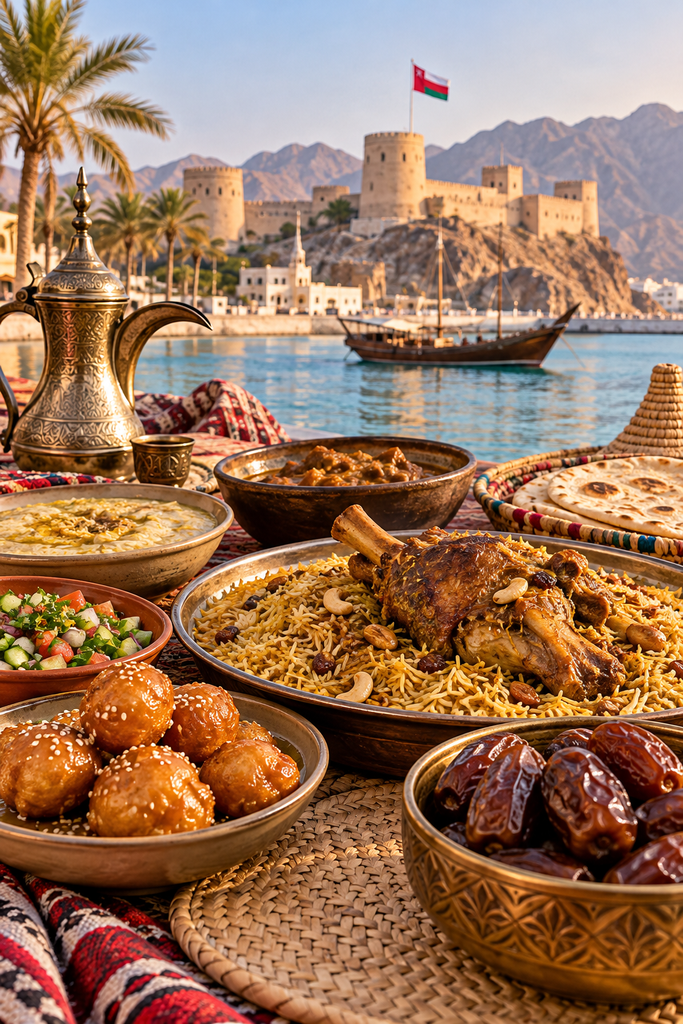
Muscat is the easiest place for many international visitors to begin because it offers traditional restaurants alongside modern dining.
Restaurants serving Omani cuisine can often be found around established tourist and residential areas, while markets provide opportunities to discover dates, spices, coffee and halwa.
Muscat
Look for menus featuring:
- Shuwa
- Majboos
- Harees
- Local seafood
- Halwa
Traditional restaurants may offer floor seating or communal platters, while others present the same recipes in standard dining rooms.
Nizwa
Nizwa can be particularly interesting for visitors combining food with heritage.
Its market environment provides opportunities to see local ingredients, dates and traditional products.
Exploring the souq in the morning and then having a local lunch can create a more complete cultural experience.
Coastal destinations
In Sur and other coastal areas, seafood deserves greater attention.
Ask restaurants about locally caught fish rather than automatically choosing imported seafood.
Salalah and Dhofar
Southern Oman has its own cultural and culinary characteristics.
Visitors should seek regional dishes and ingredients rather than assuming Muscat-style menus represent the entire country.
Ask local people
Hotels, guides and residents can often identify restaurants known for specific traditional dishes.
If you want Shuwa in particular, ask whether it is prepared traditionally and whether it needs to be ordered in advance.
Because genuine underground cooking takes many hours, availability may be limited compared with ordinary restaurant dishes.
How to Eat Traditional Omani Food Respectfully
Omani hospitality is generally warm and generous, and visitors are not expected to know every local custom.
A few simple habits are enough.
Use the right hand in traditional settings
When eating by hand from a shared dish, the right hand is traditionally used.
If cutlery is provided, using it is completely acceptable.
Visitors should follow the host or restaurant’s setup rather than forcing themselves to eat in a way that feels uncomfortable.
Do not be surprised by communal platters
Large meat-and-rice dishes may be shared.
In a traditional setting, people may sit together around the food rather than receive separate individual plates.
Follow the host’s lead about when and how to begin.
Accept coffee politely
If offered kahwa, receiving a small cup is a simple way to participate in the hospitality ritual.
When finished, gently shake the cup rather than repeatedly accepting refills.
Respect portion sizes
Traditional meals can be generous.
Avoid ordering several large rice and meat dishes before asking how many people each serves.
Sharing allows travellers to taste more foods while reducing waste.
Ask questions
Omani hosts and restaurant staff may be happy to explain ingredients, preparation methods and regional traditions.
Questions can make the meal more meaningful and help visitors distinguish genuinely local dishes from foods common across the wider Middle East.
Common Mistakes Visitors Make When Trying Omani Food
One common mistake is trying only Shuwa and assuming that one dish represents the entire cuisine.
Shuwa is important, but seafood, Majboos, bread, Harees, halwa, kahwa and regional foods provide a much broader picture.
Another mistake is assuming Omani food should be extremely spicy. Aromatic spices play a major role, but many dishes focus more on fragrance and slow-cooked flavour than chilli heat.
Visitors should also avoid assuming every Arabic restaurant serves specifically Omani cuisine. Lebanese, Yemeni, Gulf and wider Middle Eastern restaurants may share ingredients while representing different food traditions.
Another mistake is ignoring breakfast and simple everyday food. Large celebration meals are memorable, but local breads, tea and simpler dishes often reveal more about daily life.
Finally, travellers should not judge authenticity only by restaurant decoration. A modern restaurant may prepare traditional recipes very well, while a heritage-style venue may cater mainly to tourists.
Ask about ingredients and preparation rather than relying entirely on appearance.
Traditional Omani Dishes You Should Know on a First Visit
If time is limited, a first visit should focus on different types of experiences rather than ordering several similar rice dishes.
A practical tasting list could look like this:
| Food Experience | What to Try |
|---|---|
| Celebration dish | Shuwa |
| Rice dish | Majboos |
| Seafood | Mashuai or locally grilled fish |
| Casual food | Mishkak |
| Traditional comfort food | Harees |
| Bread | Local Omani bread |
| Sweet | Omani halwa |
| Hospitality drink | Kahwa |
| Accompaniment | Dates |
This combination provides meat, rice, seafood, wheat, bread, dessert and hospitality traditions within a manageable food itinerary.
The traditional Omani dishes you should know show that the Sultanate’s cuisine is about much more than one famous plate of slow-cooked meat.
Shuwa remains one of the most important dishes because its underground preparation is closely tied to Eid, celebrations and communal cooking. Oman’s Ministry of Heritage and Tourism also identifies Majboos as a signature rice dish, while coffee and dates remain central symbols of hospitality.
Seafood reflects Oman’s long coastline and maritime history, while Harees and traditional breads connect visitors with simpler everyday food traditions. Omani halwa adds an important ceremonial sweet, usually enjoyed with aromatic kahwa.
The strongest food experience therefore combines different parts of Omani life.
Try the celebration food, but also try the everyday bread.
Eat meat, but do not overlook the fish.
Taste the halwa, accept the coffee and understand the hospitality surrounding both.
That approach provides a much richer introduction to Oman than simply ordering the most famous dish on the menu.
Do follow us on Instagram
Read More – World’s Safest Cities: 10 Places With the Highest Safety Scores in 2026