blu Dubai’s Approach Is Really Two Different Water-Treatment Problems
blu Dubai takes a point-of-use approach to shower water filtration. Instead of treating all the water entering a home, its core system places filtration directly inside the shower head so water passes through the filter immediately before reaching the user’s skin and hair.
- blu Dubai Uses Point-of-Use Filtration at the Shower Head
- The NMC Cartridge Is the Core of blu Dubai’s Filtration System
- blu Dubai Combines Several Filtration Stages in One Shower System
- The System Targets Chlorine as One of Its Main Contaminants
- Certification Matters More Than Vague “Purified Water” Claims
- The Stainless-Steel Mesh Deals With Physical Sediment
- The Ionic Spray Plate Changes the Shower Experience Rather Than Doing the Main Filtration
- Flow Regulation Is Part of blu Dubai’s Water-Efficiency Approach
- blu Dubai Does Not Claim Its Standard Shower Filter Removes Hardness
- blu Uses a Separate Product for Hardness Reduction
- Cartridge Replacement Is Essential to the System
- blu Dubai Uses a Refill Model Rather Than Replacing the Whole Shower Head
- blu Dubai Separates Filtration Claims From Health Claims More Carefully Than Before
- Independent Testing and Certification Should Be Read Separately
- Why Dubai Residents May Be Interested in Point-of-Use Shower Filtration
- Point-of-Use Filtration Also Has Clear Limitations
- What to Check Before Buying a Shower Filter in Dubai
- blu Dubai’s Approach Is Really Two Different Water-Treatment Problems
- What Is blu Dubai’s Approach to Shower Water Filtration?
The idea is built around a simple distinction. Municipal water can meet treatment standards when it enters a distribution system, but the water arriving at an individual shower may still pass through building tanks, internal plumbing, fittings and ageing pipes before reaching the bathroom. blu positions its shower filtration system as a final treatment stage at the point where that water is actually used.
Technically, the company’s approach combines several different functions rather than relying on one filter material. Its Ionic Shower Head & Filter uses a proprietary Nano Molecular Cluster, or NMC, filtration medium, stainless-steel mesh stages, a precision-drilled spray plate and a Neoperl flow regulator. blu says the system is designed to reduce chlorine and a wider range of impurities while also controlling flow and changing the feel of the shower spray.
There is also an important limitation that the brand itself now states clearly: its standard shower filter does not remove the calcium and magnesium that cause hard water. That requires ion exchange, which blu addresses separately through its NXT LVL Shower Softener & Filter.
blu Dubai Uses Point-of-Use Filtration at the Shower Head
The central idea behind blu’s system is to filter water at the last possible point before it touches the user.
This is different from a whole-home filtration system, which treats water when it enters the property, or a central softener, which typically works on the entire household water supply.
blu’s approach places the filtration media inside the shower system itself.
That has several practical consequences.
Installation is simpler because the user does not need to modify the building’s plumbing system. The brand describes the shower-head installation as a quick swap rather than a major plumbing project, which can be particularly useful for renters or apartment residents.
Point-of-use vs whole-home treatment
| Approach | Where Water Is Treated | Main Advantage |
|---|---|---|
| Shower filter | At the shower head | Simple installation and targeted treatment |
| Whole-home filter | At water entry point | Treats multiple outlets |
| Water softener | Central plumbing system | Reduces calcium and magnesium hardness |
| Shower softener | Immediately before shower filter | Targets hardness at one outlet |
For a Dubai resident mainly concerned about the water touching their hair and skin during showering, the point-of-use model can be much easier to install than modifying the entire building water system.
The NMC Cartridge Is the Core of blu Dubai’s Filtration System
The central filtration component in blu’s Ionic Shower Head is its proprietary Nano Molecular Cluster, or NMC, medium.
blu describes NMC as metal clusters formed on a porous ceramic structure. According to the company’s technical explanation, the material is intended to provide a large reactive surface area for filtration while water passes through the shower head at high speed.
The company says the medium relies on a combination of redox chemistry and adsorption.
In simple terms, these mechanisms are intended to change or capture certain substances as the water passes through the cartridge.
blu currently describes NMC as targeting substances including:
- Free chlorine
- Chloramine
- Dissolved metal ions
- Rust
- Sediment
- Other trace contaminants
The company also markets broader reduction claims involving selected heavy metals and other pollutants. Those broader claims are based on its stated laboratory testing rather than the scope of the NSF certification alone, so the distinction matters.
blu Dubai Combines Several Filtration Stages in One Shower System
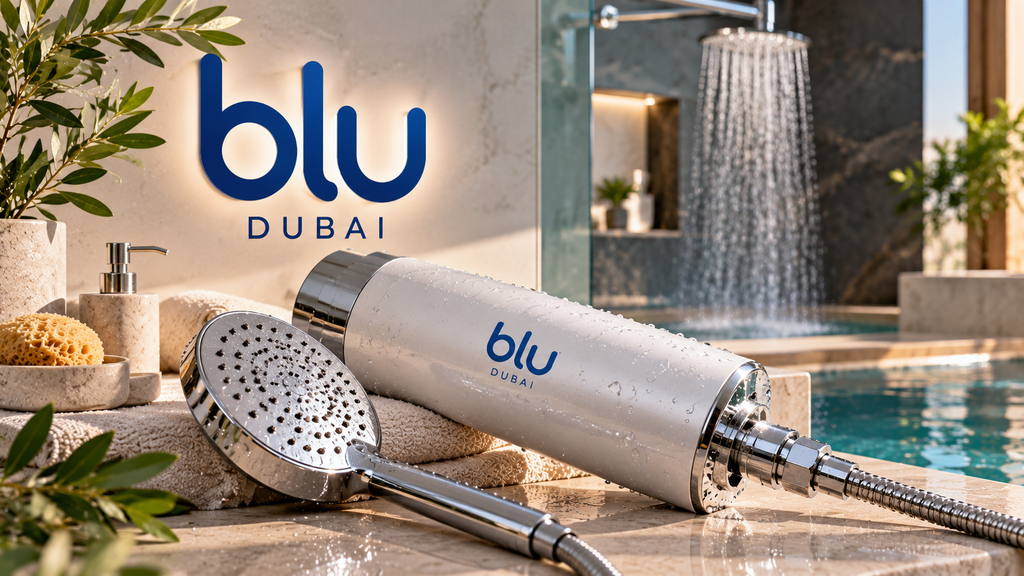
blu describes its Ionic Shower Head & Filter as a multi-stage system rather than a single filtering layer.
Its own technical guide breaks the process into five stages.
| Stage | Function |
|---|---|
| Flow regulation | Controls water flow entering the system |
| Lower stainless mesh | Captures larger particles such as rust and grit |
| NMC medium | Performs the main chemical filtration |
| Upper stainless mesh | Captures fine remaining particulates |
| Ionic spray plate | Creates the final fine spray pattern |
The water moves through these stages in a relatively short period because shower water flows much faster than water through many countertop or jug filters. blu’s own technical explanation notes that contact time is measured in fractions of a second, which is why the chemistry and surface area of the filter medium are important.
This multi-stage construction also separates physical filtration from chemical filtration.
The mesh primarily removes visible particles.
The NMC media performs the main chemical treatment.
The spray plate changes the way water exits the shower head rather than acting as the main contaminant-removal stage.
That distinction helps explain what each component is actually doing.
The System Targets Chlorine as One of Its Main Contaminants
Chlorine reduction is a major part of shower-filter marketing generally, and it is also central to blu’s positioning.
blu says its filtration medium reduces chlorine as water passes through the cartridge. Its technical material also describes reduction of chloramine and selected dissolved metal ions under test conditions.
This is relevant because chlorine can remain present in treated water as a disinfectant residual.
A shower filter does not make municipal water “safe” or “unsafe” in a regulatory sense. Instead, it changes the water at the point of use by reducing certain substances before they reach the user’s skin and hair.
That distinction is important.
A shower filter should not be interpreted as evidence that the original municipal water is unfit for use.
It is an additional consumer filtration step.
Certification Matters More Than Vague “Purified Water” Claims
One of the stronger aspects of blu’s newer technical communication is its attempt to distinguish certification from marketing language.
The company states that its cartridge is built on an NSF/ANSI 42-certified filtration medium. It also acknowledges that this certification applies to the filtration medium rather than to the complete finished shower head as an entire product.
That distinction is important because filtration claims are often presented too broadly.
NSF/ANSI 42 is associated with aesthetic drinking-water treatment performance such as chlorine, taste, odour and particulate reduction.
The shower-specific NSF standard is NSF/ANSI 177, which focuses more narrowly on free available chlorine reduction under shower conditions.
blu itself notes that these standards are not interchangeable and that a claim about one contaminant should not automatically be interpreted as proof of removal of every other substance.
What consumers should ask when comparing filters
| Question | Why It Matters |
|---|---|
| Which standard is cited? | Different standards verify different things |
| Is the whole product certified? | A component certification is not the same thing |
| Who performed the test? | Third-party verification is stronger |
| What contaminant was actually measured? | Avoids broad assumptions |
| Was testing done on a new cartridge? | Performance can decline with use |
| What is the rated service life? | Every filter eventually becomes exhausted |
A vague claim such as “tested to NSF standards” is less useful than a specific statement naming the standard, certifying body and exact contaminant reduction being verified.
The Stainless-Steel Mesh Deals With Physical Sediment
Not everything in shower water is dissolved.
Rust flakes, scale fragments, sand and other particles can sometimes appear after water has travelled through tanks and plumbing.
blu uses stainless-steel mesh on both sides of its main NMC media.
The lower mesh is intended to catch larger particles before they reach the active filter medium.
A second mesh positioned above the cartridge provides an additional physical filtration stage before water reaches the spray plate.
Mechanical filtration works differently from chemical filtration.
A mesh can physically catch particles larger than its openings.
It cannot remove dissolved calcium, magnesium, chlorine or other dissolved substances simply by straining them.
That is why blu combines the mesh with a reactive filtration medium rather than relying on mesh alone.
The Ionic Spray Plate Changes the Shower Experience Rather Than Doing the Main Filtration
The final major component is blu’s stainless-steel spray plate.
The brand says the plate uses 244 holes approximately 0.3mm in diameter, compared with larger holes on many conventional shower heads.
Forcing water through smaller openings changes the shape and feel of the spray.
blu markets this as producing a finer and fuller shower stream while helping the system maintain a consistent shower experience.
This part of the product should be distinguished from the filtration stage.
The spray plate affects:
- Droplet size
- Spray pattern
- Perceived water pressure
- Shower feel
It does not perform the same contaminant-removal function as the NMC cartridge.
blu itself makes this distinction in its technical explanation, noting that a finer spray can affect how the water feels but that feel is not filtration.
That is a useful distinction because the shower-filter category often mixes water-pressure claims and water-purity claims together.
Flow Regulation Is Part of blu Dubai’s Water-Efficiency Approach
blu also includes a Neoperl flow regulator at the inlet of the shower system.
The function is to regulate the volume of water passing through despite differences in building pressure.
blu says this can help reduce shower-water consumption while maintaining a consistent spray pattern. Its sustainability material claims reductions of up to 50% in shower water and related heating energy under its stated operating assumptions.
The practical idea is straightforward.
If the shower can maintain a comfortable spray using less water, then less hot water needs to be supplied and heated.
However, the actual saving in a home depends on:
- Existing shower-head flow
- Building pressure
- Shower duration
- Hot-water system
- User behaviour
Someone already using an efficient low-flow shower head may see a different result from someone replacing a high-flow conventional fixture.
blu Dubai Does Not Claim Its Standard Shower Filter Removes Hardness
This is one of the most important points for UAE consumers.
A shower filter and a water softener are not the same thing.
Hardness is primarily caused by dissolved calcium and magnesium.
blu’s standard Ionic Shower Head filtration media does not remove those minerals. The company states this directly in its current support and technical material.
That means users may still notice:
- Limescale on glass
- Mineral deposits on fixtures
- Hard-water spotting
after installing the standard blu shower filter.
Shower filter vs softener
| Water Issue | blu Ionic Filter | Ion-Exchange Softener |
|---|---|---|
| Chlorine | Targeted | Not its main purpose |
| Sediment | Targeted | Limited |
| Selected dissolved metals | Targeted by filter media | Depends on system |
| Calcium hardness | No | Yes |
| Magnesium hardness | No | Yes |
| Limescale | Not directly removed | Reduced through softening |
This distinction is especially important because people often use the phrase “hard water filter” loosely even when the product does not actually soften water.
blu Uses a Separate Product for Hardness Reduction
For customers who specifically want to reduce calcium and magnesium, blu has introduced a separate product called the NXT LVL Shower Softener & Filter.
According to its current support material, this system uses Seplite ion-exchange resin to exchange hardness minerals before the water reaches the standard shower filter.
This creates a two-step approach.
Stage one: soften the water by reducing calcium and magnesium.
Stage two: filter chlorine, sediment and other targeted impurities.
That is technically a more accurate way to address the common UAE complaint of “hard water” because hardness and chlorine are different water-quality issues requiring different treatment technologies.
blu’s own recent educational material emphasises this distinction rather than suggesting that one cartridge can perform both jobs.
Cartridge Replacement Is Essential to the System
Every filter medium has a finite capacity.
Once its active sites become exhausted or loaded with contaminants, performance decreases.
blu currently recommends replacing the NMC cartridge approximately every 70 to 100 showers, which it generally describes as around two months for typical use.
The exact real-world lifespan will depend on:
- Household usage
- Number of people
- Shower duration
- Incoming water conditions
- Sediment load
This matters because an old cartridge can continue allowing water to flow even after its filtration performance has declined.
There may be no dramatic warning.
A filter does not necessarily stop producing water the moment it is exhausted.
That is why scheduled cartridge replacement is central to maintaining performance.
blu Dubai Uses a Refill Model Rather Than Replacing the Whole Shower Head
The company’s sustainability approach is built around keeping the main shower hardware in use and changing only the internal filter cartridge.
blu describes the stainless-steel housing as reusable, with approximately six cartridge changes per year under its typical replacement schedule.
This is different from low-cost disposable shower filters where the entire housing may be replaced.
The refill model can reduce the amount of material discarded over time, although users still need to consider the recurring cost and waste associated with replacement cartridges.
For the consumer, the model is essentially:
Buy the shower system once → replace the cartridge regularly → keep the main hardware
This also means the real ownership cost should be measured over a year rather than looking only at the initial shower-head price.
blu Dubai Separates Filtration Claims From Health Claims More Carefully Than Before
One of the challenges with shower filters is connecting water chemistry with changes in hair or skin.
blu’s consumer marketing links filtration with softer-feeling skin, reduced scalp irritation and improvements in hair experience. However, its newer technical content is more careful about separating what can be directly measured from what may vary between individuals.
The strongest directly measurable claim relates to changes in water chemistry, such as chlorine reduction.
Changes in:
- Hair fall
- Dryness
- Eczema symptoms
- Dandruff
- Skin irritation
are more complicated because these can have many causes.
A shower filter may remove one environmental factor without addressing medical, hormonal, dermatological or lifestyle causes.
That means people with persistent hair loss, scalp disease or serious skin conditions should not treat a shower filter as a substitute for medical evaluation.
Independent Testing and Certification Should Be Read Separately
blu states that its products or filtration media have been evaluated through organisations including TÜV, SGS and Eurofins, while its NMC filtration medium is associated with NSF/ANSI 42 certification.
Consumers should still read these claims individually.
A laboratory test showing reduction of one contaminant under controlled conditions is not necessarily the same as independent certification of the entire finished product across its full service life.
For example:
| Claim Type | What It Means |
|---|---|
| Certified medium | Specific material has certification |
| Finished-product certification | Entire device certified to specified standard |
| Laboratory test | Performance measured under particular test conditions |
| Manufacturer test | Internal or commissioned testing |
| Customer review | Personal experience, not technical proof |
This is not unique to blu.
It is good practice when comparing any filtration product.
The most useful question is always: What exactly was tested, under which conditions, and by whom?
Why Dubai Residents May Be Interested in Point-of-Use Shower Filtration
Dubai homes vary considerably.
Some people live in new towers with recently installed plumbing.
Others live in older buildings where internal pipes and storage tanks may have been in service for much longer.
That means two apartments supplied by the same municipal network can still have different point-of-use conditions.
blu’s entire product philosophy is built around this final part of the water journey.
Its position is that treating water immediately before it leaves the shower head can reduce certain contaminants picked up or remaining in the water without requiring modifications to the full property.
This approach may appeal particularly to:
- Apartment renters
- People who move frequently
- Residents unable to install whole-home filtration
- Households concerned primarily about shower water
- Users seeking a reversible installation
The trade-off is that only the shower outlet is treated.
Kitchen taps, bathroom sinks and other fixtures remain unaffected.
Point-of-Use Filtration Also Has Clear Limitations
The simplicity of a shower-head system is also its biggest limitation.
It treats only one outlet.
It does not improve water throughout the property.
A standard blu shower filter also does not:
- Remove hardness minerals
- Prevent all limescale
- Replace building tank maintenance
- Fix contaminated plumbing
- Replace whole-home filtration
- Guarantee relief from medical skin or hair conditions
The company itself acknowledges several of these limitations in its current technical material, particularly the fact that its standard NMC/carbon-based filtration does not soften water.
This makes product selection much easier when the problem is correctly identified.
If the main problem is chlorine or sediment at the shower, filtration may be relevant.
If the main problem is calcium hardness and limescale, softening is the more appropriate technology.
If multiple outlets across the home need treatment, a central system may make more sense.
What to Check Before Buying a Shower Filter in Dubai
Consumers should compare filtration systems based on specifications rather than marketing language.
| Question | Why It Matters |
|---|---|
| What filtration media are inside? | Determines what can actually be removed |
| What certification applies? | Helps verify specific performance |
| Is the whole product certified? | Avoids confusion with component certification |
| Does it remove hardness? | Most shower filters do not |
| How often must cartridges be changed? | Determines annual cost |
| What is the flow rate? | Affects shower experience |
| Is installation reversible? | Important for renters |
| Are replacement cartridges easily available? | Determines long-term usability |
| What contaminants were independently tested? | Helps judge broader claims |
| What warranty applies? | Important for hardware problems |
One of the most important questions is simply:
“Does this filter soften water?”
If the answer is yes, ask what ion-exchange or hardness-removal technology is being used.
If the seller cannot explain how calcium and magnesium are removed, the softening claim deserves scrutiny.
blu Dubai’s Approach Is Really Two Different Water-Treatment Problems
The clearest way to understand blu’s current approach is to separate the shower-water issue into two categories.
Filtration
This targets substances such as chlorine, sediment and selected dissolved contaminants.
blu’s Ionic Shower Head & Filter handles this part through its NMC media and physical mesh stages.
Softening
This targets the calcium and magnesium responsible for hard water.
blu’s standard cartridge cannot perform that process, so the company offers a separate ion-exchange solution for customers who want hardness reduction.
This is a more technically accurate framework than treating “bad shower water” as one single problem.
Different water characteristics require different treatment methods.
What Is blu Dubai’s Approach to Shower Water Filtration?
At its core, blu Dubai takes a point-of-use, multi-stage approach.
Water enters through a flow regulator, passes through physical mesh filtration, moves across the company’s proprietary NMC filtration medium, passes through another mesh stage and finally exits through a precision-drilled stainless-steel spray plate.
The standard system is intended primarily to reduce chlorine, sediment and other targeted impurities immediately before shower water reaches the user. The company says its NMC filtration medium is built around NSF/ANSI 42-certified technology, while broader contaminant claims are supported separately through its stated laboratory testing.
It also combines filtration with water-flow engineering. A Neoperl regulator controls inlet flow, while the fine spray plate changes the character of the shower stream and is intended to provide a fuller-feeling spray at reduced flow.
Most importantly, blu now makes the limitation clear.
Its standard Ionic Shower Filter does not soften hard water because NMC and carbon-style filtration media do not remove calcium and magnesium. For hardness reduction, the company uses a separate ion-exchange softening system.
That distinction is probably the most useful way to judge blu’s approach.
It is not one device claiming to solve every water problem.
It is a targeted shower-filtration system designed to address specific contaminants at the point of use, with a separate technology available when the actual problem is water hardness.
Do follow us on Instagram
Read More – UAE Golden Visa: 7 Surprising Benefits You May Not Know