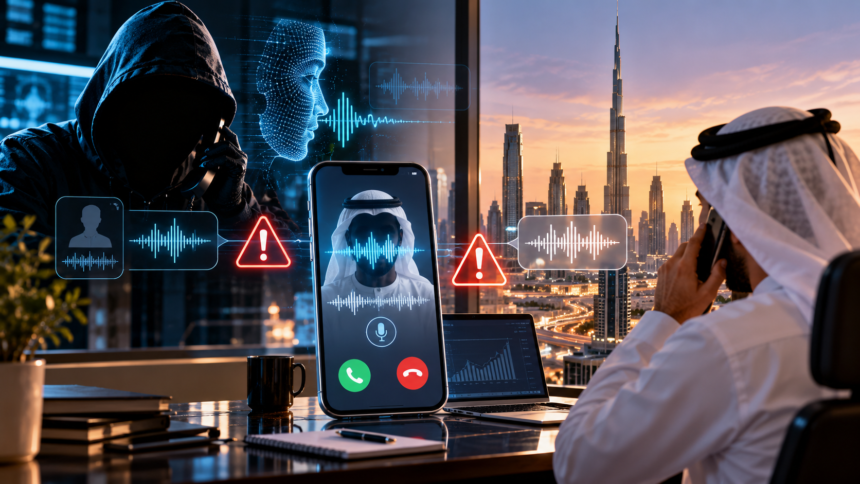
Why Gulf Businesses May Be Particularly Exposed to AI Voice Scams
Deepfake Voice Fraud is emerging as a serious cybersecurity concern for businesses across the United Arab Emirates, Saudi Arabia and the wider Gulf. As artificial intelligence becomes increasingly capable of reproducing human voices, criminals can potentially impersonate company executives, employees, suppliers and customers during telephone calls or voice messages.
- What Is Deepfake Voice Fraud and How Does AI Voice Cloning Work?
- 7 Major Deepfake Voice Fraud Risks Facing Gulf Businesses
- Real Deepfake Fraud Cases and Official Warnings in the UAE and Gulf
- Why Gulf Businesses May Be Particularly Exposed to AI Voice Scams
- How to Identify Suspicious Voice Calls and Deepfake Audio
- 7 Practical Ways Gulf Businesses Can Prevent Deepfake Voice Fraud
- UAE Cybercrime Rules, Business Responsibilities and the Future of AI Fraud
A finance employee might receive a call that appears to come from the company’s chief executive. The voice sounds familiar, the request seems urgent and the caller appears to understand internal business procedures.
However, the person speaking may not be the executive at all.
AI-generated voice technology can create convincing imitations of real individuals, making it increasingly difficult to rely on sound alone when verifying identity.
This development is particularly relevant to Gulf businesses, where international transactions, multilingual workplaces and digital financial services are common.
The consequences can extend beyond financial losses. Successful impersonation attempts may expose confidential information, compromise customer accounts, damage reputations and undermine trust in digital communications.
The threat has already attracted official attention.
In November 2025, the UAE Cybersecurity Council warned about increasingly convincing AI-generated audio and video designed to mislead audiences.
More recently, on October 15, 2026, Saudi Arabia’s Data and Artificial Intelligence Authority and Communications, Space and Technology Commission launched an awareness campaign addressing deepfake technology and its risks, including fraud and identity theft.
International incidents demonstrate how serious the financial consequences can become.
In 2024, engineering company Arup confirmed that an employee in Hong Kong had been deceived by a fabricated video conference involving impersonated executives. The incident resulted in approximately HK$200 million, or $25 million, being transferred to fraudulent accounts.
Although that incident occurred outside the Gulf, it illustrates vulnerabilities that multinational organisations everywhere must consider.
The central challenge is no longer simply identifying whether a voice sounds suspicious. Businesses must develop procedures that prevent sensitive decisions from depending solely on a telephone conversation.
This guide explores how deepfake voice technology works, seven major risks facing Gulf businesses and the practical safeguards organisations can introduce.
What Is Deepfake Voice Fraud and How Does AI Voice Cloning Work?
Deepfake voice fraud involves using artificially generated or manipulated speech to deceive another person.
It commonly involves impersonating someone the victim recognises or considers trustworthy.
The technology itself has legitimate applications, including accessibility tools, translation, entertainment and voice restoration.
Fraud occurs when synthetic audio is used deceptively to obtain money, confidential information or unauthorised access.
Understanding AI Voice Cloning
AI voice cloning systems learn characteristics of human speech.
These characteristics may include pronunciation, rhythm, tone and vocal patterns.
Advanced systems can generate new spoken sentences that resemble a particular person’s voice.
As these tools improve, familiar vocal characteristics may no longer provide reliable proof of identity.
What Is Voice Phishing?
Voice phishing, often called vishing, is a form of social engineering conducted through telephone calls or voice communication.
Traditional vishing attacks may involve criminals pretending to represent banks, government agencies or businesses.
AI voice cloning adds another layer by allowing impersonators to sound like a known person.
A caller may attempt to create urgency, demand secrecy or pressure an employee into bypassing ordinary procedures.
Deepfake Audio vs Traditional Phone Scams
| Feature | Traditional Voice Scam | AI Deepfake Voice Fraud |
|---|---|---|
| Identity Impersonation | Verbal claims | May reproduce a familiar voice |
| Technology | Ordinary calls or recordings | Synthetic or manipulated audio |
| Main Deception | False identity or authority | False identity reinforced by vocal similarity |
| Possible Targets | Individuals and businesses | Employees, executives and customers |
| Main Defence | Independent verification | Independent verification and strict controls |
Why Voice Recognition Is No Longer Enough
People naturally recognise colleagues and family members through their voices.
However, AI-generated audio can undermine this familiar method of identification.
A voice that sounds authentic should therefore be treated as one piece of information, not conclusive proof of who is speaking.
7 Major Deepfake Voice Fraud Risks Facing Gulf Businesses
AI-assisted impersonation creates several potential risks for organisations handling money, sensitive data and customer communications.
The risks are not limited to large multinational companies. Smaller businesses can also be targeted.
1. Executive Impersonation
One of the most concerning scenarios involves a criminal pretending to be a chief executive, managing director or senior financial officer.
Employees may feel pressure to follow instructions from someone they believe has authority.
An unexpected request for an urgent financial transfer should therefore be verified through established procedures, regardless of how familiar the caller sounds.
2. Fraudulent Payment Instructions
Criminals may attempt to persuade accounts teams to transfer money to unauthorised accounts.
The request may be presented as a confidential acquisition, supplier payment or emergency business expense.
A forged voice message may be combined with misleading emails or documents.
3. Supplier and Vendor Impersonation
Businesses regularly communicate with suppliers about invoices and payment schedules.
An attacker may impersonate a supplier representative and request changes to bank account details.
The main danger is accepting payment changes without independently confirming them through previously verified contact information.
4. Help Desk and Account Recovery Attacks
Employees sometimes contact IT support to reset passwords or restore access.
A convincing voice imitation may be used to persuade support personnel to bypass account-recovery checks.
Organisations should not rely on vocal familiarity when authenticating users.
5. Confidential Information Theft
An impersonator might claim to be a company executive requesting sensitive documents.
Potential targets include payroll files, customer information, commercial contracts or financial statements.
Even without a fraudulent payment, disclosure of sensitive information can create serious consequences.
6. Customer Service Impersonation
Businesses operating telephone support channels may face attempts to impersonate customers.
Attackers could seek account access, information changes or other unauthorised services.
Financial institutions and businesses handling sensitive accounts must consider stronger identity-verification methods.
7. Reputational Damage
Synthetic recordings can also falsely attribute statements to company leaders.
Such material may circulate through messaging platforms or social media.
Even when a recording is eventually disproved, it can generate confusion, customer concern or reputational harm.
Seven Risks at a Glance
| Risk | Potential Target | Possible Consequence |
|---|---|---|
| Executive Impersonation | Finance teams | Unauthorised transfers |
| Payment Instruction Fraud | Accounts payable | Financial loss |
| Supplier Impersonation | Procurement staff | Payment diversion |
| Help Desk Manipulation | IT support | Account compromise |
| Information Theft | Employees | Data exposure |
| Customer Impersonation | Service teams | Unauthorised account activity |
| False Recordings | Executives and brands | Reputational damage |
The common vulnerability is accepting a person’s apparent identity without adequate independent verification.
Real Deepfake Fraud Cases and Official Warnings in the UAE and Gulf
Deepfake-related fraud is not merely a hypothetical future threat.
International cases and official warnings show that organisations need to reconsider how they authenticate financial and operational requests.
The Arup Deepfake Incident
One of the best-documented cases occurred in Hong Kong in early 2024.
An employee at engineering company Arup received communications apparently involving senior colleagues.
The individual participated in what seemed to be a legitimate video meeting.
However, the meeting used fabricated representations of company personnel.
Following the instructions, approximately HK$200 million was transferred to fraudulent accounts.
The case demonstrated that even apparent visual and vocal confirmation can be misleading when employees do not independently validate unusual requests.
The UAE’s Warning About Synthetic Audio
In November 2025, the UAE Cybersecurity Council warned that AI-generated audio and video can reproduce people’s appearances and voices with considerable realism.
The Council encouraged verification of suspicious content through trusted sources.
Although this guidance addressed public awareness broadly, its central lesson is equally relevant to companies handling high-value transactions.
Businesses should not assume that a recording is authentic simply because it resembles a familiar executive.
Saudi Arabia’s 2026 Deepfake Awareness Campaign
On October 15, 2026, Saudi Arabia launched the “It’s AI” awareness campaign.
The initiative was developed by SDAIA and the Communications, Space and Technology Commission.
It highlights the risks of fabricated images, videos and audio recordings.
The campaign identifies fraud, identity theft and reputational damage among the possible consequences.
It also emphasises verifying information before trusting or sharing it.
A Global Threat With Gulf Relevance
Gulf businesses frequently operate across borders and communicate with international partners.
These characteristics create legitimate business opportunities but also require reliable transaction verification.
The following cases and warnings provide important context.
| Date | Case or Warning | Key Lesson |
|---|---|---|
| January 2024 | Hong Kong deepfake conference fraud | Apparent executive identity can be fabricated |
| November 2025 | UAE Cybersecurity Council warning | Synthetic audio and video require verification |
| October 2026 | Saudi deepfake awareness campaign | Voice identity and personal data need protection |
| 2025–2026 | International law enforcement alerts | Independent callbacks remain essential |
The examples should not be interpreted as evidence of a specific number of Gulf corporate deepfake fraud incidents.
Consistent public statistics separating AI voice fraud from other forms of impersonation remain limited.
Why Gulf Businesses May Be Particularly Exposed to AI Voice Scams
Several characteristics of the GCC business environment make secure communication especially important.
These do not establish that Gulf businesses are inherently more vulnerable than companies elsewhere.
Rather, they identify practical situations where deepfake-related safeguards may be valuable.
Multilingual Business Communication
Workplaces in the UAE and other Gulf countries often use English, Arabic, Hindi and additional languages.
Executives may communicate with employees in different languages depending on the task.
This creates complex communication environments where staff may be accustomed to unfamiliar accents and varying speech patterns.
Employees should avoid relying on unusual pronunciation as the main indication of fraud.
International Financial Transactions
Many Gulf companies manage payments involving overseas suppliers, customers and subsidiaries.
International transfers may involve unfamiliar account information or different banking arrangements.
This makes independent confirmation of new payment instructions especially important.
Hierarchical Organisational Structures
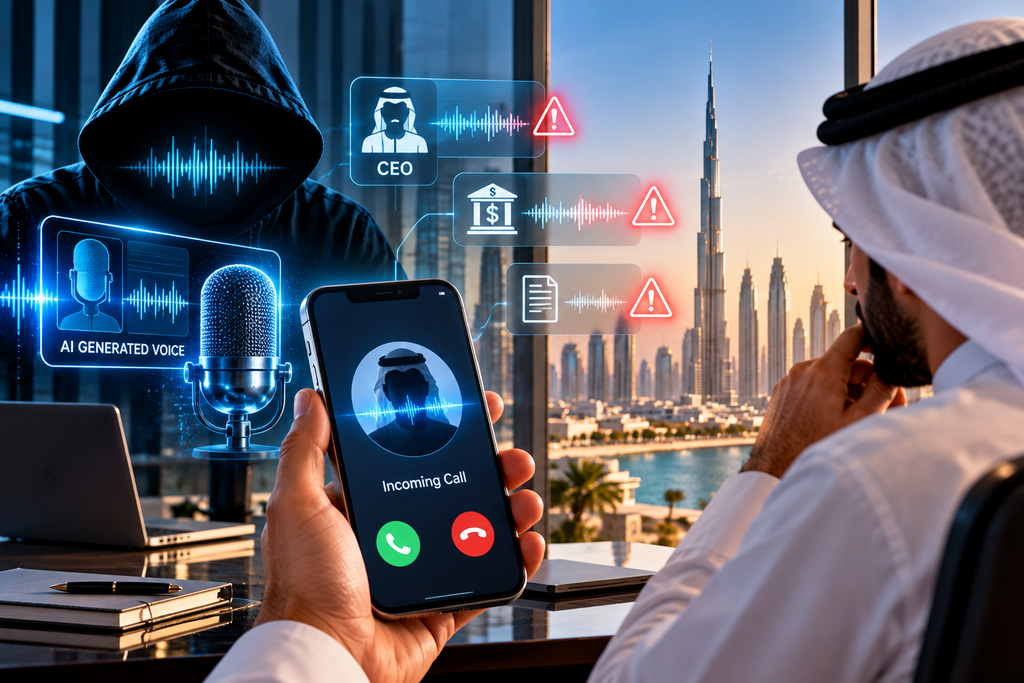
Employees may be reluctant to question instructions apparently issued by senior management.
Fraudsters can exploit this reluctance by claiming that a request is confidential or extremely urgent.
Strong company policies should make verification mandatory even when the request supposedly comes from the chief executive.
Messaging and Voice Communication
Business teams often communicate through telephone calls, voice notes and messaging applications.
These channels are convenient but can create risks when informal messages are treated as payment authorisations.
A voice note should not replace documented approval procedures.
Smaller Companies With Limited Cybersecurity Resources
Smaller businesses may not have dedicated fraud-prevention teams or advanced detection systems.
They can nevertheless introduce effective safeguards, including approval limits, verified callback procedures and basic staff training.
Risk Comparison by Business Function
| Business Function | Main Exposure | Useful Safeguard |
|---|---|---|
| Finance | Fraudulent transfers | Dual authorisation |
| Procurement | Supplier payment changes | Verified supplier confirmation |
| Human Resources | Sensitive employee data | Restricted information access |
| IT Support | Account recovery manipulation | Strong identity verification |
| Executive Offices | Impersonation and reputational risk | Trusted communications channels |
| Customer Service | Fraudulent identity claims | Multi-factor verification |
Fraud prevention should be integrated into everyday workflows rather than treated exclusively as a technical cybersecurity issue.
How to Identify Suspicious Voice Calls and Deepfake Audio
Recognising suspicious circumstances is useful, but identifying artificial speech by listening alone is increasingly unreliable.
Some synthetic voices may contain unusual pauses or inconsistent intonation.
Others may sound entirely natural.
Businesses should therefore focus primarily on the behaviour surrounding a request.
Warning Signs in Business Communications
A suspicious caller may create artificial urgency or insist that established procedures must be ignored.
The caller may also claim that another senior executive has already approved the action.
These signals do not prove that a voice is synthetic, but they can justify additional verification.
Common Red Flags
- Unexpected requests for urgent transfers.
- Instructions to change supplier bank details.
- Demands for secrecy.
- Pressure to bypass financial approval limits.
- Unusual requests for passwords or security codes.
- Refusal to use established communication channels.
- Requests that conflict with normal business procedures.
Why Audio Clues Are Not Enough
Older synthetic recordings sometimes included mechanical speech or unnatural pauses.
Modern systems may reproduce intonation and conversational rhythms more convincingly.
Legitimate calls can also contain delays or distorted audio because of network problems.
A strange-sounding call is not automatically fake, and a natural-sounding call is not automatically genuine.
Use Independent Verification
The FBI advises people to independently identify a trusted contact number and call back when identity is uncertain.
For businesses, this principle should apply to financial transfers and sensitive information requests.
Employees should use approved contact records rather than phone numbers provided during suspicious interactions.
Voice Authentication vs Identity Verification
| Method | Main Limitation |
|---|---|
| Familiar Voice | Can potentially be imitated |
| Caller ID | May be manipulated or misleading |
| Voice Message | May be synthetic or edited |
| Video Meeting | Can include fabricated participants |
| Verified Callback | Stronger when the contact record is independently trusted |
| Documented Multi-Person Approval | Reduces dependence on one person’s apparent identity |
Even sophisticated detection software can make mistakes.
Reliable protection requires overlapping safeguards rather than trusting any single indicator.
7 Practical Ways Gulf Businesses Can Prevent Deepfake Voice Fraud
Organisations can reduce impersonation risks by strengthening established financial and information-security procedures.
Many useful safeguards do not require expensive AI detection technology.
1. Require Independent Callbacks
Employees should verify unexpected financial instructions through a known, independently maintained contact method.
A request should not be considered authentic merely because the caller sounds like an executive.
2. Introduce Dual Payment Authorisation
High-value transfers should require approval from more than one authorised person.
Approval thresholds can be adjusted according to organisational size and risk.
The system should prevent a single urgent telephone call from overriding normal controls.
3. Verify Supplier Account Changes
Any request to change bank details should trigger a separate verification process.
The business should contact the supplier using previously verified information.
New account details must not be confirmed solely through the same communication that introduced the change.
4. Strengthen Help Desk Security
Password resets and account recovery should use appropriate identity-verification procedures.
IT support teams should not rely on a recognisable voice to approve sensitive account changes.
5. Train Employees Regularly
Training should explain how AI impersonation works and which behaviours are suspicious.
Simulated exercises can help finance, procurement and customer service teams practise safe responses.
Employees should feel comfortable challenging unexpected instructions from senior management.
6. Protect Publicly Available Information
Companies should review how much sensitive personal and operational information is publicly accessible.
Public appearances and speeches are part of normal professional life, and removing all recordings is neither realistic nor necessary.
The objective is to avoid unnecessary disclosure of internal workflows, confidential data and security procedures.
7. Establish a Fraud Response Plan
Every organisation should know what to do when an employee suspects a fraudulent request or transaction.
The plan should identify internal contacts, banking escalation procedures, evidence-preservation requirements and reporting responsibilities.
Business Protection Checklist
- Require independent verification for unusual payment instructions.
- Use dual approval for sensitive transactions.
- Confirm supplier account changes separately.
- Restrict access to confidential financial records.
- Train staff about voice impersonation.
- Strengthen account recovery procedures.
- Review transaction authorisation limits.
- Maintain trusted contact information.
- Establish a fraud reporting process.
- Test the procedures regularly.
Illustrative Security Response
Suppose an accounts employee receives an urgent voice message apparently from the managing director requesting an overseas payment.
The employee should follow the company’s established verification and approval procedures before taking action.
If the managing director cannot be reached through an independently verified contact method, the transfer should remain unapproved until the required verification is completed.
The aim is to prevent urgency or apparent authority from defeating financial controls.
UAE Cybercrime Rules, Business Responsibilities and the Future of AI Fraud
Deepfake technology raises legal, financial and operational questions for Gulf businesses.
The rules applicable to a particular incident depend on the jurisdiction, conduct and type of information involved.
UAE Cybercrime Legislation
The UAE’s Federal Decree-Law No. 34 of 2021 on Countering Rumours and Cybercrimes addresses various forms of unlawful online activity.
Depending on the circumstances, digital impersonation, deception and misuse of information may fall within relevant legal provisions.
The UAE Cybersecurity Council has referenced this legislation while warning about the harmful use of deepfake content.
Businesses should obtain qualified legal advice when dealing with suspected criminal conduct or significant information breaches.
Saudi Arabia’s Approach to Deepfake Awareness
Saudi authorities have emphasised public education, identity protection and responsible handling of digital content.
Their October 2026 campaign highlights the importance of examining content critically rather than accepting audio or video recordings as conclusive evidence.
For companies, this supports the wider need for verification-based security procedures.
What Businesses Should Do After Suspected Fraud
If a suspicious transfer has already been authorised, immediate action is important.
The company should contact its bank through official channels, activate internal incident-response procedures and preserve relevant records.
Depending on the circumstances, reporting to law enforcement, regulators or affected parties may be necessary.
Incident Response Checklist
| Step | Recommended Action |
|---|---|
| Identify | Recognise suspicious instructions or transactions |
| Contain | Suspend further related payments where possible |
| Notify | Contact the bank and internal security team |
| Preserve | Retain messages, records and transaction details |
| Investigate | Determine affected accounts and information |
| Report | Follow applicable reporting obligations |
| Improve | Update controls and staff training |
Will AI Detection Tools Solve the Problem?
AI-powered detection systems can analyse audio for signs of synthetic generation.
However, detection performance varies depending on recording quality, language, compression and the technology used to create the audio.
New synthetic voice systems may also reduce the effectiveness of existing detection methods.
Companies should therefore regard detection software as a supplementary control rather than a definitive identity test.
Frequently Asked Questions
What is deepfake voice fraud?
It is the deceptive use of AI-generated or manipulated voices to impersonate individuals and obtain money, information or unauthorised access.
Can criminals imitate a company executive’s voice?
AI voice-cloning technology can generate audio resembling a particular individual. The accuracy varies, but businesses should not rely solely on vocal familiarity.
Are Gulf businesses at risk?
Yes. Any organisation relying on voice communication for payments, account access or sensitive decisions may face impersonation risks.
Has deepfake technology been used in major corporate fraud?
Yes. The 2024 Arup case in Hong Kong involved fabricated executive identities and approximately HK$200 million in fraudulent transfers.
Can employees recognise deepfake audio by listening?
Sometimes unusual audio characteristics may create suspicion, but modern synthetic voices can sound realistic. Independent verification is more dependable.
What is the most important protection?
Documented, independent verification of sensitive requests, supported by appropriate approval controls, is among the most important safeguards.
Is AI voice cloning itself illegal?
The technology has legitimate uses. Legal consequences depend on how it is used, whether consent is required and the applicable jurisdiction’s laws.
Final Thoughts on Deepfake Voice Fraud in Gulf Businesses
Artificial intelligence is changing the way organisations communicate, but it is also creating new opportunities for impersonation and financial deception.
Deepfake voice technology presents a particular challenge because it exploits something people have traditionally trusted: the familiar sound of another person’s voice.
For Gulf businesses, the risks can involve fraudulent payments, supplier impersonation, account compromise, confidential information exposure and reputational damage.
The growing sophistication of synthetic audio means that employees cannot depend entirely on hearing an unusual accent or robotic speech to recognise fraud.
Instead, companies need reliable verification procedures, clear payment approval rules and staff who understand when to question unexpected instructions.
Official warnings from the UAE and Saudi Arabia demonstrate the importance of treating manipulated media as a practical security concern.
Ultimately, Deepfake Voice Fraud reinforces a fundamental lesson for modern businesses: trust should be supported by verified processes rather than appearances or familiar voices alone.
As AI technology continues evolving, Gulf companies that strengthen their financial controls, employee awareness and incident-response procedures will be better prepared to manage emerging impersonation threats.
Do follow us on Instagram
Read More – Arabic-Language AI: Can Technology Truly Understand Gulf Dialects?