Cloud Kitchen Setup Costs, Licensing and Food Safety Rules in Dubai
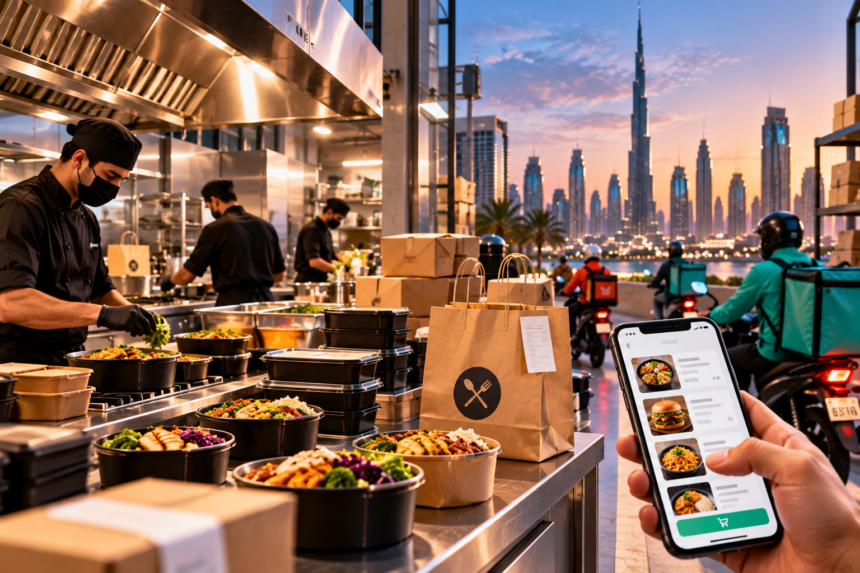
Cloud Kitchens in Dubai are changing the economics of the restaurant industry by allowing food businesses to operate without traditional dining rooms, expensive interiors or large front-of-house teams. Instead of welcoming customers into physical restaurants, these businesses prepare meals specifically for delivery through mobile applications and online ordering platforms.
- Cloud Kitchens in Dubai: What They Are and How They Operate
- 7 Ways Delivery-Only Restaurants Make Money in Dubai
- How Cloud Kitchen Profit Margins and Delivery Commissions Work
- Cloud Kitchen Setup Costs, Licensing and Food Safety Rules in Dubai
- How Technology, Delivery Platforms and Multiple Brands Support Growth
- Major Challenges and Risks Facing Delivery-Only Restaurants
- The Future of Cloud Kitchens in Dubai and Frequently Asked Questions
The concept is simple: customers place an order, a commercial kitchen prepares the meal, and a delivery service transports it to the customer’s location.
Behind this apparently straightforward process is a business model involving food production, delivery-platform commissions, digital marketing, inventory management and careful financial planning.
Dubai provides an attractive environment for delivery-focused restaurants because of its digitally connected population, established food delivery platforms and extensive range of international cuisines.
Services such as Talabat, Deliveroo, Careem Food and noon Food make it possible for customers to discover restaurant brands without visiting a physical location.
Cloud kitchens can also operate several virtual restaurant concepts from one approved commercial facility, potentially spreading fixed expenses across different menus.
Businesses such as Kitopi and Talabat Kitchens have helped establish the cloud kitchen model within the wider Gulf hospitality industry.
However, a delivery-only restaurant is not automatically profitable. Savings from avoiding a dining room can be offset by platform commissions, packaging costs, promotional discounts and the expense of attracting online customers.
An April 2026 Gulf Business interview with Talabat Kitchens highlighted the importance of shared infrastructure, demand forecasting and sustainable unit economics in expanding delivery-focused restaurant operations.
For entrepreneurs, the central question is not simply whether cloud kitchens cost less to open than traditional restaurants.
It is whether the business can earn enough from each order to cover ingredients, labour, rent, delivery expenses and other operating costs.
This guide explains how cloud kitchens work in Dubai, where their revenue comes from, how much they may cost to establish and seven strategies that can improve their financial performance.
Cloud Kitchens in Dubai: What They Are and How They Operate
A cloud kitchen is a commercial food preparation facility designed primarily or entirely for delivery orders.
It is sometimes called a ghost kitchen, dark kitchen or delivery-only restaurant.
Unlike a traditional restaurant, it generally has no customer dining area.
The business receives orders digitally, prepares meals in an approved kitchen and arranges delivery to customers.
How the Cloud Kitchen Process Works
Customers browse menus through a delivery application or the restaurant’s own ordering channel.
After an order is confirmed, the kitchen receives the details through its order-management system.
Staff prepare the food, package it and hand it to a delivery rider.
The customer receives the meal without visiting a physical restaurant.
Some kitchens operate one brand, while others manage several menus from the same facility.
Cloud Kitchens vs Traditional Restaurants
| Feature | Cloud Kitchen | Traditional Restaurant |
|---|---|---|
| Dining Area | Usually none | Usually available |
| Orders | Primarily online | Dine-in, takeaway and delivery |
| Customer Experience | Food and delivery focused | Food, atmosphere and service |
| Property Requirements | Approved commercial kitchen | Kitchen and customer areas |
| Marketing | Strong dependence on digital discovery | Digital and physical visibility |
| Staffing | Mainly kitchen and operational staff | Kitchen and front-of-house staff |
| Main Financial Challenge | Delivery economics and order volume | Rent, staffing and operating costs |
Why the Business Model Appeals to Entrepreneurs
A cloud kitchen can reduce some of the upfront investment required for a conventional restaurant.
Operators may avoid dining furniture, decorative interiors and high-visibility retail premises.
A shared kitchen facility can reduce the need to construct an entire commercial kitchen independently.
However, approved food preparation premises, trained staff, suitable equipment and food safety compliance remain necessary.
Different Cloud Kitchen Models
The industry includes independently owned delivery restaurants, shared kitchen facilities, multi-brand operators and established restaurant chains using satellite kitchens.
Each model involves different levels of operational responsibility and financial risk.
The most appropriate approach depends on available capital, cooking capacity, customer demand and business experience.
7 Ways Delivery-Only Restaurants Make Money in Dubai
Cloud kitchens generate revenue by selling prepared food and, in some cases, related products through delivery channels.
Profitability depends on earning more from those sales than the total costs of production, fulfilment and operations.
1. Selling Meals Through Delivery Platforms
The most familiar revenue source is food ordered through third-party delivery applications.
These platforms provide visibility, customer access, payments and, depending on the agreement, delivery logistics.
The restaurant earns revenue from its menu sales but pays commissions and other applicable charges.
2. Accepting Direct Orders
Some cloud kitchens encourage repeat customers to order through an approved website or digital ordering system.
Direct ordering may reduce dependence on third-party marketplace commissions.
However, the business must account for payment processing, marketing, customer service and delivery arrangements.
3. Operating Multiple Virtual Brands
A single kitchen can sometimes prepare food for several customer-facing brands.
For example, one facility might serve burgers, grilled chicken and rice bowls under different brand identities.
This can increase the range of customers reached through delivery applications.
However, businesses must ensure that each brand is properly authorised and that menus remain operationally manageable.
4. Increasing Average Order Value
Restaurants may offer suitable combinations of main dishes, sides and beverages.
A customer ordering a main course might choose an additional drink or dessert.
Higher average order values can improve revenue per delivery, provided additional products generate an adequate contribution margin.
5. Selling Family Meals and Group Orders
Group meals may generate larger transactions than single-person orders.
Family packages, office lunches and shared meal combinations can make delivery operations more efficient.
However, larger orders also require reliable preparation, packaging and timing.
6. Developing Corporate and Scheduled Orders
Some delivery-only kitchens may supply planned meals for offices, business meetings or recurring customer requirements.
These arrangements can provide more predictable demand.
The operator must confirm whether its licensed activities permit the intended catering or meal-supply arrangements.
7. Building Repeat Customer Revenue
Returning customers can be valuable because the business may not need to spend as heavily on attracting each order.
Consistent food quality, accurate preparation and reliable delivery encourage customers to reorder.
Revenue Opportunities Compared
| Revenue Model | Main Advantage | Main Challenge |
|---|---|---|
| Delivery Platforms | Access to customers | Commissions and competition |
| Direct Orders | More control over customer relationships | Marketing and fulfilment |
| Multiple Brands | Broader menu positioning | Operational complexity |
| Add-On Products | Higher order value | Additional ingredient costs |
| Family Meals | Larger transactions | Preparation capacity |
| Corporate Orders | More predictable demand | Scheduling and compliance |
| Repeat Orders | Potential customer retention | Consistent service quality |
The most sustainable businesses generally focus on repeatable unit economics rather than pursuing order volume without regard to costs.
How Cloud Kitchen Profit Margins and Delivery Commissions Work
Understanding the financial performance of each order is essential.
A cloud kitchen may receive hundreds of daily orders while still losing money if the costs of fulfilling them are too high.
What Is the Average Order Value?
Average order value, or AOV, is the average amount customers spend per transaction.
A business can calculate it by dividing total order revenue by the number of orders.
Higher AOV may help absorb fixed transaction costs, but it does not guarantee better profitability.
What Are Delivery Platform Commissions?
Delivery applications commonly charge restaurants a negotiated commission.
Commercial setup guides published in 2026 cite illustrative ranges of approximately 15% to 35%, depending on the platform, merchant agreement and service structure.
These are not verified universal rates. Individual contracts may differ, and advertising fees or promotions can create additional costs.
Illustrative Economics of One Delivery Order
| Item | Amount |
|---|---|
| Customer Food Order Value | AED 60 |
| Platform Commission (25%) | AED 15 |
| Ingredients | AED 18 |
| Packaging | AED 3 |
| Kitchen Labour Allocation | AED 8 |
| Other Variable Costs | AED 2 |
| Contribution Before Fixed Costs | AED 14 |
This is a simplified hypothetical example. It excludes VAT treatment, discounts, payment arrangements and certain other possible costs.
The AED 14 remaining from the order is not final profit.
The business must still cover fixed expenses such as rent, permanent salaries, insurance, equipment and administration.
Understanding Break-Even
Suppose a kitchen has fixed operating expenses of AED 35,000 per month.
If the contribution per order is AED 14, the kitchen needs approximately 2,500 orders monthly merely to cover those fixed expenses.
That equals about 83–84 orders per day over a 30-day month.
The calculation illustrates why order-level economics matter.
Why Discounts Can Be Dangerous
Promotions may improve visibility and attract first-time customers.
However, a discount reduces the amount available to cover expenses.
If the restaurant funds a large promotion while still paying commissions, an order can become unprofitable.
Operators should calculate promotional margins before launching campaigns.
Key Financial Indicators
| Metric | What It Measures |
|---|---|
| Average Order Value | Revenue per order |
| Food Cost Percentage | Ingredient expense relative to sales |
| Contribution Margin | Revenue remaining after variable costs |
| Customer Acquisition Cost | Marketing cost to attract a customer |
| Repeat Order Rate | Share of customers ordering again |
| Order Preparation Time | Kitchen fulfilment efficiency |
| Fixed Cost Coverage | Ability to meet regular overheads |
A cloud kitchen’s long-term performance depends on balancing these measures rather than maximising one metric alone.
Cloud Kitchen Setup Costs, Licensing and Food Safety Rules in Dubai
Opening a cloud kitchen usually involves less customer-facing construction than opening a dine-in restaurant. However, entrepreneurs still need appropriate approvals, compliant premises, equipment and sufficient working capital.
The initial investment varies significantly between shared-kitchen arrangements and independent commercial facilities.
How Much Does a Cloud Kitchen Cost to Open?
Dubai business setup advisers published different estimates during 2026. Some indicated that a ready-equipped shared facility could lower initial investment, while independently fitted kitchens might require approximately AED 80,000–200,000 or more.
These figures are indicative industry estimates, not official government fees or guaranteed startup budgets.
Illustrative Startup Budget
| Expense | Planning Estimate |
|---|---|
| Trade Licensing and Approvals | AED 15,000–25,000 |
| Initial Kitchen Rent and Deposit | AED 15,000–30,000 |
| Equipment and Setup | AED 25,000–60,000 |
| Packaging and Initial Inventory | AED 5,000–10,000 |
| Branding and Launch Marketing | AED 5,000–15,000 |
| Working Capital | AED 25,000–50,000 |
| Illustrative Total | AED 90,000–190,000 |
These hypothetical budgeting ranges are not quotations. Costs may be substantially different depending on the approved activity, premises, equipment and business structure.
Trade Licence and Municipality Approvals
A delivery-only restaurant needs an appropriate food-related trade licence from the relevant licensing authority.
Dubai Municipality also regulates the food establishment and its premises.
A separate standalone licensing category called a cloud kitchen is not generally identified in current official activity guidance. Operators must select the food business activity appropriate to what they actually prepare and sell.
Before signing a lease, entrepreneurs should confirm that the proposed location and layout can meet the applicable requirements.
Food Safety Requirements
Cloud kitchens must maintain proper hygiene, temperature control, storage and food-handling procedures.
Staff require the applicable food safety training, while equipment and workflows must meet relevant standards.
Dubai Municipality’s Foodwatch system supports food safety oversight and traceability.
Food safety cannot be treated as optional simply because customers do not physically enter the premises.
Choosing Between Shared and Independent Kitchens
A shared kitchen may provide existing infrastructure and reduce fit-out requirements.
An independent facility gives operators greater control but usually involves higher upfront investment and maintenance responsibilities.
Contracts should clarify the availability of equipment, storage, cleaning, utilities and operational support.
How Technology, Delivery Platforms and Multiple Brands Support Growth
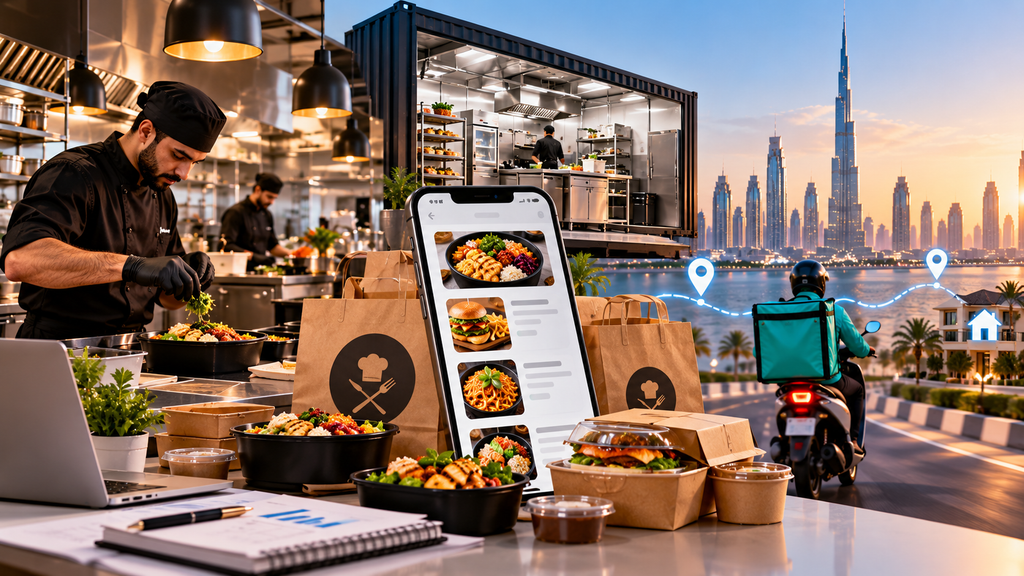
Cloud kitchens depend heavily on technology because almost every customer interaction takes place digitally.
Restaurant operators need systems that can manage incoming orders, monitor food preparation and maintain accurate inventory.
Order Management Systems
When a business receives orders from several applications, staff need a reliable way to view and process them.
Order-management systems can bring information into one operational workflow.
This may reduce confusion, missed orders and incorrect preparation.
However, technology must be implemented carefully to avoid creating additional operational complexity.
Using Demand Forecasting
Historical sales data can help operators identify busy periods and popular dishes.
A restaurant may discover that certain meals sell particularly well during weekday lunches, while other products attract more orders during evenings.
Forecasting allows managers to plan staffing, preparation and ingredient purchasing.
Talabat Kitchens discussed its technology-led approach in April 2026, highlighting demand forecasting and infrastructure optimisation as part of its operating model. <Cite ref=”turn440572search14″/>
Multi-Brand Operations
One commercial kitchen may support several virtual restaurant brands if the activities, approvals, space and operational arrangements permit.
For example, common ingredients could support several menu concepts.
However, operating additional brands does not automatically increase profit.
Every new brand creates requirements for marketing, packaging, menu management and customer service.
Technology Tools and Their Benefits
| Technology | Possible Benefit |
|---|---|
| Order Management | Fewer missed or duplicated orders |
| Inventory Software | Better stock tracking |
| Sales Analytics | Understanding customer demand |
| Kitchen Display Systems | Clearer preparation workflow |
| Customer Relationship Tools | Better repeat-customer communication |
| Delivery Tracking | Greater order visibility |
Why Location Still Matters
Cloud kitchens do not need expensive shopping-mall frontage, but location remains important.
A facility near its target delivery customers may offer shorter journeys and more reliable service.
Operators must consider rider access, delivery coverage, rent and kitchen suitability rather than simply choosing the lowest-priced property.
Major Challenges and Risks Facing Delivery-Only Restaurants
The cloud kitchen model removes some traditional restaurant expenses but introduces different challenges.
Successful operators must manage competition, online reputation, delivery reliability and profit margins simultaneously.
Dependence on Delivery Platforms
A business relying heavily on one marketplace may be vulnerable to changes in commercial agreements, visibility or platform policies.
Maintaining more than one sales channel can reduce some dependence, but operating several channels also requires coordination.
Rising Operating Expenses
Ingredients, packaging, salaries, rent and electricity all affect profitability.
A relatively small increase in food costs can become significant when margins are already limited.
Operators should update menu calculations rather than assuming earlier pricing remains sustainable.
Competition and Customer Discovery
Customers browsing delivery applications may encounter dozens of restaurants offering similar dishes.
Without a physical storefront, businesses depend heavily on digital presentation.
Accurate menus, appealing photographs, reliable preparation and genuine customer feedback are important.
Food Quality During Delivery
Not every dish travels equally well.
Some foods lose texture, temperature or presentation quality during transportation.
Menus should be developed with delivery conditions in mind.
Appropriate packaging can improve the experience, although excessive packaging increases expenses and waste.
Common Business Risks
| Risk | Possible Impact | Practical Response |
|---|---|---|
| High Commissions | Reduced order margins | Review channel economics |
| Low Order Volume | Difficulty covering fixed costs | Test demand before expansion |
| Poor Delivery Quality | Customer complaints | Improve packaging and preparation |
| Food Waste | Increased ingredient costs | Forecast stock requirements |
| Excessive Discounts | Unprofitable orders | Calculate promotional margins |
| Platform Dependence | Commercial vulnerability | Diversify sales channels |
| Food Safety Failures | Regulatory and reputational consequences | Maintain documented controls |
Why Growth Does Not Guarantee Profit
A kitchen may generate impressive sales while spending too much to fulfil orders.
Expansion should therefore follow demonstrated profitability rather than rely exclusively on growing order counts.
The Future of Cloud Kitchens in Dubai and Frequently Asked Questions
Dubai’s delivery-focused restaurant industry is likely to continue evolving as operators explore shared infrastructure, data-led planning and more efficient fulfilment models.
However, market competition and changing consumer behaviour will influence which businesses can operate sustainably.
More Shared Kitchen Infrastructure
Shared facilities may attract entrepreneurs who want to test a food concept before committing to an independent location.
Such arrangements can reduce certain setup barriers, although their commercial terms require careful evaluation.
Stronger Focus on Profitability
Restaurants may increasingly prioritise contribution margins, repeat orders and operational efficiency rather than offering constant discounts.
Reliable order fulfilment and product consistency will remain essential.
Direct Customer Relationships
Delivery marketplaces provide valuable customer discovery, but restaurants may also explore legitimate direct-order channels.
Such channels can support brand loyalty when the business provides convenience, dependable delivery and appropriate customer service.
Starting a Cloud Kitchen: Practical Checklist
- Research local customer demand.
- Define a clear menu concept.
- Compare shared and independent kitchen options.
- Confirm licensing and food safety requirements.
- Prepare realistic startup and working-capital budgets.
- Calculate food and packaging costs.
- Review delivery-platform agreements.
- Estimate contribution margin per order.
- Test packaging and delivery quality.
- Monitor performance before expanding.
Frequently Asked Questions
What is a cloud kitchen in Dubai?
A cloud kitchen is an approved commercial food preparation facility that primarily serves delivery orders rather than offering traditional dine-in service.
Are cloud kitchens profitable in Dubai?
They can be profitable, but results depend on order volume, food costs, delivery commissions, rent and operational efficiency. Profitability is not guaranteed.
How much does it cost to start a cloud kitchen?
Startup costs vary widely. Shared facilities may require less initial capital than independently fitted kitchens. Entrepreneurs should obtain current quotations for all required expenses.
Do cloud kitchens need a licence in Dubai?
Yes. They require suitable food-business licensing and applicable Dubai Municipality approvals. Operating without a dining room does not remove food safety obligations.
Can one kitchen operate multiple food brands?
Potentially, yes, subject to appropriate licensing, brand arrangements, operational capacity and food safety requirements.
Which delivery platforms do cloud kitchens use?
Examples include Talabat, Deliveroo, Careem Food and noon Food. Commercial conditions and coverage vary by platform.
Are cloud kitchens cheaper than traditional restaurants?
They may require lower customer-facing fit-out and property expenses, but delivery commissions and marketing can offset some savings.
What is the biggest financial risk?
One major risk is failing to generate sufficient contribution margin per order to cover the business’s fixed expenses.
Final Thoughts on Cloud Kitchens in Dubai
Cloud kitchens represent an important development in Dubai’s food and hospitality industry.
By focusing on delivery rather than dine-in service, entrepreneurs can launch restaurant concepts without some of the expenses associated with conventional dining establishments.
However, this model creates a different set of commercial challenges.
Delivery commissions, digital marketing, packaging, food costs and operational consistency all influence financial performance.
The businesses most likely to build sustainable operations are those that understand their customers, calculate costs carefully and maintain strong food safety standards.
Technology can support demand forecasting, inventory management and customer service, while shared infrastructure can make expansion more flexible.
Nevertheless, neither automation nor multiple virtual brands can compensate for consistently unprofitable orders.
Ultimately, Cloud Kitchens in Dubai demonstrate how the restaurant industry is adapting to digital consumer habits.
For entrepreneurs, the central opportunity is not simply opening a restaurant without tables and chairs. It is developing a food business capable of producing consistent quality, attracting repeat customers and earning sustainable margins in a competitive delivery market.
Editorial Note: This article reflects industry information and Dubai business guidance available through October 27, 2026. Startup budgets, commission percentages and financial examples are illustrative, not verified prices or profitability forecasts. Licensing and food safety requirements should be confirmed with the relevant authorities before investment.
Do follow us on Instagram
Read More – AI-Generated Influencers: Could Virtual Personalities Reshape Gulf Advertising?