How Reverse Logistics Affects Profit Margins and Operating Costs
Reverse Logistics in Gulf is becoming an essential part of the e-commerce industry as online retailers across the United Arab Emirates, Saudi Arabia and other GCC countries manage growing customer expectations around product returns, refunds and exchanges. While businesses have spent years improving delivery speed, attention is increasingly shifting towards what happens when customers decide to send products back.
- Reverse Logistics in Gulf: What It Is and How It Works
- 7 Reasons Reverse Logistics Is Becoming Important for Gulf Retailers
- E-Commerce Returns in the UAE and Saudi Arabia: Changing Customer Expectations
- How Reverse Logistics Affects Profit Margins and Operating Costs
- Technology, Automation and AI in Reverse Logistics Operations
- UAE Consumer Protection Rules and Sustainable Return Management
- The Future of Reverse Logistics in Gulf E-Commerce and Frequently Asked Questions
For online shoppers, returning an unsuitable product should ideally be simple. A customer may order clothing that does not fit, receive a damaged electronic device or discover that an item differs from its online description.
Behind every return is a complicated operational process involving transportation, product inspection, inventory management, financial reconciliation and customer communication.
This process is known as reverse logistics.
Unlike traditional logistics, which moves products from warehouses to customers, reverse logistics manages the movement of goods in the opposite direction.
For retailers, efficient returns management can influence profitability, customer satisfaction and long-term competitiveness.
Recent research highlights why the issue deserves attention. DHL’s 2026 E-Commerce Trends Report found that 73% of surveyed UAE online shoppers preferred home collection for returns. The same research reported that 64% had a paid delivery-and-returns subscription, demonstrating the growing importance of convenient logistics services.
International evidence also illustrates the financial scale of returns. The US National Retail Federation estimated that 19.3% of online sales in the United States would be returned during 2025.
That figure is specific to the US market and should not be presented as the return rate for Gulf retailers.
However, it demonstrates why returns management has become an important operational priority internationally.
For GCC businesses, the challenge is to create convenient return experiences without allowing transportation, processing and inventory losses to undermine profits.
This article explains how reverse logistics works, why it matters for online retailers and seven ways businesses can improve returns management while supporting sustainable growth.
Reverse Logistics in Gulf: What It Is and How It Works
Reverse logistics refers to the movement of products from customers back towards retailers, manufacturers, warehouses or other processing facilities.
The process can involve returns, repairs, refurbishment, recycling and disposal.
In e-commerce, it most commonly begins when a customer requests to return a purchased item.
How the Reverse Logistics Process Works
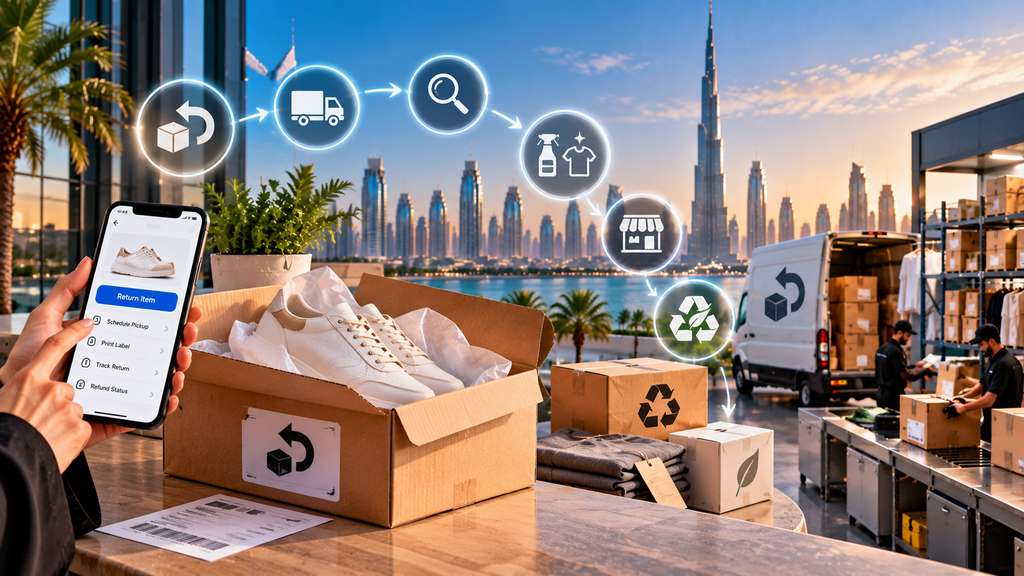
A customer first submits a return request through an online platform or customer service channel.
The retailer checks whether the product meets applicable return conditions and consumer protection requirements.
If the return is accepted, the customer may be offered collection, courier delivery or a designated drop-off location.
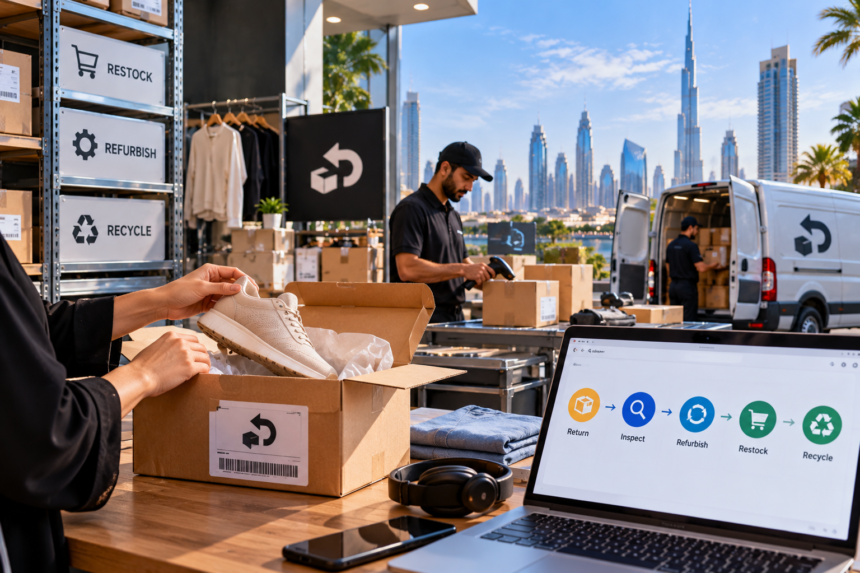
The product is transported to a processing centre, where staff inspect its condition and determine what happens next.
Depending on the outcome, the item may be restocked, repaired, refurbished, returned to the supplier or responsibly recycled.
Forward Logistics vs Reverse Logistics
| Feature | Forward Logistics | Reverse Logistics |
|---|---|---|
| Direction | Warehouse to customer | Customer to retailer |
| Main Purpose | Fulfil customer orders | Manage returned goods |
| Product Condition | Usually ready for sale | Requires inspection |
| Inventory Process | Stock leaves warehouse | Stock may re-enter inventory |
| Customer Interaction | Delivery tracking | Return and refund updates |
| Main Challenge | Delivery efficiency | Recovery cost and product value |
Why the Process Is More Complicated
Outgoing deliveries usually involve products prepared for fulfilment.
Returned items arrive in different conditions.
Some remain unopened, while others may have damaged packaging, missing components or signs of use.
Retailers must inspect them individually before deciding whether resale is appropriate.
This makes reverse logistics more complex than simply transporting products back to a warehouse.
7 Reasons Reverse Logistics Is Becoming Important for Gulf Retailers
Reverse logistics affects several areas of business performance, from customer trust to operating expenses.
As e-commerce develops across the GCC, these considerations are becoming increasingly relevant.
1. Customers Expect Convenient Returns
Online shoppers cannot always inspect products before purchasing.
Return options therefore provide reassurance, particularly for clothing, footwear and expensive electronics.
Convenient processes can reduce uncertainty and make customers more comfortable purchasing from unfamiliar retailers.
2. Return Policies Influence Purchasing Decisions
Customers often examine delivery and refund conditions before placing an order.
DHL’s January 2026 analysis reported that 79% of shoppers in its international research would abandon purchases because of unsuitable return policies.
This demonstrates the importance of returns to purchasing decisions, although individual market results vary.
3. Returns Can Reduce Profit Margins
Every returned product can create additional expenses.
These may include collection fees, inspection costs, repackaging, payment processing and reduced resale value.
For products with low margins, several unexpected expenses may eliminate the profit from the original sale.
4. Faster Refunds Support Customer Confidence
Customers generally want to know whether their return has been received and when an approved refund will be processed.
Clear communication reduces uncertainty and unnecessary customer service enquiries.
Retailers that manage refunds consistently may strengthen customer relationships.
5. Products Need to Return to Inventory Quickly
An unopened product in good condition may be suitable for resale.
However, delays in inspection and restocking can reduce its commercial value.
This is particularly relevant to seasonal fashion, promotional products and rapidly changing electronics.
6. Sustainability Is Becoming More Important
Returned products should not automatically become waste.
Some items can be restocked, repaired, refurbished or resold.
Effective reverse logistics can help recover usable goods and reduce unnecessary disposal.
7. Retailers Need Better Operational Data
Return information can reveal recurring product problems.
For example, frequent sizing complaints may indicate inaccurate clothing measurements.
High damage rates may suggest packaging or transportation problems.
Analysing these patterns can help businesses address the causes of returns.
Seven Business Benefits
| Benefit | Business Impact |
|---|---|
| Convenient Returns | Greater customer confidence |
| Clear Return Policies | Better purchasing experience |
| Cost Management | Protection of profit margins |
| Efficient Refunds | Improved customer communication |
| Faster Restocking | Better inventory recovery |
| Product Reuse | Reduced unnecessary waste |
| Return Analytics | Improved operational decisions |
E-Commerce Returns in the UAE and Saudi Arabia: Changing Customer Expectations
The Gulf’s online shopping market includes consumers with different preferences, purchasing habits and delivery expectations.
Retailers serving several GCC countries must understand these differences rather than assuming one returns policy will work equally well everywhere.
What UAE Research Reveals
DHL’s 2026 E-Commerce Trends Report identified strong demand for convenient delivery and returns in the UAE.
According to the report:
- 84% of UAE shoppers preferred home delivery.
- 73% preferred home collection for returns.
- 64% had a paid delivery-and-returns subscription.
- 23% used parcel lockers for returns.
These findings suggest that flexibility matters alongside delivery speed.
Customers may want different ways to return items depending on their location, schedules and accessibility requirements.
Saudi Arabia’s Growing Logistics Ecosystem
Saudi Arabia’s expanding e-commerce market is creating opportunities for specialised logistics services.
Retailers must coordinate deliveries and returns across major cities and smaller communities.
Distances, courier availability and warehouse locations can influence collection costs.
Businesses should therefore design return networks around actual customer demand and geographic coverage.
Why GCC Markets Require Different Approaches
The UAE has concentrated urban areas and extensive delivery infrastructure.
Saudi Arabia covers a much larger geographical area, creating different transportation requirements.
Other GCC markets, including Qatar, Kuwait, Bahrain and Oman, also have distinct delivery networks and customer expectations.
Regional Returns Considerations
| Market | Important Operational Consideration |
|---|---|
| UAE | Convenient collection and multiple return options |
| Saudi Arabia | Distance and regional logistics coverage |
| Qatar | Efficient urban collection and processing |
| Kuwait | Retailer and courier coordination |
| Bahrain | Cost-effective return consolidation |
| Oman | Geographic distribution and collection networks |
These are broad operational considerations rather than measured rankings of national logistics performance.
The Importance of Customer Choice
Some shoppers prefer home collection because it eliminates the need to travel.
Others may find parcel lockers or drop-off locations more convenient.
Offering suitable alternatives can help retailers balance customer preferences with transportation expenses.
How Reverse Logistics Affects Profit Margins and Operating Costs
One of the biggest challenges for online retailers is calculating the complete financial impact of returns.
The original delivery expense is only one part of the equation.
A product may also require collection, inspection, repackaging and additional storage.
Understanding the True Cost of a Return
Consider an online retailer selling a fashion product for AED 200.
The product is returned because the customer ordered the wrong size.
The retailer may need to pay for collection and processing before offering the item for sale again.
Illustrative Return Cost
| Expense | Hypothetical Cost |
|---|---|
| Return Collection | AED 15 |
| Product Inspection | AED 8 |
| Repackaging | AED 5 |
| Administration and Payment Handling | AED 7 |
| Additional Storage | AED 5 |
| Total Return Processing Cost | AED 40 |
These are illustrative calculations, not verified GCC logistics provider prices.
The retailer has spent AED 40 processing the return, even before accounting for the original delivery expense, inventory financing and any reduction in the product’s resale value.
If the product cannot be sold at its original price, the financial impact may increase further.
Why Product Value Matters
A return costing AED 40 has a different impact on a product worth AED 80 compared with one worth AED 2,000.
Businesses should therefore establish processes appropriate to each product category.
For low-value items, the cost of collection may sometimes exceed the value recoverable through resale.
However, refund obligations and consumer rights must still be respected.
Recovering Value From Returned Goods
Returned products can follow several different paths.
| Product Condition | Possible Action |
|---|---|
| Unopened and Undamaged | Restock |
| Opened but Resalable | Inspect and repackage |
| Minor Defect | Repair or refurbish |
| Seasonal or Slow-Moving | Discount or liquidate |
| Unsuitable for Resale | Consider compliant recycling |
| Unsafe or Non-Compliant | Follow appropriate disposal procedures |
Why Faster Processing Matters
Retailers benefit when returned goods are evaluated promptly.
A product waiting several weeks for inspection may miss an important selling period.
In contrast, efficient processing can return suitable items to inventory while demand remains strong.
However, speed should not compromise product safety or accurate inspections.
Technology, Automation and AI in Reverse Logistics Operations
Digital technology is becoming increasingly important in managing the volume and complexity of online returns.
Retailers can use software systems to connect customer requests, couriers, warehouses and refund operations.
Automated Return Management
A return-management system allows customers to submit requests through an online portal.
The software may verify order details, generate return references and communicate collection instructions.
Automation can reduce repetitive administrative work and provide consistent information.
However, complicated or disputed cases may still require human support.
Tracking Returned Products
Tracking systems can show whether a parcel has been collected, transported or received at a processing facility.
Customers benefit from greater transparency, while retailers gain more reliable operational information.
Accurate tracking is especially important when returns pass through several logistics partners.
Artificial Intelligence and Return Analytics
AI tools can identify patterns across large volumes of return data.
For example, a retailer may discover that one clothing product generates unusually high return requests because of sizing problems.
Another product may experience frequent damage during delivery.
Identifying the cause can help reduce future returns.
Warehouse Automation
Sorting systems, barcode scanning and digital inventory platforms may improve processing speed.
Larger operations can also use automated equipment to direct returned goods towards inspection or restocking areas.
However, smaller retailers may achieve meaningful improvements through simpler software and well-designed procedures.
Technology Comparison
| Technology | Main Function | Potential Benefit |
|---|---|---|
| Return Portal | Customer requests | Easier initiation |
| Parcel Tracking | Monitor movement | Better visibility |
| Barcode Scanning | Identify returned goods | Fewer inventory errors |
| AI Analytics | Identify return patterns | Improved decisions |
| Warehouse Automation | Assist sorting | Greater processing efficiency |
| Inventory Integration | Update product availability | Faster restocking |
Avoiding Excessive Automation
Automation should be introduced where it solves a practical problem.
A small online retailer with relatively few monthly returns may not need expensive warehouse robotics.
A clear returns policy, dependable courier arrangement and basic inventory system may initially provide greater value.
UAE Consumer Protection Rules and Sustainable Return Management
Reverse logistics is not only a commercial issue.
Businesses must also consider consumer protection, product safety and environmental responsibilities.
UAE Consumer Protection Framework
The UAE’s Federal Law No. 15 of 2020 on Consumer Protection provides protections relating to product quality, information and remedies for defective goods.
Federal Decree-Law No. 14 of 2023 on Modern Technology-Based Trade regulates online commercial activity and includes provisions concerning consumer rights and the return of goods and services.
The applicable remedy depends on the circumstances and relevant legal requirements.
Retailers should not assume that a published no-returns policy removes mandatory legal obligations concerning defective or non-compliant products.
Clear Return Policies
A well-designed policy should explain eligibility, timeframes, product-condition requirements and refund procedures.
It should also distinguish voluntary returns for change of mind from legally required remedies involving defective goods.
Important Policy Information
- Products eligible for return.
- Applicable return periods.
- Collection or drop-off arrangements.
- Required product condition.
- Refund and exchange procedures.
- Applicable return charges.
- Procedures for damaged or incorrect items.
- Customer support contact information.
Sustainability and Product Recovery
Reverse logistics can support circular business practices by returning usable products to the market.
However, transportation and packaging associated with returns can also create environmental impacts.
The goal should be to avoid unnecessary returns while managing unavoidable ones responsibly.
Reuse, Repair and Recycling
Products in suitable condition may be resold.
Others may be refurbished or repaired by qualified service providers.
Recycling becomes appropriate when reuse is not feasible and materials can be recovered responsibly.
Businesses should not donate unsafe or unsuitable products merely to avoid disposal expenses.
Sustainable Returns Comparison
| Practice | Potential Benefit |
|---|---|
| Accurate Product Descriptions | Fewer avoidable returns |
| Detailed Size Guides | Better customer selection |
| Consolidated Collection | More efficient transport |
| Reusable Packaging | Potential reduction in packaging waste |
| Product Repair | Extended useful life |
| Refurbishment | Recovery of resale value |
| Responsible Recycling | Improved material recovery |
Sustainable reverse logistics begins before the customer places an order.
Providing accurate information can reduce unnecessary movement of goods.
The Future of Reverse Logistics in Gulf E-Commerce and Frequently Asked Questions
Returns management is becoming an increasingly important component of online retail strategy.
The development of delivery subscriptions, parcel locker networks and technology-led fulfilment services illustrates growing attention to customer convenience.
However, future investment will depend on operational costs, consumer behaviour and profitability.
More Flexible Return Networks
Retailers may increasingly combine home collection with drop-off locations and parcel lockers.
Different methods can serve different customer preferences while helping businesses manage transport expenses.
Stronger Integration Between Retailers and Couriers
Integrated digital systems can improve communication between stores, warehouses and logistics companies.
This may help reduce delays and improve visibility across the returns process.
Greater Focus on Reducing Avoidable Returns
Retailers are likely to continue investing in product information, sizing tools and customer support.
Preventing unnecessary returns can be more economical than processing them efficiently after they occur.
Practical Checklist for Gulf Online Retailers
- Review existing return policies.
- Verify consumer protection compliance.
- Measure return rates by product category.
- Calculate processing costs.
- Compare collection and drop-off options.
- Establish clear inspection procedures.
- Improve product descriptions.
- Track refund processing times.
- Identify products suitable for resale or repair.
- Monitor customer satisfaction.
Frequently Asked Questions
What is reverse logistics in e-commerce?
Reverse logistics manages the return movement of products from customers to retailers, warehouses, manufacturers or processing facilities.
Why is reverse logistics important for Gulf retailers?
It influences customer satisfaction, operating costs, inventory recovery and compliance with consumer protection requirements.
Are online returns increasing in the UAE?
Returns management is becoming more important as e-commerce develops, but consistent public data establishing a precise UAE-wide annual return-rate trend remains limited.
What is the difference between forward and reverse logistics?
Forward logistics moves products towards customers, while reverse logistics manages goods moving back through the supply chain.
How can businesses reduce return costs?
They can improve product information, optimise collection arrangements, inspect goods quickly and use return data to identify recurring problems.
Can returned products be resold?
Yes, when their condition, product category and applicable regulations permit resale. Appropriate inspection and disclosure may be necessary.
Does the UAE regulate e-commerce returns?
Yes. UAE consumer protection and modern technology-based trade legislation establish relevant obligations. Specific rights depend on the transaction and circumstances.
Final Thoughts on Reverse Logistics in Gulf Online Retail
Reverse logistics is becoming an essential part of online retail operations across the GCC.
As consumers become more comfortable purchasing products digitally, they also expect convenient ways to return unsuitable or defective goods.
For businesses, these expectations create both challenges and opportunities.
Poorly managed returns can increase costs, delay inventory recovery and weaken customer confidence.
Efficient processes, by contrast, can improve operational visibility, support product recovery and help retailers build stronger customer relationships.
Technology can assist with tracking, automation and data analysis, while clear policies provide customers with greater confidence.
Sustainability is another important consideration, particularly when returned products can be repaired, refurbished or resold rather than discarded.
Ultimately, Reverse Logistics in Gulf is no longer simply a process for handling unwanted products.
It is becoming part of the overall customer experience and a significant factor in e-commerce competitiveness.
Retailers that balance customer convenience with responsible operations, regulatory compliance and realistic financial planning will be better positioned to manage the changing demands of Gulf online shopping.
Editorial Note: This article reflects research and regulatory information available through October 2026. UAE survey findings are not representative of every GCC market. Financial examples are illustrative and should not be treated as actual logistics service quotations or guaranteed business outcomes.
Do follow us on Instagram
Read More – Cloud Kitchens in Dubai: How Delivery-Only Restaurants Make Money