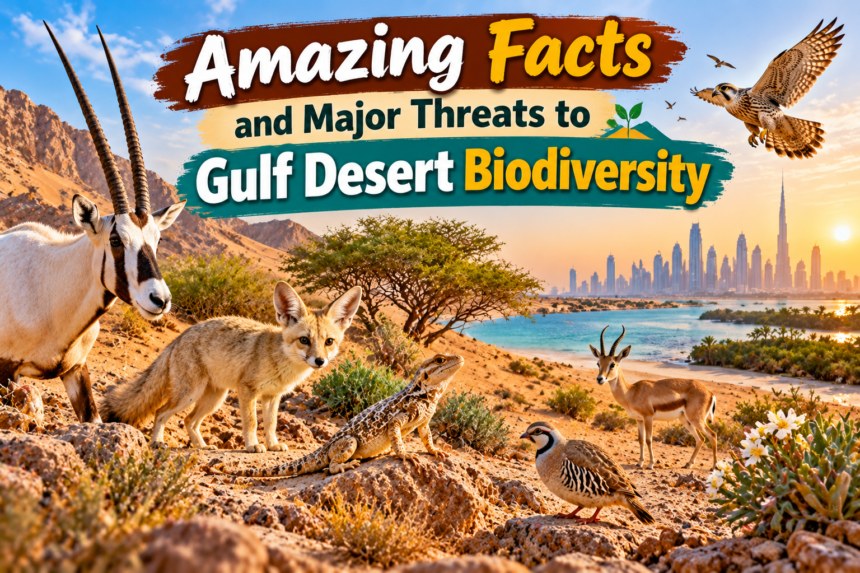
The Hidden Gulf Desert Biodiversity: 7 Amazing Facts and 5 Major Threats
When people think about the Gulf region, they often imagine golden sand dunes, busy cities, oil fields, and hot weather. However, the deserts of the Arabian Peninsula are much more than empty stretches of sand. They are living ecosystems filled with plants, mammals, reptiles, birds, insects, and other organisms that have developed remarkable ways to survive in dry and challenging conditions.
- 1. What Makes Gulf Desert Ecosystems Special?
- 2. Seven Amazing Facts About Gulf Desert Biodiversity
- 3. The Arabian Oryx, Gazelles, and Other Desert Mammals
- 4. Desert Plants: The Foundation of Life
- 5. The Different Desert Landscapes Across the GCC
- 6. Five Major Threats to Gulf Desert Ecosystems
- 7. Why Desert Biodiversity Matters to People
- 8. How Gulf Countries Can Protect Hidden Desert Biodiversity
- 9. How You Can Help Protect Gulf Desert Wildlife
- Conclusion: Protecting the Hidden Life of Gulf Deserts
- Frequently Asked Questions (FAQs)
From the vast Rub’ al Khali, also known as the Empty Quarter, to the rocky plains of Qatar, the sandy deserts of the United Arab Emirates, and the dry valleys of Oman, the Gulf region contains a surprising variety of natural habitats. Each habitat supports life that may be difficult to notice at first glance.
Some animals hide underground during the hottest hours. Some plants grow deep roots to reach water. Others remain inactive during dry periods and become active when rain creates favourable conditions. These survival methods make Gulf desert ecosystems both fascinating and important.
However, desert biodiversity faces growing pressure from construction, habitat loss, pollution, climate change, and human disturbance. Understanding these natural systems is an important step towards protecting them.
In this article, we explore the hidden biodiversity of Gulf desert ecosystems, including seven amazing facts, important plants and animals, five major threats, and practical ways to protect the region’s natural heritage.
1. What Makes Gulf Desert Ecosystems Special?
A desert ecosystem is a natural environment where rainfall is limited and living organisms must adapt to water shortages and changing temperatures. In Gulf countries, these conditions are often combined with intense sunlight, sandy or rocky ground, and large differences between daytime and nighttime temperatures.
Despite these challenges, desert environments support many forms of life.
The United Arab Emirates has a varied natural landscape that includes sand dunes, gravel plains, mountains, dry valleys called wadis, oases, salt flats, and coastal habitats. These different environments support different groups of plants and animals. The UAE government’s official information on topography and ecosystems explains how these landscapes contribute to the country’s biodiversity.
Desert biodiversity includes:
- Mammals: Arabian oryx, Arabian sand gazelles, desert foxes, hedgehogs, and other small mammals.
- Reptiles: Lizards, geckos, skinks, and different species of snakes.
- Birds: Eagles, falcons, owls, larks, and birds that migrate through the Arabian Peninsula.
- Plants: Ghaf trees, acacia species, desert grasses, shrubs, and seasonal wildflowers.
- Insects and invertebrates: Ants, beetles, scorpions, spiders, and other small creatures that play important ecological roles.
These organisms are connected through food chains, shelter, soil conditions, and the availability of water.
For example, desert shrubs provide food for insects and plant-eating animals. Insects become food for birds and reptiles. Small mammals may feed predators such as foxes and owls. When one part of this system changes, other species may be affected too.
The hidden biodiversity of Gulf deserts is therefore not just about unusual animals. It is about the relationships that allow an entire ecosystem to survive.
2. Seven Amazing Facts About Gulf Desert Biodiversity
The Gulf’s deserts contain many natural wonders that are easy to overlook. Here are seven interesting facts about these remarkable ecosystems.
Fact 1: The desert is not empty
A wide area of sand may appear lifeless, especially during the hottest part of the day. Yet plants, insects, reptiles, and mammals can live in and around dunes, rocky ground, and scattered vegetation.
Some species are active at night, while others hide beneath rocks, inside burrows, or under shrubs. These behaviours reduce exposure to extreme heat and help animals conserve water.
Dubai Municipality’s information on Al Wohoosh Desert Conservation Reserve describes a protected area supporting desert foxes, hedgehogs, wild hares, lizards, insects, and a variety of native plants.
This shows why a quiet desert landscape should never automatically be considered an area without wildlife.
Fact 2: The Arabian oryx is a remarkable conservation success
The Arabian oryx is one of the best-known animals of the Arabian Peninsula. It has a pale coat, dark facial markings, long horns, and broad hooves suited to movement over soft ground.
The species was declared extinct in the wild during the 1970s, but captive breeding, protection, and reintroduction programmes helped restore wild populations.
The Environment Agency – Abu Dhabi reports that the UAE is home to a major population of Arabian oryx and continues conservation work to protect the species.
Its recovery demonstrates that careful planning and sustained conservation efforts can help threatened wildlife return to suitable habitats.
Fact 3: Some desert animals avoid the daytime heat
Many desert animals reduce their activity during the hottest hours. Some become active after sunset, when the ground and air begin to cool.
Nocturnal or evening activity helps conserve water and reduces the risk of overheating. Burrows and natural hiding places also provide shelter from high temperatures and predators.
This is one reason wildlife may be present in a desert even when visitors see very few animals during daylight.
Fact 4: A single rainfall can transform the landscape
Rainfall is limited across much of the Arabian desert, but when it arrives, it can create sudden changes.
Seeds that have remained dormant in the soil may germinate. Small plants and wildflowers can appear, insects become more active, and animals find fresh food. Temporary pools may also support small organisms and attract birds.
These changes are usually seasonal or temporary. Their timing depends on the amount of rainfall, soil conditions, and temperature.
Desert life is therefore closely linked to weather patterns, even when rain is uncommon.
Fact 5: Small creatures play a big role
Insects, spiders, scorpions, and other small invertebrates may receive less attention than large mammals, but they are essential to desert ecosystems.
Some insects pollinate flowers. Others help break down organic material, move nutrients through the soil, or provide food for birds, reptiles, and small mammals.
Scavengers and decomposers also help return nutrients to the environment.
Losing these small organisms could affect many other species in the food web.
Fact 6: Desert plants have clever survival methods
Plants in Gulf deserts must survive with limited water and often in nutrient-poor soil. Some develop deep or widespread root systems. Others have small leaves, protective surfaces, or growth patterns that reduce water loss.
Some desert plants grow quickly after rainfall, produce flowers or seeds, and then become less visible during dry conditions.
The ghaf tree is particularly important in parts of the UAE because it provides shade, shelter, and food resources for wildlife. Other native trees and shrubs, including acacia species and sidr, also help support desert habitats.
Fact 7: Gulf deserts support migratory birds
Desert ecosystems are important not only for resident animals but also for birds moving between breeding, feeding, and wintering areas.
Some birds use the Arabian Peninsula as a stopover during migration. They may depend on particular habitats for rest and food before continuing their journey.
Protecting desert wetlands, open plains, and suitable feeding areas can therefore help wildlife that travels across international borders.
These seven facts reveal an important lesson: the Gulf desert is a living environment full of relationships, seasonal changes, and specialised survival strategies.
3. The Arabian Oryx, Gazelles, and Other Desert Mammals
Large mammals often attract the most attention when people explore Gulf wildlife, but their survival depends on suitable habitat, enough food, and protection from human disturbance.
Arabian oryx
The Arabian oryx is adapted to arid environments and can survive under conditions that would be difficult for many large mammals. Its pale body helps reflect sunlight, while its broad hooves assist movement across sandy ground.
Oryx feed on vegetation, including grasses and shrubs, depending on what is available. They may travel in search of food and suitable conditions.
Although conservation programmes have helped restore the species in some areas, long-term protection remains important. Habitat loss, barriers to movement, and disturbance can still affect wild populations.
Historically, the Arabian oryx probably ranged throughout most of the Middle East. In the early 1800s, it still occurred in the Sinai Peninsula, Palestine region, the Transjordan, much of Iraq, and most of the Arabian Peninsula. During the 19th and early 20th centuries, its range decreased to Saudi Arabia, and by 1914, only a few survived outside that country
Arabian sand gazelle
The Arabian sand gazelle, also known as Gazella marica, inhabits sandy deserts and coastal plains. It is a fast-moving animal that can survive in dry environments where food availability changes with rainfall.
The Environment Agency – Abu Dhabi identifies habitat degradation and uncontrolled hunting among the threats facing this species. Its official species profile also describes conservation efforts involving monitoring and the protection of gazelle populations.
Today it survives in the wild in small, isolated populations in Saudi Arabia, the United Arab Emirates, Oman, and southeastern Turkey. Small numbers may also be present in Kuwait, Iraq, Jordan, and Syria. The total population of wild sand gazelles is thought to be less than 3,000.
Desert foxes and other small mammals
Foxes, hedgehogs, hares, jerboas, and other small mammals are important parts of the desert food web. Their diets may include insects, plant material, and smaller animals.
Some dig burrows, which provide shelter and protection from extreme weather. Others use dense vegetation or rocky spaces to hide.
These animals help support ecosystem balance and provide food for predators.
Protecting mammals requires more than preventing hunting. It also means keeping habitats connected so that animals can move between feeding areas, shelters, and breeding sites.
4. Desert Plants: The Foundation of Life
Plants form the foundation of many desert food chains. Even where vegetation appears sparse, native shrubs, trees, grasses, and seasonal flowers provide food, shade, shelter, and breeding spaces for wildlife.
The ghaf tree
The ghaf is an important native tree in parts of the UAE. Its roots, branches, and canopy help create useful microhabitats in an otherwise dry environment.
The shade beneath a mature tree can be cooler than the surrounding open ground. This can offer relief to animals and help some smaller plants survive.
Ghaf trees also contribute to soil stability and provide resources for wildlife. Their conservation is therefore valuable for more than their appearance.
Botanical Name: Prosopis cineraria (family Fabaceae).
Lifespan: The tree typically lives for an average of up to 120 years, though famous older specimens exist—such as the 400-year-old.
Acacia and sidr trees
Acacia species and sidr trees occur in several Arabian habitats. They may provide browsing material, flowers, seeds, shade, or places for animals to rest, depending on the species and conditions.
Native trees can be especially valuable in wadis and other locations where moisture collects more readily than on exposed dunes.
They both survive in extremely heat and poor soils, they both belong to entirely different botanical families.
Desert grasses and shrubs
Grasses and low shrubs help support plant-eating animals and insects. Their roots can help stabilise soil, and their presence may influence where wildlife feeds or shelters.
However, plants do not grow equally well in all desert locations. Some species prefer shifting sand, while others are associated with gravel plains, rocky ground, or dry drainage channels.
This is why planting a random selection of vegetation is not always the best way to restore a desert. Conservation projects should use appropriate native plants and consider the natural conditions of each site.
5. The Different Desert Landscapes Across the GCC
The Gulf Cooperation Council includes Bahrain, Kuwait, Oman, Qatar, Saudi Arabia, and the United Arab Emirates. Although their climates share many features, their natural landscapes are not identical.
United Arab Emirates
The UAE contains extensive sandy deserts as well as gravel plains, mountains, wadis, salt flats, and oases. Protected areas such as Dubai Desert Conservation Reserve and other regional reserves help conserve wildlife and natural habitats.
The United Arab Emirates is named after the seven emirates that formed a federation: the Emirate of Abu Dhabi, the Emirate of Dubai, the Emirate of Ajman, the Emirate of Sharjah, the Emirate of Ras Al Khaimah, the Emirate of Umm Al Quwain, and the Emirate of Fujairah
Saudi Arabia
Saudi Arabia contains large desert areas, including the Rub’ al Khali and the sandy regions of Nafud. Its protected areas support desert plants, Arabian oryx, gazelles, foxes, reptiles, and many bird species.
The National Center for Wildlife describes ‘Uruq Bani Ma’arid as a protected area in the western part of the Empty Quarter. Its dunes, inter-dune corridors, and vegetated valleys support distinctive desert plants and animals. The reserve also plays an important role in Arabian oryx conservation.
Qatar
Qatar includes sandy dunes and rocky desert, known as hamada. Although rainfall is limited, the country supports more than 300 species of wild plants, according to Visit Qatar’s nature guide.
Desert roses, grasses, shrubs, and other plants form part of this landscape, while reptiles, insects, and birds are among the wildlife that can be found in suitable habitats.
Oman
Oman’s biodiversity includes desert plains, mountains, wadis, coastal habitats, and areas that receive more rainfall than the central deserts. These differences create a wide variety of plant and animal habitats.
The Oman Environment Authority highlights the country’s varied landscape and rich biodiversity. Its ecosystems face pressures from human activity, making habitat protection an important conservation priority.
Kuwait and Bahrain
Kuwait and Bahrain both have arid environments, but their location and landforms create different habitat conditions.
Kuwait includes desert plains and coastal environments, while Bahrain combines arid land with island and coastal habitats. Native plants, insects, reptiles, and birds form part of their broader natural diversity.
Across all six GCC countries, conserving desert biodiversity requires attention to local conditions rather than assuming every desert habitat is the same.
6. Five Major Threats to Gulf Desert Ecosystems
Although desert species are adapted to difficult natural conditions, they are not prepared for every kind of human disturbance. Several pressures can damage habitats or reduce wildlife populations.
Threat 1: Urban development and habitat loss
Rapid development can change natural desert landscapes through road construction, housing projects, industrial areas, and new infrastructure.
When development divides habitats into smaller pieces, animals may have difficulty reaching food, water, shelter, or breeding areas. Roads can also create collision risks, while construction activity may disturb sensitive wildlife.
What can help?
- Carry out environmental assessments before major projects.
- Protect important wildlife habitats from unnecessary development.
- Include wildlife-friendly planning in road and infrastructure projects.
- Avoid disturbing breeding areas and known wildlife corridors.
- Restore damaged sites using suitable native plants where appropriate.
Planning is especially important because some desert habitats take a long time to recover after heavy disturbance.
Threat 2: Climate change and rising temperatures
Climate change may affect the timing and amount of rainfall, the frequency of extreme heat, and the availability of food and water for wildlife.
Plants may struggle if dry periods become longer or temperatures exceed the conditions in which they normally grow. Animals may face additional pressure when food is scarce or suitable shelter becomes harder to find.
The exact effects differ between species and locations. Some organisms may tolerate certain changes better than others.
What can help? Long-term climate monitoring, protection of connected habitats, reduction of emissions, and conservation based on scientific research can strengthen the ability of ecosystems to cope with change.
Threat 3: Litter and pollution
Plastic bags, food packaging, metal waste, and other litter can harm desert wildlife. Animals may become trapped in waste or swallow items they mistake for food.
Discarded waste can also affect soil quality and the natural appearance of protected areas.
Vehicle fluids, chemicals, and poorly managed waste disposal can cause additional damage to sensitive environments.
Visitors should take their rubbish home, use designated disposal points, and avoid leaving food waste behind. Businesses operating near desert areas should also ensure that waste cannot blow into surrounding habitats.
Threat 4: Off-road driving and excessive human disturbance
Desert driving and recreational activities can damage plant cover, disturb animals, and leave tracks that alter fragile ground surfaces.
Repeated driving over the same area can break plants and disturb soil. Vehicles may also approach wildlife too closely, creating stress or forcing animals to move away from important feeding areas.
Camping can have similar effects when visitors leave rubbish, light fires in unsuitable places, or disturb animals during sensitive periods.
Responsible visitors should remain on approved routes, respect protected-area rules, avoid chasing wildlife, and never remove plants or animals from their natural habitat.
Threat 5: Overgrazing, hunting, and illegal wildlife trade
Livestock grazing has long been part of life in the Arabian Peninsula, but grazing pressure must be managed carefully. When too many animals feed in a limited area, native plants may not have enough time to recover.
Uncontrolled hunting can reduce wildlife populations, especially when animals reproduce slowly or live in small isolated groups.
Illegal capture and trade can also harm native species.
Enforcement, community awareness, suitable grazing management, and support for conservation programmes can help reduce these pressures.
Protecting desert ecosystems does not mean excluding people from every landscape. It means finding practical ways for human activities to take place without destroying the natural systems on which wildlife depends.
7. Why Desert Biodiversity Matters to People
Desert biodiversity is not valuable only because it contains rare or beautiful animals. Healthy ecosystems also provide benefits that support human communities.
Soil protection
Native plants help hold soil in place. Their roots and surface cover can reduce erosion in suitable habitats, while plant litter contributes organic material to the soil.
Pollination and nutrient cycling
Insects and other small organisms help pollinate some plants and break down organic matter. These processes support plant growth and the movement of nutrients through the ecosystem.
Scientific research
Desert species offer opportunities to study heat tolerance, water conservation, animal behaviour, and adaptation to extreme conditions. Research can improve understanding of both natural ecosystems and broader environmental challenges.
Cultural heritage
The desert has shaped the history and traditions of communities across the Arabian Peninsula. Knowledge of native plants, animals, seasonal weather, and water sources has been important in traditional life.
Protecting biodiversity can therefore also help preserve local ecological knowledge and a deeper connection to place.
Nature education and responsible tourism
Well-managed wildlife reserves and nature programmes allow people to learn about desert ecosystems without placing unnecessary pressure on wildlife.
Responsible tourism can create opportunities for guides, researchers, conservation workers, and nearby communities when activities are carefully managed.
8. How Gulf Countries Can Protect Hidden Desert Biodiversity
Conservation works best when it combines habitat protection, scientific research, effective regulations, and public participation.
Establish and manage protected areas
Protected areas can conserve important habitats and give wildlife space to feed, reproduce, and move naturally. But a protected label alone is not enough. Areas also need monitoring, management plans, adequate resources, and enforcement.
Support wildlife surveys and research
Scientists need information about animal numbers, plant distribution, breeding patterns, and habitat changes. Regular surveys help identify declining populations and evaluate whether conservation measures are working.
Restore native plants
Habitat restoration should focus on suitable native species and local environmental conditions. Planting the wrong species or changing natural water flows can create new problems.
Improve public awareness
Schools, communities, tourism businesses, and local authorities can explain why even small desert organisms deserve protection.
Simple messages about litter, off-road driving, wildlife disturbance, and native plants can help visitors make better choices.
Work with local communities
Residents, herders, land managers, researchers, and conservation organisations all hold useful knowledge. Cooperation can help identify practical solutions that protect biodiversity while respecting local needs.
The UAE, Oman, and Saudi Arabia provide examples of protected areas and biodiversity programmes that support these efforts. Their experiences also show the importance of maintaining conservation work over time.
9. How You Can Help Protect Gulf Desert Wildlife
Individuals can contribute to conservation through everyday decisions, even if they do not work directly with wildlife.
Here are some practical ways to help:
- Take all rubbish home when visiting the desert.
- Drive only on permitted routes.
- Keep a safe distance from wild animals.
- Do not feed wildlife or attempt to handle it.
- Avoid picking native plants or collecting wild animals.
- Follow local camping and fire-safety regulations.
- Join organised clean-ups or reputable conservation programmes.
- Learn to recognise native species and share accurate information.
- Support responsible tourism and businesses that respect protected areas.
- Report suspected hunting or illegal wildlife activity to the relevant authorities.
When photographing animals, avoid chasing them for a better view. A photograph is never worth making an animal abandon its shelter or waste energy escaping from people.
The most helpful approach is to observe nature quietly, follow local guidance, and leave the habitat as undisturbed as possible.
Conclusion: Protecting the Hidden Life of Gulf Deserts
The deserts of the Gulf region are far more diverse than their dry appearance suggests. Beneath the sand, between the rocks, and around native shrubs and trees, an interconnected community of plants, mammals, reptiles, birds, and insects survives through remarkable adaptations.
Arabian oryx and sand gazelles represent some of the region’s best-known wildlife, while foxes, hedgehogs, lizards, insects, and native plants also play vital roles. Protected areas across the GCC help conserve these species and preserve the habitats on which they depend.
However, urban expansion, climate change, pollution, off-road disturbance, overgrazing, and illegal hunting can threaten this natural heritage.
The future of Gulf desert biodiversity depends on responsible planning, scientific research, effective protection, and public awareness. Every conserved habitat and every responsible visitor can contribute to healthier ecosystems.
The desert is not an empty place. It is a living natural system, and protecting its hidden biodiversity means protecting an important part of the Gulf’s environmental heritage.
Frequently Asked Questions (FAQs)
1. What is biodiversity in Gulf desert ecosystems?
It refers to the variety of living organisms found in the deserts of the Arabian Peninsula, including native plants, mammals, birds, reptiles, insects, and other organisms, along with the habitats and relationships that support them.
2. Which animals live in Gulf deserts?
Depending on the location, animals may include Arabian oryx, Arabian sand gazelles, desert foxes, hedgehogs, hares, jerboas, lizards, snakes, scorpions, insects, and several types of birds.
3. What plants grow in Gulf desert ecosystems?
Native vegetation includes ghaf trees, acacia species, sidr trees, grasses, shrubs, and seasonal wildflowers. The exact plant species vary with soil, rainfall, and habitat conditions.
4. Why is desert biodiversity important?
Desert biodiversity supports food webs, soil protection, pollination, nutrient cycling, scientific research, nature education, and cultural heritage. Healthy ecosystems also provide habitats for wildlife and help maintain ecological balance.
5. What are the main threats to Gulf desert biodiversity?
Major threats include habitat loss caused by development, climate change, pollution, off-road driving, excessive disturbance, overgrazing, hunting, and illegal wildlife trade.
6. How do animals survive in the hot Gulf desert?
Different species use different adaptations. Some are active at night, hide in burrows, reduce activity during hot periods, or obtain moisture through food. Desert plants may have specialised roots, small leaves, or seasonal growth patterns.
7. How can tourists help protect desert wildlife?
Tourists can stay on approved routes, take rubbish home, avoid feeding or approaching animals, respect protected areas, and follow local rules for camping and photography.
8. Which Gulf countries have important desert conservation areas?
All six GCC countries contain natural habitats and conservation areas. Examples include Dubai Desert Conservation Reserve in the UAE, ‘Uruq Bani Ma’arid in Saudi Arabia, and desert and wadi habitats in Oman and Qatar. The habitats and species protected differ by location.
Do follow us on Instagram
Read More – Essential Things to Consider Before Adopting a Pet in Gulf City