


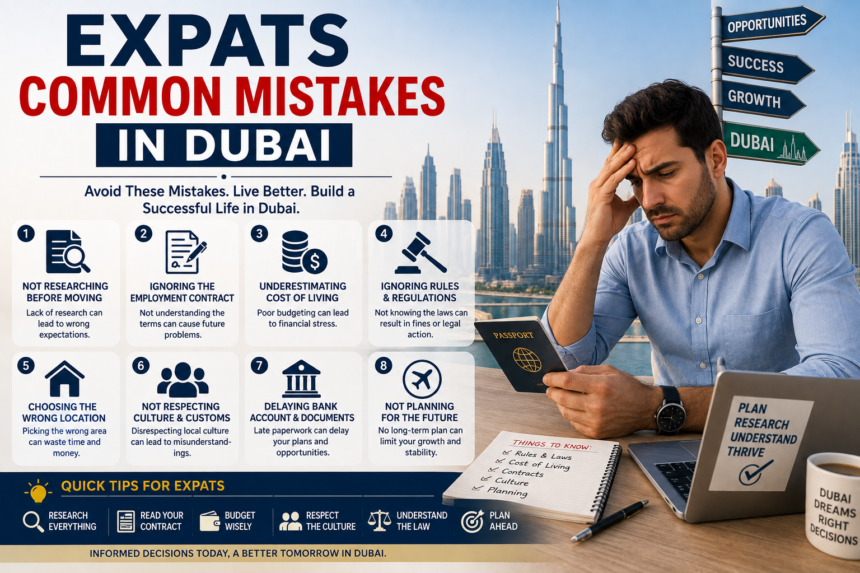
15 Mistakes to Avoid Expats Common Mistakes in Dubai
Dubai is one of the world’s most popular destinations for expatriates, offering excellent career opportunities, modern infrastructure, international communities, and a high standard of living. Every year, thousands of professionals, families, entrepreneurs, and skilled workers move to Dubai hoping to build a better future. However, adjusting to life in a new country requires more than finding a job and accommodation. Expats also need to understand local laws, visa requirements, financial responsibilities, workplace regulations, driving rules, and cultural expectations.
- 1. Expats Common Mistakes in Dubai: Ignoring Visa and Residency Rules
- 2. Working Without the Correct Work Permit
- 3. Signing an Employment Contract Without Reading It
- 4. Assuming You Can Change Jobs Whenever You Want
- 5. Underestimating the Cost of Living in Dubai
- 6. Spending Too Much in the First Few Months
- 7. Not Understanding Dubai Rental Contracts
- 8. Ignoring UAE Laws and Social Customs
- 9. Treating Social Media as Completely Private
- 10. Making Traffic Violations
- 11. Driving With an Invalid or Unsuitable Licence
- 12. Ignoring Health Insurance
- 13. Trusting Every Job Offer or Recruitment Agent
- 14. Failing to Build Emergency Savings
- 15. Relying on Outdated Information
- Common Financial Mistakes Expats Should Avoid
- Common Workplace Mistakes Expats Should Avoid
- How Expats Can Adjust Successfully to Life in Dubai
- A Practical Checklist for New Expats in Dubai
- Frequently Asked Questions About Common Expat Mistakes in Dubai
Many expats in Dubai make avoidable mistakes simply because they rely on assumptions, outdated information, or advice from friends and social media. A rule that may be normal in another country can work differently in the UAE. Even seemingly minor mistakes involving visas, employment, contracts, social media, driving, or personal finances can create unnecessary stress and financial problems.
This guide covers the common mistakes expats make in Dubai and explains practical ways to avoid them. Whether you are planning to move to Dubai, have recently arrived, or have lived in the emirate for years, understanding these mistakes can help you enjoy a safer, more financially secure, and more successful life in Dubai.
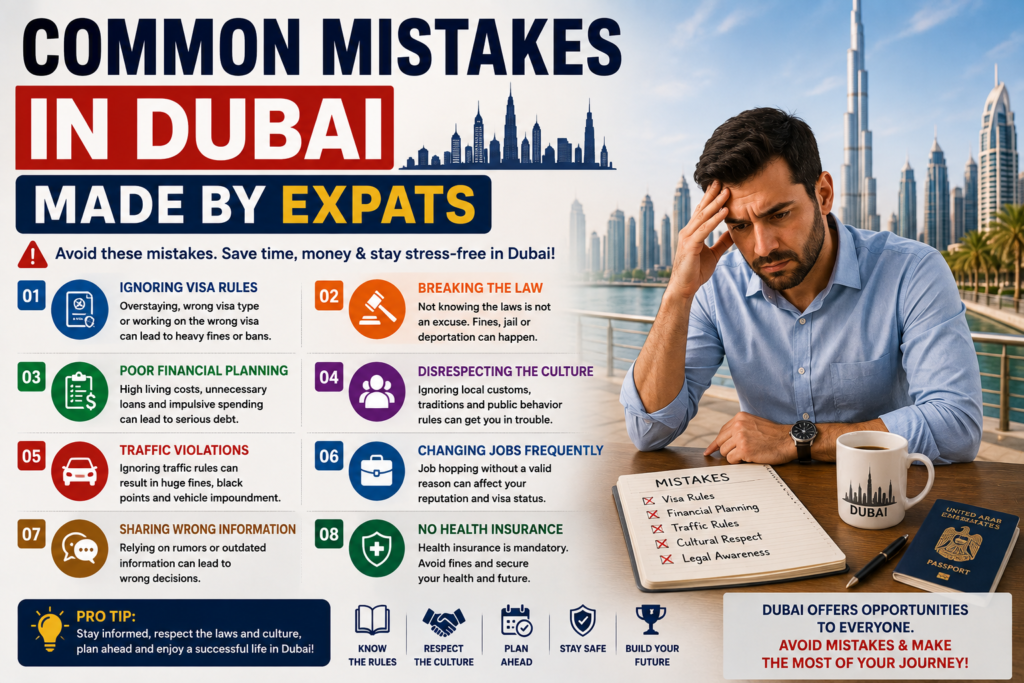
1. Expats Common Mistakes in Dubai: Ignoring Visa and Residency Rules
One of the biggest mistakes expats make in Dubai is assuming that visa requirements are simple and can be ignored after entering the country. Your legal right to live and work in the UAE depends on your specific visa or residence status, and different categories have different conditions.
The UAE has several residence options, including standard employment residence visas and other categories such as Green and Golden residency. A standard employment visa is normally arranged by the employer, while other residence options have their own eligibility requirements.
Expats should never assume that a visa remains valid indefinitely or that they can continue working after a visa or work authorization changes.
Common visa mistakes include:
- Forgetting to check visa or residence expiry dates
- Assuming a tourist visa permits employment
- Working without the appropriate work permit
- Failing to update personal information when required
- Relying on unofficial visa advice
- Ignoring cancellation or status-change procedures
- Assuming the same rules apply to every residence category
The UAE Government clearly states that working on a visit or tourist visa is prohibited. Working in the UAE requires the appropriate legal authorization.
How to avoid this mistake: Keep digital and physical copies of your visa, Emirates ID, passport, employment documents, and other important records. Check expiry dates regularly and use official government channels for visa information.
2. Working Without the Correct Work Permit
Another serious mistake is assuming that having a residence visa automatically means you can work for any company.
Under UAE labour regulations, working without a valid work permit is illegal. The work permit process is handled through the appropriate authorities, including the Ministry of Human Resources and Emiratisation (MoHRE) for applicable private-sector employment.
This is particularly important for expats who are:
- Changing employers
- Taking freelance work
- Starting a side job
- Working part-time
- Working for more than one employer
- Moving from a family-sponsored visa to employment
- Accepting informal job offers
The UAE permits certain forms of part-time employment, but the appropriate permit must be obtained.
How to avoid this mistake: Never begin a new job, freelance arrangement, or second job based only on a verbal agreement. Confirm that the necessary work authorization is in place before starting.
3. Signing an Employment Contract Without Reading It
Dubai has a highly international job market, and expats sometimes accept employment offers quickly because they are eager to begin working. Signing a contract without carefully checking the details can create problems later.
A UAE employment contract should contain important information such as the job, workplace, start date, employment duration, salary, and applicable terms. The official UAE Government states that employment contracts should be based on the agreed offer and comply with applicable labour regulations.
Before signing, check:
- Basic salary
- Allowances
- Working hours
- Job title and responsibilities
- Probation period
- Annual leave
- Notice period
- Insurance benefits
- Overtime arrangements
- Bonus or commission terms
- Relocation benefits
- Accommodation arrangements
- End-of-service benefits
Never assume that a verbal promise will automatically become part of your employment agreement.
How to avoid this mistake: Read every page of your job offer and employment contract. Keep copies of the documents and ask for clarification before signing if something is unclear.
4. Assuming You Can Change Jobs Whenever You Want
Dubai’s job market offers many opportunities, but expats should understand the legal process involved in changing employment.
Under UAE labour regulations, workers may be able to move to another employer when their contract expires or when employment ends under circumstances permitted by the law. Specific rules can apply depending on how the employment relationship ends, particularly during probation.
A common mistake is resigning suddenly because another company has offered a better salary without checking:
- Your notice period
- Probation rules
- Contract terms
- Work permit status
- Residence status
- Any applicable restrictions
- Outstanding employer obligations
Employees should also be careful about working for another company before the necessary employment authorization is completed.
How to avoid this mistake: Before resigning, review your contract and confirm the correct legal process for changing jobs. Do not rely solely on advice from colleagues or online forums.
5. Underestimating the Cost of Living in Dubai
Dubai can provide an excellent lifestyle, but it can also become expensive if you do not budget carefully.
Some new expats calculate their finances based only on their salary and rent. They may forget about transportation, utilities, mobile services, insurance, school fees, groceries, entertainment, deposits, annual payments, and unexpected expenses.
Before moving, prepare a realistic monthly budget covering:
- Rent
- Electricity and water
- Internet and mobile services
- Groceries
- Transportation
- Car payments and fuel
- Health insurance
- School or childcare expenses
- Entertainment
- Dining out
- Clothing
- Emergency savings
- Travel
- Loan repayments
Dubai’s tax structure can also create misconceptions. The UAE does not levy personal income tax on individuals, but consumers still pay VAT and other applicable charges.
How to avoid this mistake: Build a budget based on your actual lifestyle rather than assuming a high salary automatically means a high level of savings.
6. Spending Too Much in the First Few Months
Many new expats are excited by Dubai’s restaurants, shopping malls, hotels, entertainment venues, beaches, and nightlife. The temptation to spend heavily during the first few months can make it difficult to build savings.
A better approach is to establish your essential monthly expenses first.
Consider using a simple financial structure:
- Essential expenses
- Savings
- Debt repayment
- Investments
- Lifestyle spending
- Emergency fund
Avoid taking expensive loans simply to maintain a lifestyle that your income cannot comfortably support.
A good emergency fund can be particularly valuable because employment circumstances can change unexpectedly.
7. Not Understanding Dubai Rental Contracts
Finding accommodation is one of the first major decisions for many expats. A common mistake is renting a property without understanding the tenancy agreement or completing the required registration process.
Dubai’s official guidance states that residential tenants use an Ejari tenancy contract, which records the legal terms and conditions of the lease.
Before renting a property, carefully check:
- Annual rent
- Payment schedule
- Security deposit
- Maintenance responsibilities
- Renewal conditions
- Early termination provisions
- Agency fees
- Utility arrangements
- Parking
- Community or building rules
Do not transfer significant amounts of money without verifying the property, landlord or authorized agent and the terms of the agreement.
How to avoid this mistake: Use legitimate property channels, carefully review the tenancy contract, and complete the applicable registration procedures.
8. Ignoring UAE Laws and Social Customs
Dubai is multicultural, but it remains part of the UAE and has its own laws and cultural expectations. Expats should not assume that everything permitted in their home country is automatically acceptable in Dubai.
The UAE Government advises visitors and residents to respect local customs and social etiquette. Public behaviour, dress, photography, language, and respect for religion and public institutions are areas where people should exercise particular care.
Expats should be especially careful about:
- Public displays of affection
- Offensive language
- Obscene gestures
- Disrespectful behaviour
- Inappropriate clothing in certain public settings
- Photographing people without permission
- Photographing restricted locations
- Disrespecting religious or cultural practices
This does not mean expats have to abandon their identity. Dubai is highly diverse, but respecting the laws and customs of the country is an essential part of living there successfully.
9. Treating Social Media as Completely Private
Another mistake is assuming that social media posts are harmless because they are made from a personal account.
The UAE has laws governing online conduct, including legislation addressing rumours, cybercrimes, privacy, reputation, and other digital activities.
Expats should think carefully before:
- Posting accusations about another person
- Sharing private photographs
- Publishing someone’s personal information
- Recording people without appropriate permission
- Sharing rumours
- Making offensive comments
- Posting sensitive workplace information
- Sharing confidential company documents
A social media argument can become a legal or professional problem if it crosses applicable legal boundaries.
How to avoid this mistake: Think before posting. Avoid sharing private information about other people and verify information before forwarding or publishing it.
10. Making Traffic Violations
Dubai has an advanced road network, but driving requires attention to local traffic laws.
Expats who have recently moved to Dubai may be unfamiliar with local road signs, speed limits, lane discipline, parking regulations, Salik arrangements, and traffic penalties.
Traffic violations can result in fines, black points and, depending on the offence, other consequences. The RTA’s official driving handbook lists numerous violations and associated fines and black points.
Common driving mistakes include:
- Speeding
- Using a mobile phone while driving
- Changing lanes dangerously
- Ignoring traffic signals
- Parking incorrectly
- Driving aggressively
- Failing to maintain a safe distance
- Not understanding road signs
- Allowing traffic fines to accumulate
How to avoid this mistake: Learn Dubai’s traffic rules before driving regularly. Check your traffic account for fines and maintain your vehicle properly.
11. Driving With an Invalid or Unsuitable Licence
Expats should also understand that driving eligibility depends on their residence or visit status and the country that issued their licence.
RTA rules specify different procedures for licence exchange and driving eligibility. Requirements can include a valid Emirates ID, eye testing and an original licence, depending on the individual’s circumstances.
Do not assume that a foreign driving licence automatically gives a UAE resident unlimited permission to drive.
How to avoid this mistake: Check the current RTA requirements applicable to your nationality and residence status before driving.
12. Ignoring Health Insurance
Health insurance is another area where new residents sometimes make assumptions.
Dubai mandates health insurance for employees in both the public and private sectors, and health insurance requirements can also apply to other residents depending on their circumstances.
Expats should understand what their policy covers before assuming that every medical expense will be paid.
Check:
- Annual coverage limit
- Hospital network
- Outpatient coverage
- Emergency treatment
- Prescription coverage
- Dental and optical benefits
- Maternity coverage
- Deductibles
- Co-payments
- Exclusions
How to avoid this mistake: Read your insurance policy rather than relying only on the statement that you are “covered.”
13. Trusting Every Job Offer or Recruitment Agent
Dubai attracts job seekers from around the world, and scammers sometimes take advantage of people searching for employment.
A genuine job opportunity should involve a proper employment process. The UAE Government provides official guidance for verifying employment offers and explains the role of MoHRE in private-sector employment procedures.
Be cautious if someone:
- Demands large recruitment fees from you
- Promises an unrealistically high salary
- Refuses to provide a written offer
- Requests sensitive information through unofficial channels
- Asks you to work without authorization
- Pressures you to transfer money immediately
- Claims they can guarantee a visa or job
How to avoid this mistake: Verify companies, contracts and job offers through official channels before paying money or travelling.
14. Failing to Build Emergency Savings
Dubai can be financially rewarding, but expats should avoid assuming that their current job will always remain secure.
An emergency fund can help cover essential expenses if you experience:
- Job loss
- Unexpected medical expenses
- Relocation costs
- Family emergencies
- Delayed salary
- Unexpected travel
- Major repairs
Eligible employees may also benefit from the UAE’s unemployment insurance scheme, subject to the scheme’s eligibility requirements. The official UAE Government explains that the scheme provides limited financial compensation to eligible insured workers whose employment ends in qualifying circumstances.
However, unemployment insurance should complement—not replace—personal savings.
How to avoid this mistake: Build an emergency fund as soon as possible and avoid depending entirely on your monthly salary.
15. Relying on Outdated Information
Perhaps the most common mistake among expats is assuming that information from a friend, an old blog post, or a social media video is still accurate.
UAE rules and government procedures can change. Visa categories, labour regulations, work permits, insurance requirements, tenancy procedures, and government services may be updated.
For example, the UAE’s employment framework has changed significantly over recent years, and current private-sector employment is governed by Federal Decree-Law No. 33 of 2021 and its amendments.
How to avoid this mistake: When the issue involves law, visa status, employment, residency, driving or money, check an official government source before taking action.
Common Financial Mistakes Expats Should Avoid
Good financial planning can make a major difference to the Dubai experience. Some common financial mistakes include:
- Spending the entire salary every month
- Taking loans without understanding the total repayment cost
- Using credit cards irresponsibly
- Failing to maintain emergency savings
- Not tracking subscriptions
- Ignoring bank fees
- Sending money internationally without comparing transfer costs
- Renting a property that is too expensive
- Buying a car without calculating its complete cost
- Assuming a tax-free salary means all income and transactions are tax-free everywhere
The UAE does not impose individual income tax, but expats with international income or financial interests should understand the tax rules of their home country and any other jurisdictions that may apply to them.
Common Workplace Mistakes Expats Should Avoid
Workplace culture can vary significantly between countries. Expats should take time to understand their employer’s expectations.

Avoid:
- Being late regularly
- Ignoring company policies
- Sharing confidential information
- Missing deadlines
- Leaving without following notice requirements
- Starting another job without the required authorization
- Signing documents without reading them
- Assuming verbal promises override written contracts
- Ignoring legitimate workplace complaints
- Failing to keep employment records
The UAE Labour Law applies broadly to private-sector employees, including expatriates, although certain categories of workers are subject to separate legislation.
How Expats Can Adjust Successfully to Life in Dubai
Avoiding mistakes is not simply about knowing what not to do. Successful expat life in Dubai also requires planning, adaptability and respect.
Learn the Rules: Spend time learning about residence requirements, employment regulations, driving laws, tenancy procedures and everyday social expectations.
Respect Local Culture: Dubai is multicultural, but respect for UAE traditions, religion and public etiquette remains important.
Manage Your Money: Create a realistic budget, save consistently and avoid unnecessary debt.
Keep Important Documents Safe: Maintain digital and physical copies of:
- Passport
- Residence documents
- Emirates ID
- Employment contract
- Insurance policy
- Tenancy agreement
- Driving licence
- Vehicle documents
- Bank information
Use Official Sources: For important matters, use official UAE Government, MoHRE, Dubai Government, GDRFA Dubai, ICP, RTA and other relevant government platforms rather than relying exclusively on social media.
A Practical Checklist for New Expats in Dubai
Before or shortly after moving to Dubai, consider completing the following checklist:
- Check your visa and residence status
- Confirm your work permit
- Read your employment contract
- Understand your salary and benefits
- Arrange suitable health insurance
- Prepare a monthly budget
- Build emergency savings
- Research accommodation carefully
- Complete the required tenancy registration
- Learn local traffic regulations
- Check driving licence requirements
- Understand workplace rules
- Learn basic UAE social etiquette
- Be careful about social media activity
- Keep copies of important documents
- Verify job offers and recruitment agencies
- Use official government websites for legal information
Frequently Asked Questions About Common Expat Mistakes in Dubai
Q1. What is the biggest mistake expats make in Dubai?
Ans: One of the biggest mistakes is failing to understand UAE laws and residency requirements. Visa status, work authorization, employment contracts and public conduct are areas where mistakes can have serious consequences.
Q2. Can expats work in Dubai on a tourist visa?
Ans: No. The UAE Government states that working while holding a visit or tourist visa is prohibited. Appropriate work authorization is required.
Q3. Is Dubai expensive for expats?
Ans: Dubai can be expensive, particularly for accommodation, education, transportation and lifestyle spending. However, the actual cost depends heavily on location, household size and personal choices.
Q4. Do expats need health insurance in Dubai?
Ans: Dubai mandates health insurance for public- and private-sector employees, and other insurance requirements can depend on residency circumstances.
Q5. Can expats change jobs in Dubai?
Ans: Yes, employees can change jobs under applicable UAE labour and work-permit rules. The conditions can depend on how the existing employment contract ends, so employees should follow the correct legal process.
Q6. Do expats pay income tax in Dubai?
Ans: The UAE does not levy personal income tax on individuals. However, other taxes and charges, including VAT, apply in the UAE, and an expat may also have tax obligations in another country depending on their circumstances.
Conclusion
Moving to Dubai can be an exciting opportunity, but successful expat life requires preparation. The common mistakes expats make in Dubai are often avoidable when people take time to understand local regulations, manage their finances, respect UAE culture and verify information through reliable sources.
The most important areas to pay attention to are visa requirements, work permits, employment contracts, job changes, rental agreements, financial planning, health insurance, traffic rules, social media, and local laws.
Dubai is an international city with residents from many different backgrounds, and its multicultural environment makes it easier for newcomers to settle in. At the same time, expats are expected to follow UAE laws and respect local customs.
The best approach is simple: know the rules, plan your finances, protect your documents, respect the culture, verify information and think carefully before making important decisions.
By avoiding common mistakes and staying informed, expats can reduce unnecessary costs and stress while making the most of the professional, personal and lifestyle opportunities that Dubai offers.
This article is intended for general informational purposes and should not be treated as legal, immigration, tax or financial advice. UAE rules and government procedures can change, so readers should verify important matters with the relevant official UAE authority before taking action.
Do follow us on Instagram
Read More – Finance Mistakes Expats Make