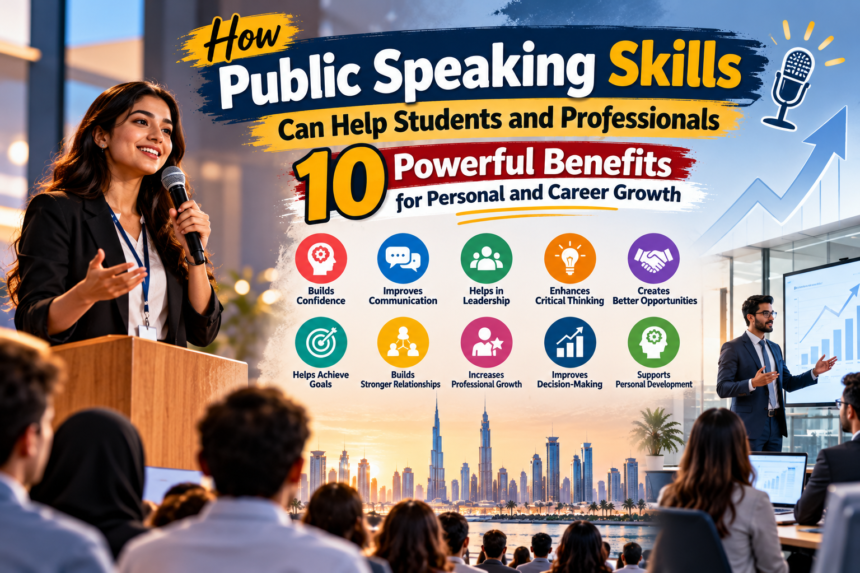
Public Speaking Skills Can Help Students and Professionals
Public speaking is an important skill that can make a difference in education, career development, and everyday life. Whether a student is presenting a college project, a job seeker is attending an interview, or a professional is explaining an idea during a business meeting, the ability to speak clearly and confidently can create valuable opportunities.
- 1. Builds Confidence and Reduces Fear
- 2. Improves Communication Skills
- 3. Helps Students Perform Better in Academic Activities
- 4. Makes Job Interviews Easier and More Effective
- 5. Develops Leadership and Team Management Skills
- 6. Improves Career Growth and Professional Opportunities
- 7. Strengthens Critical Thinking and Organising Abilities
- 8. Helps People Build Networks and Professional Relationships
- 9. Helps Professionals Handle Meetings, Clients, and Presentations
- 10. Encourages Personal Development and Self-Expression
- 11. Common Public Speaking Challenges and How to Overcome Them
- 12. Practical Ways to Improve Public Speaking Skills
- 13. A Simple 7-Day Public Speaking Practice Plan
- Conclusion: Public Speaking Is a Skill That Creates Opportunities
- Frequently Asked Questions (FAQs)
Many people believe that public speaking is only useful for teachers, motivational speakers, politicians, or company leaders, but this is a misconception. In reality, public speaking is useful for everyone. Students need it for classroom discussions, explaining assignments, and participating in presentations. Professionals use it to share their ideas, communicate with clients, lead teams, and present their work.
Good public speaking is not about using difficult English words or speaking loudly. It is about organising your thoughts, understanding your audience, choosing the right words, and delivering your message in a way people can understand.
The good news is that public speaking is a skill that can be developed through regular practice. You do not have to be naturally confident or have a perfect speaking voice to become a good speaker.
In this article, we will explore 10 powerful ways public speaking skills can help students and professionals, why communication matters in modern workplaces, common speaking challenges, and practical tips to improve your confidence.
1. Builds Confidence and Reduces Fear
One of the biggest benefits of public speaking is that it helps people become more confident when expressing their thoughts in front of others.
When teachers ask students to speak in front of the entire class, they often and become nervous. This is because they fear forgetting a word, making a grammatical error, receiving negative comments, or being judged by their classmates. Professionals experience similar feelings during meetings, presentations, interviews, and client discussions.
Public speaking practice helps people become more familiar with these situations. Each time someone prepares and delivers a short speech, they gain experience in expressing ideas before an audience.
Confidence usually develops gradually. A person who initially struggles to speak for one minute may eventually become comfortable delivering a presentation for ten minutes.
How public speaking builds confidence:
- It helps people become comfortable speaking in front of groups.
- It encourages them to express opinions without unnecessary hesitation.
- It teaches them how to manage nervousness.
- It improves their ability to respond to questions.
- It helps them trust their preparation and knowledge.
For example, a college student who regularly participates in classroom presentations may feel more prepared when attending a placement interview. Similarly, an employee who shares updates in team meetings may become more comfortable presenting ideas to senior managers.
Confidence does not mean having no fear. It means learning how to communicate even when you feel nervous.
2. Improves Communication Skills
Public speaking and communication are closely connected. A good speaker needs to explain information clearly, use suitable language, listen carefully, and understand the needs of the audience.
These abilities are useful in almost every area of life.
Students need communication skills to ask teachers questions, participate in discussions, explain project work, and communicate with classmates. Professionals need them to coordinate with colleagues, explain tasks, manage client conversations, and share information with different departments.
According to the National Association of Colleges and Employers (NACE), communication is an important career-readiness competency. It includes exchanging information and ideas clearly, using verbal and non-verbal communication, listening actively, and communicating respectfully with people from different backgrounds. NACE: Career Readiness Competencies
Public speaking can improve communication by helping you:
- Organise your thoughts before speaking.
- Select simple and meaningful words.
- Explain complex topics in an understandable way.
- Avoid unnecessary repetition.
- Pay attention to tone, speed, and pronunciation.
- Listen to questions and respond appropriately.
For instance, imagine a software developer explaining a technical problem to a non-technical manager. Using complicated programming terms may confuse the listener. A skilled communicator explains the problem in simple language, describes its effect, and suggests a possible solution.
The goal is not to impress people with difficult words. The goal is to make sure they understand your message.
3. Helps Students Perform Better in Academic Activities
Public speaking plays an important role in student life. Schools, colleges, and universities often ask students to participate in speeches, seminars, classroom presentations, debates, group discussions, and project demonstrations.
These activities give students opportunities to explain what they have learned rather than simply memorising information.
For example, an MCA student presenting a software project needs to explain the project’s purpose, technologies, important features, and working process. A business student may need to explain a marketing strategy, while a science student may present research findings.
Preparing for these activities encourages students to understand their subjects more deeply.
Academic situations where public speaking is useful include:
- Classroom presentations.
- Group discussions and debates.
- College seminars and workshops.
- Project demonstrations.
- Viva examinations.
- Research presentations.
- Student events and competitions.
- Student leadership activities.
The University of Toronto Scarborough explains that oral communication supports classroom participation, presentations, academic discussions, relationships with teachers and classmates, and preparation for interviews. University of Toronto: Academic Communication
Public speaking also teaches students how to explain information in a logical order. Instead of presenting random facts, they learn to introduce a topic, discuss its main points, provide examples, and finish with a clear conclusion.
These habits are useful for academic performance and future professional responsibilities.
4. Makes Job Interviews Easier and More Effective
A job interview is one of the most important situations where public speaking and communication skills become useful.
During an interview, employers want to understand a candidate’s knowledge, experience, attitude, problem-solving ability, and suitability for the role. A candidate may have good qualifications, but if they cannot explain their skills clearly, the interviewer may struggle to understand their strengths.
Public speaking practice can help job seekers prepare better answers and communicate with greater confidence.
Common interview questions include:
- Tell me about yourself.
- Why should we hire you?
- What are your strengths and weaknesses?
- Why do you want to join our company?
- Describe a challenge you faced and how you handled it.
- Where do you see yourself in five years?
You do not need to memorise every answer word for word. Instead, understand the main points and practise explaining them naturally.
For example, a fresher applying for a software development position might explain a college project by covering:
- What problem the project solves.
- Which technologies were used.
- What responsibilities they handled.
- Which difficulties they faced.
- What they learned from the experience.
A customer service candidate may need to demonstrate patience, clear explanations, and the ability to handle difficult conversations.
Practising public speaking helps candidates become more comfortable explaining their experiences, answering unexpected questions, and maintaining a professional manner.
5. Develops Leadership and Team Management Skills
Leadership is not just about giving instructions or holding a senior position. A good leader must communicate goals, explain responsibilities, encourage team members, solve problems, and keep everyone informed.
Public speaking helps people develop the communication abilities needed for these responsibilities.
Students can practise leadership by becoming class representatives, organising college events, leading group projects, or participating in student clubs. These experiences teach them how to share information and coordinate with others.
Professionals may use public speaking when introducing a project, assigning responsibilities, conducting meetings, training employees, or explaining business decisions.
How public speaking supports leadership:
- Helps leaders explain goals and expectations.
- Makes team discussions more organised.
- Encourages people to share their ideas.
- Supports decision-making and problem-solving.
- Builds trust through clear communication.
- Helps leaders motivate and guide team members.
For example, imagine a team leader introducing a new project. If the leader clearly explains the project’s purpose, deadlines, responsibilities, and expected results, employees are more likely to understand what needs to be done.
However, leadership communication is not only about speaking. Listening to team members, understanding their concerns, and responding respectfully are equally important.
6. Improves Career Growth and Professional Opportunities
In the workplace, technical knowledge is important, but professionals also need to explain how their knowledge can solve problems and support business goals.
A developer may need to demonstrate an application to a client. A marketing executive may present campaign results. A sales professional may explain a product to potential customers. A manager may communicate future plans to an entire team.
In all these situations, the ability to speak clearly can make professional work easier.
Public speaking can also support career development in several ways:
- Presenting your work during performance reviews.
- Sharing ideas with senior management.
- Participating in professional events.
- Conducting employee training sessions.
- Building relationships with clients and colleagues.
- Representing your organisation at conferences.
- Explaining your achievements during interviews.
NACE includes communication among its career-readiness competencies because employees need to exchange information and ideas effectively within and outside organisations. NACE: Communication Competency
Public speaking alone does not guarantee promotion or career success. However, it can help professionals make their knowledge, contributions, and ideas easier for others to understand.
A person who communicates clearly may find it easier to take part in important discussions and accept responsibilities that require interaction with others.
7. Strengthens Critical Thinking and Organising Abilities
A good speech is not simply a collection of sentences. It requires planning, research, logical thinking, and the ability to select information that matters to the audience.
When preparing a speech, you need to understand the topic, decide what you want to communicate, organise your ideas, and consider possible questions.
This process encourages critical thinking.
For example, a student preparing a speech about environmental protection may need to research pollution, understand its causes, compare possible solutions, and decide which examples best explain the topic.
Similarly, a business professional preparing a presentation about sales performance may need to understand figures, identify trends, explain challenges, and suggest improvements.
Public speaking can strengthen thinking and planning skills by teaching you to:
- Identify the main purpose of a speech.
- Separate important information from unnecessary details.
- Organise ideas into a logical sequence.
- Use examples to support an explanation.
- Consider different opinions.
- Answer questions based on facts and reasoning.
The University of Melbourne’s academic skills guidance highlights preparation, organisation, language, visuals, body language, and purposeful practice as important parts of effective presentations. University of Melbourne: Presenting Effectively
These abilities are useful not only when delivering speeches but also when writing reports, solving problems, planning projects, and making decisions.
8. Helps People Build Networks and Professional Relationships
Meeting new people is an important part of education and career development. However, starting conversations and introducing yourself can sometimes feel uncomfortable.
Public speaking practice can make these situations easier because it teaches you how to introduce yourself, explain your interests, ask questions, and communicate with different audiences.
For students, networking opportunities may include college events, seminars, workshops, competitions, alumni meetings, and placement activities.
For professionals, networking may happen during conferences, industry events, training sessions, client meetings, and business discussions.
A simple introduction can help someone start a professional conversation.
For example:
“Hello, I am a graduate in computer applications. I am interested in software development, especially Java and React. I have worked on a few projects, and I am currently improving my full-stack development skills.”
A good introduction should sound natural and relevant to the situation.
Public speaking also helps people participate in conversations rather than remaining silent throughout an event. When someone can explain their thoughts clearly and listen with interest, building professional relationships may become easier.
Networking is not about speaking to as many people as possible. It is about creating genuine connections through respectful and meaningful communication.
9. Helps Professionals Handle Meetings, Clients, and Presentations
Meetings are a regular part of many professional environments. Employees may need to share progress, explain problems, suggest improvements, discuss deadlines, or answer questions from customers and managers.
Public speaking skills help professionals communicate effectively in these situations.
During business meetings
Clear speaking helps employees share updates without confusing other team members. It also makes discussions more organised and focused.
During client presentations
Professionals need to explain products, services, project timelines, and possible solutions in a way clients can understand.
During sales conversations
Salespeople use communication and presentation abilities to understand customer needs, explain product benefits, and respond to questions honestly.
During training sessions
Managers and trainers must explain processes, demonstrate tasks, and make sure participants understand important information.
Imperial College London’s guidance on verbal communication highlights the value of adapting communication to different audiences, using voice and body language effectively, and presenting complex information clearly. Imperial College London: Verbal Communication
For professionals, an effective presentation is not about filling every slide with information. It is about identifying the key message and helping the audience understand it.
10. Encourages Personal Development and Self-Expression
Public speaking can also improve personal development beyond classrooms and workplaces.
It gives people opportunities to express their opinions, share experiences, discuss social issues, and explain ideas that matter to them.
For example, someone may participate in a community event, speak about education, introduce a cultural programme, or explain the benefits of environmental protection.
These experiences help people become more aware of their strengths and areas for improvement.
Public speaking can encourage:
- Better self-expression.
- More organised thinking.
- Greater awareness of body language.
- Improved listening habits.
- A willingness to accept feedback.
- More comfort in social situations.
- Respect for different opinions.
It is also a useful way to learn how to disagree politely. A good speaker does not need to agree with everyone. They should be able to explain their point of view without insulting or ignoring others.
Over time, these habits can improve everyday communication with friends, family members, classmates, colleagues, and the wider community.
11. Common Public Speaking Challenges and How to Overcome Them
Although public speaking offers many benefits, not everyone finds it easy. Some people feel nervous, while others struggle to organise their thoughts or speak clearly.
The important thing is to identify the problem and work on it gradually.
Fear of speaking in front of people
Many beginners worry that others will judge their performance or notice every mistake.
How to improve: Start by speaking in front of a mirror or recording a short video. Then practise with a friend before speaking in front of a larger group.
Forgetting words during a speech
Trying to memorise every sentence can make a presentation stressful. If you forget one line, you may lose your flow.
How to improve: Prepare short notes containing the main points instead of memorising the entire speech. Understand the topic so you can explain it naturally.
Speaking too quickly
Nervous speakers sometimes rush through their sentences, making it difficult for the audience to understand them.
How to improve: Speak at a comfortable speed, pause between important points, and practise reading aloud.
Lack of vocabulary
Some people hesitate because they think they need advanced English vocabulary to speak well.
How to improve: Use simple, correct, and meaningful words. Practise explaining everyday topics in your own language before gradually expanding your vocabulary.
Poor body language
Looking down continuously, avoiding eye contact, or making distracting movements can affect how a message is received.
How to improve: Maintain natural eye contact, keep a comfortable posture, and use hand movements only when they support your message.
Difficulty answering questions
Unexpected questions can make even prepared speakers nervous.
How to improve: Listen carefully, take a moment to think, and answer only what you understand. It is acceptable to say that you do not know something and will check it rather than inventing an answer.
12. Practical Ways to Improve Public Speaking Skills
Public speaking improves through regular practice. You do not need a stage, a microphone, or a large audience to get started.
Here are some simple methods that students and professionals can use.
Practise speaking for two minutes every day
Choose a familiar topic and speak about it for two minutes. Topics may include your hometown, education, favourite book, hobbies, career goals, or a recent experience.
This exercise helps you become comfortable expressing ideas without depending on a written script.
Read aloud
Read newspapers, articles, books, or short stories aloud. Focus on pronunciation, pauses, clear sentences, and a natural speaking speed.
Record yourself
Use your mobile phone to record a short speech. Watch the recording and notice:
- Whether your words are clear.
- Whether you speak too quickly.
- Whether you repeat the same words.
- Whether your posture looks comfortable.
- Whether your explanation follows a clear order.
Do not expect perfection in the first recording. Use it to identify one or two areas for improvement.
Join discussions and speaking activities
Participate in classroom discussions, debate clubs, seminars, workshops, or community speaking groups. These activities provide opportunities to practise with real audiences.
Prepare before presenting
Understand your topic and organise the content into three main parts:
- Introduction: Explain what you are going to discuss.
- Main points: Present the important ideas with examples.
- Conclusion: Summarise the message and finish clearly.
Ask for feedback
Request honest feedback from teachers, classmates, friends, or colleagues. Ask what was clear, what could be improved, and whether your presentation held their attention.
Practise with different audiences
Explain the same topic to a friend, a family member, and a small group. You will learn how to adjust your language and examples depending on who is listening.
13. A Simple 7-Day Public Speaking Practice Plan
Beginners can follow this simple plan to build a regular speaking habit. Spend around 15–20 minutes on each day’s activity.
| Day | Practice Activity | Main Goal |
|---|---|---|
| Day 1 | Introduce yourself for two minutes | Improve self-introduction |
| Day 2 | Speak about your favourite topic | Organise thoughts |
| Day 3 | Read a short article aloud | Improve clarity and pronunciation |
| Day 4 | Record a three-minute speech | Observe speaking habits |
| Day 5 | Explain a topic without reading notes | Build confidence |
| Day 6 | Give a short presentation to a friend | Practise with an audience |
| Day 7 | Deliver a five-minute speech and review it | Check progress and identify improvements |
After completing the first week, repeat the activities with new topics. Gradually increase the speaking time and try speaking in front of more people.
The aim is not to become perfect in seven days. It is to develop a habit of practising, reviewing, and improving.
Conclusion: Public Speaking Is a Skill That Creates Opportunities
Public speaking is much more than delivering a speech in front of a large audience. It is the ability to communicate ideas clearly, explain information, listen to others, and express yourself with confidence.
For students, it supports classroom participation, academic presentations, group discussions, project demonstrations, and job interviews. For professionals, it helps with meetings, client communication, leadership, teamwork, presentations, and career development.
The most important thing to remember is that effective public speaking is not limited to naturally confident people. Anyone can improve by preparing well, practising regularly, using simple language, and learning from feedback.
You do not need a perfect accent, advanced vocabulary, or a powerful voice to become a good speaker. You need a clear message, a suitable structure, and the willingness to keep practising.
Start with a small conversation, then move to a short speech, and gradually challenge yourself with larger audiences. Every time you practise, you take another step towards becoming a more confident and effective communicator.
Frequently Asked Questions (FAQs)
1. Why are public speaking skills important for students?
Public speaking helps students participate in classroom discussions, deliver presentations, explain projects, take part in debates, and prepare for interviews. It also supports confidence, organisation, and clear communication.
2. How can public speaking help professionals?
Professionals use public speaking to present ideas, lead meetings, communicate with clients, train employees, explain project updates, and share their achievements. These skills can support teamwork and career development.
3. Can public speaking improve self-confidence?
Yes. Regular practice can help people become more comfortable expressing their ideas in front of others. Confidence generally develops through preparation, repeated experience, and constructive feedback.
4. How can beginners overcome the fear of public speaking?
Beginners can start by speaking in front of a mirror, recording short videos, practising with friends, and gradually speaking to larger groups. Preparing the topic and using short notes can also help.
5. What are the most important public speaking skills?
Important skills include clear communication, preparation, organisation, active listening, suitable body language, voice control, audience awareness, and the ability to answer questions.
6. Is English necessary for good public speaking?
No. Good public speaking is possible in any language. What matters most is communicating clearly and adapting your language to the audience. Improving English may be useful in many academic and professional settings, but a perfect accent is not necessary.
7. How can students practise public speaking at home?
Students can read aloud, record short speeches, explain school or college topics, practise self-introductions, and ask family members to listen and provide feedback.
8. How long does it take to improve public speaking skills?
There is no fixed timeline. Improvement depends on practice, experience, preparation, and individual comfort. Regular short speaking exercises can help people notice progress over time.
Do follow us on Instagram
Read More – Public Libraries Still Matter in the Digital Age