BYD’s Existing Aftersales Network in the UAE and Saudi Arabia
Buying an electric vehicle is increasingly becoming a practical option for drivers across the Gulf. Modern electric cars offer advanced technology, different charging options and an alternative to conventional petrol-powered vehicles. However, choosing an electric car involves more than comparing prices, battery range and driving features.
- Why BYD GCC Expansion Is Becoming a Major Automotive Development
- What Is BYD’s Planned Regional Parts Hub in the UAE?
- 7 Ways BYD’s Regional Spare-Parts Hub Could Benefit GCC EV Owners
- BYD’s Existing Aftersales Network in the UAE and Saudi Arabia
- EV Maintenance, Batteries and Repairs: What Owners Should Understand
- The Business of BYD’s GCC Expansion: Logistics, Investment and Competition
- Challenges and Questions Surrounding BYD’s Planned Regional Parts Hub
- The Future of BYD GCC Expansion and Frequently Asked Questions
For many customers, the real test of a vehicle begins after the purchase. Owners want to know whether spare parts are available, how quickly repairs can be completed and whether authorised technicians can provide reliable service when something goes wrong.
These questions are becoming especially relevant as Chinese automotive manufacturers expand their presence in the United Arab Emirates, Saudi Arabia and other Gulf markets.
The latest BYD GCC Expansion plans suggest that the company is increasingly focused on building a stronger regional support network rather than simply introducing additional vehicles.
On October 30, 2026, BYD executive vice-president Stella Li told Gulf Business that the Gulf Cooperation Council had become the company’s leading priority for international expansion.
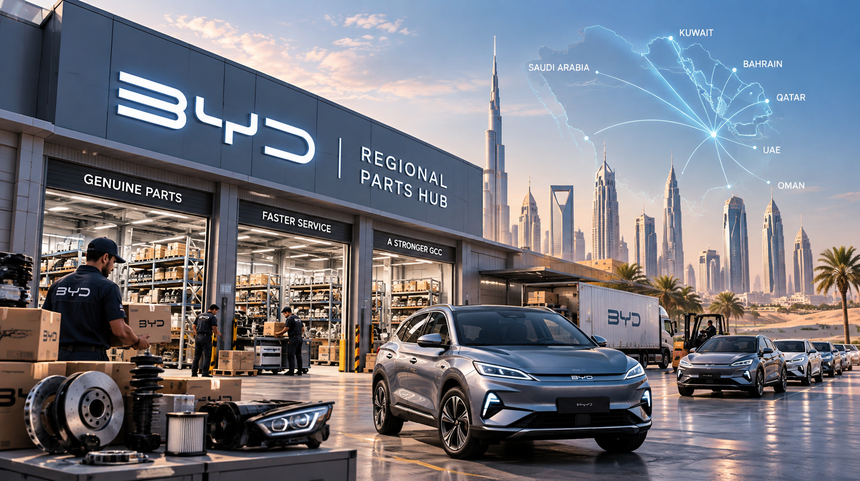
The Chinese automotive manufacturer is preparing to increase its regional investment, expand its retail and aftersales services and establish a dedicated spare-parts distribution centre between Dubai and Abu Dhabi.
The announcement represents an important development for the electric vehicle market because aftersales support can strongly influence customer confidence.
While customers may be attracted by a vehicle’s design, technology or purchase price, long-term satisfaction also depends on dependable repairs, replacement components and accessible service centres.
BYD is already strengthening these services through its partnership with Al-Futtaim in the UAE and Saudi Arabia. In August 2026, Al-Futtaim announced that BYD’s Saudi retail network had reached 10 active showrooms, including new locations in Riyadh and Al-Qassim.
Several facilities combine vehicle sales, servicing and spare parts under one roof.
The proposed regional distribution centre could support this expanding network by improving the movement of components between suppliers, warehouses and authorised service locations.
However, the facility remains a planned development. BYD has not publicly confirmed a precise opening date, final operating capacity or guaranteed improvements in delivery times.
For existing and prospective owners, the central question is what a regional spare-parts hub could realistically change about the experience of owning an electric vehicle in the GCC.
Why BYD GCC Expansion Is Becoming a Major Automotive Development
BYD has developed from a battery-focused company into a major international manufacturer of electric and plug-in hybrid vehicles.
Its expansion strategy increasingly involves establishing stronger regional operations, commercial partnerships and customer-support infrastructure.
The Gulf is becoming an important part of that approach.
What BYD Announced in October 2026
In an interview published by Gulf Business on October 30, BYD executive vice-president Stella Li described the GCC as the company’s highest international expansion priority.
She identified opportunities extending beyond passenger vehicles into battery energy storage, robotics and autonomous-driving technologies.
Li also emphasised two immediate priorities for the automotive business: developing a strong regional network and strengthening spare-parts and aftersales capabilities.
The planned distribution centre between Dubai and Abu Dhabi is part of that strategy.
Why the Gulf Is Attractive to Automakers
The GCC includes several markets with established automotive demand, significant road infrastructure and consumers interested in new vehicle technologies.
The UAE and Saudi Arabia are particularly important to BYD’s current regional development because the company has already established retail and service operations in both countries.
Other GCC markets may provide additional opportunities, although product availability, dealership coverage and charging infrastructure vary by location.
From Vehicle Sales to Long-Term Operations
Selling a vehicle creates an initial commercial relationship, but aftersales support can continue for years.
Customers may need routine inspections, replacement components, accident repairs, software updates and technical assistance.
A manufacturer expanding into a new market therefore needs more than attractive showrooms. It requires dependable systems supporting the entire ownership experience.
| Expansion Area | BYD’s Regional Direction | Potential Significance |
|---|---|---|
| Vehicle Sales | Broader retail presence | Improved customer access |
| Aftersales Support | Additional service capacity | More convenient maintenance |
| Spare Parts | Planned regional distribution hub | Potentially better supply coordination |
| New Models | Wider product portfolio | Greater consumer choice |
| Battery Technology | Continued regional interest | Broader energy opportunities |
| Local Partnerships | Expanded cooperation | Stronger market operations |
The company’s plans suggest a shift towards deeper regional participation, but commercial success will depend on execution and customer demand.
What Is BYD’s Planned Regional Parts Hub in the UAE?
A regional spare-parts distribution centre is a logistics facility designed to store, manage and distribute replacement components to dealers and service centres across a defined area.
Instead of each service location relying entirely on separate international shipments, a central warehouse can maintain selected inventory and coordinate deliveries.
For a growing automotive brand, this can help establish a more organised supply chain.
The Proposed Location
Stella Li said BYD is developing a distribution centre positioned between Dubai and Abu Dhabi.
The broad location was disclosed in the October 30 interview, but the exact site has not been publicly confirmed.
The company has also not announced an official opening date, warehouse size or complete list of markets the facility will serve.
These details matter because the actual benefits will depend on the facility’s operational design and distribution arrangements.
How a Regional Parts Hub Could Work
A typical automotive parts distribution system receives components from manufacturers and approved suppliers, stores them according to expected demand and distributes them when authorised service centres place orders.
For BYD, such a facility could potentially support electric and plug-in hybrid vehicles across the regional network.
The actual parts stocked would depend on model availability, inventory planning and the company’s supply arrangements.
International Shipping vs Regional Stocking
| Process | Without Sufficient Regional Stock | With an Effective Regional Hub |
|---|---|---|
| Parts Sourcing | May require an overseas order | Selected items may already be nearby |
| Order Processing | Multiple international stages | Potentially more direct coordination |
| Delivery | International shipping and customs | Regional distribution |
| Inventory | Spread across separate locations | Coordinated regional stock |
| Emergency Demand | May require special shipments | Depends on available inventory |
| Customer Waiting Time | Can be affected by overseas supply | May improve for stocked parts |
A regional warehouse does not eliminate international imports. Components still need to reach the warehouse, and uncommon parts may continue to require special orders.
The advantage comes from stocking the right components in the right quantities and delivering them efficiently.
7 Ways BYD’s Regional Spare-Parts Hub Could Benefit GCC EV Owners
The proposed distribution centre could influence several aspects of electric vehicle ownership.
However, these are potential benefits rather than confirmed service improvements. Actual results will depend on inventory, logistics, staffing and the availability of particular components.
1. Shorter Waiting Times for Common Parts
One potential advantage is quicker access to frequently required components.
If parts are already stored within the region, authorised service centres may avoid waiting for separate international deliveries.
This could reduce repair delays for selected maintenance and replacement items.
However, uncommon components may still need to be imported.
2. More Predictable Repair Scheduling
Service centres often need to confirm parts availability before completing repairs.
A well-managed regional warehouse could make stock information more consistent and help technicians schedule work more accurately.
Greater predictability may be particularly valuable for customers who depend on their vehicles for daily commuting or business activities.
3. Stronger Support Outside Major Cities
BYD’s Gulf expansion increasingly includes service locations beyond the largest metropolitan centres.
A regional distribution network could support these facilities by improving the movement of parts across different locations.
However, customers in smaller cities will still depend on local workshop capacity and delivery arrangements.
4. Better Support for a Growing Vehicle Range
As BYD introduces additional electric and plug-in hybrid models, service centres need access to a wider variety of compatible components.
A central warehouse may help coordinate inventory across different vehicle lines.
This is important because components designed for one model are not necessarily interchangeable with those used in another.
5. Potentially Lower Emergency Shipping Requirements
When a necessary component is unavailable locally, urgent international delivery can create additional costs and delays.
Maintaining suitable regional inventory may reduce the frequency of these special orders.
However, lower logistics costs do not automatically mean that retail spare-parts prices will fall.
6. Greater Confidence in Long-Term Ownership
Customers evaluating electric vehicles often consider what will happen several years after purchase.
An established spare-parts network may provide reassurance that the brand intends to support its vehicles beyond the initial sale.
This confidence could influence purchasing decisions, although its commercial effect has not yet been measured for the proposed BYD hub.
7. Improved Coordination Between Dealerships
A regional hub could support consistent ordering, inventory visibility and logistics processes across authorised service locations.
This may help distributors identify commonly required components and respond to demand patterns.
Technology integration and effective management will be essential to achieving these benefits.
Seven Potential Owner Benefits
| Potential Benefit | Why It Matters | What Determines Success |
|---|---|---|
| Faster Parts Access | Reduced waiting for selected repairs | Stock availability |
| Predictable Repairs | Easier service planning | Accurate inventory systems |
| Wider Service Support | Better geographic coverage | Local workshop capacity |
| Model Compatibility | Support for more vehicles | Correct parts identification |
| Lower Shipping Dependence | Fewer urgent imports | Inventory planning |
| Ownership Confidence | Greater reassurance | Consistent service delivery |
| Dealer Coordination | More reliable operations | Integrated logistics |
The facility’s performance should eventually be assessed using actual repair times, availability rates and customer experience rather than the announcement alone.
BYD’s Existing Aftersales Network in the UAE and Saudi Arabia
The proposed hub would build on service infrastructure that BYD and its regional partners have already developed.
These existing operations provide useful context because a distribution centre can only support customers effectively when suitable authorised service locations are available.
BYD in the UAE
BYD operates in the UAE through its partnership with Al-Futtaim.
Its UAE network includes showrooms, discovery centres and authorised aftersales locations across several emirates.
BYD’s published information identifies dedicated service facilities and locations combining vehicle sales with maintenance support.
The company provides services such as routine maintenance, tyre care and air-conditioning inspections.
Its UAE website also allows customers to request service appointments.
BYD in Saudi Arabia
Saudi Arabia represents another important market for the company.
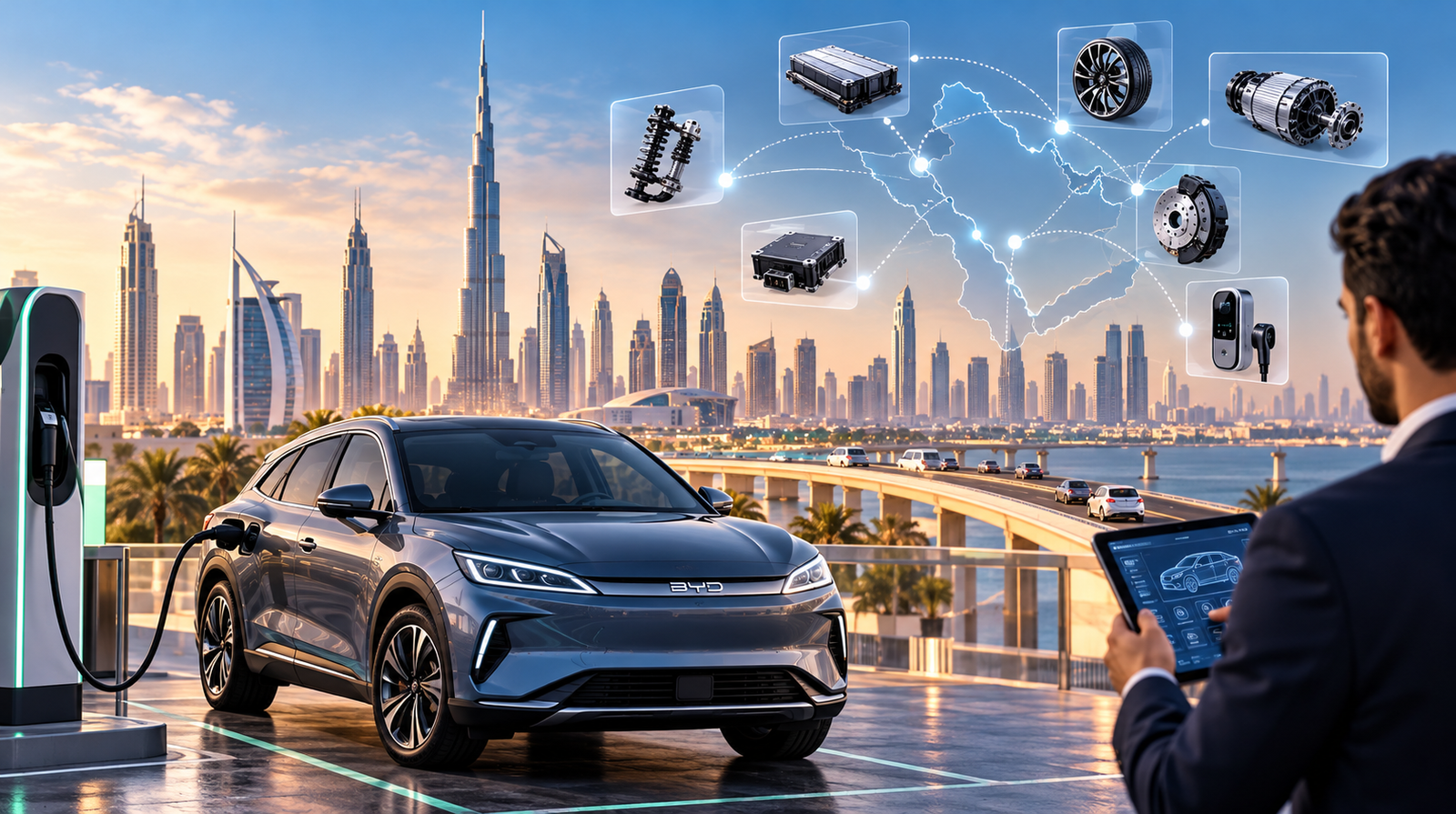
In August 2026, Al-Futtaim announced the opening of BYD showrooms in Riyadh and Al-Qassim, bringing the brand’s active retail network to 10 showrooms across the Kingdom.
Both new locations were designed as integrated 3S facilities, meaning sales, service and spare parts are offered together.
The company had previously announced additional locations in Abha, Khurais and Dhahran during March 2026.
Saudi Parts Availability Claims
BYD Saudi Arabia’s published customer information states that 96% of its certified maintenance and genuine repair parts are available locally.
This is the company’s reported inventory measure, not an independently verified percentage for every part across every model and service location.
It also does not mean that all vehicle components can be supplied immediately.
Customers should verify availability for their specific vehicle and required repair.
Existing Network Compared
| Market | Confirmed Development | Main Customer Relevance |
|---|---|---|
| UAE | Established authorised sales and service network | Maintenance and parts support |
| Saudi Arabia | 10 active showrooms announced in August 2026 | Wider customer access |
| Riyadh | Additional integrated facility | Sales, service and parts |
| Al-Qassim | First BYD showroom in the region | New geographic coverage |
| Wider GCC | Regional expansion priority | Potential future network development |
The planned regional warehouse could complement these existing operations, but it should not be confused with a completed expansion of local service centres.
EV Maintenance, Batteries and Repairs: What Owners Should Understand
Electric vehicles have different maintenance requirements from conventional petrol-powered cars.
They generally have fewer engine-related mechanical components, but they still require inspections, replacement parts and professional repairs.
Understanding these differences can help customers make realistic ownership decisions.
Routine Electric Vehicle Maintenance
Battery-electric cars do not require traditional engine oil changes.
However, tyres, brakes, suspension, air-conditioning equipment and other components still need maintenance.
The manufacturer’s service schedule should guide inspections and replacement intervals.
Plug-In Hybrids Have Additional Requirements
BYD also sells plug-in hybrid vehicles, which combine an internal combustion engine with an electric drive system.
These vehicles have additional engine-related maintenance requirements compared with fully electric models.
BYD Saudi Arabia’s published aftersales guidance recommends routine maintenance for battery-electric vehicles every 12 months or 20,000 kilometres, whichever comes first.
For plug-in hybrids, it identifies a schedule of 12 months or 10,000 kilometres, whichever comes first.
Actual requirements should be confirmed against the specific vehicle’s maintenance documentation.
Battery and Drive Unit Support
Battery systems are among the most important components of electric vehicles.
BYD Saudi Arabia publishes a limited warranty covering the high-voltage battery and drive unit for eight years or 200,000 kilometres, whichever comes first, subject to the stated terms.
The warranty information also refers to a battery-capacity threshold of at least 70%.
Warranty terms can differ between countries and models, so UAE and other GCC buyers should check their own contracts.
Maintenance Comparison
| Maintenance Area | Battery-Electric Vehicle | Plug-In Hybrid |
|---|---|---|
| Engine Oil | Not applicable | Required according to schedule |
| Battery System | Inspection and diagnostics | Inspection and diagnostics |
| Tyres | Regular maintenance | Regular maintenance |
| Brakes | Inspection and servicing | Inspection and servicing |
| Air Conditioning | Maintenance required | Maintenance required |
| Engine Components | No combustion engine | Additional maintenance |
| Software | Updates may be required | Updates may be required |
Why Authorised Repair Expertise Matters
High-voltage vehicle systems require appropriate tools, safety procedures and trained technicians.
Customers should avoid assuming that every independent workshop has the equipment or certification required for complex electric vehicle repairs.
The regional expansion of service infrastructure is therefore as important as the availability of spare parts.
The Business of BYD’s GCC Expansion: Logistics, Investment and Competition
A regional spare-parts hub is a commercial investment as well as a customer-service initiative.
Automotive distribution involves inventory financing, warehousing, transportation, information systems and relationships with authorised dealerships.
For manufacturers, improving these operations can support the wider growth of the brand.
Why Regional Warehouses Matter Financially
A manufacturer serving several countries may face high logistics costs when parts are shipped separately from overseas suppliers.
Regional inventory consolidation could improve distribution efficiency and reduce some urgent shipping requirements.
However, warehouses also create costs involving rent, staffing, technology, insurance and working capital.
The financial outcome depends on whether these expenses are justified by improved service and logistics efficiency.
Illustrative Parts Distribution Economics
Consider a hypothetical regional operation supplying 20 authorised service locations.
| Monthly Operating Item | Hypothetical Amount |
|---|---|
| Warehouse and Facility Costs | AED 180,000 |
| Employees and Management | AED 150,000 |
| Regional Transportation | AED 120,000 |
| Inventory Technology | AED 40,000 |
| Insurance and Administration | AED 60,000 |
| Total Monthly Operating Costs | AED 550,000 |
These figures are illustrative, not reported costs for BYD’s proposed facility.
They exclude inventory purchases, financing, customs expenses, depreciation and other possible obligations.
The purpose is to demonstrate that a regional parts hub involves a substantial operational commitment rather than simply storing components closer to customers.
Competition in the GCC EV Market
BYD competes with established international manufacturers and other Chinese automotive brands.
Consumers may compare vehicles based on pricing, driving range, charging compatibility, design and technology.
However, service accessibility and ownership support can also influence long-term brand loyalty.
As more manufacturers enter the market, aftersales quality may become an increasingly important point of differentiation.
Regional Business Opportunities
| Business Area | Potential Opportunity |
|---|---|
| Warehousing | Specialist automotive storage |
| Logistics | Regional parts transportation |
| Technician Training | EV repair and diagnostic skills |
| Software | Inventory and service management |
| Workshop Equipment | High-voltage service tools |
| Vehicle Servicing | Expanded authorised repair capacity |
| Customer Support | Scheduling and service communication |
The actual economic impact of the proposed hub remains uncertain until BYD provides more information about its investment, staffing and operating plans.
Challenges and Questions Surrounding BYD’s Planned Regional Parts Hub
While the proposed distribution centre could improve the ownership experience, several important questions remain unanswered.
Customers and industry observers should distinguish between the company’s investment intentions and measurable service outcomes.
The Opening Date Remains Unconfirmed
BYD has identified the broad location of the planned facility but has not announced an exact commissioning date.
Until construction and operational arrangements are confirmed, it would be premature to promise immediate improvements in spare-parts delivery.
Not Every Part Will Necessarily Be Stocked
Automotive warehouses typically prioritise inventory based on expected demand.
Common maintenance components may be easier to justify keeping in stock than rare or expensive parts.
Even after the hub opens, some repairs could continue to require international orders.
Parts Supply Is Only One Part of Repair Time
A replacement component may be available while a service centre is experiencing a shortage of technicians or workshop capacity.
Insurance approvals, accident assessments and specialised repair procedures can also affect how long a vehicle remains unavailable.
A regional warehouse could address some supply delays without solving every service bottleneck.
GCC Countries Have Different Market Requirements
The six GCC countries have different vehicle registration systems, distribution arrangements and commercial conditions.
A warehouse in the UAE would still need efficient cross-border logistics to supply customers elsewhere.
Customs, transportation and local dealer systems could affect delivery performance.
Questions BYD Owners Should Ask
- Is the required spare part available locally?
- Does the authorised service centre have a confirmed delivery estimate?
- Are the necessary technicians and diagnostic tools available?
- Is the repair covered by the vehicle’s warranty?
- Will the part come from local stock or an international supplier?
- Are labour and replacement costs included in the quotation?
- Can the service centre provide written repair updates?
- What happens if the estimated completion date changes?
A strong distribution network should ultimately provide transparent information as well as faster physical deliveries.
The Future of BYD GCC Expansion and Frequently Asked Questions
BYD’s latest plans indicate that the company views the Gulf as a strategic region for its broader automotive and technology operations.
The development of a regional parts hub could become an important step in creating more localised customer support.
However, future progress should be measured through confirmed investments, operating infrastructure and customer outcomes.
A Broader Technology Strategy
Stella Li’s October 2026 comments highlighted opportunities extending beyond electric vehicles.
BYD is interested in battery energy storage, autonomous-driving technology, robotics and more advanced in-car digital services.
These developments show the company’s intention to participate in several related industries.
However, announced ambitions are different from completed regional projects.
More Models and Luxury Vehicle Launches
BYD has also indicated that it intends to bring more vehicles to the Gulf and use the region for the global launch of an upcoming luxury model.
Such developments could strengthen brand visibility and expand consumer choice.
Actual launch dates, specifications and prices should be confirmed separately when officially announced.
Frequently Asked Questions
What did BYD announce about GCC expansion?
On October 30, 2026, BYD executive vice-president Stella Li said the GCC was the company’s leading international expansion priority. Its plans include additional investment, stronger aftersales support and a regional spare-parts distribution centre.
Where will BYD’s regional parts hub be located?
The company has identified a location between Dubai and Abu Dhabi. The precise site has not been publicly confirmed.
When will the BYD parts hub open?
BYD has not announced a confirmed opening date for the proposed facility.
Will the hub reduce repair waiting times?
It could improve access to selected spare parts and reduce some shipping delays. Actual benefits will depend on inventory and service operations.
Will BYD spare parts become cheaper in the GCC?
Lower logistics costs are possible, but BYD has not announced a guaranteed reduction in spare-parts prices.
How many BYD showrooms are there in Saudi Arabia?
Al-Futtaim announced 10 active BYD showrooms across Saudi Arabia in August 2026.
Does BYD already offer aftersales support in the UAE?
Yes. BYD operates an authorised aftersales network in the UAE through its regional partnership with Al-Futtaim.
Does a regional warehouse mean every part will be available immediately?
No. Availability depends on the components stocked, the vehicle model and the relevant service centre’s requirements.
Does BYD provide battery warranties?
Yes, subject to country-specific terms. Customers should verify the warranty duration, mileage limits and battery-capacity conditions for their vehicle.
Final Thoughts on BYD’s GCC Expansion
BYD’s decision to make the Gulf a leading international priority reflects a shift in its regional strategy.
The company is looking beyond vehicle sales towards the infrastructure required to support customers throughout the ownership journey.
A regional spare-parts distribution centre could improve supply coordination, strengthen authorised service networks and potentially reduce delays for selected repairs.
For existing owners, these improvements could make electric vehicle maintenance more predictable. For prospective buyers, stronger aftersales support may provide additional confidence when considering a new brand.
However, the planned facility’s actual impact will depend on when it becomes operational, how effectively inventory is managed and whether service centres can deliver consistent results.
For the wider GCC automotive industry, the announcement also highlights the growing importance of local infrastructure and long-term customer support.
Ultimately, BYD GCC Expansion could influence electric vehicle ownership not only through new models and technology, but through the practical experience of keeping vehicles on the road.
The real measure of success will be whether regional investment translates into dependable service, transparent repair processes and a better experience for Gulf drivers.
Do follow us on Instagram
Read More – UAE E-Invoicing Penalties: What Businesses Need to Know Before 2027