Dubai and Riyadh Office Markets: What the 2026 Data Shows
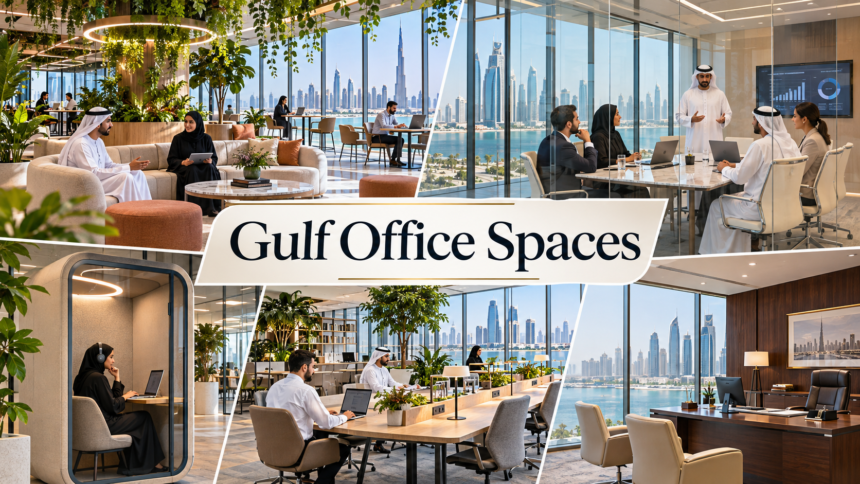
Traditional offices are undergoing a major transformation across the Gulf as businesses reconsider how much space they need and how employees use it. From Dubai and Abu Dhabi to Riyadh and Doha, companies are exploring flexible layouts, shared workspaces and technology-driven environments that support changing business needs. Gulf office spaces are no longer judged only by their location, size or appearance. Employers are increasingly considering operating costs, employee experience, collaboration and long-term flexibility when deciding where and how their teams should work.
- Why Gulf Companies Are Moving Beyond Traditional Offices
- 7 Office Trends Changing Workplaces Across the Gulf
- Dubai and Riyadh Office Markets: What the 2026 Data Shows
- Flexible Offices vs Traditional Leases: Which Costs Less?
- Hybrid Work and Employee Experience in Gulf Offices
- Smart and Sustainable Offices: The Future of Gulf Buildings
- Challenges and the Future of Gulf Office Spaces
The shift does not mean that traditional offices are disappearing. In fact, demand for high-quality commercial property remains strong in several major Gulf cities. What is changing is the relationship between businesses and the buildings they occupy.
Some companies prefer smaller offices with shared meeting facilities, while others are investing in premium headquarters designed to attract employees and clients. Startups may choose serviced offices rather than committing immediately to expensive interior construction and long leases.
The latest property research reflects this changing environment. Savills reported in October 2026 that Dubai’s average office rents remained stable at approximately AED 241 per square foot during the third quarter, while offices smaller than 1,000 square feet accounted for 66% of transactions.
In Riyadh, prime office occupancy reached approximately 98% during the same quarter, according to Savills. Despite strong demand, businesses were becoming more selective about flexibility, location and lease commitments.
These findings suggest that the future of Gulf workplaces is not simply about reducing office space. It is about using commercial property more strategically.
For companies, the challenge is creating environments that support productive work without unnecessary financial commitments. For property owners, it is understanding what modern tenants expect. For employees, office design increasingly affects daily comfort, communication and the experience of working in a growing regional economy.
Why Gulf Companies Are Moving Beyond Traditional Offices
For decades, a conventional business office often followed a predictable arrangement. Companies leased dedicated premises, allocated permanent desks to employees and expected most work to happen inside the building during fixed hours.
That model remains suitable for many organisations, particularly those handling sensitive information, specialised equipment or regular face-to-face customer services.
However, several business developments are encouraging companies to reconsider whether the same arrangement works for every employee and department.
The Changing Cost of Commercial Property
Office expenses extend beyond monthly or annual rent. Companies may also pay for fit-outs, furniture, utilities, maintenance, technology and contractual commitments.
In expensive business districts, these costs can represent a significant operating burden.
Businesses therefore have a reason to examine how frequently particular rooms, desks and facilities are used.
A large office that remains partly empty during normal working hours may not provide good value simply because it has an impressive address.
Changing Expectations of Workplace Quality
Employees increasingly need environments that support different tasks throughout the day.
An open collaboration area may be useful for team discussions but unsuitable for confidential calls or concentrated analysis.
Consequently, businesses are considering layouts that provide a combination of meeting rooms, private workspaces and shared facilities.
The Influence of Business Growth
The GCC continues to attract international businesses, professional services firms and technology companies.
New market entrants often need office space before they know exactly how large their regional teams will become.
Flexible lease arrangements may allow these companies to establish a presence without committing immediately to larger premises.
Traditional vs Modern Office Models
| Feature | Traditional Office | Modern Flexible Office |
|---|---|---|
| Lease | Often longer commitments | May offer shorter terms |
| Workspace | Mainly fixed desks | Mix of work settings |
| Expansion | Additional leased premises | Potentially scalable |
| Setup | Tenant-managed fit-out | Sometimes ready to occupy |
| Shared Facilities | Within company premises | May be shared |
| Cost Structure | Rent and separate expenses | Often bundled, depending on provider |
Neither approach is universally better. Businesses need to evaluate actual costs, employee requirements and contractual obligations before choosing a model.
7 Office Trends Changing Workplaces Across the Gulf
Workplace transformation is taking several forms across the GCC. Some changes involve real estate decisions, while others focus on technology, design and employee experience.
1. Growing Demand for Flexible Offices
Serviced offices and managed workspaces allow eligible businesses to occupy prepared facilities under different contractual arrangements.
These spaces may include meeting rooms, reception services, internet access and shared amenities.
For a growing company, the appeal is often faster occupancy and less initial spending on interior construction.
2. Smaller but Better-Equipped Offices
Rather than automatically seeking the largest available floor area, some occupiers are prioritising efficient layouts and better facilities.
This does not necessarily mean employing fewer people. A business may simply allocate space differently.
The strong demand for smaller office units in Dubai demonstrates the relevance of more compact commercial premises.
3. Hybrid and Flexible Work Arrangements
Some employers combine office attendance with approved remote work.
This can influence the number of desks required and the type of collaboration spaces a business needs.
However, hybrid work is not universal across the Gulf. Employee eligibility and workplace arrangements depend on company policy and relevant regulations.
4. Collaborative Work Environments
Modern office designs often place greater emphasis on spaces where employees can work together.
Flexible meeting areas, project rooms and shared worktables can support teamwork.
They should be balanced with quieter areas for tasks requiring concentration.
5. Smart Building Technology
Companies and landlords are exploring technology that monitors occupancy, cooling, lighting and building performance.
Appropriate systems may improve energy management and maintenance planning.
However, smart technology also creates cybersecurity, privacy and implementation requirements.
6. Greater Focus on Wellness and Comfort
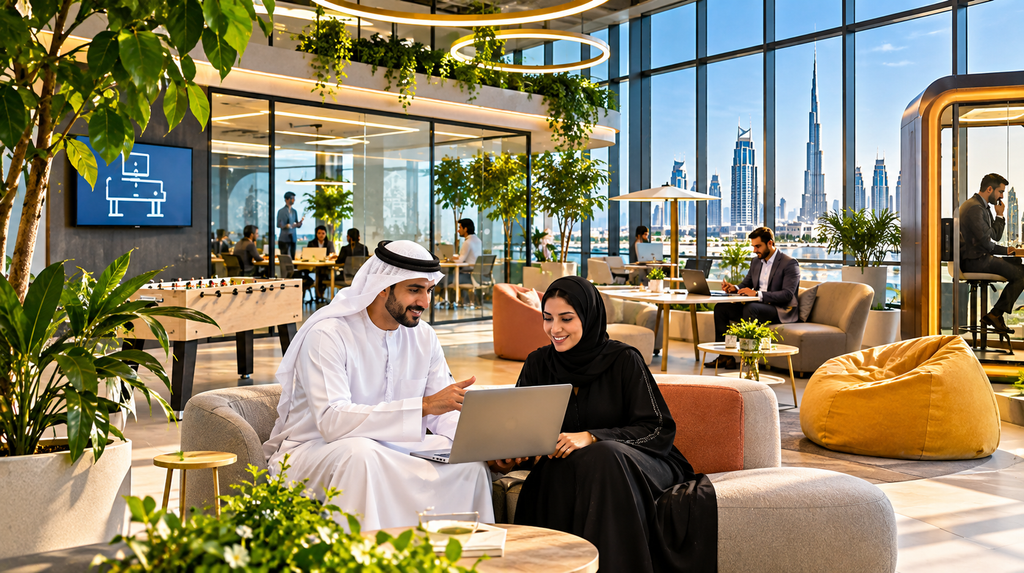
Indoor air quality, lighting, acoustic conditions and suitable furniture can influence workplace experience.
Businesses are increasingly considering these features when assessing premium office buildings.
Nevertheless, wellness claims should be based on actual building performance rather than marketing descriptions alone.
7. Sustainable Office Buildings
Energy-efficient cooling, responsible water use and improved building materials are becoming more relevant in Gulf property decisions.
New developments may pursue recognised sustainability certifications, while older buildings may require upgrades.
Environmental benefits depend on measured operating performance and the full costs of improvements.
Seven Workplace Trends Compared
| Trend | Main Business Benefit | Main Challenge |
|---|---|---|
| Flexible Offices | Reduced upfront commitments | Higher unit costs in some cases |
| Smaller Offices | More efficient space use | Limited expansion capacity |
| Hybrid Work | More adaptable schedules | Coordination and security |
| Collaboration Areas | Easier teamwork | Noise and privacy |
| Smart Technology | Improved building management | Data protection |
| Wellness Design | Better working conditions | Fit-out costs |
| Sustainable Buildings | Potential energy efficiency | Investment and maintenance |
Companies do not need to adopt every trend. The strongest workplace strategy is one that responds to the nature of the business and its employees.
Dubai and Riyadh Office Markets: What the 2026 Data Shows
Dubai and Riyadh provide important examples of how office demand is evolving across the Gulf.
Both cities continue to attract corporate occupiers, but changing tenant preferences are influencing the types of buildings and lease arrangements that companies consider.
Dubai’s Demand for Smaller Offices
Savills’ third-quarter 2026 Dubai Office Market Report recorded approximately 20,200 rental transactions during the period.
The report found that 66% of transactions involved offices smaller than 1,000 square feet. Average office rents remained broadly stable at AED 241 per square foot, although prices varied considerably between business districts and building categories.
These findings indicate strong demand for compact offices, but they do not prove that every company is downsizing or adopting remote work.
Some small units are leased by new businesses, while others serve existing organisations expanding their commercial presence.
The Growth of Flexible Workspace in the UAE
An October 2026 report by Cushman & Wakefield Core found that flexible workspace was becoming increasingly important in the UAE’s office market.
It estimated that flexible offices represented approximately 2.6% of Dubai’s total office stock, despite strong interest in the sector.
The report also recorded more than 680,000 square feet of flexible office space absorbed across the UAE since January 2025.
These figures suggest growing demand while also showing that conventional office property remains the dominant model.
Riyadh’s Premium Office Market
Riyadh has experienced significant demand for high-quality commercial buildings, supported partly by corporate expansion and international companies establishing regional operations.
Savills reported approximately 98% occupancy in the city’s prime office segment during the third quarter of 2026.
The report also observed a growing preference for short-term renewals, immediately available premises and flexible workspace solutions.
This combination is important: businesses may want more adaptable contracts even when demand for physical offices remains strong.
Office Market Trends Compared
| Indicator | Dubai | Riyadh |
|---|---|---|
| Latest Report | Q3 2026 | Q3 2026 |
| Major Finding | 66% of transactions involved units below 1,000 sq ft | Prime occupancy around 98% |
| Reported Price Measure | AED 241 per sq ft average office rent | Zone A asking rent around SAR 2,860 per sq m annually |
| Tenant Preference | Quality, transport and suitable space | Flexibility, premium buildings and available space |
| Market Challenge | Limited premium supply in selected locations | Tight prime availability |
The rent figures use different geographic definitions, units and market measures, so they should not be treated as directly comparable prices.
What This Means for Other GCC Markets
Bahrain, Qatar, Kuwait and Oman also have businesses with different workplace requirements.
Financial services companies may prioritise established commercial districts, while smaller service providers may prefer affordable premises with flexible terms.
However, local office availability, licensing requirements and rental conditions differ. Trends observed in Dubai or Riyadh should not automatically be applied to every GCC city.
Flexible Offices vs Traditional Leases: Which Costs Less?
One reason companies are reconsidering office arrangements is the difference between upfront expenditure and recurring operating costs.
A conventional office lease may offer control over layout and branding, but tenants often need to finance the interior fit-out and purchase furniture and equipment.
A serviced office may include many of these facilities within a monthly fee, though its price per desk can be higher.
Understanding the Full Cost of Occupancy
Businesses should evaluate rent, deposits, service charges, fit-out expenses, utilities, internet, maintenance and the cost of changing premises.
They should also review what happens when employee numbers increase or decrease.
A cheaper advertised rent does not necessarily mean lower total operating costs.
Illustrative Dubai Office Cost Model
Consider a hypothetical company employing 20 people and evaluating two different workplace arrangements.
| Annual Cost | Traditional Office | Serviced Office |
|---|---|---|
| Rent or Workspace Fees | AED 180,000 | AED 300,000 |
| Utilities and Internet | AED 30,000 | Included |
| Maintenance and Services | AED 20,000 | Included |
| Furniture and Fit-Out Allocation | AED 50,000 | Included |
| Other Administration | AED 15,000 | AED 10,000 |
| Total | AED 295,000 | AED 310,000 |
These figures are hypothetical and do not represent verified market quotations.
In this example, the traditional office costs AED 15,000 less annually. However, the serviced office may involve lower initial expenditure and allow greater flexibility under its particular contract.
For a business expecting rapid changes in staff numbers, flexibility could be valuable even when the annual fee is higher.
When a Conventional Lease Makes Sense
Companies with stable teams, specialised equipment or substantial confidentiality requirements may prefer dedicated premises.
A long-term office can also support customised layouts and stronger control over branding.
However, owners and tenants should consider the consequences of being tied to premises that may eventually become unsuitable.
When Flexible Space Makes Sense
New market entrants, startups and project-based teams may benefit from offices that are already furnished and operational.
Some businesses may also use flexible spaces for temporary teams or additional locations.
Contract terms remain important because different providers may have varying cancellation rules, deposits, meeting-room charges and service restrictions.
Hybrid Work and Employee Experience in Gulf Offices
The development of hybrid work is influencing conversations about office design, but the situation differs between employers and countries.
Some companies encourage employees to work from the office regularly, while others permit remote arrangements for suitable roles.
The challenge is coordinating people, technology and physical space without reducing service quality.
Remote Work Is Not Automatically an Employee Right
In the UAE private sector, employees do not have an automatic entitlement to work remotely simply because their duties can be performed online.
Any arrangement needs to comply with applicable employment requirements and the employer’s policies.
Government-sector remote work arrangements also operate under specific frameworks and eligibility conditions.
Consequently, companies should avoid treating international workplace trends as substitutes for local employment rules.
Designing Offices for Collaboration
A hybrid workplace may need fewer permanently assigned desks, but it can require more meeting rooms and suitable video-conferencing facilities.
Companies should consider how frequently employees attend, which departments need regular collaboration and what equipment their work requires.
An office with inadequate meeting facilities may create problems even when total desk capacity appears sufficient.
Protecting Concentration and Privacy
Open-plan offices can facilitate communication, but they can also introduce distractions.
Employees handling confidential information may require private rooms, secure networks or dedicated workstations.
A well-designed workplace should support different types of work instead of assuming that collaboration is always the priority.
Employee Experience Beyond Office Appearance
Comfortable seating, reliable air conditioning, suitable lighting and manageable noise levels are practical considerations.
In Gulf cities, the journey to the workplace also matters. Office buildings near public transport or convenient road connections may be more attractive to employees and visitors.
Companies assessing workplace quality should consider these factors alongside furniture and interior design.
Smart and Sustainable Offices: The Future of Gulf Buildings
Modern offices are becoming part of a wider discussion about building efficiency and environmental performance.
In hot climates, air conditioning can represent an important operating expense, making building design particularly relevant to property owners and tenants.
Energy-Efficient Cooling
Suitable insulation, solar-control glazing and well-maintained cooling systems can reduce unnecessary energy demand.
Smart controls may also adjust building systems according to occupancy and operating schedules.
However, real savings depend on building conditions and appropriate commissioning.
Occupancy Monitoring
Some buildings use sensors to identify which areas are being used.
This information may help facilities teams manage cleaning schedules, meeting rooms and energy systems.
Employers should ensure that monitoring is transparent, proportionate and consistent with applicable data-protection obligations.
Secure Digital Infrastructure
Modern offices need reliable internet, cybersecurity controls and suitable communication systems.
The UAE’s National Secure Remote Working Policy, updated in July 2026, emphasises secure remote access, device protection, data security and risk management.
These principles are relevant when companies create workplaces connecting office-based and remotely working teams.
The Role of Building Retrofitting
New offices can incorporate advanced systems during construction, while older properties may require upgrades.
Retrofitting may involve improved cooling equipment, lighting, glazing and space layouts.
Property owners need to determine whether the expected benefits justify the capital investment.
Sustainability Measures Compared
| Office Improvement | Potential Benefit | Important Consideration |
|---|---|---|
| Efficient HVAC | Lower cooling demand | Maintenance |
| Smart Lighting | Reduced unnecessary use | Equipment and controls |
| Better Glazing | Less solar heat gain | Cost and daylight |
| Occupancy Sensors | More informed management | Privacy |
| Water Efficiency | Reduced consumption | Equipment performance |
| Building Retrofitting | Improved existing assets | Initial investment |
Businesses should assess environmental performance through actual consumption data rather than relying entirely on certification labels or marketing claims.
Challenges and the Future of Gulf Office Spaces
The next phase of workplace transformation will involve balancing flexibility with the continued importance of physical offices.
The Gulf’s commercial property market is not moving uniformly towards smaller premises or remote work. Instead, businesses are developing different strategies according to their workforce, industry and growth expectations.
Challenges Facing Employers
Flexible arrangements can create difficulties when teams need frequent face-to-face coordination.
Companies must also manage cybersecurity, employee supervision, workplace culture and the cost of maintaining both digital and physical infrastructure.
The strongest approach may combine appropriate flexibility with clearly defined operational expectations.
Challenges Facing Landlords
Property owners may need to respond to demand for modern amenities, efficient buildings and different leasing arrangements.
Older offices with limited technology or outdated building systems could face greater pressure to upgrade.
However, converting conventional premises into serviced offices is not automatically profitable. Operators must consider staffing, management, occupancy and additional investment.
What Could Happen Next?
Research from JLL, Savills and Cushman & Wakefield Core suggests that flexibility and workplace quality will remain important considerations.
Companies may increasingly evaluate office space according to utilisation, total operating cost, employee requirements and the ability to adapt.
Yet premium physical offices are likely to remain valuable for organisations requiring collaboration, customer interaction and a consistent corporate presence.
Office Planning Checklist
- Assess the number of employees who regularly need office space.
- Review actual desk and meeting-room utilisation.
- Compare total costs, not just advertised rent.
- Check lease flexibility and exit conditions.
- Evaluate public transport and location.
- Consider privacy and cybersecurity requirements.
- Provide suitable quiet and collaborative areas.
- Review cooling, lighting and building efficiency.
- Plan for changes in staff numbers.
- Gather employee feedback before major changes.
Frequently Asked Questions
Why are Gulf companies changing their offices?
Businesses are considering costs, employee requirements, flexible leases, technology and the quality of their workplaces.
Are traditional offices disappearing in Dubai?
No. Demand for high-quality conventional offices remains strong, although flexible workspace and smaller premises are gaining attention.
What is a flexible office?
A flexible office generally offers workspace under adaptable arrangements, sometimes with furnished premises, meeting facilities and shared services.
Is coworking cheaper than renting a private office?
Not always. Coworking may reduce upfront expenses, but long-term costs depend on the number of employees, services and contract terms.
Is hybrid work legally required in the UAE?
No. Hybrid and remote arrangements depend on applicable regulations and employer approval or policy.
Why are premium offices popular in Riyadh?
Corporate expansion, international business activity and limited availability of certain high-quality properties are supporting demand.
Can smart offices reduce electricity costs?
They may improve energy management, but savings depend on the technology, building and operating practices.
Will Gulf offices become smaller?
Some companies may choose compact premises, while others will expand or upgrade to larger headquarters. There is no single regional pattern.
Final Thoughts
Gulf companies are not abandoning offices. They are reconsidering what offices should provide.
As commercial rents, employee expectations and technology change, businesses are looking beyond conventional layouts and fixed assumptions about workplace size.
Flexible offices, collaborative designs and energy-efficient buildings offer different ways to improve how commercial property is used. However, each approach has costs and limitations that require careful assessment.
For employers, the objective is to create workplaces that support productivity and sustainable business operations. For landlords, the challenge is delivering spaces that remain attractive as tenant requirements evolve.
Ultimately, the future of Gulf office spaces is likely to involve a wider variety of workplace models rather than the disappearance of traditional offices.
The most successful environments will be those that combine practical design, sensible financial planning and the flexibility to adapt as businesses grow.
Do follow us on Instagram
Read More – How Middle East Private Equity Is Transforming Family Businesses