Powerful Reasons to Protect Endangered Species in the UAE
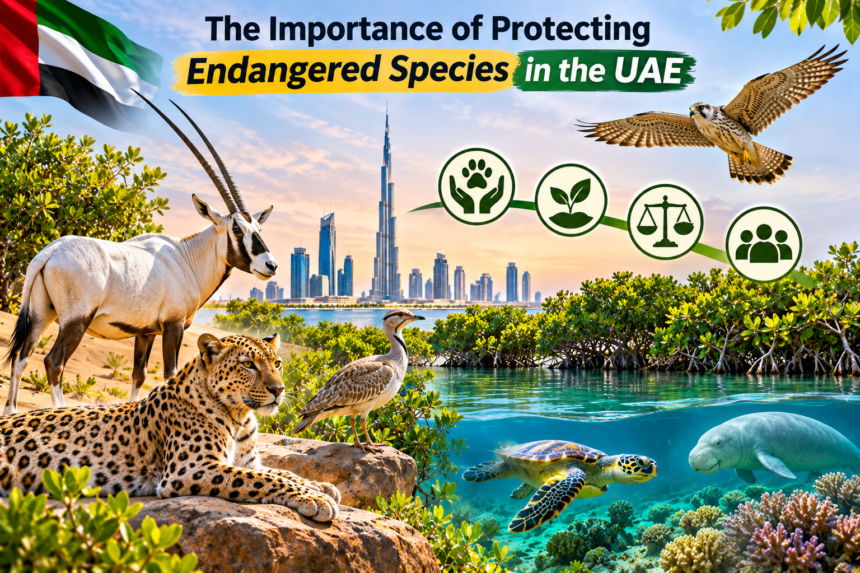
The United Arab Emirates is widely known for its modern cities, impressive buildings, beautiful coastlines, and vast desert landscapes. However, beyond its urban development, the country is also home to a remarkable variety of wildlife. From the Arabian oryx roaming across protected desert areas to sea turtles swimming through coastal waters, the UAE supports many species that play important roles in the natural environment.
- 1. The UAE Is Home to Unique and Valuable Wildlife
- 2. Protecting Endangered Species Helps Maintain Ecological Balance
- 3. The Arabian Oryx Shows Why Conservation Works
- 4. Marine Species Need Healthy UAE Coastlines
- 5. Five Major Threats to Endangered Species in the UAE
- 6. Protected Areas Provide Safe Habitats for Wildlife
- 7. Mangroves, Coral Reefs, and Seagrass Meadows Need Protection Too
- 8. Conservation Is Also Important for Future Generations
- 9. How the UAE Is Supporting Wildlife Conservation
- 10. How Residents, Businesses, and Tourists Can Help
- 11. The Role of Technology in Protecting Endangered Species
- 12. Five Reasons Wildlife Conservation Benefits People Too
- Conclusion: Protecting Endangered Species Means Protecting the UAE’s Natural Future
- Frequently Asked Questions (FAQs)
Some of these animals are facing serious threats. Habitat loss, coastal construction, pollution, illegal hunting, fishing activities, and climate change are putting pressure on different wildlife populations. Species that once lived across wider areas may now depend on a smaller number of suitable habitats and conservation programmes.
Protecting endangered and threatened species is therefore an important part of the UAE’s environmental future. It is not only about saving rare animals. It is also about protecting the natural systems that support human life, maintaining ecological balance, preserving national heritage, and ensuring that future generations can experience the country’s wildlife.
The UAE has already developed protected areas, wildlife monitoring programmes, habitat restoration projects, and partnerships with conservation organisations. The Environment Agency – Abu Dhabi (EAD), the Ministry of Climate Change and Environment, and other organisations play important roles in these efforts.
In this article, we explore important reasons why protecting endangered species in the UAE matters, the animals that need attention, the major threats they face, and how residents, businesses, and visitors can support wildlife conservation.
1. The UAE Is Home to Unique and Valuable Wildlife
Although much of the UAE has an arid climate, its natural environment is more diverse than many people realise. The country contains sandy deserts, mountains, rocky valleys, mangroves, coral reefs, seagrass meadows, coastal islands, and wetlands.
Each habitat supports different forms of life.
For example, desert areas provide shelter and feeding grounds for Arabian oryx, gazelles, foxes, reptiles, and insects. Coastal waters support sea turtles, dugongs, dolphins, and fish, while mangroves and wetlands provide important habitats for birds and other wildlife.
According to the UAE’s official government information, the country’s ecosystems include coral reefs, mangrove forests, and sand dunes, with several vulnerable and endangered species living in these environments. The government also identifies biodiversity conservation as an important part of its environmental commitments.
Some important species found in the UAE include:
- Arabian oryx.
- Arabian sand gazelle.
- Arabian tahr.
- Hawksbill sea turtle.
- Green sea turtle.
- Dugong.
- Socotra cormorant.
- Houbara bustard.
- Arabian sand cat.
- Different species of reptiles, birds, and marine life.
It is important to understand that not every species listed here has the same conservation status. Some are classified as Endangered or Critically Endangered, while others are Vulnerable or facing local threats.
Protecting this biodiversity helps maintain the UAE’s natural identity and supports the long-term health of its ecosystems.
2. Protecting Endangered Species Helps Maintain Ecological Balance
Every animal and plant has a role in its natural environment. Even species that are rarely seen can make important contributions to the balance of an ecosystem.
For example, predators help control the populations of smaller animals. Herbivores influence plant growth through grazing. Birds and insects may help with pollination, seed dispersal, and the movement of nutrients.
When a species disappears or its population becomes too small, the effects can extend throughout the food chain.
Why ecological balance matters
- Predators help regulate populations of prey animals.
- Herbivores influence vegetation and plant communities.
- Insects support pollination and decomposition.
- Birds can distribute seeds across different areas.
- Marine animals contribute to healthy underwater ecosystems.
- Native plants provide food and shelter for wildlife.
Consider desert ecosystems. If native plant communities are damaged, animals that depend on them may lose important sources of food and shelter. Smaller animals can then become less available to predators, affecting several levels of the food web.
Marine ecosystems also depend on balance. Healthy seagrass meadows support green turtles and dugongs, while coral reefs provide food and shelter for many marine species.
Why Protecting Endangered Species Matters
- Maintaining Food Chains and Webs
- Preserving Biodiversity
- Human Benefits
Protecting endangered species is therefore also about protecting the natural relationships that allow these ecosystems to function.
3. The Arabian Oryx Shows Why Conservation Works
The Arabian oryx is one of the most recognised wildlife symbols of the UAE. It has a white coat, long horns, dark facial markings, and broad hooves that help it move across sandy terrain.
However, its history also demonstrates the dangers wildlife can face.
The Arabian oryx was heavily hunted in the past, and its numbers declined until the species was declared extinct in the wild during the 1970s. Habitat loss also contributed to its disappearance.
Conservation programmes, captive breeding, and reintroduction efforts helped the animal return to protected desert habitats.
The Environment Agency – Abu Dhabi describes the UAE as home to the world’s largest Arabian oryx population, reporting more than 6,900 individuals. The species is currently classified as Vulnerable on the IUCN Red List.
Why is the Arabian oryx important?
The Arabian oryx is part of the natural and cultural heritage of the Arabian Peninsula. Its recovery also demonstrates what can happen when conservation programmes receive long-term support.
The species can survive in difficult desert conditions and feed on available vegetation. Its ability to detect rainfall and fresh plant growth over considerable distances is one of its remarkable adaptations.
Today, protected areas such as the Arabian Oryx Protected Area and Qasr Al Sarab Protected Area provide important habitats for the species.
The recovery of the Arabian oryx reminds us that wildlife decline does not always have to end in extinction. With scientific planning, habitat protection, monitoring, and cooperation, threatened species can have a better chance of recovery.
4. Marine Species Need Healthy UAE Coastlines
The UAE’s coastal waters are important habitats for several threatened marine species. However, these environments are under pressure from human activities and environmental changes.
Hawksbill sea turtle
The hawksbill turtle is globally classified as Critically Endangered. It is recognised by its narrow, beak-like mouth and patterned shell.
Hawksbill turtles are closely connected to coral reef habitats, where they feed on marine organisms such as sponges. They also use suitable sandy beaches for nesting.
The Environment Agency – Abu Dhabi identifies coastal development, marine pollution, abandoned fishing nets, and over-exploitation as threats to the species. Marawah Marine Biosphere Reserve is an important feeding habitat for hawksbill turtles in Abu Dhabi.
Green sea turtle
Green turtles are classified as Endangered globally. They often feed in shallow coastal waters, especially around seagrass meadows.
The Environment Agency – Abu Dhabi estimates that around 6,732 green turtles use Abu Dhabi’s waters for feeding. It also monitors turtle populations and protects important habitats in marine protected areas.
Dugongs
Dugongs are large marine mammals sometimes called sea cows because they feed mainly on seagrass.
They are classified as Vulnerable globally and face threats such as entanglement in abandoned fishing nets, habitat loss, marine pollution, and boat collisions.
EAD reports that approximately 3,000 dugongs are present in waters monitored by Abu Dhabi, with important populations associated with Marawah Marine Biosphere Reserve and Al Yasat Marine Protected Area.
These species show why protecting coastal habitats is just as important as protecting animals themselves.
5. Five Major Threats to Endangered Species in the UAE
The UAE’s wildlife has adapted to challenging natural conditions, but these adaptations cannot protect animals from every human activity or environmental change.
Several threats can reduce animal populations and damage the habitats on which they depend.
Threat 1: Habitat loss and urban development
The UAE has experienced major urban and infrastructure development. New roads, residential areas, ports, industrial facilities, and tourism projects can change natural landscapes.
If development takes place without sufficient environmental planning, wildlife may lose feeding areas, nesting beaches, breeding sites, and natural routes between habitats.
For example, coastal development can affect sea turtle nesting locations and marine habitats. Construction in mountainous areas may disturb species such as the Arabian tahr.
What can help? Environmental assessments, protected areas, suitable development planning, and restoration of damaged habitats can help reduce these effects.
Threat 2: Pollution and plastic waste
Plastic bags, fishing lines, packaging, and other waste can enter the sea and desert environment.
Marine animals may become trapped in discarded fishing gear or mistake plastic for food. Pollution can also damage coral reefs, seagrass beds, mangroves, and wetlands.
On land, litter and poorly managed waste can harm animals and affect their natural surroundings.
What can help? Better waste management, responsible fishing practices, recycling, and regular clean-up activities can reduce pollution.
Threat 3: Illegal hunting and wildlife trade
Hunting can seriously affect species that already have small or declining populations.
Illegal capture and trade can also place pressure on rare animals, particularly reptiles, birds, and other wildlife kept or sold as exotic pets.
The effects may be difficult to notice immediately, but the removal of even a small number of breeding animals can be important for threatened populations.
What can help? Strong enforcement, wildlife monitoring, public education, and responsible reporting of suspected illegal activities.
Threat 4: Fishing activities and marine disturbance
Fishing is an important economic activity, but some fishing practices can accidentally capture turtles, dolphins, dugongs, and seabirds.
Abandoned fishing nets can continue trapping animals even after the equipment has been lost. Boat traffic can also cause collisions with marine wildlife.
What can help? Responsible fishing methods, suitable fishing regulations, recovery of lost gear, and awareness among boat operators can reduce these risks.
Threat 5: Climate change and rising temperatures
Climate change can affect habitats through higher temperatures, changing rainfall, coastal erosion, and marine heatwaves.
Sea turtles are particularly sensitive to changes in nest temperature because temperature influences the sex of their hatchlings. Very high temperatures can also affect egg development and survival.
Coral reefs may experience bleaching during periods of unusually warm water, while desert species may face additional pressure when food and water become less available.
What can help? Habitat restoration, climate monitoring, scientific research, and reducing greenhouse gas emissions can support long-term conservation.
The UAE government’s biodiversity information identifies development, pollution, over-exploitation of natural resources, invasive species, and climate change among the pressures affecting its terrestrial and marine environments.
6. Protected Areas Provide Safe Habitats for Wildlife
One of the most important ways to conserve endangered species is to protect the places where they live.
A protected area is a location managed to conserve biodiversity and natural resources. It may include desert landscapes, mountains, wetlands, islands, mangroves, coral reefs, or coastal waters.
Protected areas can limit damaging activities and create safer conditions for wildlife to feed, breed, and move naturally.
The UAE’s Ministry of Climate Change and Environment reported in its 2023 biodiversity conservation guide that the country had 33 terrestrial protected areas and 16 marine protected areas at the time of publication. The guide also describes internationally recognised conservation sites, including Ramsar wetlands and UNESCO biosphere reserves. Important UAE conservation locations
Marawah Marine Biosphere Reserve: An important marine area in Abu Dhabi that supports dugongs, sea turtles, seagrass habitats, and other marine life.
Al Wathba Wetland Reserve: A significant wetland area known for its birdlife, including greater flamingos. EAD reports that more than 260 bird species have been recorded there.
Jebel Ali Wildlife Sanctuary: A coastal and marine protected area in Dubai that supports seabirds, marine habitats, and different reptile species. It is also recognised internationally for its ecological importance.
Arabian Oryx Protected Area: An important desert habitat that supports Arabian oryx, gazelles, and other native species.
Protected areas are not simply places where animals are kept away from people. They are important parts of long-term environmental planning and wildlife research.
7. Mangroves, Coral Reefs, and Seagrass Meadows Need Protection Too
Protecting endangered species requires more than focusing on individual animals. Their habitats must also be healthy.
Mangrove forests
Mangroves grow along suitable coastal areas and provide shelter, breeding locations, and feeding grounds for many marine organisms and birds.
They also help protect coastlines and store carbon in their biomass and sediments.
The UAE has a national ambition to plant 100 million mangroves by 2030. In September 2024, the Environment Agency – Abu Dhabi, the Ministry of Climate Change and Environment, and Emirates Nature-WWF launched national guidelines for mangrove restoration to support scientifically planned planting and habitat recovery.
Successful restoration requires choosing appropriate locations, using suitable species, and monitoring the health of newly planted mangroves.
Coral reefs
Coral reefs support many marine organisms, including fish, crustaceans, and sea turtles.
They cover less than 1% of the ocean floor, coral reefs support at least 25% of all marine species, earning them the nickname “rainforests of the sea”.
The Environment Agency – Abu Dhabi reports that Abu Dhabi has approximately 350 square kilometres of coral reef-associated habitat and conducts monitoring to assess coral community health.
Seagrass meadows
Seagrass is an underwater flowering plant that forms important feeding habitats for green turtles and dugongs.
Healthy seagrass beds also support fish and other marine organisms, stabilise sediments, and contribute to coastal ecosystem health.
Seagrass meadows are dense underwater ecosystems formed by marine flowering plants that grow in shallow coastal waters and estuaries on every continent except Antarctica.
They are true flowering plants with roots, stems, leaves, flowers, and seeds—unlike algae or seaweeds
They act as critical nurseries and homes for fish, crabs, shrimp, seahorses, and endangered species like dugongs and sea turtles.
Protecting these three habitats helps support many species at the same time.
8. Conservation Is Also Important for Future Generations
Endangered species are part of the UAE’s natural heritage. Their survival connects modern generations with the landscapes and wildlife that have existed in the region for centuries.
The Arabian oryx, for example, has a special place in the country’s conservation story. Sea turtles and dugongs also represent the importance of the Arabian Gulf’s marine environment.
If these species disappear, future generations may only learn about them through photographs, books, and museum displays.
Conservation helps prevent that loss.
It also creates opportunities for children and young people to learn about:
- Native animals and plants.
- Desert and marine ecosystems.
- Environmental responsibility.
- Traditional relationships with nature.
- Scientific research.
- Sustainable development.
Schools, museums, wildlife centres, protected areas, and educational programmes can help people understand why biodiversity matters.
Environmental education is especially useful when it includes practical activities. A student who takes part in a supervised beach clean-up or learns about native plants may develop a stronger connection with the natural environment.
Protecting endangered species today helps ensure that wildlife remains part of the UAE’s natural heritage tomorrow.
9. How the UAE Is Supporting Wildlife Conservation
The UAE uses several approaches to protect endangered and threatened species. These include research, protected areas, breeding programmes, habitat restoration, monitoring, and cooperation between government organisations and conservation partners.
Arabian oryx recovery programmes
The recovery of the Arabian oryx is one of the country’s most recognised conservation achievements. Breeding and reintroduction programmes helped restore populations after the species disappeared from the wild.
Sea turtle monitoring
EAD monitors sea turtle populations and manages protected areas that support feeding and nesting habitats. Awareness programmes also encourage fishermen and recreational boat operators to avoid vessel strikes and other harmful interactions.
Dugong research
EAD has studied and monitored dugongs since 1999. Its work includes aerial surveys, satellite tracking, investigations of animal deaths, and research into migration and genetics.
New conservation initiatives in 2026
In May 2026, Miral announced four conservation priorities under its IMPACT by Miral platform. These included tracking sea turtle populations across the Arabian Gulf, protecting Arabian sand cats in Abu Dhabi’s deserts, and safeguarding the critically endangered Dama gazelle.
In January 2026, the Mohamed bin Zayed Species Conservation Fund and Mubadala announced a two-year initiative to support dugong and seagrass conservation in the UAE and four other countries. The partnership also included support for early-career conservation leaders.
These examples show how government agencies, companies, researchers, and conservation organisations can work together to protect wildlife.
10. How Residents, Businesses, and Tourists Can Help
Wildlife conservation is not only the responsibility of environmental organisations. Residents, visitors, businesses, and local communities can also make a difference.
Even small daily actions can help reduce pressure on endangered species.
What residents can do
- Avoid leaving plastic and other rubbish in natural areas.
- Reduce unnecessary single-use plastic.
- Keep a safe distance from wild animals.
- Never feed wildlife unless an authorised programme specifically instructs you to do so.
- Avoid buying products made from protected wildlife.
- Report injured animals or suspected illegal hunting to the relevant authorities.
- Follow the rules of protected areas.
- Support environmental education and community clean-ups.
What tourists can do
Visitors should enjoy natural areas responsibly. They should avoid disturbing nesting beaches, chasing animals for photographs, removing plants, or driving away from approved routes.
When visiting mangroves, wetlands, or desert reserves, it is important to follow the instructions of guides and conservation staff.
Responsible wildlife tourism can also help people understand the value of natural habitats.
What businesses can do
Companies can support conservation by:
- Conducting environmental assessments before development.
- Reducing waste and pollution.
- Protecting sensitive habitats near work sites.
- Supporting native habitat restoration.
- Monitoring environmental impacts.
- Funding research and conservation partnerships.
- Educating employees about local wildlife.
Businesses involved in construction, tourism, transport, fishing, and energy production can play a particularly important role because their activities may interact directly with natural habitats.
11. The Role of Technology in Protecting Endangered Species
Modern conservation is increasingly using technology to understand wildlife and manage habitats.
Researchers and environmental organisations can use digital tools to collect information, monitor animals, and identify environmental changes.
Camera traps
Camera traps use motion sensors to photograph animals without requiring researchers to remain nearby. They are useful for studying shy or nocturnal animals.
EAD uses remote infrared camera traps to monitor the Arabian tahr population in the Jabal Hafit area.
Satellite tracking
Some marine animals can be fitted with suitable tracking devices to help scientists understand their movements and habitat use.
This information can help identify areas that require additional protection.
Drones
Drones can support habitat mapping, environmental surveys, and restoration programmes. They can also help researchers observe some wildlife populations while reducing the need for frequent ground visits.
Artificial intelligence and data analysis
AI-supported tools can help researchers organise camera images, examine patterns, and process large amounts of environmental information.
However, technology works best when combined with field research, scientific expertise, and long-term conservation planning.
12. Five Reasons Wildlife Conservation Benefits People Too
Protecting endangered species is not only valuable for animals. Healthy natural environments also provide important benefits to people and communities.
1. Healthier coastal environments: Mangroves, reefs, and seagrass meadows support marine biodiversity and help maintain coastal ecosystems.
2. Better environmental education: Wildlife conservation gives students and families opportunities to learn about nature and scientific research.
3. Support for responsible tourism: Well-managed natural areas can attract visitors who are interested in wildlife, landscapes, and outdoor experiences.
4. Scientific and research opportunities: Conservation creates opportunities for studies in ecology, marine biology, animal behaviour, and environmental management.
5. Protection of natural heritage: Native animals and habitats help maintain the UAE’s environmental identity and connect future generations with the country’s landscapes.
The UAE’s National Biodiversity Strategy and related environmental policies recognise the importance of conserving natural resources and maintaining healthy ecosystems.
Conclusion: Protecting Endangered Species Means Protecting the UAE’s Natural Future
The UAE is home to remarkable wildlife, from the Arabian oryx and Arabian tahr to green turtles, hawksbill turtles, dugongs, and many species of birds. These animals are part of the country’s natural heritage, and their survival depends on healthy habitats and responsible human activities.
Habitat destruction, pollution, illegal hunting, marine disturbance, and climate change can threaten wildlife populations. However, protected areas, scientific monitoring, breeding programmes, restoration projects, and public participation can help reduce these pressures.
The recovery of the Arabian oryx demonstrates that conservation can produce meaningful results when it receives long-term support. Current initiatives involving sea turtles, dugongs, mangroves, and other threatened species show that wildlife protection continues to develop.
Residents, visitors, businesses, schools, and government organisations all have a role to play. Respecting protected areas, reducing waste, avoiding disturbance, supporting reliable conservation programmes, and learning about native species are practical steps towards a healthier environment.
Protecting endangered species is not simply about saving rare animals. It is about preserving the natural balance, cultural heritage, and environmental resources that make the UAE unique. By protecting wildlife today, the country can help ensure that future generations inherit a living and diverse natural environment.
Frequently Asked Questions (FAQs)
1. Why is protecting endangered species important in the UAE?
Protecting endangered species helps maintain ecological balance, preserve natural habitats, support biodiversity, and protect the UAE’s environmental heritage. It also benefits research, education, and responsible nature tourism.
2. Which endangered animals are found in the UAE?
Important threatened species include the Arabian tahr, hawksbill turtle, and green turtle. Other species such as the Arabian oryx, dugong, Arabian sand gazelle, and Socotra cormorant are classified as Vulnerable globally. Conservation status can vary by species and assessment.
3. What are the biggest threats to endangered species in the UAE?
Major threats include habitat loss, urban and coastal development, pollution, illegal hunting, discarded fishing nets, disturbance, and climate change.
4. How does the UAE protect endangered wildlife?
The UAE uses protected areas, scientific monitoring, breeding and reintroduction programmes, habitat restoration, research, and cooperation between government authorities and conservation organisations.
5. Why is the Arabian oryx important to the UAE?
The Arabian oryx is an important symbol of the UAE’s wildlife heritage and a well-known conservation success. Breeding and reintroduction programmes helped restore its population after it became extinct in the wild during the 1970s.
6. Why should marine habitats be protected?
Marine habitats such as coral reefs, seagrass meadows, and mangroves provide food and shelter for marine life. They support endangered turtles and dugongs, fish populations, and wider coastal ecosystems.
7. What is the role of protected areas in wildlife conservation?
Protected areas help preserve important natural habitats and limit activities that may damage wildlife. They also provide valuable locations for research, monitoring, breeding, and species recovery.
8. How can tourists help protect endangered species in the UAE?
Tourists can stay on approved routes, avoid feeding or disturbing animals, dispose of rubbish responsibly, respect nesting beaches, and follow the instructions of protected-area staff.
9. How does climate change affect endangered animals?
Climate change can increase temperatures, affect rainfall, damage coastal habitats, and change food availability. Marine heatwaves may also affect coral reefs, while warmer nesting sand can influence sea turtle hatchling development.
10. What can children do to support wildlife conservation?
Children can learn about native animals, reduce plastic waste, participate in supervised clean-up activities, respect wildlife, and encourage responsible environmental habits at home and school.
Do follow us on Instagram
Read More – The Skills Gulf Employers May Need in the Future