Essential Skills Gulf Employers May Need in the Future
The job market across the Gulf Cooperation Council (GCC) is changing as businesses adopt new technologies, expand into different industries, and respond to changing customer needs. Countries such as the United Arab Emirates, Saudi Arabia, Qatar, Bahrain, Kuwait, and Oman are investing in areas such as artificial intelligence, financial technology, tourism, renewable energy, logistics, healthcare, and digital services.
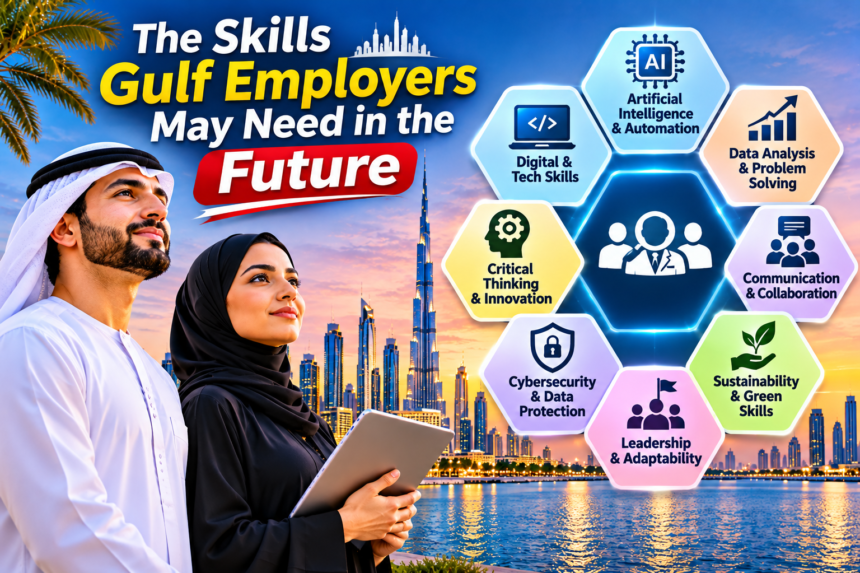
- 1. Artificial Intelligence and Digital Skills
- 2. Data Analysis and Analytical Thinking
- 3. Cybersecurity and Digital Safety
- 4. Communication and Professional English
- 5. Critical Thinking and Problem-Solving
- 6. Creativity and Innovation
- 7. Adaptability, Flexibility, and Lifelong Learning
- 8. Leadership and Teamwork
- 9. Emotional Intelligence and Customer Service
- 10. Green Skills and Environmental Awareness
- 11. Multilingual Skills and Cultural Awareness
- 12. Industry-Specific Technical and Practical Skills
- 13. How Skill Requirements May Differ Across GCC Countries
- 14. How Students and Fresh Graduates Can Prepare for Future Jobs
- 15. What Employers Can Do to Prepare Their Workforce
- 16. Challenges in Building a Future-Ready Workforce
- Conclusion: Build the Skills That Help You Grow With the Gulf Job Market
- Frequently Asked Questions (FAQs)
These changes are influencing what employers expect from their employees. A university degree and basic computer knowledge may provide a starting point, but many roles increasingly require practical experience, digital understanding, communication, problem-solving, and the ability to learn new things.
For example, a finance professional may need to understand data analytics and digital banking. A software developer may need knowledge of AI tools and cybersecurity. A hotel employee may benefit from customer service skills, language abilities, and familiarity with online booking systems.
The World Economic Forum’s Future of Jobs Report 2025 identifies AI and big data, cybersecurity, technological literacy, creative thinking, adaptability, and lifelong learning among the skills expected to grow in importance by 2030. Its regional analysis also identifies significant changes in the Middle East and North Africa labour market.
This means future career opportunities will not depend on technical knowledge alone. Employers will also need people who can communicate clearly, work with others, manage change, and make responsible decisions.
In this article, we explore 12 important skills Gulf employers may need in the future, which industries may use them, and how students, fresh graduates, and experienced professionals can prepare for a changing job market.
1. Artificial Intelligence and Digital Skills
Artificial intelligence (AI) is changing how businesses manage information, communicate with customers, complete routine tasks, and make decisions.
Companies across the Gulf are exploring AI applications in banking, healthcare, retail, education, transportation, government services, and other industries. As adoption increases, employees will need to understand how to work with digital tools and use them responsibly.
You do not have to become an AI engineer to benefit from learning about artificial intelligence. Even basic AI knowledge can help employees understand how automated tools work and where they may be useful.
Important AI and digital skills include:
- Understanding how generative AI tools work.
- Writing clear prompts for AI systems.
- Checking AI-generated information for accuracy.
- Understanding basic automation.
- Using digital workplace platforms.
- Managing digital information.
- Understanding data privacy and responsible AI use.
- Knowing when human judgement is necessary.
For example, a marketing employee may use AI to generate initial content ideas, but should still check the facts, improve the writing, and ensure that the final message suits the audience.
Similarly, a customer service employee may use an AI-supported system to find answers quickly, while handling complex customer complaints personally.
Deloitte’s 2026 State of AI in the Enterprise report found that many Middle Eastern organisations are already reporting efficiency improvements from AI, although workforce readiness and changes to job responsibilities remain important challenges.
Kingdom of Saudi Arabia (KSA) is spending billions into digital and AI infrastructure, highlighted by Project Transcendence ($100 billion initiative) and massive data center pipeline expansions managed through the Saudi Data and AI Authority (SDAIA)
How to prepare: Start with basic AI tools, understand their limitations, and practise using them for tasks connected to your profession.
2. Data Analysis and Analytical Thinking
Data has become an important part of business decision-making. Companies collect information about sales, customers, employees, finances, operations, and market performance.
A growing company can have sales reports, CRM records, finance files, customer data, operational dashboards, and market research and still make a weak decision. The problem is rarely the absence of numbers. It is the gap between having data and knowing which evidence should change the decision.
However, collecting data is not enough. Businesses need people who can understand information, identify patterns, and explain what the results mean.
This is why data analysis and analytical thinking may become increasingly valuable across different Gulf industries.
Where can these skills be useful?
Banking and finance: Analysing transactions, customer behaviour, financial performance, and potential risks.
Retail: Understanding customer preferences, product demand, and sales patterns.
Healthcare: Organising information, reviewing service performance, and supporting operational planning.
Logistics: Monitoring deliveries, inventory, transport costs, and supply chain performance.
Marketing: Studying website traffic, campaign results, and customer engagement.
Useful tools to learn
- Microsoft Excel.
- SQL and database fundamentals.
- Power BI.
- Tableau.
- Python for data analysis.
- Basic statistics and data visualisation.
A beginner does not need to master every tool at once. Learning Excel and basic data interpretation is a useful starting point before moving towards more advanced software.
The World Economic Forum identifies analytical thinking as one of the most important core skills reported by employers globally. It also expects AI and big data skills to increase significantly in importance by 2030.
Employees who can turn information into useful business insights may become valuable members of teams across the GCC.
3. Cybersecurity and Digital Safety
As more business activities move online, protecting information and computer systems becomes increasingly important.
Banks manage financial records, hospitals maintain patient information, retailers process online payments, and government organisations operate digital services. These systems need protection from cyberattacks, data theft, fraud, and unauthorised access.
Cybersecurity is therefore not only a concern for technology companies. It affects almost every organisation that uses digital systems.
Important cybersecurity skills include:
- Network security.
- Identifying common cyber threats.
- Data protection.
- Access management.
- Cloud security.
- Security monitoring.
- Incident response.
- Risk assessment.
- Security awareness and training.
Potential career roles include cybersecurity analyst, network security engineer, information security officer, security consultant, and penetration tester.
However, not everyone working in cybersecurity needs to become an advanced programmer. Some roles focus on compliance, security policies, audits, risk management, and employee awareness.
The World Economic Forum lists networks and cybersecurity among the fastest-growing skills expected over the 2025–2030 period.
How to prepare: Learn computer networking, operating systems, basic security concepts, and safe digital practices. Practical laboratories and recognised professional training can help build stronger knowledge.
4. Communication and Professional English
Technical knowledge can help someone complete a task, but communication helps them explain the work to other people.
In the Gulf, workplaces often bring together employees from different nationalities, cultures, and professional backgrounds. Teams may communicate with international customers, suppliers, managers, and business partners.
Clear communication is therefore important in both office-based and customer-facing roles.
Employers may value people who can:
- Explain ideas in simple language.
- Write professional emails and reports.
- Participate in meetings.
- Give presentations.
- Listen carefully to customers and colleagues.
- Ask clear questions.
- Handle disagreements respectfully.
- Communicate progress and problems.
English is widely used in many international business environments across the GCC. However, the language requirements differ between employers, industries, and positions.
For customer-facing roles, learning basic Arabic can also be useful. In some positions, additional languages may help employees communicate with a wider customer base.
For example, a hotel employee who can communicate politely in English and Arabic may be able to assist more guests. A business analyst who can explain technical findings clearly may help managers make better decisions.
Communication is not simply about speaking fluently. It involves listening, understanding the audience, choosing suitable words, and sharing information accurately.
5. Critical Thinking and Problem-Solving
Modern workplaces involve problems that cannot always be solved by following a fixed instruction.
A company may experience a delay in deliveries, a sudden increase in customer complaints, a technical failure, or an unexpected change in demand. Employees need to understand what has happened and identify practical solutions.
Critical thinking helps people examine information before making decisions.
Employers may value employees who can:
- Identify the actual cause of a problem.
- Compare different solutions.
- Check information before accepting it.
- Recognise risks and possible consequences.
- Make decisions using available evidence.
- Understand different viewpoints.
- Explain the reasons behind their decisions.
For example, if a retail company notices falling sales, an employee should not immediately assume that prices are too high. They may need to examine customer feedback, product availability, marketing activity, and competitors before suggesting changes.
In a hospital, logistics company, bank, or construction business, the ability to identify problems early can help improve daily operations.
The World Economic Forum continues to rank analytical thinking among the most important core skills for employers. Critical thinking also supports responsible use of AI and other digital tools.
6. Creativity and Innovation
Creativity is not limited to artists, designers, or people working in advertising. It is also useful in technology, business management, customer service, education, manufacturing, and entrepreneurship.
Creative employees look for better ways to complete tasks, solve problems, develop products, and improve customer experiences.
For example:
- A marketing employee may develop a new campaign idea.
- A software developer may design a simpler user experience.
- A teacher may create an engaging learning activity.
- A restaurant manager may improve the customer experience.
- An engineer may find a more efficient production method.
Innovation often begins with asking simple questions:
- Can this process be made easier?
- Is there a better way to serve customers?
- Can technology reduce unnecessary work?
- How can we improve quality?
- What problems are customers facing?
The World Economic Forum identifies creative thinking as a skill expected to grow in importance over the next five years.
In the Gulf, where businesses are developing new services and competing in international markets, employees who can combine creativity with practical knowledge may help organisations improve and grow.
7. Adaptability, Flexibility, and Lifelong Learning
One of the most important skills for future employees will be the ability to adapt.
Technology changes, companies introduce new systems, customer expectations develop, and job responsibilities can shift. Employees may need to learn new software, take on different duties, or work with people from unfamiliar professional backgrounds.
Adaptability means being willing and able to respond to these changes.
It includes:
- Learning new tools and systems.
- Accepting constructive feedback.
- Adjusting to changing responsibilities.
- Working in different team environments.
- Managing unexpected situations.
- Remaining open to new ideas.
- Updating professional knowledge.
Lifelong learning is closely connected to adaptability. Employees who continue learning are better prepared to understand new developments in their industries.
This does not mean attending endless courses or collecting certificates. Learning can also happen through workplace projects, practical experience, professional discussions, and independent study.
The World Economic Forum identifies resilience, flexibility, agility, curiosity, and lifelong learning among the skills expected to remain important and grow in value by 2030.
Practical tip: Set aside a small amount of time each week to learn something connected to your job or career goals.
8. Leadership and Teamwork
Leadership is not limited to senior managers or company directors. Employees at different levels need to coordinate tasks, support colleagues, share ideas, and take responsibility.
A person may demonstrate leadership by managing a small project, helping a new employee, handling a customer problem, or organising a team activity.
Teamwork is equally important because many business tasks require cooperation between people with different skills.
Leadership skills employers may value
- Decision-making.
- Responsibility and accountability.
- Motivation.
- Delegation.
- Planning and organisation.
- Conflict management.
- Mentoring and supporting others.
- Clear communication.
Why teamwork matters
A software project may involve developers, designers, testers, and project managers. A hotel depends on coordination between reception, housekeeping, restaurant staff, and management. A logistics operation needs cooperation between drivers, warehouse teams, and supervisors.
Even highly skilled employees can struggle when they cannot work effectively with others.
The World Economic Forum includes leadership and social influence among the most important core skills recognised by employers.
For fresh graduates, leadership does not have to come from a formal job title. Managing a college project, organising an event, or helping a student group can provide useful examples of teamwork and responsibility.
9. Emotional Intelligence and Customer Service
As digital services expand, human interaction will remain important in many occupations.
Emotional intelligence involves understanding your own emotions, recognising how others may feel, and responding in a thoughtful way.
It can help employees manage difficult conversations, work with different personalities, and maintain professional relationships.
This is particularly important in customer-facing industries across the Gulf, including hospitality, banking, healthcare, retail, aviation, tourism, and real estate.
Important abilities include:
- Empathy.
- Patience.
- Active listening.
- Emotional self-control.
- Conflict resolution.
- Respectful communication.
- Understanding customer needs.
- Handling complaints professionally.
Imagine a hotel guest who is unhappy because their room is not ready. A good employee listens carefully, acknowledges the concern, explains the situation, and offers an appropriate solution.
Similarly, a customer service representative may need to remain calm when a customer is frustrated about a delayed payment or service problem.
Customer service is not simply about being polite. It involves understanding the problem and taking suitable action.
The ILO’s research on skills in the Arab region found that online vacancies in the selected markets studied combine cognitive and socio-emotional skills. This suggests that employers often value different abilities together rather than looking only for technical knowledge.
10. Green Skills and Environmental Awareness
Sustainability is becoming an important part of business planning across the Gulf.
Countries in the region are investing in renewable energy, energy efficiency, water management, waste reduction, environmental protection, and cleaner industrial systems.
These developments may create demand for workers who understand environmental standards and sustainable business practices.
Green skills are the abilities needed to support activities that reduce environmental impact and use resources responsibly.
Important green skills may include:
- Renewable energy technologies.
- Energy management.
- Environmental engineering.
- Water conservation.
- Waste management.
- Sustainable construction.
- Environmental monitoring.
- Carbon reporting and emissions management.
- Environmental, social, and governance (ESG) reporting.
Potential career roles include environmental engineer, renewable energy technician, sustainability analyst, energy auditor, environmental compliance officer, and waste management specialist.
Green skills are not relevant only to specialist environmental jobs. A building manager may need to understand energy-efficient systems, while a manufacturing employee may need knowledge of waste reduction and resource management.
The World Economic Forum includes environmental stewardship among the skills expected to rise in importance by 2030.
For job seekers, learning about sustainability can be useful in construction, manufacturing, engineering, energy, logistics, and corporate management.
11. Multilingual Skills and Cultural Awareness
The GCC is home to a diverse workforce and international business community. Employees regularly interact with people from different countries, languages, and cultural backgrounds.
This makes multilingual communication and cultural awareness useful professional abilities.
English is commonly used in many international workplaces, while Arabic remains the official language of the GCC countries and an important part of everyday life.
Depending on the role, knowledge of Hindi, Urdu, Malayalam, Tamil, Tagalog, French, or other languages may also help employees communicate with customers and colleagues.
How multilingual skills can help
- Improve customer communication.
- Support international business relationships.
- Help employees work with diverse teams.
- Make tourism and hospitality interactions easier.
- Support sales and business development.
- Improve communication in some healthcare settings.
Cultural awareness is equally important. Employees should understand that greetings, communication styles, workplace expectations, and social customs can vary between communities.
For example, a professional working with customers across the GCC may need to understand local business etiquette and communicate respectfully with different audiences.
The World Economic Forum’s regional analysis also identifies multilingualism as a skill whose demand is expected to rise more than the global average in some Middle Eastern and North African employer responses.
Learning another language may take time, but even basic knowledge can be useful in the right working environment.
12. Industry-Specific Technical and Practical Skills
Alongside general skills, employers will continue to need people with specialised knowledge related to particular jobs.
The Gulf economy includes many industries, and each requires a different combination of professional and technical abilities.
| Industry | Skills That May Be Important |
|---|---|
| Banking and finance | Financial analysis, risk management, compliance, fintech |
| Information technology | Programming, cloud computing, AI, cybersecurity |
| Healthcare | Clinical knowledge, patient care, medical technology |
| Tourism and hospitality | Customer service, languages, hotel systems, operations |
| Construction | Engineering, project management, safety, digital design |
| Manufacturing | Automation, quality control, maintenance, robotics |
| Logistics | Supply chain management, inventory systems, data analysis |
| Education | Digital teaching, communication, subject knowledge |
| Renewable energy | Solar technology, electrical engineering, energy management |
| Retail and e-commerce | Digital sales, customer experience, inventory management |
For example, a person interested in construction may benefit from learning building information modelling (BIM), project planning, and occupational safety. Someone entering financial services may need accounting, regulatory knowledge, and data analysis.
This is why job seekers should research the requirements of specific occupations rather than assuming that one popular skill will be useful for every job.
The ILO’s research on online vacancies in the Arab region found increasing demand for ICT and service-oriented roles in the markets it analysed, while also identifying the importance of training to reduce skills mismatches. Its study covered Egypt, Jordan, and the UAE, so its findings should not be treated as a complete picture of every GCC country.
13. How Skill Requirements May Differ Across GCC Countries
Although the GCC countries share several economic priorities, their labour markets are not identical. Each country has its own industries, development plans, regulations, and workforce needs.
United Arab Emirates
The UAE has a strong focus on digital transformation, artificial intelligence, financial services, tourism, logistics, and renewable energy. Employers may value technological literacy, data analysis, cybersecurity, communication, and customer experience.
The UAE’s National Employment Strategy 2031 also focuses on developing workforce skills, promoting lifelong learning, and supporting employment in value-added industries.
Saudi Arabia
Saudi Arabia is developing sectors such as tourism, technology, finance, manufacturing, infrastructure, entertainment, and renewable energy under its Vision 2030 programme.
The World Economic Forum’s regional analysis identifies technological literacy, AI, big data, and cybersecurity among the skills receiving increased attention from employers in Saudi Arabia.
Qatar
Qatar’s economy includes energy, financial services, construction, aviation, education, healthcare, tourism, and logistics. Digital capabilities, engineering knowledge, project management, and specialised professional skills can be relevant across these sectors.
Bahrain
Bahrain has an established financial services industry and a developing fintech and digital business environment. Relevant skills include financial analysis, cybersecurity, compliance, data analytics, and customer service.
The WEF’s country-level findings for Bahrain identify creative thinking, leadership and social influence, AI and big data, resilience, and motivation among the core skills reported by employers in its 2025 survey.
Kuwait
Kuwait’s employment needs include finance, energy, engineering, healthcare, construction, education, logistics, and digital services. Technical knowledge, operational management, digital literacy, and professional communication can support different career paths.
Oman
Oman is developing tourism, logistics, manufacturing, fisheries, energy, and other non-oil sectors. Skills in engineering, supply chain management, hospitality, digital services, and sustainability may be relevant as these industries develop.
These examples highlight an important point: there is no single skill combination that guarantees employment across the entire Gulf. A candidate should understand the country, sector, employer, and specific job requirements.
14. How Students and Fresh Graduates Can Prepare for Future Jobs
Students and fresh graduates can begin preparing for the future of work before they enter full-time employment.
A degree provides academic knowledge, but employers may also want practical evidence that candidates can perform tasks and work with other people.
Choose a career direction
Research industries and identify two or three job roles that match your education and interests. Read job descriptions to understand what employers actually require.
Develop practical technical skills
Use online courses, college projects, internships, and personal projects to practise relevant tools.
For example:
- IT students can build websites, applications, or database projects.
- Finance students can practise accounting, Excel, and financial analysis.
- Marketing students can develop SEO and digital campaign samples.
- Engineering students can work on CAD, technical design, and project documentation.
- Hospitality students can gain customer-facing experience.
Improve communication
Practise introducing yourself, writing professional emails, explaining your projects, and answering interview questions.
Build a portfolio
A portfolio can help demonstrate practical skills. It may include project descriptions, work samples, reports, designs, presentations, or code.
Look for internships and training
Internships, apprenticeships, industry workshops, and entry-level jobs provide exposure to real workplace expectations.
Continue learning
Technology and business needs change, so keep updating your knowledge. Choose courses based on the skills required for your target occupation instead of collecting certificates without a clear purpose.
15. What Employers Can Do to Prepare Their Workforce
Developing future-ready employees is not only the responsibility of individuals. Employers also need to create working environments where people can develop and use their skills.
Companies can support workforce development through:
- Regular training and professional development.
- Mentoring and knowledge-sharing programmes.
- Digital skills workshops.
- Practical projects and internal mobility.
- Leadership development.
- Training in AI safety and data protection.
- Clear career progression opportunities.
- Fair access to learning for different employee groups.
The ILO and UN Economic and Social Commission for Western Asia’s 2026 report on artificial intelligence and employment futures in the Arab region highlights the need for AI literacy, advanced technical capabilities, and suitable governance skills. It also warns that workers may experience unequal access to training and employment opportunities during technological change.
Businesses that invest in employee development may be better positioned to adapt to changing technology and retain valuable knowledge.
16. Challenges in Building a Future-Ready Workforce
Although future skills offer opportunities, developing them is not always easy.
Skills gaps
Employers may struggle to find people with specialised knowledge in AI, cybersecurity, data analysis, automation, and other technical areas.
Unequal access to training
Some employees have access to professional courses and workplace training, while others may lack the time, financial resources, or support needed to improve their skills.
Rapid technological change
Tools and systems can change quickly. A skill learned several years ago may need updating, especially in fast-moving technical fields.
Lack of practical experience
Some graduates know the theory but have limited experience applying it to workplace tasks. Projects, internships, and practical training can help address this gap.
Balancing technical and human skills
Companies may focus heavily on technology while overlooking communication, leadership, emotional intelligence, and teamwork. Successful workplaces need a balance of both.
The WEF estimates that 39% of workers’ existing skill sets globally may be transformed or become outdated between 2025 and 2030. Its regional analysis places the projected share of changing on-the-job skills at 46% for the Middle East and North Africa. These are survey-based estimates, not a prediction that the same proportion of jobs will disappear.
Conclusion: Build the Skills That Help You Grow With the Gulf Job Market
The future of employment across the Gulf will be shaped by digital transformation, economic diversification, artificial intelligence, sustainability, and changing business requirements.
Employers may increasingly need people who can work with technology, understand data, protect digital information, communicate effectively, solve problems, and adapt to new responsibilities.
Technical skills such as AI, cybersecurity, programming, and data analysis will be important in many industries. At the same time, human skills such as creativity, leadership, emotional intelligence, teamwork, and communication will continue to play a major role.
For students and fresh graduates, the best way to prepare is to choose a suitable career direction, gain practical experience, and develop skills that match actual job requirements. Working professionals can benefit from continuous learning, workplace training, and staying informed about changes in their industries.
Employers also have a responsibility to provide fair opportunities for training and career development. A future-ready workforce depends on cooperation between businesses, educational institutions, governments, and employees.
Remember that not every skill is necessary for every person. A healthcare professional may need different technical knowledge from a software developer, while a hospitality employee may place greater importance on customer experience and communication.
The most valuable approach is to combine the right technical knowledge with strong human skills and a willingness to keep learning. The future of work in the Gulf will belong to people who can adapt, think clearly, work responsibly, and turn their knowledge into practical results.
Frequently Asked Questions (FAQs)
1. What skills Gulf employers may need in the future?
Important skills may include AI literacy, data analysis, cybersecurity, technological literacy, communication, critical thinking, creativity, adaptability, leadership, and sustainability awareness. Requirements will vary between countries, industries, and job roles.
2. Which technical skills are in demand across the GCC?
AI, programming, cloud computing, cybersecurity, data analytics, financial technology, automation, and digital business systems are important technical areas to watch. Job seekers should check current vacancies to identify the requirements of specific roles.
3. Are communication skills still important in the age of AI?
Yes. Employees still need to explain ideas, understand customers, work with colleagues, manage difficult conversations, and make decisions. Technology may support communication, but it does not remove the need for effective human interaction.
4. Will artificial intelligence replace jobs in Gulf countries?
AI may automate some tasks and change responsibilities in many occupations. It can also support new activities and improve productivity. The effect will depend on the industry, job type, technology adoption, and how employers train their workforce.
5. Why is cybersecurity important for Gulf employers?
Businesses use digital systems to manage financial, customer, employee, and operational information. Cybersecurity skills help protect these systems from attacks, data theft, fraud, and unauthorised access.
6. Do Gulf employers prefer technical skills or soft skills?
Most organisations need a combination of both. Technical knowledge helps employees complete specialised tasks, while communication, teamwork, adaptability, and problem-solving help them work effectively with others.
7. Is Arabic useful for getting a job in the Gulf?
Arabic can be useful, particularly in customer-facing roles, government-related services, hospitality, sales, healthcare, and positions involving local customers. English is also widely used in many international workplaces. Language requirements depend on the specific job.
8. What should fresh graduates learn to get a job in the GCC?
Fresh graduates should develop job-related technical knowledge, communication skills, computer literacy, practical project experience, and interview confidence. They should also research the qualifications and skills listed in actual job advertisements.
9. Are green skills becoming important in the Gulf?
Green skills are relevant to renewable energy, construction, manufacturing, environmental management, water conservation, and sustainability reporting. Their importance will depend on investment and environmental priorities in each country.
10. How can working professionals prepare for future job requirements?
Professionals can review industry trends, learn relevant digital tools, attend training, work on practical projects, seek feedback, and update their knowledge regularly. Continuous learning helps employees adapt as job responsibilities change.
Do follow us on Instagram
Read More – The Future of Work and Careers in Bahrain