




What Happens When AI Makes Financial or Privacy Mistakes?
Imagine asking an artificial intelligence assistant to book the cheapest available flight from Dubai to London. The assistant finds an option, completes the reservation and sends a confirmation. Hours later, the traveller discovers that the booking is for the wrong date and cannot be refunded. In another situation, an AI assistant accidentally sends confidential business information to an unintended recipient or purchases a product that the user never intended to buy.
- What Are Personal AI Assistants and How Do They Work?
- 7 Serious Risks When Personal AI Assistants Make Mistakes
- Who Is Legally Responsible When an AI Assistant Fails?
- UAE, EU and UK Rules on AI Accountability
- What Happens When AI Makes Financial or Privacy Mistakes?
- How Businesses Can Build Accountable AI Assistants
- The Future of Personal AI Assistants and FAQs
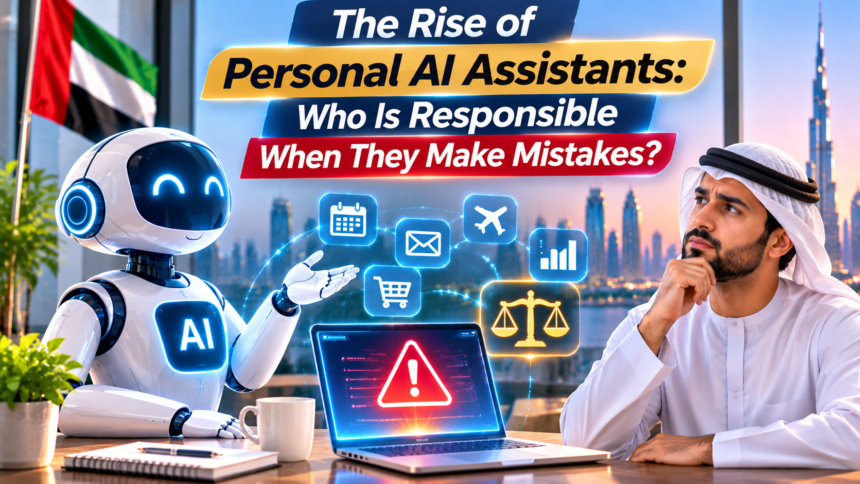
These examples illustrate a growing question in the digital economy: who is responsible when artificial intelligence makes a mistake?
Personal AI Assistants are evolving from systems that answer questions into tools capable of completing tasks, connecting with applications and making certain decisions on behalf of users.
They can potentially organise schedules, compare products, prepare messages, manage information and interact with online services.
Some emerging systems are also designed to perform multi-step activities, including navigating websites and initiating transactions with varying levels of user approval.
This development introduces opportunities for convenience and efficiency, but it also creates new challenges involving accountability.
Traditional digital tools usually require people to carry out individual actions themselves. More autonomous AI systems can make intermediate decisions, select options and execute instructions with less direct involvement.
When an error occurs, several parties may be involved: the user who requested the action, the company that developed the AI, the business operating the service and a third-party platform that processed the transaction.
Responsibility is not automatically assigned to one party.
It depends on what the system was authorised to do, what caused the error, the applicable laws and the contractual relationships between those involved.
Regulators are beginning to address these questions more directly.
In October 2026, the United Kingdom’s Digital Regulation Cooperation Forum published a joint statement addressing consumer protection and emerging agentic AI systems.
In the UAE, the Central Bank has introduced guidance concerning responsible AI use by licensed financial institutions, including oversight, customer protection and accountability.
These developments highlight the need for clear safeguards as AI moves from providing information to taking action.
What Are Personal AI Assistants and How Do They Work?
Personal AI assistants are software systems designed to help individuals complete tasks through natural-language interaction.
Users can communicate with these systems through text or voice instead of navigating every application manually.
Their capabilities vary significantly.
Some assistants primarily respond to questions, summarise documents and draft communications. Others can connect with external tools or services to retrieve information and perform authorised actions.
From Chatbots to AI Agents
A traditional chatbot generally responds to a prompt and waits for another instruction.
A more autonomous AI agent may break a goal into smaller tasks, select tools and take multiple steps towards completing the requested activity.
For example, a user might ask an assistant to organise a business trip.
The system could search for transport options, compare hotels, prepare an itinerary and, where the user has granted appropriate permission, initiate bookings.
However, these capabilities depend on the specific product and its connected services. Not every assistant can complete transactions or independently control external applications.
How Autonomous Decisions Are Made
Modern AI systems use machine-learning models to interpret instructions and generate responses.
When connected to tools, they may also use information retrieved from external services to decide which action to take next.
Problems can arise when the system misunderstands a request, receives inaccurate information or selects an inappropriate action.
AI Assistant vs Autonomous AI Agent
| Feature | Basic AI Assistant | More Autonomous AI Agent |
|---|---|---|
| Main Function | Provide information and assistance | Complete multi-step tasks |
| User Involvement | Usually frequent | May be less frequent |
| External Applications | Limited or optional | Often uses connected tools |
| Transaction Capability | Product-dependent | Possible with authorisation |
| Error Consequences | Often incorrect information | May involve real-world actions |
| Oversight | User reviews responses | Controls and monitoring become critical |
The distinction matters because an inaccurate answer and an unauthorised financial transaction can create very different consequences.
7 Serious Risks When Personal AI Assistants Make Mistakes
As personal AI assistants become more capable, the consequences of errors may extend beyond inconvenience.
Their potential risks depend on the information they access and the actions they are allowed to perform.
1. Incorrect Financial Transactions
An assistant authorised to purchase products or manage payments could select the wrong item, amount or recipient.
A simple misunderstanding might result in an expensive transaction.
Whether the user can recover the money depends on the circumstances, payment rules, contractual terms and applicable consumer protections.
2. Wrong Travel and Hotel Bookings
Travel planning involves multiple details, including dates, destinations, passenger names and cancellation conditions.
An AI system could misinterpret a preference or overlook a restriction.
The resulting booking might be costly to change, particularly if it is non-refundable.
3. Exposure of Personal Information
Assistants may process emails, documents, calendars and other sensitive records.
If permissions are too broad or a connected service is compromised, information may be disclosed improperly.
Privacy risks can arise even without an obvious software malfunction.
4. Misleading Financial Advice
An AI assistant might provide inaccurate information about investments, borrowing or insurance.
If users rely on such information without verification, they could make unsuitable decisions.
Products offering regulated financial advice may face additional requirements depending on the jurisdiction.
5. Incorrect Medical Information
AI systems may help explain general health information, but they can produce inaccurate or incomplete responses.
A mistake involving medication, symptoms or treatment decisions could have serious consequences.
Clinical decisions require appropriate professional assessment.
6. Unauthorised Communications
An assistant with messaging or email permissions might send an incorrect message or disclose confidential information.
This could affect business relationships, reputations or contractual negotiations.
Users should be able to review important communications before they are sent.
7. Excessive Automation
The more authority a system receives, the more opportunities it may have to make consequential decisions without timely intervention.
An agent could repeatedly perform a mistaken action or misunderstand a broad instruction.
Clear permission limits and reliable stopping mechanisms are therefore important.
Seven Risks Compared
| Risk | Possible Consequence | Key Safeguard |
|---|---|---|
| Financial Errors | Unwanted payments | Transaction approval |
| Booking Mistakes | Cancellation expenses | Final itinerary review |
| Data Exposure | Privacy harm | Limited permissions |
| Financial Misinformation | Poor decisions | Professional verification |
| Medical Errors | Health risks | Clinical oversight |
| Incorrect Messages | Confidentiality or reputation damage | Send confirmation |
| Excessive Autonomy | Repeated unwanted actions | Spending and action limits |
The seriousness of an error depends not only on whether the AI made a mistake but also on whether appropriate controls could have prevented it.
Who Is Legally Responsible When an AI Assistant Fails?
Legal responsibility for AI mistakes depends on the facts and the relevant jurisdiction.
There is no universal rule stating that every mistake belongs entirely to the user or entirely to the AI developer.
In practice, responsibility may involve several organisations and individuals.
The AI Developer
A developer may face legal exposure if a defective product, misleading claim or failure to meet applicable obligations contributes to harm.
However, the existence of an inaccurate AI response does not automatically establish legal liability.
The relevant duties, defect or wrongdoing, causation and losses must be assessed.
The Company Deploying the Assistant
Businesses that provide AI-powered services to customers may retain legal obligations even when they rely on third-party technology.
In guidance updated in October 2026, the UK’s Competition and Markets Authority states that businesses remain responsible for complying with consumer law when using AI agents.
This includes situations where another company supplied the underlying technology.
However, UK guidance does not automatically establish identical legal outcomes in the UAE or other countries.
The User
A user may also bear responsibility for actions they knowingly approve or authorise.
For example, a person who confirms an incorrect booking after receiving accurate details may face a different situation from someone whose assistant completes a transaction outside its permitted authority.
The level of consent, the clarity of information and the system’s actual behaviour all matter.
Third-Party Service Providers
An AI assistant may depend on external booking platforms, payment services or data providers.
A mistake could originate from one of those services rather than the AI model itself.
Determining responsibility may require examining transaction records, service agreements and the source of the incorrect information.
Who May Be Responsible?
| Party | Possible Responsibility | Important Question |
|---|---|---|
| AI Developer | Product design and applicable legal duties | Was the system defective or improperly represented? |
| Service Operator | Customer protection and safe deployment | Were suitable controls implemented? |
| User | Authorised instructions and approvals | What did the user knowingly permit? |
| External Platform | Transaction or service performance | Did the connected service malfunction? |
| Business Integrator | System configuration and monitoring | Was the integration properly tested? |
Why AI Cannot Simply Accept Legal Blame
An AI assistant may describe an action as its own mistake, but this does not determine legal responsibility.
Current accountability frameworks focus on identifiable people, organisations, products and legally recognised relationships.
The system’s autonomous behaviour may make the investigation more complicated, but it does not automatically eliminate existing obligations.
A meaningful investigation therefore examines what happened, who controlled the system and which legal duties applied.
UAE, EU and UK Rules on AI Accountability
Governments and regulators are developing different approaches to AI oversight.
Some rules apply specifically to artificial intelligence, while others use established consumer protection, privacy and product liability laws.
For users in the Gulf, these distinctions are particularly important because international AI products may be developed, hosted and operated in different countries.
UAE: Financial Institutions and Human Oversight

In February 2026, the Central Bank of the UAE issued guidance on the responsible adoption and use of AI and machine learning by licensed financial institutions.
The guidance emphasises governance, transparency, consumer protection, ongoing monitoring and meaningful human oversight.
It identifies different oversight arrangements: human approval before decisions, human monitoring of automated activity and limited autonomous operation for appropriate low-risk processes.
The guidance also states that financial institutions should allow customers to request human review or explanations of AI-generated decisions and maintain accessible complaint channels.
Importantly, it places accountability for AI governance and outcomes with senior management and boards, even when institutions use external technology providers.
These principles apply within the guidance’s financial-sector scope. They should not be presented as a universal law governing every personal AI assistant in the UAE.
UAE Personal Data Protection
Federal Decree-Law No. 45 of 2021 establishes the UAE’s federal Personal Data Protection Law.
Its provisions include requirements concerning the handling and protection of personal information, subject to the law’s scope and exceptions.
An assistant processing private messages, identification information or other personal records may therefore create obligations for the organisations controlling or processing that data.
However, privacy law is not a substitute for determining liability over a mistaken booking or payment.
European Union: AI and Product Liability
The EU AI Act establishes obligations based on the characteristics and risks of particular AI systems.
Under the regulatory timetable in force as of November 2026, some AI Act requirements are already applicable, while certain high-risk system requirements are scheduled to apply later.
The EU has also adopted an updated Product Liability Directive that expressly covers software, including AI-enabled products.
Member states must transpose the directive by December 9, 2026, and its updated rules apply to products placed on the market or put into service after that date.
The directive is not a general guarantee of compensation for every inaccurate chatbot response. Its application depends on requirements concerning defective products and qualifying damage.
United Kingdom: Consumer Protection
The UK Competition and Markets Authority issued guidance in March 2026 explaining how existing consumer protection duties apply when businesses use AI agents.
The guidance was updated on October 30, 2026, alongside a joint regulatory statement addressing agentic AI.
Its central principle is that businesses cannot avoid consumer protection responsibilities simply by using automated systems.
Regulatory Comparison
| Jurisdiction | Relevant Framework | Main Accountability Focus |
|---|---|---|
| UAE | Central Bank AI/ML guidance | Financial-sector governance and consumer protection |
| UAE | Federal Personal Data Protection Law | Lawful and secure personal data processing |
| European Union | AI Act | Obligations based on AI system characteristics and risks |
| European Union | Product Liability Directive | Liability for qualifying damage from defective products |
| United Kingdom | Consumer law and CMA guidance | Businesses remain responsible for consumer-facing conduct |
Regulatory approaches differ, but the common direction is towards clearer responsibilities and stronger oversight of consequential AI activities.
What Happens When AI Makes Financial or Privacy Mistakes?
The consequences of an AI mistake can become more difficult to resolve when several services are involved.
Consider an illustrative situation in which a resident uses an AI assistant to compare hotel prices and complete a booking.
The assistant selects the wrong destination, while a third-party website processes the payment.
Who should resolve the complaint?
The Importance of Authorisation
The first question is what the user actually requested.
Did the person ask the assistant to research hotels, prepare a shortlist or complete the purchase?
A request to compare options should not automatically be treated as unrestricted permission to spend money.
If the assistant acted beyond its authority, the evidence may be relevant to determining responsibility.
Reviewing the Transaction Records
Payment confirmations, booking references, assistant activity records and relevant communications may help establish the sequence of events.
These records could reveal whether the system misunderstood the instruction or received incorrect information from the provider.
They may also show whether the user approved the final transaction.
Disputing Financial Transactions
Users should contact the relevant merchant or financial institution promptly if they discover an incorrect transaction.
Available remedies depend on applicable payment rules, contract terms and the nature of the error.
An unwanted transaction is not automatically legally unauthorised merely because AI was involved.
Responding to Personal Data Exposure
If an assistant sends private information to the wrong destination, the immediate priority is limiting further exposure.
Users may need to revoke permissions, change compromised credentials and contact the service provider.
Where personal data breaches trigger legal notification duties, the responsible organisation must consider the applicable requirements.
Illustrative Error Scenarios
| Situation | Immediate Action | Potential Responsible Parties |
|---|---|---|
| Wrong Hotel Booking | Contact booking provider | User, agent operator, booking platform |
| Unexpected Payment | Contact merchant or bank | Service operator, payment provider, user |
| Private Email Sent Incorrectly | Restrict access and report incident | Agent operator, integrator, user |
| Misleading Product Recommendation | Preserve offer and complaint records | Seller, service operator |
| Incorrect Financial Information | Seek qualified review | Adviser or service operator, depending on facts |
These are examples rather than predetermined legal outcomes.
Why Reliable Records Matter
Without sufficient records, users may struggle to establish what instructions were given or which actions occurred.
Businesses may also find it difficult to investigate complaints.
Responsible AI deployment therefore requires suitable recordkeeping, balanced against privacy and data-retention obligations.
<WritingBlock id=”63843″ variant=”document”>## How Users Can Prevent Costly AI Assistant Mistakes
Personal AI assistants can provide useful support, but consumers should consider how much authority they grant these systems.
The risks increase when an assistant can access sensitive information or perform transactions without additional approval.
Limit Access to Personal Accounts
An assistant should receive only the permissions necessary to perform a particular task.
For example, access to a calendar does not automatically justify permission to read private financial records.
Consumers should review connected applications regularly and remove permissions they no longer need.
Require Confirmation for Important Actions
Purchases, money transfers, account changes and external communications can have lasting consequences.
Users should consider requiring final confirmation before these actions occur.
A system may be helpful in preparing a transaction without needing permission to complete it independently.
Verify High-Stakes Information
AI-generated financial, medical and legal information can contain mistakes.
Consumers should verify important details through reliable sources and qualified professionals.
The more significant the possible consequences, the greater the need for independent checking.
Review Subscription and Service Terms
Users should understand what a service promises, what actions it can perform and how complaints are handled.
Contractual limitations may affect available remedies, although enforceability depends on applicable law.
Consumer Safety Checklist
- Understand which actions the AI assistant can perform.
- Restrict access to unnecessary applications and information.
- Require approval before payments or bookings.
- Set spending limits where supported.
- Check destinations, dates and prices before confirmation.
- Review important emails before sending.
- Verify financial, legal and medical information.
- Keep transaction confirmations and relevant records.
- Check how to cancel or reverse an action.
- Know how to contact human support.
These precautions cannot prevent every error, but they can reduce the consequences of excessive automation.
How Businesses Can Build Accountable AI Assistants
Companies introducing personal AI assistants must consider more than functionality and convenience.
They need to establish who supervises the system, what risks it creates and how problems will be resolved.
The National Institute of Standards and Technology’s AI Risk Management Framework provides voluntary guidance for identifying, assessing and managing AI-related risks.
Its generative AI profile addresses additional concerns associated with systems that generate content and support decisions.
Establish Clear Responsibility
Every business deploying an AI assistant should identify the teams responsible for performance, security and compliance.
Responsibility should remain clear even when the underlying technology comes from an external supplier.
Set Limits on Autonomous Actions
An assistant used for routine scheduling may need fewer safeguards than one handling financial transactions.
Businesses should define what the system can do independently and which activities require human approval.
Monitor Performance
Testing should continue after deployment.
Developers and operators need to identify recurring errors, unexpected behaviour and changes that may affect users.
A system that initially performs well may encounter new situations or changing information.
Create Human Escalation Channels
Customers should have a practical way to challenge incorrect outcomes and seek human assistance.
A complaint process is less useful if consumers cannot reach someone capable of investigating the problem.
Plan for Incident Response
Businesses should prepare procedures for incorrect payments, privacy incidents and other consequential failures.
This includes establishing how to stop problematic activities, preserve necessary records and communicate with affected users.
Business Accountability Framework
| Business Function | Responsibility | Recommended Control |
|---|---|---|
| Management | Governance and risk decisions | Named accountability |
| Product Team | Functionality and user experience | Testing and permission design |
| Security Team | Protection of systems and information | Access controls |
| Compliance Team | Applicable legal obligations | Regulatory review |
| Customer Support | Complaint resolution | Human escalation |
| Technical Operations | Monitoring and reliability | Incident procedures |
The Economics of Accountability
Safety measures create operational costs, but the absence of appropriate controls can also expose businesses to financial and reputational losses.
An illustrative company deploying an AI customer service assistant might allocate resources to testing, monitoring, security review and complaint handling.
These expenses should be incorporated into the business model rather than treated as optional additions.
The financial value of an AI assistant should therefore be assessed through both its efficiency gains and the risks associated with its use.
The Future of Personal AI Assistants and FAQs
Personal AI assistants are becoming more capable of supporting activities across different applications and services.
As this technology develops, the relationship between user instructions and automated decisions may become increasingly complex.
Consumers may delegate more everyday tasks, while businesses expand the use of agents for customer support, shopping and routine administration.
However, greater autonomy also increases the importance of accountability.
The Importance of Human Oversight
AI assistants can help people make decisions, but some actions require meaningful human judgement.
The level of oversight should depend on the risks involved.
A system organising a personal reading list does not need the same controls as one initiating financial transactions.
Better Transparency and Control
Future services may offer more detailed permission settings, accessible activity histories and clearer explanations of actions.
These features could help users understand what an assistant has done and intervene when necessary.
However, transparency alone will not compensate for inadequate security or unreliable behaviour.
Regulation and Innovation
Governments face the challenge of encouraging useful AI applications while protecting consumers.
Regulatory frameworks are developing at different speeds, and legal obligations vary by jurisdiction.
Companies operating internationally must therefore assess the requirements relevant to their services and customers.
Frequently Asked Questions
What is a personal AI assistant?
A personal AI assistant is a software system that helps users complete tasks, answer questions and interact with digital services through natural-language instructions.
Can AI assistants make decisions without human approval?
Some systems can perform authorised actions with limited intervention. The degree of autonomy depends on the product, its permissions and available safeguards.
Who is responsible when an AI assistant makes a mistake?
Responsibility depends on the circumstances and applicable law. It may involve the user, developer, service operator or another provider.
Can users receive compensation for AI mistakes?
Possibly. Compensation depends on the legal basis of the claim, the losses suffered, causation and applicable consumer or contractual protections.
Is the AI developer always responsible?
No. A developer may have relevant legal duties, but responsibility is not automatically established by every incorrect output.
Can an AI assistant make financial transactions?
Some connected systems can initiate transactions when the required services and permissions are available.
What happens if an AI assistant exposes personal data?
The responsible organisations may need to investigate the incident and comply with applicable privacy and security obligations.
Does the UAE regulate AI-related consumer risks?
Yes, certain existing laws and sector-specific requirements apply. The Central Bank of the UAE has also issued guidance addressing responsible AI use by licensed financial institutions.
Does the EU AI Act guarantee compensation for AI errors?
No. The AI Act establishes regulatory obligations. Compensation claims depend on other relevant legal provisions and circumstances.
How can users reduce the risk of AI mistakes?
They can restrict permissions, require approval for consequential actions, verify important information and maintain relevant transaction records.
Final Thoughts
The rise of personal AI assistants represents a significant shift in how people interact with technology.
Instead of simply providing information, increasingly capable systems can help users complete tasks, coordinate activities and interact with external services.
These developments create opportunities for convenience and efficiency, but they also raise important accountability questions.
When an AI assistant makes a mistake, determining responsibility requires examining the user’s authorisation, the technology’s behaviour, the organisations involved and the applicable laws.
Businesses cannot assume that automation removes their existing obligations, while consumers should understand the risks of granting extensive permissions.
Regulatory developments in the UAE, European Union and United Kingdom demonstrate growing attention to these challenges.
The future of Personal AI Assistants will therefore depend not only on their technical capabilities but also on trust, transparency and effective safeguards.
As digital assistants become more autonomous, the central challenge will be ensuring that greater convenience does not come at the expense of consumer control, privacy or accountability.
Do follow us on Instagram
Read More – AI Translation in Gulf Workplaces: 7 Powerful Changes to Communication