


National Rail vs High-Speed Rail: What Is the Difference?
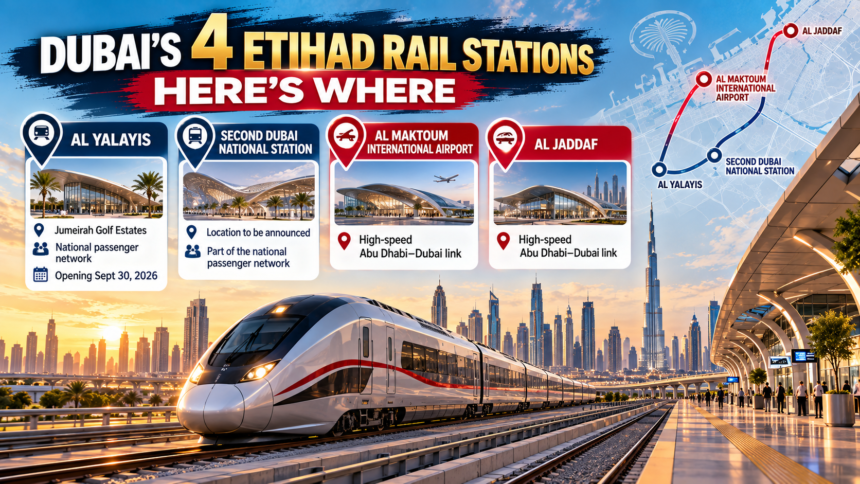
Dubai’s transport network is preparing for another major transformation. The emirate is set to have four Etihad Rail-linked stations, connecting residents not only to the UAE’s national passenger railway but eventually to a separate high-speed line between Dubai and Abu Dhabi.
- Dubai Etihad Rail Stations: The Four Locations Explained
- Al Yalayis Near Jumeirah Golf Estates Will Be Dubai’s First Etihad Rail Station
- Meydan Is Expected to Get Dubai’s Second National Rail Station
- Al Maktoum International Airport Will Get a High-Speed Rail Station
- Al Jaddaf Will Bring High-Speed Rail Closer to Central Dubai
- How the Abu Dhabi–Dubai High-Speed Train Will Work
- Etihad Rail Is Already Carrying Passengers Across the UAE
- When Will All the Etihad Rail Stations Open?
- How Dubai Metro Could Connect With Etihad Rail
- Could Etihad Rail Reduce Road Traffic Between Emirates?
- What Could Four Stations Mean for Different Parts of Dubai?
- What Passengers Should Know Before Dubai Service Begins
- National Rail vs High-Speed Rail: What Is the Difference?
- Why Dubai’s Four Etihad Rail Stations Matter
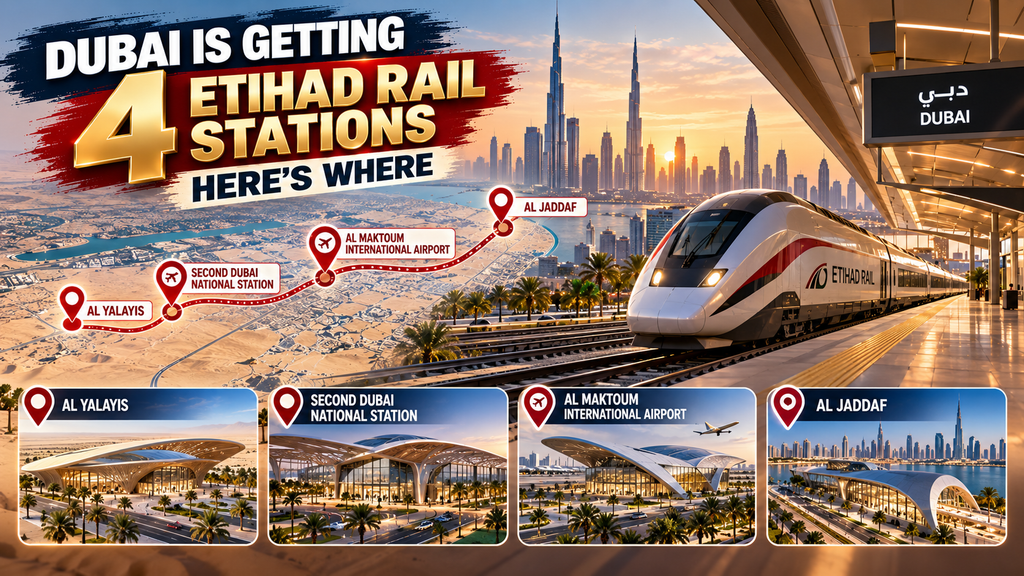
The four stations will not all belong to the same railway service. Two are planned for the national Etihad Rail passenger network, while another two are part of the separate high-speed rail project designed to connect Dubai and Abu Dhabi in around 30 minutes. Dubai’s Roads and Transport Authority revealed the wider four-station plan in September 2026.
The first of these stations, Al Yalayis Station near Jumeirah Golf Estates, is scheduled to open on September 30, 2026, bringing Dubai directly into Etihad Rail’s national passenger network. A second conventional passenger station is indicated around Meydan on Dubai’s 2032 rail network plan, although its formal name and opening date have not yet been officially announced.
The other two stations will serve the future high-speed Abu Dhabi–Dubai line. These are planned at Al Maktoum International Airport and Al Jaddaf, creating potential connections between inter-emirate trains, airports and Dubai Metro services.
Together, these four stations could significantly change how people travel into, through and around Dubai. Instead of relying only on cars, taxis, intercity buses and domestic flights, commuters could eventually move between Dubai, Abu Dhabi, Sharjah, Fujairah and other parts of the UAE through an increasingly integrated rail system.
Dubai Etihad Rail Stations: The Four Locations Explained
Dubai’s four planned Etihad Rail connections are split between two different projects, which is important because the trains, speeds and purposes will not be identical.
The first two stations are linked to the national passenger railway. That service uses the broader UAE rail network and is designed to connect cities and communities across the country.
The other two stations belong to a dedicated high-speed railway between Abu Dhabi and Dubai, which Etihad Rail says will operate on a separate, fully electrified network.
| Dubai Station | Rail Service | Current Status |
|---|---|---|
| Al Yalayis / Jumeirah Golf Estates | National Etihad Rail passenger network | Opening September 30, 2026 |
| Meydan area | National Etihad Rail passenger network | Shown on Dubai 2032 rail plan |
| Al Maktoum International Airport | Abu Dhabi–Dubai high-speed rail | Planned |
| Al Jaddaf | Abu Dhabi–Dubai high-speed rail | Planned |
The distinction matters because someone travelling from Dubai to Fujairah would potentially use the national passenger network, while someone looking for the fastest future journey between Dubai and Abu Dhabi could use the dedicated high-speed service.
The four-station plan also gives Dubai multiple rail gateways rather than relying on one central terminal.
That could reduce pressure on a single station and make Etihad Rail more accessible to people living in very different parts of the city.
Al Yalayis Near Jumeirah Golf Estates Will Be Dubai’s First Etihad Rail Station
The first and most immediate addition is Al Yalayis Station, located near Jumeirah Golf Estates in southern Dubai.
Earlier Etihad Rail announcements referred to the Dubai station as Jumeirah Golf Estates, while more recent updates identify it as Al Yalayis. The location remains close to Jumeirah Golf Estates Metro Station and Sheikh Mohammed bin Zayed Road.
The station is scheduled to begin passenger operations on September 30, 2026, alongside Al Dhaid Station in Sharjah. That date marks Dubai’s formal entry into the national passenger railway network.
Why this location matters
Al Yalayis sits within one of Dubai’s fastest-growing southern corridors. It provides access to communities around Jumeirah Golf Estates while remaining relatively close to Dubai Production City, Dubai Sports City, Dubai South and Al Maktoum International Airport.
Its position near major road networks also makes it easier to reach by car or taxi.
Perhaps more importantly, a dedicated pedestrian connection is planned between the Etihad Rail station and Jumeirah Golf Estates Metro Station, which sits on the Dubai Metro Red Line.
This means a passenger could eventually travel into Dubai by national rail, transfer to the Metro and continue towards locations such as:
- Dubai Marina
- JLT
- Mall of the Emirates
- Business Bay
- Downtown Dubai
- Dubai International Airport
- Deira
That integration is a major part of the long-term transport strategy.
Al Yalayis Quick Guide
| Detail | Information |
|---|---|
| Area | Near Jumeirah Golf Estates |
| Official recent name | Al Yalayis Station |
| Opening date | September 30, 2026 |
| Rail type | National passenger network |
| Metro connection | Planned link to Jumeirah Golf Estates Metro |
| Nearby road | Sheikh Mohammed bin Zayed Road |
| Main role | Dubai gateway to UAE national rail network |
Etihad Rail’s national passenger trains can operate at speeds of up to 200km/h and are designed to carry approximately 400 passengers per train.
The network is expected to offer a very different experience from Dubai Metro. Rather than serving neighbourhood-to-neighbourhood urban trips, Etihad Rail is focused on longer-distance intercity travel.
Meydan Is Expected to Get Dubai’s Second National Rail Station
The second Dubai station on the national Etihad Rail passenger network has not yet been officially named by Etihad Rail or the RTA.
However, Dubai’s Rail Network Plan 2032 indicates a future Etihad Rail passenger station in the Meydan area.
That location could become extremely important because Meydan sits much closer to central Dubai than Al Yalayis.
Areas surrounding Meydan include Mohammed Bin Rashid City, Business Bay, Downtown Dubai, Ras Al Khor and parts of Nad Al Sheba.
A station there could therefore give a large central and eastern Dubai population easier access to national rail services without travelling all the way towards Jumeirah Golf Estates.
Why Meydan could become a major interchange
Dubai’s wider rail plans show future lines converging around several strategic hubs.
The proposed Dubai Metro Gold Line is expected to connect with Etihad Rail at Meydan, according to the 2032 network map.
That creates the possibility of future journeys where passengers can:
- Arrive in Dubai by national rail
- Transfer onto Dubai Metro
- Travel into Business Bay or Downtown
- Connect towards Jumeirah or Bur Dubai
- Reach residential areas along future rail corridors
The precise design, construction timeline and official opening date for the Meydan Etihad Rail station have not yet been confirmed.
That is an important distinction because the station appears on the long-term network plan, but it is not part of the September 2026 launch.
Dubai’s Two National Rail Stations Compared
| Detail | Al Yalayis | Meydan |
|---|---|---|
| Confirmed station | Yes | Indicated on network plan |
| Opening | September 30, 2026 | Not announced |
| Location | South Dubai | Central Dubai |
| Metro integration | Red Line near Jumeirah Golf Estates | Future network integration |
| Main advantage | First operational national rail gateway | Potential central-city access |
Together, the two stations could eventually divide passenger demand more efficiently.
Travellers living around Dubai Marina, Sports City or Dubai South may find Al Yalayis convenient, while residents closer to Downtown and central Dubai could eventually use Meydan.
Al Maktoum International Airport Will Get a High-Speed Rail Station
The third station is very different.
A future Etihad Rail high-speed station is planned at Al Maktoum International Airport, connecting Dubai’s expanding aviation hub directly to the Abu Dhabi–Dubai high-speed railway.
This could become especially important as Al Maktoum International Airport expands over the coming years.
Dubai has major long-term plans to develop the airport into one of the world’s largest aviation hubs, making fast ground transport increasingly important.
A high-speed rail station could allow passengers to arrive at the airport from Abu Dhabi without needing to rely entirely on highways.
Potential benefits could include:
- Faster transfers between Abu Dhabi and Al Maktoum Airport
- Reduced road congestion
- Easier airport access for Abu Dhabi residents
- Improved links between air and rail travel
- More transport options for Dubai South
- Better connectivity for Expo City and surrounding districts
The high-speed railway itself is planned to operate separately from the national passenger system.
Etihad Rail announced the project in January 2025, saying it would create a fully electrified high-speed connection between Abu Dhabi and Dubai.
What Makes the High-Speed Line Different?
| Feature | National Passenger Rail | High-Speed Rail |
|---|---|---|
| Purpose | Connect multiple UAE cities | Rapid Abu Dhabi–Dubai travel |
| Maximum speed | Up to 200km/h | Up to 350km/h |
| Network | UAE-wide | Dedicated Abu Dhabi–Dubai corridor |
| Dubai stations | Al Yalayis + future second station | Al Maktoum Airport + Al Jaddaf |
| Journey style | Intercity | High-frequency fast corridor |
| Abu Dhabi–Dubai journey | Around 57 minutes indicated on national rail | Around 30 minutes planned |
The difference between the two systems is particularly important when discussing travel times.
The widely reported 30-minute Abu Dhabi–Dubai journey refers to the future high-speed rail project, not the normal Etihad Rail national passenger trains.
Al Jaddaf Will Bring High-Speed Rail Closer to Central Dubai
The fourth Etihad Rail-linked station is planned for Al Jaddaf, making it potentially one of the most important future transport interchanges in Dubai.
Al Jaddaf sits close to Dubai Creek, Healthcare City, Bur Dubai and several major road corridors. It also already has access to the Dubai Metro Green Line.
RTA plans indicate that the future high-speed station could integrate with both the Green Line and the future Blue Line.
That would give high-speed rail passengers much more direct access to central and eastern Dubai.
Why Al Jaddaf matters
Imagine travelling from Abu Dhabi to Dubai in around 30 minutes and then transferring almost immediately onto Dubai Metro.
From Al Jaddaf, passengers could potentially continue towards:
- Bur Dubai
- Dubai Creek
- Dubai Healthcare City
- Deira
- Dubai Festival City areas
- Academic City through future Blue Line connections
- Dubai International Airport through wider Metro transfers
This kind of transport integration is exactly what makes the four-station strategy so important.
The stations are not being designed simply as isolated railway terminals. The wider goal is to connect national and high-speed rail with Dubai’s Metro, buses and future local transport infrastructure.
How the Abu Dhabi–Dubai High-Speed Train Will Work
The high-speed line is one of the UAE’s most ambitious future mobility projects.
Etihad Rail announced the project in January 2025 as a separate rail system complementing the national passenger railway. It will be fully electrified and designed for speeds of up to 350km/h.
The headline figure is the expected 30-minute journey between Abu Dhabi and Dubai.
That is significantly faster than driving during many peak periods and could change how people think about commuting between the two emirates.
High-Speed Rail at a Glance
| Feature | Planned Detail |
|---|---|
| Route | Abu Dhabi–Dubai |
| Maximum speed | Up to 350km/h |
| Expected journey time | Around 30 minutes |
| Network type | Fully electrified, dedicated rail |
| Dubai stations | Al Maktoum Airport and Al Jaddaf |
| Role | High-frequency inter-emirate transport |
The project is expected to serve both business and leisure travel.
For some professionals, a 30-minute train could make living in one emirate and working in another considerably more practical.
However, the exact total door-to-door commute would still depend on how far a passenger lives from the station and how long their final Metro, taxi or bus connection takes.
Why it could change commuting
Driving between Dubai and Abu Dhabi can be straightforward outside peak periods but becomes much more time-consuming when traffic increases.
Rail introduces predictability.
Instead of estimating traffic conditions, a passenger could potentially know that the main intercity part of the trip will take around 30 minutes.
That reliability can be as important as the raw speed.
Etihad Rail Is Already Carrying Passengers Across the UAE
Although Dubai’s service is only arriving at the end of September, the national passenger railway is already operating.
Etihad Rail launched an introductory passenger service between Abu Dhabi and Fujairah on June 30, 2026, with an approximate journey time of one hour and 45 minutes.
The initial service has recorded strong demand.
By early August, Etihad Rail said more than 70,000 tickets had been sold, showing significant interest from families, commuters, leisure travellers, schools and business passengers.
The service offers two main travel classes.
Comfort Class
Passengers receive guaranteed seating, power access, charging facilities and complimentary Wi-Fi. Food and drinks can be purchased from a trolley during the journey.
Premium Class
Premium Class provides wider reclining seats, additional legroom and complimentary snacks and drinks alongside a larger selection available for purchase.
This gives passengers a travel experience that sits somewhere between conventional urban rail and airline-style intercity service.
When Will All the Etihad Rail Stations Open?
Etihad Rail is rolling out its passenger network in phases.
The first service between Abu Dhabi and Fujairah began on June 30, 2026. Dubai and Al Dhaid are next, with both scheduled to open on September 30.
Madinat Zayed and Liwa will then open on November 30, followed by Al Sila, Al Dhannah and Al Mirfa on December 30. Sharjah’s University City Station is currently scheduled to open on March 30, 2027.
Etihad Rail Passenger Network Rollout
| Date | Stations |
|---|---|
| June 30, 2026 | Abu Dhabi and Fujairah operational |
| September 30, 2026 | Dubai Al Yalayis and Al Dhaid |
| November 30, 2026 | Madinat Zayed and Liwa |
| December 30, 2026 | Al Sila, Al Dhannah and Al Mirfa |
| March 30, 2027 | Sharjah University City |
The second Dubai national-network station at Meydan belongs to the longer-term expansion plan and does not yet have a confirmed opening date.
Similarly, the Al Jaddaf and Al Maktoum high-speed stations are part of the separate future high-speed project, for which an operational launch date has not yet been publicly confirmed.
How Dubai Metro Could Connect With Etihad Rail
This may eventually be the most important part of Dubai’s rail transformation.
A national railway is far more useful when passengers can easily reach it without relying on a car.
RTA has therefore been planning Etihad Rail alongside Dubai Metro rather than treating the two systems as completely separate.
The Al Yalayis station is expected to connect with the Red Line through Jumeirah Golf Estates. Meydan appears on longer-term plans as a future interchange, while Al Jaddaf could connect the high-speed network with the Green and Blue lines.
Possible Future Rail Connections
| Etihad Rail Station | Potential Dubai Connection |
|---|---|
| Al Yalayis | Metro Red Line |
| Meydan | Future local rail / Gold Line planning |
| Al Jaddaf | Metro Green Line and future Blue Line |
| Al Maktoum Airport | Airport transport and wider Dubai South links |
This could create journeys that currently require several separate transport modes.
A passenger from Fujairah could arrive at Al Yalayis, walk to the Metro and continue towards Downtown Dubai.
Someone arriving from Abu Dhabi on future high-speed rail could get off at Al Jaddaf and transfer towards Deira or Dubai Creek.
A passenger flying from Al Maktoum Airport could eventually use high-speed rail to travel towards Abu Dhabi.
That is why the four stations should be seen as part of one wider transport ecosystem rather than four isolated projects.
Could Etihad Rail Reduce Road Traffic Between Emirates?
One of the biggest long-term benefits could be reduced dependence on cars for inter-emirate journeys.
Thousands of people regularly move between Dubai, Abu Dhabi, Sharjah and neighbouring emirates for work, education, family and leisure.
Today, most of those journeys take place by road.
Etihad Rail will not eliminate car travel, but it introduces an alternative.
Rail can be especially useful for:
- Daily commuters
- Business travellers
- Students
- Families
- Tourists
- People without cars
- Airport passengers
- Weekend travellers
Predictability is one of rail’s strongest advantages.
Road journeys can change dramatically depending on traffic, accidents, weather or peak periods.
A scheduled railway service creates a much more consistent travel time.
Etihad Rail has said the network is designed to give people another reliable transport choice rather than replace existing ways of travelling.
That approach is important.
Dubai and the wider UAE will continue needing cars, taxis, buses and flights. Rail simply adds another layer to the system.
What Could Four Stations Mean for Different Parts of Dubai?
The four-station distribution is particularly interesting because each location serves a different part of the emirate.
Al Yalayis
Best positioned for southern and western Dubai communities, including Jumeirah Golf Estates, Sports City and areas towards Dubai South.
Meydan
Could become more useful for central Dubai, MBR City, Downtown-adjacent districts and future Metro connections.
Al Jaddaf
Likely to serve central-eastern Dubai and provide strong connections with existing and future Metro lines.
Al Maktoum International Airport
Could become a major aviation-rail interchange for Dubai South and passengers travelling between Abu Dhabi and Dubai’s future airport hub.
Who Could Benefit Most?
| Area | Potential Most Convenient Station |
|---|---|
| Jumeirah Golf Estates | Al Yalayis |
| Dubai Sports City | Al Yalayis |
| Dubai South | Al Yalayis / Al Maktoum |
| Downtown Dubai | Meydan / Al Jaddaf |
| Business Bay | Meydan |
| Deira | Al Jaddaf via Metro |
| Dubai Creek | Al Jaddaf |
| Al Maktoum Airport passengers | Al Maktoum high-speed station |
| Abu Dhabi commuters | Al Jaddaf / Al Maktoum depending on destination |
This distribution could make the network much more useful than a single central terminus.
What Passengers Should Know Before Dubai Service Begins
With Al Yalayis scheduled to open on September 30, passengers should keep an eye on Etihad Rail’s official channels for final route schedules and fares.
Current service information for the wider network shows that tickets can be purchased through Etihad Rail’s digital channels, while timetables are being expanded as additional stations become operational.
Before planning a journey, check:
- Your departure station
- Final destination
- Train timetable
- Ticket class
- Luggage allowance
- Metro connection
- Parking availability
- How early to arrive
- Final-mile transport
- Any schedule updates
Passengers should also remember that Etihad Rail is not the same as Dubai Metro.
The national railway is intended for longer intercity travel, which means journeys are likely to involve reserved seats and scheduled departures rather than simply arriving and taking the next train every few minutes.
National Rail vs High-Speed Rail: What Is the Difference?
The two systems are easy to confuse because both are associated with Etihad Rail.
However, they serve different purposes.
The national passenger rail network is already being introduced and connects multiple emirates and regional communities.
The high-speed rail network is a future dedicated system specifically designed to connect Abu Dhabi and Dubai much faster.
Simple Comparison
| Detail | National Etihad Rail | Abu Dhabi–Dubai High-Speed Rail |
|---|---|---|
| Already operating? | Yes, in phases | No |
| Maximum speed | Up to 200km/h | Up to 350km/h |
| Main purpose | UAE-wide connectivity | Fast Dubai–Abu Dhabi travel |
| Dubai stations | Al Yalayis + future Meydan | Al Jaddaf + Al Maktoum Airport |
| Abu Dhabi–Dubai time | Around 57 minutes indicated | Around 30 minutes planned |
| Network style | Multi-city | Dedicated corridor |
The distinction also explains why Dubai can have four Etihad Rail stations without every station appearing on the same passenger route map.
Two belong to one network, and two belong to another.
Why Dubai’s Four Etihad Rail Stations Matter
Dubai has spent decades building an increasingly integrated transport system.
The Metro transformed urban travel within the city. The Tram improved local movement around Marina and JBR, while buses, taxis and marine transport fill important gaps.
Etihad Rail adds an entirely new layer: long-distance rail.
The first Al Yalayis station brings Dubai into the national passenger network from September 30, but the larger four-station plan shows that the strategy goes much further.
Meydan could become a future national rail interchange closer to central Dubai.
Al Jaddaf could connect high-speed Abu Dhabi services directly with Dubai Metro.
Al Maktoum International Airport could become a major air-and-rail gateway.
Combined, these projects could make it much easier to travel across the UAE without relying completely on highways.
They could also change how people think about distance.
If Abu Dhabi becomes around 30 minutes away by high-speed train, living in Dubai and working in Abu Dhabi may feel less impractical for some commuters.
If Fujairah can be reached comfortably by passenger rail, weekend travel could become easier for people who would prefer not to drive.
And if airport passengers can move between aviation and rail through integrated stations, the distinction between city transport and national transport becomes much smaller.
The biggest change will not be one new railway line.
It will be the creation of a connected system where Metro, national rail, high-speed trains, buses and airports increasingly work together.
For now, Dubai’s first major milestone is almost here: Al Yalayis Station is scheduled to open on September 30, 2026.
The other three planned connections show what could come next.
Do follow us on Instagram
Read More – Is Christmas Day a Public Holiday in Dubai This Year?