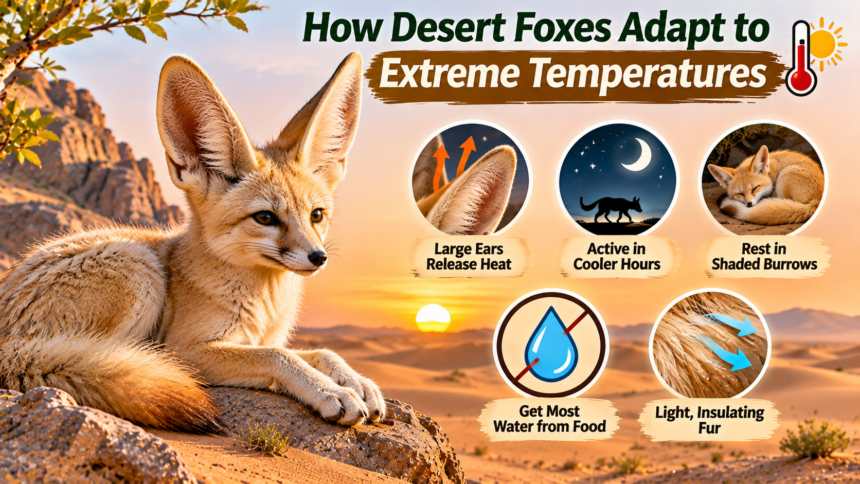
How Desert Foxes Adapt Extreme Temperatures Amazing Adaptations That Help Them Thrive
Deserts are some of the toughest places for animals to live. During the day, temperatures can become extremely high, while nights may be surprisingly cold. Water is often difficult to find, food can be limited, and strong sunlight makes survival even more challenging. Yet, several animals have developed special features that allow them to live in these harsh conditions.
- 1. Large Ears Help Desert Foxes Release Body Heat
- 2. Thick Fur Protects Them from Both Heat and Cold
- 3. Fur-Covered Paws Protect Their Feet from Hot Sand
- 4. Living in Underground Burrows Helps Them Escape the Heat
- 5. Being Active at Night Helps Them Avoid Extreme Heat
- 6. Desert Foxes Can Survive with Very Little Drinking Water
- 7. Their Diet Helps Them Survive When Food Is Limited
- 8. Their Sandy Colour Helps Them Blend into the Desert
- 9. Strong Senses Help Desert Foxes Find Food in the Dark
- 10. Small Body Size Helps Them Manage Desert Resources
- 11. Different Desert Foxes Have Different Adaptations
- 12. Threats That Make Desert Survival More Difficult
- 13. How People Can Help Protect Desert Foxes
- Conclusion: Desert Foxes Are Masters of Survival
- Frequently Asked Questions (FAQs)
One excellent example is the desert fox. With its sharp senses, thick fur, large ears, and clever lifestyle, this small mammal has developed remarkable ways to deal with extreme temperatures.
Desert foxes are not all the same species. The name is commonly used for foxes that live in dry environments, including the fennec fox, found across parts of North Africa and the Arabian Peninsula, and Rüppell’s fox, which lives in desert and semi-desert areas of the Middle East and North Africa. Both species have physical and behavioural adaptations that help them survive heat and limited water.
These adaptations are not limited to one body feature. Their ears, paws, fur, kidneys, feeding habits, and daily activities work together to help them manage difficult weather conditions.
This article explores how desert foxes adapt to extreme temperatures, including their special body features, water-saving methods, underground shelters, feeding habits, and the challenges they face as desert environments change.
1. Large Ears Help Desert Foxes Release Body Heat
One of the most noticeable features of a desert fox, especially the fennec fox, is its large ears.
At first, these ears may look unusual compared with those of other foxes. However, they have an important purpose. They help the animal detect sounds and can also play a role in controlling body temperature.
Their large ears, which can grow up to 6 inches long, contain many tiny blood vessels. These blood vessels widen to release extra body heat into the cooler air, helping them stay cool in hot weather.
The ears contain many small blood vessels close to the skin. When the surrounding air is cooler than the fox’s body, heat can move from the blood through the ear surface and into the air. This helps the animal release some excess body heat.
Large ears also give desert foxes an excellent sense of hearing. They can detect small movements and sounds made by insects, rodents, and other animals hiding in the sand.
The main benefits of large ears include:
- Helping release excess body heat under suitable conditions.
- Detecting prey moving under sand or among dry plants.
- Listening for possible dangers nearby.
- Improving awareness of the surrounding environment.
However, large ears are not a complete solution to extreme heat. When the air itself becomes very hot, they may not release heat as effectively. This is why desert foxes also depend on shade, burrows, and resting during the hottest parts of the day.
2. Thick Fur Protects Them from Both Heat and Cold
It may seem strange that an animal living in a hot desert has thick fur. However, this feature helps desert foxes survive both hot days and cold nights.
The fur acts as a layer of insulation between the animal’s body and the outside environment. During the day, it helps reduce the direct effect of strong sunlight on the skin. At night, when desert temperatures fall, it helps the fox retain body warmth.
Fennec foxes have long, soft fur that is usually cream, sandy, or pale in colour. Their thick coat provides protection against changes in temperature throughout the day and night.
Rüppell’s foxes also have fur suited to dry environments, with a sandy or greyish coat depending on the individual and habitat.
This natural insulation helps desert foxes avoid losing too much body heat during cold periods while providing protection from direct sunlight.
3. Fur-Covered Paws Protect Their Feet from Hot Sand
Desert sand can become extremely hot under direct sunlight. For animals that regularly walk across dunes and rocky ground, protecting their feet is important.
Fennec foxes have thick fur on the bottoms of their paws. This fur acts as a protective covering between their footpads and the hot ground.
It also provides better grip when they move across loose sand.
Fur-covered paws offer several benefits:
- Protecting the feet from hot sand.
- Helping the fox move across soft desert surfaces.
- Providing grip while running and digging.
- Reducing direct contact between the footpads and rough ground.
This small but useful adaptation allows the fox to travel across its habitat without relying on completely smooth or shaded surfaces.
It is a good example of how even the smallest body features can make a difference in a difficult environment.
4. Living in Underground Burrows Helps Them Escape the Heat
One of the most effective ways desert foxes avoid extreme daytime temperatures is by staying underground.
Fennec foxes spend much of the day resting inside burrows that they dig in sandy areas. These underground shelters protect them from direct sunlight, strong winds, and high surface temperatures.
The temperature underground is often more stable than the temperature on the open desert surface. This allows the fox to rest in a more protected environment.
Burrows may also provide safety from predators and a secure place for females to raise their young.
Some fennec fox dens contain connected tunnels and more than one entrance. These openings can provide different ways to enter or leave the shelter when necessary. The Smithsonian’s National Zoo reports that fennec burrow systems can extend for considerable distances.
Underground shelters help desert foxes:
- Avoid the strongest daytime sunlight.
- Rest in cooler and more stable conditions.
- Reduce exposure to hot winds.
- Stay protected from some predators.
- Raise their young in a sheltered environment.
Burrowing is therefore one of the most important behavioural adaptations for desert survival.
5. Being Active at Night Helps Them Avoid Extreme Heat
Another important adaptation is the time when desert foxes become active.
Many desert foxes are mainly nocturnal, meaning they are most active at night. Instead of spending long periods searching for food under the strong daytime sun, they usually rest in their shelters and become active after sunset.
Night-time temperatures are generally lower than daytime temperatures. This makes travelling, hunting, and searching for food less stressful.
During the night, desert foxes may:
- Search for insects and small animals.
- Hunt rodents and lizards.
- Find fruits, roots, and other plant materials.
- Explore their surroundings.
- Move between feeding areas.
Some foxes may also be active during the early morning or evening, when the sun is less intense.
This behaviour helps reduce exposure to extreme heat and can also lower water loss. Spending the hottest hours inside a burrow allows the animal to save energy and avoid unnecessary movement.
6. Desert Foxes Can Survive with Very Little Drinking Water
Water is one of the most valuable resources in a desert. Unlike animals living near rivers, lakes, or forests, desert foxes cannot always depend on finding open water.
Fortunately, they have adaptations that help them manage limited water supplies.
Fennec foxes can obtain much of the moisture they need from their food. Small animals, insects, fruits, and other food sources contain water that helps support their bodies.
Instead of depending on water sources, they get most of the water they need from their food.
They have two main ways of getting water:
- Water from Food: They eat insects, lizards, small rodents, birds, and desert plants. These foods contain natural moisture that helps meet most of their daily water needs.
- Metabolic Water: Their bodies also produce a small amount of water naturally when they digest food and turn it into energy. This helps them survive in dry desert areas where water is difficult to find.
Their kidneys are also efficient at conserving water. Research into desert fox physiology has found that fennecs have specialised water-saving abilities, including producing highly concentrated urine. This helps reduce the amount of water lost from the body.
Some useful water-saving adaptations include:
- Obtaining moisture from food.
- Producing concentrated urine.
- Reducing unnecessary water loss.
- Limiting activity during the hottest hours.
- Resting in protected underground shelters.
This does not mean desert foxes never need water. Their needs depend on weather, food availability, activity, and other conditions. Their adaptations simply help them survive when fresh water is difficult to find.
7. Their Diet Helps Them Survive When Food Is Limited
Finding food in the desert can be difficult because plants and small animals are not available everywhere. Desert foxes deal with this challenge by eating different types of food.
Fennec foxes are omnivorous, meaning they eat both animal and plant matter. Their diet can change according to the season and what is available.
They may eat:
- Insects such as grasshoppers and beetles.
- Small rodents.
- Lizards and other reptiles.
- Birds and eggs.
- Fruits and berries.
- Roots and other plant materials.
Rüppell’s foxes also have a varied diet and can feed on small animals, insects, and plant material. This flexible diet is useful in dry environments where food sources may change throughout the year.
Eating fruits and other moisture-rich foods can also provide some of the water needed by their bodies.
By using different food sources, desert foxes are better able to survive periods when their preferred prey is difficult to find.
8. Their Sandy Colour Helps Them Blend into the Desert
The colour of a desert fox’s fur is another important feature that supports survival.
Many desert foxes have sandy, cream, or light brown coats. These colours help them blend into dunes, dry soil, and rocky surroundings. This is known as camouflage.
Camouflage is useful because it makes the animal less noticeable to predators and helps it approach small prey without being easily detected.
For example, a fennec fox’s pale coat blends well with sandy environments. Rüppell’s fox also has a sandy-coloured coat, although some individuals may appear greyer in rocky areas.
Camouflage provides several advantages:
- Making it harder for predators to spot them.
- Helping them approach prey quietly.
- Supporting safer movement through open areas.
- Reducing the chance of being noticed while resting.
Their natural colouring is an example of how desert animals develop features that suit their surroundings.
9. Strong Senses Help Desert Foxes Find Food in the Dark
Searching for food in a desert at night requires excellent senses. Many small animals hide under the sand, inside burrows, or among dry plants.
Desert foxes use their hearing and eyesight to detect possible prey.
The large ears of fennec foxes are especially useful because they can pick up faint sounds. A fox may hear insects moving or small animals digging beneath the ground.
Once it detects a possible food source, it can use its front paws to dig and uncover prey.
Their eyes are also suited to activity in low-light conditions, allowing them to move and search for food at night.
Strong senses help desert foxes:
- Detect insects and rodents.
- Notice movement in the surrounding area.
- Identify possible danger.
- Find food in low-light conditions.
- Navigate through difficult terrain.
These abilities are particularly valuable because desert nights can still be dark and food may be hidden beneath the surface.
10. Small Body Size Helps Them Manage Desert Resources
Many desert foxes are relatively small animals. The fennec fox is the smallest member of the dog family, also known as Canidae.
A small body needs less total food and energy than a much larger animal. This can be useful in deserts where resources are limited.
Small size also gives animals a relatively high surface area compared with their body volume. This can help heat exchange under suitable conditions, although body size alone does not determine how well an animal handles extreme temperatures.
The fennec fox also combines its small body with large ears, fur-covered feet, burrowing behaviour, and efficient water use.
Research comparing desert foxes with species from less dry environments has found differences in water loss and other physiological features linked to desert living.
Together, these adaptations help desert foxes manage limited food, water, and energy.
11. Different Desert Foxes Have Different Adaptations
It is important to understand that all desert foxes do not have exactly the same features. Their adaptations depend on their species, habitats, and local weather conditions.
Two useful examples are the fennec fox and Rüppell’s fox.
Fennec fox:
- Very large ears compared with its body size.
- Thick, pale fur.
- Fur-covered paws.
- Nocturnal activity.
- Underground burrows.
- Strong ability to conserve water.
Rüppell’s fox:
- Sandy or greyish fur that blends into dry environments.
- Large ears that support hearing and heat exchange.
- Fur-covered footpads.
- Mainly nocturnal behaviour.
- A flexible diet.
- An ability to live in desert, rocky, and semi-desert habitats.
The Rüppell’s fox is found across parts of North Africa and the Arabian Peninsula, while the fennec fox occurs across North Africa and extends into parts of the Arabian Peninsula.
These examples show that different fox species can develop similar solutions to the challenges of living in dry environments.
12. Threats That Make Desert Survival More Difficult
Although desert foxes are naturally adapted to harsh conditions, they are not protected from every environmental threat.
Human activities and changes in the natural environment can make survival more difficult.
Some important threats include:
Habitat loss: Roads, buildings, mining, and other development can damage natural shelters and feeding areas.
Road accidents: Foxes may cross roads at night and get hit by vehicles.
Food shortages: Changes in natural habitats can reduce the number of insects, rodents, and other prey animals.
Poisoning: Chemicals placed to control pests or predators can harm foxes when they eat contaminated animals.
Illegal capture: Some small foxes are captured for the exotic pet trade, which can affect wild populations.
Climate change: Increasing temperatures, changing rainfall, and longer dry periods may affect food availability and suitable habitats.
In Saudi Arabia, the National Center for Wildlife lists Rüppell’s sand fox and Arabian red fox among the animals found in several protected landscapes. These areas help maintain habitats where desert wildlife can continue to survive.
Protecting desert foxes therefore requires more than understanding their physical adaptations. It also requires protecting the natural environments on which they depend.
13. How People Can Help Protect Desert Foxes
Wildlife protection is a shared responsibility. Governments and conservation organisations play important roles, but local communities and visitors can also help.
Some useful actions include:
- Avoid disturbing foxes or their burrows.
- Never feed wild foxes.
- Do not leave food waste in natural areas.
- Drive carefully on roads passing through wildlife habitats.
- Report injured or trapped animals to authorised wildlife authorities.
- Avoid buying wild-caught exotic animals.
- Support protected areas and responsible wildlife tourism.
- Teach children about desert animals and their importance.
Visitors should observe wild animals from a safe distance and never attempt to touch, chase, or take them home.
These simple actions can help reduce unnecessary pressure on desert wildlife.
Conclusion: Desert Foxes Are Masters of Survival
Desert foxes are remarkable examples of how animals adapt to difficult environments. Their large ears, protective fur, fur-covered paws, underground burrows, nocturnal habits, and water-saving abilities allow them to survive in places where temperatures can change dramatically.
Fennec foxes and Rüppell’s foxes show how different species can use a combination of physical features and behaviour to manage heat, find food, and conserve water.
However, natural adaptations alone cannot protect them from habitat destruction, road accidents, poisoning, and climate change. Their future also depends on healthy ecosystems and responsible human activities.
Understanding how desert foxes survive helps us appreciate the value of wildlife and the natural processes that support life in dry environments.
Desert foxes are not just small animals living in the sand. They are remarkable survivors whose special adaptations show the power of nature and the importance of protecting desert ecosystems.
Frequently Asked Questions (FAQs)
1. How do desert foxes Adapt extreme Temperatures?
Desert foxes use several adaptations, including large ears, protective fur, underground burrows, and nocturnal activity. These features help them avoid direct sunlight, manage body heat, and conserve water.
2. Why do fennec foxes have such large ears?
Their large ears help them detect sounds made by insects and small animals. They also help release excess body heat when surrounding air conditions allow.
3. Do desert foxes sleep during the day?
Many desert foxes, including fennec foxes, spend much of the day resting in underground burrows. They usually become active during the evening and night when temperatures are lower.
4. How do desert foxes protect their feet from hot sand?
Fennec foxes have thick fur on the bottoms of their paws. This helps protect their footpads from hot sand and gives them better grip when moving across loose ground.
5. How do desert foxes survive without drinking much water?
They obtain moisture from their food and have efficient kidneys that help reduce water loss. Their underground shelters and lower activity during hot hours also help conserve water.
6. What do desert foxes eat?
Their diet may include insects, rodents, lizards, birds, eggs, fruits, roots, and other available food. The exact diet depends on the species and its habitat.
7. Can desert foxes survive cold desert nights?
Yes. Their thick fur helps keep them warm when temperatures fall after sunset. Underground burrows also provide shelter from cold winds.
8. Which desert fox has the largest ears?
The fennec fox is especially famous for its very large ears relative to its body size. These ears help with hearing and heat exchange.
9. Are desert foxes found in the Arabian Peninsula?
Yes. Rüppell’s fox and fennec fox occur in parts of the Arabian Peninsula. Arabian red foxes are also found in several habitats across the region.
10. What are the main threats to desert foxes?
The main threats include habitat loss, road accidents, poisoning, illegal capture, reduced food availability, and climate change.
Do follow us on Instagram
Read More – Why Vultures Are Important to Desert Ecosystems