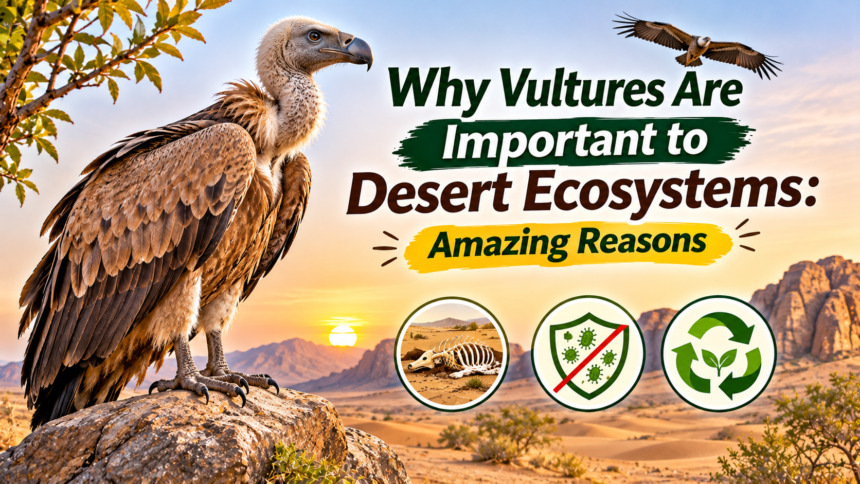
Why Vultures Are Important to Desert Ecosystems: 10 Reasons We Must Protect These Birds
When people think about desert wildlife, they often imagine camels, foxes, snakes, and eagles. However, there is another group of birds that plays an equally important role in keeping desert environments healthy that is vultures.
- 1. What Are Vultures and Where Do They Live?
- 2. Vultures Act as Nature’s Cleanup Crew
- 3. Vultures Help Maintain the Natural Food Chain
- 4. Vultures Can Help Limit the Spread of Disease
- 5. Important Vulture Species Found in the Arabian Peninsula
- 6. Why Vultures Are Especially Important in Desert Environments
- 7. The Challenges Facing Vultures in the Arabian Peninsula
- 8. How Saudi Arabia Is Working to Protect Vultures
- 9. Conservation Efforts in the UAE and Oman
- 10. How People Can Help Protect Desert Vultures
- 11. The Future of Vultures in Desert Ecosystems
- Conclusion: Protecting Vultures Means Protecting Desert Nature
- Frequently Asked Questions (FAQs)
Vultures are large birds that mainly feed on dead animals. Although they are sometimes misunderstood because of their feeding habits and appearance, they perform an important job in nature. By eating animal remains, they help remove dead matter from the environment and return nutrients to the natural food cycle.
In desert ecosystems, where food and water can be limited and animal remains may stay exposed to heat for long periods, scavenging birds are an important part of the natural balance.
Countries across the Arabian Peninsula, including Saudi Arabia, Oman, and the UAE, provide habitats for different vulture species. The Egyptian vulture, lappet-faced vulture, and griffon vulture are among the birds found in the region.
However, habitat changes, poisoning, hunting, power-line accidents, and changes in food availability are creating challenges for these birds.
This article explores why vultures are important to desert ecosystems, how they help nature, the species found in the Arabian Peninsula, the threats they face, and the conservation work being carried out to protect them.
1. What Are Vultures and Where Do They Live?
Vultures are large scavenging birds that mainly feed on the remains of dead animals, known as carrion. They belong to two different bird groups: Old World vultures, found across Africa, Europe, and Asia, and New World vultures, found in the Americas.
They have strong hooked beaks that help them tear meat and broad wings that allow them to travel long distances while searching for food.
Most vultures have excellent eyesight. They can fly high above the ground and search large areas for animal remains. Some species also follow other birds or animals to locate food.
Their common features include:
- Large wings that help them glide over long distances.
- Strong, hooked beaks for tearing food.
- Sharp eyesight for spotting food from the air.
- Strong feet for standing and moving around feeding areas.
- Bare or lightly feathered heads in many species.
Vultures live in different environments, including mountains, grasslands, rocky areas, open plains, and deserts.
In the Arabian Peninsula, they are especially important because the region contains large dry landscapes and open habitats where scavenging birds can search for food over wide areas.
2. Vultures Act as Nature’s Cleanup Crew
One of the most important roles of vultures is removing dead animals from the environment.
In nature, animals die for many reasons. Some die from old age, disease, injuries, hunger, or attacks by predators. Their bodies eventually become part of the natural food cycle.
Vultures help by finding and eating these remains. Their strong beaks allow them to feed on parts of carcasses that many other animals cannot easily access.
This process is especially useful in open desert landscapes, where dead animals may remain exposed to sunlight and heat.
By consuming animal remains, vultures help:
- Remove dead organic matter from the environment.
- Reduce the time carcasses remain exposed.
- Provide food for other living organisms through the natural food cycle.
- Support the movement of nutrients through ecosystems.
- Limit the build-up of animal remains in feeding areas.
Different scavengers perform different jobs. Some birds feed on smaller remains, while larger vultures can handle bigger carcasses.
This makes them valuable members of the desert ecosystem.
3. Vultures Help Maintain the Natural Food Chain
Every species has a role in its ecosystem. Predators control prey populations, herbivores feed on plants, and decomposers break down dead organic material.
Vultures are part of this system because they feed on animals that have already died.
Their feeding activity connects different parts of the food chain. Instead of allowing all animal remains to stay unused, vultures consume them and help return their nutrients to the environment.
For example, when a gazelle dies in a desert habitat, vultures may locate the carcass and begin feeding. Other scavengers and decomposers can also benefit from what remains.
This creates a natural process in which animal remains become part of the wider ecosystem again.
It is important to remember that vultures do not work alone. Bacteria, insects, other birds, and mammals also help break down dead matter.
Together, these organisms support the natural recycling process that keeps ecosystems functioning.
4. Vultures Can Help Limit the Spread of Disease
Dead animals can become a source of harmful bacteria and other organisms, particularly when their remains are left exposed for long periods.
Vultures can help by consuming carcasses relatively quickly. Their feeding activity may reduce the time available for some other scavengers to access the remains.
This can be useful because certain animals, including feral dogs and other mammals, may carry diseases that can spread between animals and sometimes affect people.
Vultures have strong digestive systems that allow them to consume food that could be dangerous to many other animals.
Deserts are harsh places where dead animals can spread diseases and attract harmful pests. Vultures play an important role in keeping the environment clean and healthy. Their bodies are specially designed to eat dead animals without getting sick.
- Strong Stomach Acid: Vultures have very strong stomach acid that helps them digest rotten meat containing harmful germs and bacteria. This allows them to eat infected animals without becoming sick.
- Stopping the Spread of Diseases: When vultures eat dead animals carrying diseases, their strong digestive system destroys many harmful germs. This helps prevent diseases from spreading to other animals and reduces health risks for humans.
However, their role in disease control should not be exaggerated. Scientific research shows that the effects of vultures on disease transmission depend on the ecosystem, the species involved, and the conditions surrounding a carcass. They are an important part of natural waste removal, but they cannot replace proper waste management or disease-control measures.
Their presence can therefore support a healthier natural environment, even though the exact health benefits vary between locations.
5. Important Vulture Species Found in the Arabian Peninsula
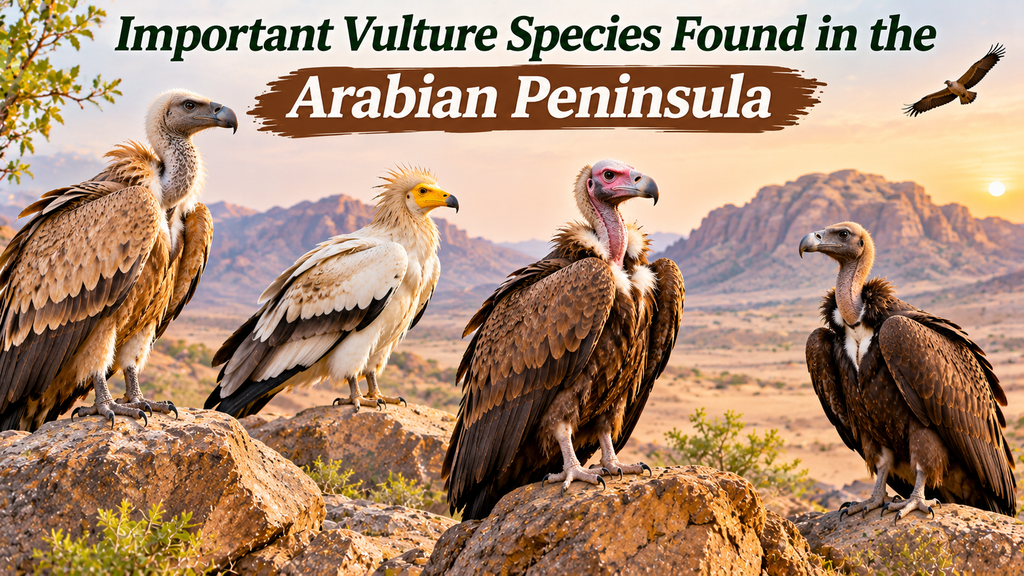
The Arabian Peninsula is home to several important scavenging bird species. Their habitats include mountains, open plains, rocky areas, and desert landscapes.
Some well-known examples include:
Egyptian Vulture: Also called Al Rakhmah locally in the UAE, this bird has pale feathers and a yellow face. It has a varied diet that includes animal remains, waste, insects, eggs, and other food sources. It is classified as Endangered.
Lappet-Faced Vulture: This is one of the largest vulture species found in Arabia. It has a powerful bill that helps it open tough carcasses. It is classified as Endangered and is found in Saudi Arabia and other parts of the region.
Griffon Vulture: This large bird has broad wings and often searches for food across open landscapes. It can travel long distances while looking for animal remains. It has been recorded in Saudi Arabia’s protected areas.
Bearded Vulture: Unlike most vultures, this species is known for feeding heavily on bones. It is associated with mountainous environments and has been recorded in the Arabian Peninsula.
Each species has different feeding habits and habitat needs. Protecting this diversity is important for maintaining healthy wildlife populations across the region.
6. Why Vultures Are Especially Important in Desert Environments
Deserts may appear empty at first glance, but they contain complex ecosystems. Many animals survive in difficult conditions by adapting to limited food, extreme temperatures, and a shortage of water.
When an animal dies in a desert, its remains become a food source for scavengers. Vultures are well suited to finding these food sources because they can travel across large areas without using much energy.
Their broad wings allow them to glide using rising warm air, called thermals. This helps them search for food over long distances.
Vultures are particularly useful in desert landscapes because:
- Food may be spread across large areas.
- Animal remains can be difficult to locate from the ground.
- Large carcasses provide food for several scavengers.
- Long-distance flight allows birds to search wide habitats.
- Their feeding helps move nutrients through the ecosystem.
They also form part of a wider network of wildlife. Their presence reflects the availability of food, suitable habitats, and places where birds can rest and breed.
When vulture populations decline, it can be a warning that the ecosystem is facing environmental pressure.
7. The Challenges Facing Vultures in the Arabian Peninsula
Although parts of the Arabian Peninsula remain important for vultures, these birds face several challenges.
Some of the biggest threats include:
Poisoning: Poisoned carcasses can kill vultures that feed on them. This is one of the most serious threats because several birds may feed on the same carcass.
Power-line accidents: Vultures can be electrocuted when they land on unsafe electrical structures or collide with power lines.
Loss of food: Changes in livestock farming, waste management, and the availability of safe animal remains can reduce food sources.
Habitat disturbance: Construction, quarrying, human activity, and damage to nesting areas can affect where vultures live and reproduce.
Illegal hunting: Some birds are killed through hunting or captured for trade.
Food contamination: Carcasses containing toxic chemicals, medicines, or lead from ammunition may poison scavenging birds.
Nature Middle East has highlighted poisoning, electrocution, declining food supplies, and changes in waste management as important conservation concerns for vultures in the Arabian Peninsula.
These threats show why conservation needs to focus on food safety, habitat protection, and responsible infrastructure development.
8. How Saudi Arabia Is Working to Protect Vultures
Saudi Arabia is an important country for vulture conservation because it contains large natural landscapes and protected areas that support different scavenging bird species.
The King Salman bin Abdulaziz Royal Reserve is one example. In September 2024, the Saudi Press Agency reported that the reserve recorded more than 310 vultures across the species included in its survey. The report identified 35 lappet-faced vultures and around 200 griffon vultures.
The reserve’s conservation activities include:
- Protecting natural habitats.
- Reducing illegal hunting.
- Improving electrical infrastructure to lower electrocution risks.
- Ensuring that available carcasses are not contaminated with harmful substances.
- Monitoring wildlife populations.
- Supporting biodiversity restoration.
AlUla is also becoming an important centre for vulture research.
A Saudi Press Agency report in September 2026 stated that field monitoring in AlUla regularly recorded between 20 and 30 lappet-faced vultures, along with four breeding pairs during the current season.
The Royal Commission for AlUla, working with King Abdullah University of Science and Technology, has also introduced GPS tracking to study the birds’ movements, behaviour, and potential threats.
These programmes show how research and habitat protection can work together to support vulture populations.
9. Conservation Efforts in the UAE and Oman
Other countries in the Arabian Peninsula are also taking steps to protect vultures.
UAE: Monitoring Egyptian Vultures
The Environment Agency – Abu Dhabi monitors the Egyptian vulture population in the emirate.
According to the agency, the species is found in Abu Dhabi at Jabal Hafit, where it regularly monitors this small but important population.
Since 2016, the agency has used satellite tracking to study four Egyptian vultures and understand their movements and use of the area.
The agency also identifies collisions with power lines, hunting, poisoning, and lack of food networks as important threats.
Oman: Research and Community Awareness
Oman is home to several resident and migratory birds of prey, including Egyptian vultures and lappet-faced vultures.
The Environment Society of Oman started its Raptor Research and Conservation Programme in 2012. Its work includes studying bird populations, sharing scientific information, encouraging public awareness, and supporting conservation action.
The organisation also highlights threats such as poisoning, power-line accidents, habitat degradation, and food shortages.
These efforts are important because vultures can travel across borders. Protecting them requires cooperation between countries and conservation organisations.
10. How People Can Help Protect Desert Vultures
Vulture conservation is not only the responsibility of wildlife experts and government organisations. Local communities, farmers, businesses, tourists, and individuals can also help.
Simple actions can make a difference.
- Never use poison against wildlife: Poisoned carcasses can kill many scavenging birds.
- Report injured birds: Contact authorised wildlife rescue or environmental authorities.
- Protect nesting areas: Avoid disturbing birds during their breeding season.
- Dispose of waste responsibly: Do not leave contaminated animal remains in open areas.
- Support wildlife research: Encourage conservation projects and responsible monitoring.
- Spread awareness: Help others understand the importance of vultures.
- Respect protected areas: Follow environmental rules when visiting natural habitats.
- Support safe infrastructure: Encourage bird-friendly power-line designs and maintenance.
Farmers and livestock owners can also work with conservation authorities to reduce conflict and manage animal remains safely.
When local communities understand the role of vultures, they are more likely to support their protection.
11. The Future of Vultures in Desert Ecosystems
The future of vultures in the Arabian Peninsula will depend on how well countries balance development with wildlife protection.
Vultures play an important role in keeping desert environments clean. They are nature’s natural cleaners because they feed on dead animals. In deserts, where temperatures are very high and resources are limited, removing dead animals quickly helps keep the environment healthy and maintain the natural balance.
New roads, buildings, power networks, and waste facilities can affect bird populations if they are not planned carefully. However, these developments can also be designed to reduce risks.
Future conservation work may focus on:
- More detailed monitoring of vulture populations.
- GPS tracking and camera-based research.
- Safer power-line structures.
- Protection of nesting and feeding areas.
- Better management of animal remains.
- Public education and community involvement.
- Cooperation between countries across the Arabian Peninsula.
The recent monitoring and tracking work in AlUla, along with Egyptian vulture monitoring in Abu Dhabi and research programmes in Oman, offers encouraging examples.
However, conservation must continue over the long term. Protecting a few birds today is not enough; the goal is to maintain healthy populations that can reproduce and survive in their natural habitats.
Conclusion: Protecting Vultures Means Protecting Desert Nature
Vultures may not always receive the attention given to larger and more attractive animals, but their role in desert ecosystems is extremely important. By feeding on dead animals, they help remove organic remains, support nutrient recycling, and contribute to the natural balance of the environment.
The Arabian Peninsula is home to important vulture species, including Egyptian vultures, lappet-faced vultures, and griffon vultures. However, poisoning, power-line accidents, habitat disturbance, and changes in food availability continue to create challenges.
Conservation programmes in Saudi Arabia, the UAE, and Oman show that research, habitat protection, safe food sources, and public awareness can support these birds.
Their protection also helps preserve the wider desert environment, including the animals and plants that share their habitats.
Vultures are not simply birds that feed on dead animals. They are important workers of nature, helping keep ecosystems functioning. Protecting them means protecting the natural balance of our deserts for future generations.
Frequently Asked Questions (FAQs)
1. Why are vultures are important to desert ecosystems?
Vultures help remove dead animal remains, support nutrient recycling, and contribute to the natural food cycle. They are an important part of desert biodiversity.
2. What do vultures eat?
Most vultures mainly eat dead animals, known as carrion. Some species also eat insects, eggs, waste, and other food sources.
3. Which vultures are found in the Arabian Peninsula?
Important species include the Egyptian vulture, lappet-faced vulture, griffon vulture, and bearded vulture.
4. How do vultures help keep the environment clean?
They feed on animal remains, helping remove organic matter from the environment and reducing the time carcasses remain exposed.
5. Are vultures dangerous to humans?
Vultures generally avoid people and do not normally hunt healthy humans or animals. They mainly feed on dead animals and pose little direct threat to people.
6. Why are vultures important for disease control?
By consuming carcasses, vultures may reduce opportunities for some other scavengers to feed on them. This can help limit certain disease pathways, although the benefits depend on local conditions.
7. What are the main threats to vultures?
Major threats include poisoning, hunting, electrocution, collisions with power lines, food shortages, and loss of suitable habitats.
8. How is Saudi Arabia protecting vultures?
Saudi Arabia is supporting conservation through protected areas, wildlife monitoring, anti-poaching measures, GPS tracking, and efforts to reduce poisoning and power-line risks.
9. Which vulture is monitored at Jabal Hafit in the UAE?
The Environment Agency – Abu Dhabi regularly monitors the Egyptian vulture at Jabal Hafit and has used satellite tracking to study its movements.
10. How can people help protect vultures?
People can avoid poisoning wildlife, report injured birds, respect protected habitats, dispose of waste properly, support conservation organisations, and spread awareness about their ecological role.
Do follow us on Instagram
Read More – The Asiatic Cheetah