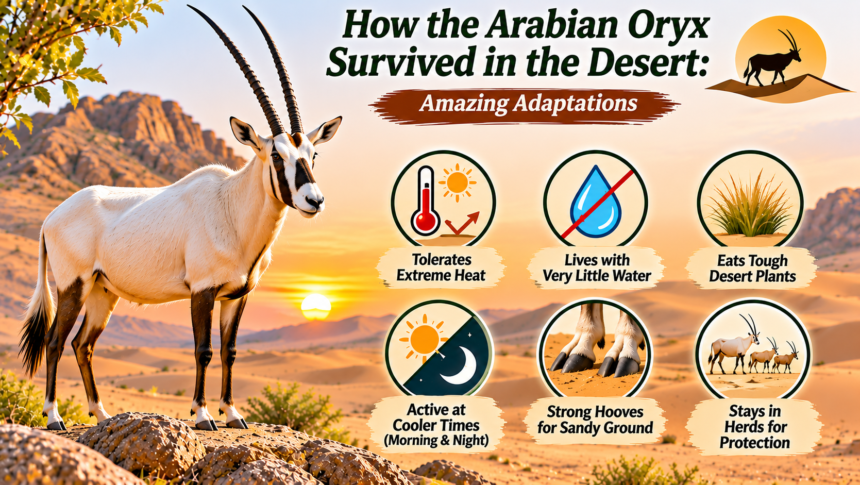
How the Arabian Oryx Survived in the Desert Amazing Adaptations That Make It a Desert Survivor
The Arabian desert is one of the most challenging places for wildlife. During summer, temperatures can become extremely high, rainfall is limited, and fresh water is difficult to find. Food is also not always available, especially during long dry periods. Yet, some animals have developed remarkable ways to survive these conditions. One of the best examples is the Arabian oryx.
- 1. A White Coat Helps the Arabian Oryx Manage Extreme Heat
- 2. A Special Body System Helps Keep Its Brain Cool
- 3. The Arabian Oryx Can Survive for Long Periods Without Drinking Water
- 4. It Changes Its Body Temperature to Save Water
- 5. Broad Hooves Help It Walk Across Soft Desert Sand
- 6. It Rests in the Shade During the Hottest Hours
- 7. Its Flexible Diet Helps It Survive When Food Is Limited
- 8. It Travels Long Distances to Find Fresh Food After Rain
- 9. Living in Groups Helps the Arabian Oryx Stay Safe
- 10. Long Horns Help Protect the Arabian Oryx
- 11. From Extinction in the Wild to a Conservation Success Story
- 12. How Saudi Arabia and the UAE Are Protecting the Arabian Oryx
- Conclusion: The Arabian Oryx Is a True Survivor of the Desert
- Frequently Asked Questions (FAQs)
The Arabian oryx is a beautiful desert antelope known for its bright white coat, long straight horns, and strong body. It lives in dry environments across the Arabian Peninsula, where it has developed special physical features and behaviours to deal with heat and water shortages.
Unlike animals that depend on regular access to rivers or lakes, the Arabian oryx can survive for long periods without drinking water directly. It gets much of the moisture it needs from desert plants and uses special body systems to reduce water loss.
However, its survival story is not only about natural adaptations. The Arabian oryx was once declared extinct in the wild because of excessive hunting. Later, captive breeding and reintroduction programmes helped bring it back to its natural environment.
Today, it is one of the most recognised wildlife conservation success stories in the Arabian Peninsula.
In this article, we explore how the Arabian oryx survived in the desert, including its heat-resistant body features, water-saving abilities, feeding habits, movement, and the conservation work that helped protect this remarkable animal.
1. A White Coat Helps the Arabian Oryx Manage Extreme Heat
One of the most noticeable features of the Arabian oryx is its bright white coat. This light colour is not just part of its appearance. It also helps the animal manage the strong sunlight found in desert environments.
Light-coloured fur reflects more sunlight than darker fur, helping reduce the amount of solar heat absorbed by the body. This is especially useful during the hottest hours of the day.
Its coat also provides insulation. Although insulation is often associated with cold weather, it can help reduce the transfer of heat between the outside environment and the animal’s body.
During cooler periods, the oryx can also benefit from its insulating coat, which helps it retain body warmth.
Other features of its appearance include:
- Dark markings around the face.
- Long, narrow horns.
- A strong body suited to travelling across dry land.
- Pale fur that blends into sandy surroundings.
The white coat is one of several adaptations that work together to help the Arabian oryx survive the harsh desert climate.
2. A Special Body System Helps Keep Its Brain Cool
One of the most interesting adaptations of the Arabian oryx is a special blood circulation system that helps protect its brain from extreme heat.
The animal has a network of blood vessels known as the carotid rete. This system is involved in a process called selective brain cooling.
In simple terms, blood returning from the cooler areas around the nasal passages can help cool blood travelling towards the brain. This allows the oryx to maintain a cooler brain temperature under certain hot and dry conditions.
Scientists have studied this adaptation in free-ranging Arabian oryx in Saudi Arabia. Research published in the Journal of Experimental Biology found evidence of selective brain cooling in these animals, particularly under dry environmental conditions.
This adaptation is important because the brain is sensitive to excessive heat. By helping regulate brain temperature, the oryx can cope better with difficult desert conditions.
How the “Nasal Air Conditioner” Works
The Arabian oryx has a special cooling system that helps keep its brain cool during extreme desert heat.
- Network of Blood Vessels: The carotid rete is a group of tiny blood vessels located near the brain and nasal passages. It helps control the temperature of the blood.
- The Cooling Process: When the oryx breathes in hot, dry air, moisture inside its nose evaporates. This helps cool the blood flowing through nearby veins.
- Protecting the Brain: Before hot blood reaches the brain, it passes through this network of blood vessels. The cooler blood helps remove heat from it, lowering its temperature by up to 3°C (5.4°F). This helps protect the brain from extreme heat.
It is a good example of how the body of a desert animal can develop specialised ways to manage extreme weather.
3. The Arabian Oryx Can Survive for Long Periods Without Drinking Water
Water is one of the most important resources for survival, but finding it can be difficult in the Arabian Desert. Some areas may go for long periods without rainfall or permanent water sources.
The Arabian oryx has developed an impressive ability to manage limited water supplies.
Instead of depending only on drinking water, it obtains much of its moisture from the plants it eats. Grasses, leaves, buds, and succulent roots can contain water that helps meet its needs.
It also has efficient internal systems that reduce unnecessary water loss.
Primary Sources of Water
The Arabian oryx gets most of the water it needs from desert plants instead of depending on water sources. It eats different types of plants that provide both food and moisture.
- Stipagrostis Grasses: These desert grasses are one of the oryx’s main food sources. It usually eats them at night or early in the morning when they contain moisture from dew.
- Wild Melons and Succulents: The oryx also eats wild melons and water-rich desert plants. These plants provide natural moisture and help keep its body hydrated.
- Underground Roots and Tubers: The oryx uses its strong hooves to dig into the ground and find roots and tubers. These underground plant parts contain water and nutrients that help it survive in dry conditions.
- Acacia Buds and Pods: It also feeds on young buds, flowers, and seed pods from Acacia trees. These provide extra moisture and nutrients, helping the oryx survive in the desert.
Research on free-ranging Arabian oryx in Saudi Arabia has shown that these animals can reduce water intake during dry periods by lowering water loss through breathing and other body processes, producing more concentrated urine, and reducing the amount of water lost in their waste.
Some of its important water-saving abilities include:
- Getting moisture from desert plants.
- Producing concentrated urine.
- Reducing water loss through evaporation.
- Producing relatively dry droppings.
- Adjusting activity during hot weather.
This does not mean the Arabian oryx never needs water. Its requirements depend on the weather, food availability, and physical condition. Its adaptations simply allow it to survive much longer when drinking water is difficult to find.
4. It Changes Its Body Temperature to Save Water
One of the most remarkable discoveries about the Arabian oryx is that it can allow its body temperature to change naturally during the day.
This ability is known as heterothermy.
Many mammals maintain a relatively stable internal temperature. However, research has shown that the Arabian oryx can allow its body temperature to rise during the hot daytime hours and cool again at night.
Why is this useful?
When the animal allows some heat to build up in its body during the day, it does not need to lose as much heat through sweating or other forms of evaporation.
As temperatures fall during the night, the stored heat can gradually leave the body.
This helps reduce the amount of water that would otherwise be needed for cooling.
A study of free-ranging Arabian oryx in Saudi Arabia found that daily body temperature changes became much greater during hot weather. Researchers concluded that this ability helps the animal manage water shortages in its natural habitat.
It is an excellent example of how the Arabian oryx manages heat without depending heavily on water.
5. Broad Hooves Help It Walk Across Soft Desert Sand
Desert surfaces can be difficult to travel across. Soft sand may cause an animal’s feet to sink, making movement more tiring.
The Arabian oryx has broad, rounded hooves that help it move across loose sand more easily. Its hooves spread its weight over a larger surface, improving support on soft ground.
This feature is useful because the oryx may need to travel long distances to find fresh food and suitable resting areas.
Its strong legs and sturdy body also help it move across rocky ground and dry plains.
Broad hooves offer several benefits:
- Better movement on soft sand.
- More support while walking across dry ground.
- Easier travel between feeding areas.
- Greater stability on uneven surfaces.
These features make the Arabian oryx well suited to the sandy and stony environments found across the Arabian Peninsula.
6. It Rests in the Shade During the Hottest Hours
The Arabian oryx does not remain active throughout the day when temperatures are extremely high. It changes its daily routine to avoid the strongest heat.
During very hot periods, it often rests in the shade of trees, shrubs, or other available shelter.
It is generally more active during cooler hours, especially early morning and late afternoon. In extremely hot conditions, it may also become active at night.
This behaviour is known as behavioural thermoregulation. It means an animal changes its activities or surroundings to control its body temperature.
The oryx may also use its front hooves to scrape a shallow depression in the ground. It can lie in this area, where the sand underneath the hot surface may be cooler.
These behaviours help it:
- Avoid direct sunlight.
- Reduce unnecessary movement during the hottest hours.
- Save energy.
- Rest in a more comfortable place.
- Reduce the need for evaporative cooling.
Studies of Arabian oryx in Saudi Arabia have recorded their use of shade and changes in activity during hot and dry periods.
7. Its Flexible Diet Helps It Survive When Food Is Limited
Finding food in the desert is not always easy. Rainfall may be irregular, and some plants may become dry or disappear during long periods without rain.
The Arabian oryx survives this challenge by eating different types of desert vegetation.
It is a herbivore, which means it eats plant material rather than meat. Its diet includes:
- Grasses.
- Leaves.
- Plant buds.
- Desert shrubs.
- Roots and underground tubers.
- Moisture-rich plants when available.
The animal can also make use of vegetation that is not especially rich in nutrients. This flexibility helps it survive when preferred food becomes scarce.
During dry periods, it may search for roots and underground plant parts that retain some moisture.
Its ability to eat different kinds of vegetation is important because desert food supplies change throughout the year.
By moving between feeding areas and using a variety of plants, the oryx increases its chances of finding enough food and moisture.
8. It Travels Long Distances to Find Fresh Food After Rain
Rainfall can completely change parts of a desert landscape. After rain, dry soil may produce fresh grasses, leaves, and other vegetation.
The Arabian oryx has an excellent ability to respond to these changes. It can travel across large areas in search of newly growing plants and better feeding conditions.
According to the Environment Agency – Abu Dhabi, the Arabian oryx can detect rainfall and fresh plant growth from as far as 90 kilometres. This is a reported wildlife fact rather than a fixed distance that applies in every situation.
Research also shows that Arabian oryx are highly mobile animals. They may travel farther after rainfall and reduce their movements during very hot and dry periods when shade becomes more important.
This movement helps them find:
- Fresh grasses after rainfall.
- New leaves and plant growth.
- Moisture-rich vegetation.
- Better feeding areas.
- Suitable places to rest.
Their ability to respond to changing weather conditions is one of the reasons they are so well adapted to desert life.
9. Living in Groups Helps the Arabian Oryx Stay Safe
Arabian oryx often live in small groups rather than spending all their time alone.
Living in a herd provides some protection because several animals can remain alert to their surroundings. If one animal notices danger, others may respond.
Groups also help young animals stay close to adults, which can offer additional protection.
Their social behaviour changes according to food availability and environmental conditions. When resources are limited, larger groups may break into smaller units, and some males may move over wider areas on their own.
Fauna & Flora reports that Arabian oryx herds can sometimes contain as many as 30 individuals, although smaller groups are common when conditions are less favourable.
Group living is not a direct solution to extreme heat, but it is another useful part of their survival strategy.
10. Long Horns Help Protect the Arabian Oryx
Both male and female Arabian oryx have long, straight or slightly curved horns. These horns are one of their most recognisable features.
They are mainly used in competition between animals, especially males during disputes over dominance and access to females.
The horns can also be used for defence against predators when necessary.
Other natural defence features include strong legs, good awareness of their surroundings, and the ability to move across open and difficult terrain.
Their horns do not directly protect them from heat, but they are an important part of their ability to survive in the wild.
The Arabian oryx’s combination of physical strength, environmental awareness, and herd behaviour helps it deal with the challenges of desert life.
11. From Extinction in the Wild to a Conservation Success Story
The Arabian oryx’s survival story is not only about adapting to nature. It is also about how humans helped save a species that was close to disappearing.
For many years, Arabian oryx were hunted for their meat and hides. The growing use of vehicles and modern weapons made hunting more effective. Habitat loss and disturbance added further pressure.
By 1972, the Arabian oryx had disappeared from the wild and was officially classified as Extinct in the Wild.
However, conservation organisations had already started work to save the remaining animals.
In 1962, Fauna & Flora launched Operation Oryx, an international effort that helped establish a captive breeding population known as the World Herd. These animals later became the foundation for reintroduction programmes.
In 1982, ten Arabian oryx were released into the wild in Oman. This was the beginning of a major recovery effort and an important moment in modern wildlife conservation.
The species was gradually reintroduced into protected areas in Oman, Saudi Arabia, the UAE, Jordan, and Israel.
In 2011, the IUCN reclassified the Arabian oryx from Extinct in the Wild to Vulnerable, recognising the progress made through conservation breeding and reintroduction.
This story demonstrates that even a species declared extinct in the wild can recover when long-term conservation work receives sufficient support.
12. How Saudi Arabia and the UAE Are Protecting the Arabian Oryx
Today, different countries in the Arabian Peninsula are working to protect the Arabian oryx through breeding programmes, protected areas, wildlife monitoring, and habitat restoration.
In the UAE, the Environment Agency – Abu Dhabi reports that the country is home to the world’s largest Arabian oryx population, with more than 6,900 individuals. It identifies areas such as the Arabian Oryx Protected Area and Qasr Al Sarab Protected Area as important locations for the species.
Saudi Arabia is also supporting the species through protected areas and reintroduction projects.
One example is the Shaybah Wildlife Sanctuary in the Empty Quarter. Aramco reports that the sanctuary recorded 351 Arabian oryx in 2025, alongside sand gazelles and red-necked ostriches. The project protects native habitats and limits threats such as hunting and disturbance.
These efforts are important because they protect not only the oryx but also the wider desert environment.
Conclusion: The Arabian Oryx Is a True Survivor of the Desert
The Arabian oryx is an excellent example of how wildlife can adapt to extreme environments. Its pale coat helps manage sunlight, its specialised blood circulation supports brain cooling, and its body can conserve water during long dry periods.
Its broad hooves help it walk across sand, while its flexible diet allows it to use different desert plants. It also changes its daily activities, rests in the shade, and travels across large areas when rainfall brings fresh vegetation.
However, natural adaptations alone were not enough to protect it from human threats. Hunting and habitat loss once pushed the species to extinction in the wild. Captive breeding, reintroduction, protected areas, and conservation partnerships helped bring it back.
Today, the Arabian oryx is a powerful example of what long-term wildlife protection can achieve.
The Arabian oryx is more than a beautiful desert antelope. It is a symbol of survival, adaptation, and conservation, reminding us why protecting the natural environment is important for future generations.
Frequently Asked Questions (FAQs)
1. How does the Arabian oryx survived in the desert?
The Arabian oryx survives through several adaptations, including its white coat, efficient water conservation, flexible diet, specialised cooling system, broad hooves, and ability to remain active during cooler hours.
2. Why does the Arabian oryx have a white coat?
Its pale coat reflects more sunlight than darker fur, helping reduce the amount of heat absorbed from the sun.
3. Can the Arabian oryx survive without drinking water?
Yes. It can survive for long periods without direct access to drinking water by obtaining moisture from desert plants and reducing water loss through its body.
4. What does the Arabian oryx eat?
It eats grasses, leaves, buds, shrubs, roots, and other desert plants. Its diet changes depending on what is available.
5. How does the Arabian oryx keep its brain cool?
It has a specialised blood circulation system called the carotid rete, which helps cool blood travelling towards the brain through heat exchange.
6. Why does the Arabian oryx rest during the day?
It rests in shade during very hot periods to reduce exposure to direct sunlight and avoid unnecessary heat and water loss.
7. How do Arabian oryx move across soft sand?
Their broad, rounded hooves spread their body weight over a larger surface, helping them travel across loose sand.
8. Why was the Arabian oryx declared extinct in the wild?
The main reasons were excessive hunting, habitat loss, and human disturbance. By 1972, no naturally surviving wild population remained.
9. Is the Arabian oryx still endangered?
The Arabian oryx is currently classified as Vulnerable on the IUCN Red List. Conservation programmes have helped restore populations, but continued protection is still necessary.
10. Where can Arabian oryx be found today?
Reintroduced populations can be found in countries including the UAE, Saudi Arabia, Oman, Jordan, and Israel, with different levels of protection and management.
Do follow us on Instagram
Read More – How Desert Foxes Adapt to Extreme Temperatures Amazing Facts