The Future of AI-Powered Infrastructure and Urban Planning in Gulf Cities
Cities across the Arabian Gulf are undergoing rapid transformation as governments invest in modern transportation networks, commercial districts, residential developments, utilities, and public facilities. From Dubai’s expanding urban landscape to Doha’s intelligent infrastructure projects, the complexity of managing modern cities is increasing. As urban populations grow and infrastructure systems become more interconnected, authorities are exploring technologies that could improve planning, maintenance, and operational efficiency.
- 1. What Are Digital Twins and How Do They Work in Smart Cities?
- 2. How Digital Twins Can Improve Infrastructure Maintenance and Reduce Costs
- 3. The Powerful Role of Digital Twins in Traffic and Transportation Management
- 4. How Gulf Cities Are Adopting Digital Twin Technology
- 5. Why Digital Twins Could Improve Sustainability and Climate Resilience
- 6. Challenges of Implementing Digital Twins Across Gulf Infrastructure
- 7. The Future of Digital Twins in Gulf Cities: Smarter Infrastructure Management
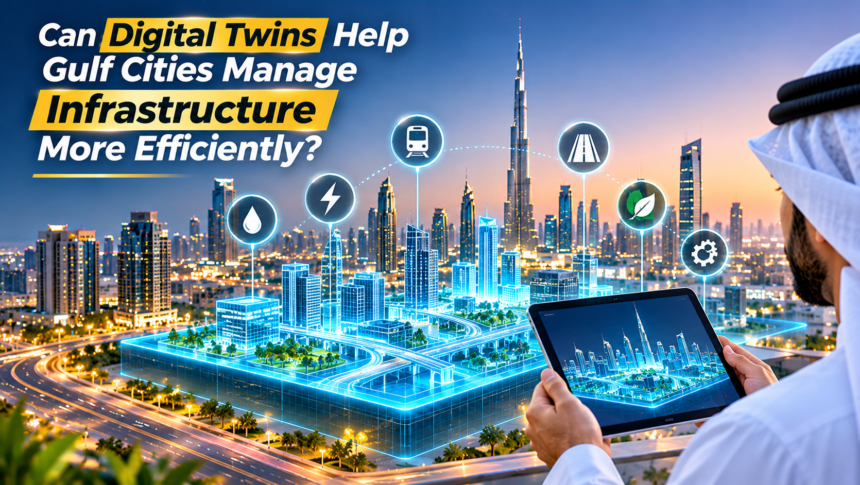
Digital twins in Gulf cities are emerging as a promising solution for managing infrastructure through virtual models connected to real-world information. These systems can help planners, engineers, and municipal authorities understand how physical assets operate, monitor their condition, and simulate potential changes before implementing them in the real environment.
Unlike conventional digital maps or architectural models, sophisticated digital twins can incorporate continuously updated information from sensors, infrastructure databases, and operational systems. This allows decision-makers to examine how roads, buildings, utilities, and other urban assets may respond to changing conditions.
The technology is particularly relevant to the Gulf Cooperation Council (GCC), where extreme temperatures, growing infrastructure networks, ambitious development projects, and sustainability objectives create significant management challenges.
Dubai and Qatar have already introduced initiatives involving digital twins and advanced infrastructure modelling. These developments demonstrate the region’s growing interest in using data and simulation to support urban management.
However, digital twins are not automatic solutions to every infrastructure problem. Their effectiveness depends on reliable information, appropriate technical design, cybersecurity, professional expertise, and the ability to translate digital insights into practical action.
Understanding the opportunities and limitations of this technology reveals how digital twins could influence the future of infrastructure management across Gulf cities.
1. What Are Digital Twins and How Do They Work in Smart Cities?
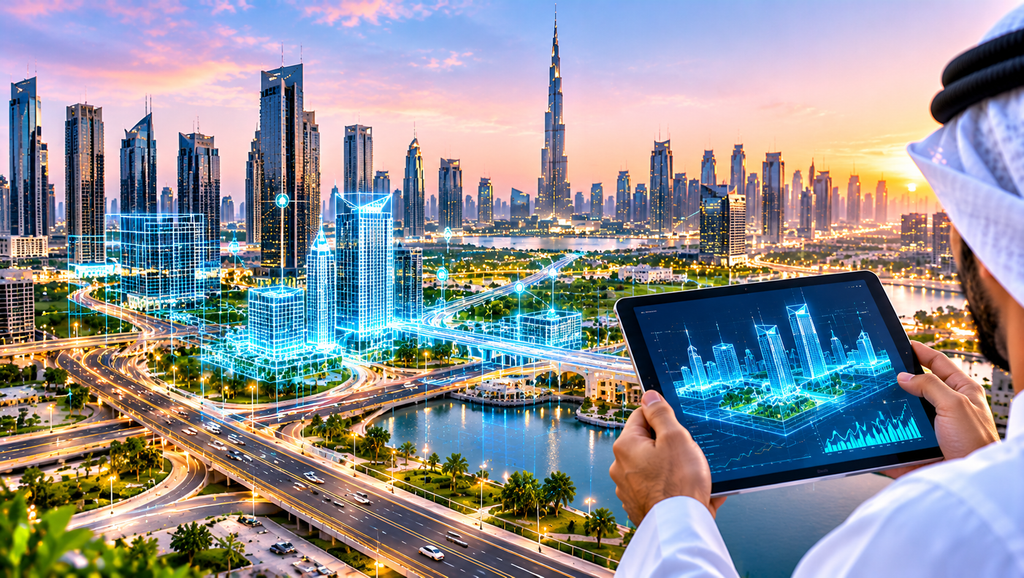
A digital twin is a virtual representation of a physical object, infrastructure asset, system, or process that can be connected to information about its real-world counterpart.
In urban environments, digital twins may represent individual buildings, transportation networks, water systems, bridges, or larger sections of a city.
Their primary purpose is to help users understand how physical systems operate and explore possible changes without immediately modifying real-world infrastructure.
Understanding the Digital Twin Concept
A traditional three-dimensional model displays the appearance or structure of an object.
A digital twin goes further by linking the virtual model with relevant operational information.
For example, a digital model of a commercial building might display its internal layout and equipment locations. When connected to building management systems, it could also provide information about energy consumption, equipment performance, and maintenance conditions.
Engineers may use this information to identify inefficient systems or examine possible improvements.
The United States National Institute of Standards and Technology describes digital twins as models that can support monitoring, simulation, optimisation, and predictions about physical systems.
How Digital Twins Collect Information
Digital twins may combine several technologies, including:
- Internet of Things sensors that monitor physical conditions.
- Geographic Information Systems that organise location-based information.
- Building Information Modelling systems containing engineering data.
- Artificial intelligence and advanced analytics.
- Cloud or dedicated computing infrastructure.
- Simulation software for testing possible scenarios.
- Asset management databases containing maintenance records.
Not every digital twin requires all these technologies.
The appropriate combination depends on the intended application and the complexity of the infrastructure.
Digital Maps Versus Digital Twins
| Feature | Conventional Digital Map | Digital Twin |
|---|---|---|
| Primary Function | Displays geographical information | Represents and analyses physical systems |
| Data Updates | May use periodic updates | Can incorporate continuously updated information |
| Operational Monitoring | Generally limited | Can monitor selected infrastructure conditions |
| Simulation | Not necessarily included | Can test potential scenarios |
| Predictive Analysis | Depends on additional tools | May support forecasting and maintenance planning |
| Infrastructure Management | Helps locate assets | Can support asset performance decisions |
A digital twin is therefore more than a visually impressive representation of a city.
Its value depends on whether the model provides useful insights that can support actual infrastructure decisions.
2. How Digital Twins Can Improve Infrastructure Maintenance and Reduce Costs
Infrastructure maintenance is a major responsibility for municipal authorities, utility providers, transport agencies, and property operators.
Roads, bridges, drainage systems, electrical equipment, and public facilities require regular inspection and maintenance to remain operational.
Traditional maintenance methods may involve scheduled inspections, manual reporting, and repairs following equipment failure.
Digital twins can complement these approaches by helping organisations understand asset conditions more accurately.
The Role of Predictive Maintenance
Predictive maintenance involves using relevant information to estimate when equipment may require inspection, repair, or replacement.
A digital twin connected to monitoring systems could help engineers identify changes in equipment behaviour.
For example, sensors installed on selected pumping equipment might record vibration, temperature, and operating conditions.
Engineers could analyse this information to identify patterns associated with wear or reduced performance.
Maintenance teams could then investigate potential problems before an unexpected breakdown occurs.
Reducing Unnecessary Maintenance
Not all infrastructure requires identical maintenance schedules.
Some assets operate under more demanding conditions than others.
A digital twin may help organisations distinguish equipment requiring immediate attention from assets that remain within acceptable operating conditions.
This can support more targeted maintenance planning.
However, such decisions require reliable sensors, validated analytical models, and appropriate engineering judgement.
Maintenance activities required by safety regulations must still be completed.
Supporting Long-Term Asset Management
Infrastructure operators need to understand the condition of assets throughout their useful lives.
Digital twins may help centralise information about installation dates, operating history, inspections, repairs, and replacement requirements.
This information can support budgeting and decisions about future infrastructure investment.
Potential Applications Across Urban Infrastructure
| Infrastructure Asset | Digital Twin Application | Potential Benefit |
|---|---|---|
| Bridges | Structural monitoring and simulation | Earlier identification of potential maintenance needs |
| Water Pumps | Equipment performance analysis | Reduced unexpected interruptions |
| Roads | Condition and traffic analysis | More informed maintenance planning |
| Public Buildings | Equipment and energy monitoring | Better operational efficiency |
| Electrical Systems | Performance and load analysis | Improved maintenance coordination |
| Drainage Infrastructure | Flow and capacity modelling | Better preparation for heavy rainfall |
Can Digital Twins Actually Reduce Costs?
Digital twins can potentially reduce costs by improving maintenance timing, limiting unnecessary inspections, and identifying operational inefficiencies.
However, savings are not guaranteed.
Implementation involves expenditure on sensors, software, data integration, cybersecurity, and professional training.
Infrastructure owners should compare these costs with measurable improvements in equipment reliability, operational performance, and asset life.
3. The Powerful Role of Digital Twins in Traffic and Transportation Management
Transportation is one of the most promising applications of digital twin technology.
Gulf cities operate complex road networks connecting residential communities, commercial districts, airports, ports, and industrial areas.
Managing these systems requires an understanding of traffic conditions, population movement, infrastructure capacity, and potential disruptions.
Digital twins can help authorities examine transportation networks using real-world data and simulations.
Traffic Simulation and Road Planning
A transportation digital twin may incorporate information about roads, intersections, traffic signals, vehicle volumes, and travel patterns.
Planners can then explore how changes to road layouts or traffic signal timings might affect movement.
For example, engineers might test alternative intersection configurations before committing to construction.
This can help identify potential bottlenecks and reduce uncertainty during planning.
However, simulated results must be checked against actual traffic conditions.
Dubai’s Traffic Signal Digital Twin Initiative
In February 2025, Dubai’s Roads and Transport Authority announced work on its next-generation traffic signal control system, known as UTC-UX Fusion.
The project incorporates artificial intelligence, predictive analytics, and digital twin technology.
At the time of the announcement, RTA projected that the upgraded system could improve journey times and reduce intersection congestion by approximately 10% to 20%.
This figure represents the authority’s stated project objective, not a verified citywide performance result.
The initiative demonstrates how digital twins can support the modelling and management of complex transportation systems.
Testing Infrastructure Changes Before Construction
Road expansion projects can involve expensive engineering work and temporary disruption.
Digital simulations may help planners evaluate options before beginning physical construction.
For example, authorities could examine how a new pedestrian crossing, bus lane, or road connection might influence nearby traffic.
Such modelling is particularly useful when infrastructure changes affect several interconnected roads.
Public Transport and Mobility Planning
Digital twins may also support public transport planning by examining how stations, buses, pedestrian routes, and road networks interact.
Cities could use modelling tools to evaluate passenger flows and identify areas where additional access improvements are needed.
However, passenger data must be handled responsibly, particularly where movement patterns could reveal sensitive information about individuals.
4. How Gulf Cities Are Adopting Digital Twin Technology
Digital twin technology is moving beyond theoretical discussions in parts of the GCC.
Government authorities and infrastructure organisations have announced programmes involving virtual city models, digital mapping, real-time monitoring, and integrated urban data.
The maturity and scope of these initiatives differ, so announced objectives should not be confused with independently verified operational results.
Dubai’s Digital Twin Platform
Dubai has introduced several initiatives involving digital twin technology.
In July 2026, Dubai officially launched its Digital Twin Platform as part of its broader digital transformation agenda.
The platform is intended to support smart urban planning, infrastructure understanding, and evidence-based decision-making.
Dubai Municipality has also developed technologies connecting geographical information with digital models of the built environment.
These systems are designed to improve the availability of information about infrastructure, buildings, and urban assets.
Dubai Live and Real-Time City Operations
In October 2025, Dubai Municipality launched Dubai Live, a platform designed to support real-time monitoring and management of municipal operations.
The platform integrates digital twin technology, artificial intelligence, and advanced analytics.
Its stated applications include urban planning, infrastructure monitoring, sustainability management, and emergency response.
Dubai Municipality also announced a digital partnership with Dubai Land Department in October 2025.
The collaboration includes plans to use digital twin technology and integrated property information to improve urban management.
Qatar’s National Digital Twin Development
Qatar has also advanced digital twin-related infrastructure planning.
In June 2026, the Public Works Authority, Ashghal, highlighted the integration of Building Information Modelling and Geographic Information Systems as part of work toward a national digital twin.
These technologies can connect engineering information with location-based data.
This combination may help authorities understand infrastructure conditions and plan future improvements.
Msheireb Downtown Doha
In February 2026, Msheireb Properties announced a collaboration with Ooredoo Qatar and Honeywell to develop an AI-enabled urban operations platform.
The planned platform integrates information from thousands of sensors and includes a digital twin of city infrastructure.
Its objectives include improving operational efficiency and helping engineers model potential updates before implementation.
Examples of GCC Digital Twin Initiatives
| Location | Initiative | Intended Application |
|---|---|---|
| Dubai | Dubai Digital Twin Platform | Urban planning and infrastructure analysis |
| Dubai | Dubai Live | Real-time municipal operations |
| Dubai | RTA Traffic Signal Upgrade | Traffic optimisation and prediction |
| Qatar | Ashghal National Digital Twin Development | Infrastructure information integration |
| Doha | Msheireb Smart City Platform | Infrastructure monitoring and operational modelling |
Other GCC cities may explore comparable technologies as their smart infrastructure programmes develop.
However, adoption should be evaluated according to confirmed project capabilities rather than marketing descriptions alone.
5. Why Digital Twins Could Improve Sustainability and Climate Resilience
Environmental conditions create distinctive infrastructure challenges across Gulf cities.
High summer temperatures, intense sunlight, water demand, and energy-intensive cooling requirements influence how buildings and municipal systems operate.
Extreme rainfall can also create drainage and transportation challenges.
Digital twins may help city authorities evaluate these issues using data-driven models.
Improving Building Energy Efficiency
Buildings represent an important opportunity for operational efficiency.
Digital twins connected to building management systems could analyse cooling demand, equipment performance, and energy consumption.
For example, facility managers may use a model to compare alternative operating schedules for air-conditioning equipment.
The objective would be to maintain appropriate indoor comfort while reducing unnecessary energy consumption.
However, model recommendations must account for occupancy, building characteristics, equipment limitations, and indoor air-quality requirements.
Managing Water Infrastructure
Water infrastructure is particularly important in Gulf environments.
Digital twins may support the monitoring of distribution networks, pumping systems, and selected treatment facilities.
Engineers could use models to evaluate pressure changes, analyse equipment behaviour, or test how networks might respond to maintenance activities.
These applications may help identify operational inefficiencies.
However, reliable field measurements and engineering validation remain necessary.
Flood Modelling and Emergency Planning
Digital twins may also support urban flood-risk modelling.
Authorities can combine terrain information, drainage-network data, rainfall scenarios, and infrastructure characteristics to explore potential impacts.
Such models could help identify vulnerable locations and evaluate possible drainage improvements.
However, simulations cannot predict every weather event precisely.
Their purpose is to support preparedness and scenario planning rather than guarantee complete protection from flooding.
Climate-Related Digital Twin Applications
| Environmental Challenge | Potential Digital Twin Application |
|---|---|
| High Cooling Demand | Building energy analysis |
| Water Network Inefficiencies | Distribution and pump modelling |
| Heavy Rainfall | Drainage and flood simulations |
| Urban Heat | Temperature and microclimate analysis |
| High Electricity Demand | Load forecasting and network planning |
| Infrastructure Ageing | Condition monitoring and renewal planning |
Supporting More Sustainable Development
Digital twins could help planners evaluate environmental consequences before certain infrastructure decisions are implemented.
For example, a proposed development may be assessed for its effects on mobility, energy demand, and surrounding infrastructure.
However, environmental improvements must be measured after implementation.
A digital model demonstrating potential savings does not prove that those savings will occur in practice.
6. Challenges of Implementing Digital Twins Across Gulf Infrastructure
Despite their potential, digital twins can be expensive and technically complex to develop.
Large cities contain infrastructure systems operated by different agencies, utility providers, contractors, and private companies.
Combining these systems requires reliable data governance, compatible technology, and clear organisational responsibilities.
The Challenge of Data Integration
Infrastructure information may exist in several incompatible formats.
A municipal authority might maintain geographic data while an engineering contractor uses separate design software.
A utility provider may operate specialised monitoring systems that do not communicate easily with other platforms.
Creating a useful digital twin requires identifying which information is necessary and establishing reliable methods for exchanging it.
Without appropriate integration, the model may become outdated or incomplete.
Cybersecurity and Infrastructure Protection
Digital twins may connect to operational systems controlling important infrastructure.
This creates cybersecurity risks that must be addressed from the beginning.
The US National Institute of Standards and Technology published guidance in February 2025 examining security and trust considerations for digital twin technology.
Potential concerns include unauthorised access, unreliable information, compromised sensors, and vulnerabilities arising from interconnected systems.
Authorities must consider authentication, access restrictions, network security, and incident-response procedures.
Privacy and Data Governance
Some digital twins may process information involving building occupancy, transportation patterns, or other activities connected to individuals.
Data collection should be limited to legitimate operational purposes and handled in accordance with applicable privacy requirements.
Where possible, planners can use aggregated or appropriately anonymised information.
However, anonymisation is not automatically sufficient in every situation.
High Implementation Costs
Advanced digital twins may require specialised software, computing infrastructure, sensors, and ongoing technical maintenance.
Cities should avoid investing in large-scale systems without clearly defined objectives.
A limited digital twin focused on a specific water network or transport corridor may provide a more manageable starting point.
Challenges and Practical Responses
| Challenge | Potential Risk | Possible Response |
|---|---|---|
| Fragmented Infrastructure Data | Incomplete models | Common data standards |
| High Implementation Costs | Limited financial returns | Phased pilot projects |
| Cybersecurity Threats | Operational disruption | Security-by-design controls |
| Inaccurate Sensors | Misleading predictions | Calibration and validation |
| Limited Technical Expertise | Poor implementation | Training and specialist partnerships |
| Vendor Dependence | Difficult upgrades or migration | Interoperability requirements |
| Privacy Concerns | Unnecessary exposure of personal data | Data minimisation and governance |
Why Human Expertise Remains Essential
Digital twins provide information and analytical support, but they do not replace engineers, planners, or infrastructure operators.
Models can produce incorrect results when their underlying assumptions or information are inaccurate.
Professional review is particularly important when decisions affect public safety, infrastructure reliability, or essential services.
7. The Future of Digital Twins in Gulf Cities: Smarter Infrastructure Management
The future of digital twins in the GCC will depend on whether municipalities and infrastructure operators can demonstrate practical improvements in service quality, maintenance efficiency, and long-term planning.
Rather than creating digital replicas solely for visual presentation, authorities will need systems capable of supporting specific operational decisions.
Moving Toward Connected Urban Infrastructure
A city may initially develop separate digital twins for buildings, traffic systems, or utility networks.
Over time, connecting selected systems could provide a more comprehensive understanding of urban operations.
For example, road maintenance activities may affect public transport, nearby businesses, and utility access.
An integrated model could help planners explore these relationships before scheduling work.
However, system integration should be guided by genuine operational requirements.
The Importance of Pilot Projects
Large-scale digital twin development can involve substantial complexity.
Authorities may benefit from beginning with a clearly defined pilot project.
A municipal agency could focus on a selected group of buildings, a traffic corridor, or a specific infrastructure asset.
The pilot could establish whether digital modelling improves planning or maintenance decisions.
Successful applications may then be expanded gradually.
Digital Twin Implementation Checklist
- Identify the infrastructure problem the project must address.
- Establish measurable operational objectives.
- Review available asset and sensor information.
- Evaluate data quality and integration requirements.
- Select an appropriate modelling approach.
- Include cybersecurity and privacy controls.
- Train relevant engineering and operational staff.
- Validate models against real-world performance.
- Measure operational improvements and implementation costs.
- Update models as infrastructure changes.
How Should Cities Measure Success?
Digital twin projects should be evaluated through practical performance indicators.
Useful measures may include maintenance response times, equipment availability, operational expenditure, energy consumption, and the accuracy of infrastructure forecasts.
A transportation project could assess whether simulated improvements correspond with actual traffic performance.
A building-management project might evaluate energy use while ensuring that comfort and safety standards are maintained.
Digital Twin Performance Indicators
| Performance Area | Possible Measurement |
|---|---|
| Maintenance | Asset downtime and repair response |
| Transportation | Travel times and intersection delays |
| Energy | Consumption relative to relevant baselines |
| Water | Network performance and loss indicators |
| Planning | Accuracy of modelled outcomes |
| Financial Efficiency | Cost relative to operational benefits |
| Data Reliability | Completeness and accuracy of records |
These indicators should be selected before implementation wherever possible.
This makes it easier to determine whether the technology delivers measurable value.
Opportunities for GCC Technology Businesses
Digital twin development may create opportunities for engineering consultants, software developers, data specialists, sensor providers, and cybersecurity companies.
Universities and technical training institutions could also contribute through research and workforce development.
Local technology companies may develop specialised solutions suited to Gulf climatic conditions and infrastructure requirements.
However, commercial opportunities depend on procurement needs, technical standards, competition, and the ability to demonstrate effective solutions.
Conclusion
Digital twins have the potential to help Gulf cities manage infrastructure more efficiently by connecting virtual models with real-world information.
Their applications extend across transportation, buildings, utilities, maintenance, urban planning, and environmental management.
Initiatives in Dubai and Qatar demonstrate growing regional interest in digital twin technology as part of wider smart-city development.
For municipalities and infrastructure operators, the potential benefits include improved visibility, more informed maintenance decisions, better scenario planning, and stronger coordination between infrastructure systems.
However, these outcomes are not automatic.
Effective implementation requires reliable data, cybersecurity safeguards, technical expertise, appropriate investment, and continuous model validation.
Gulf cities should therefore assess digital twins according to measurable operational improvements rather than the complexity or visual appearance of the technology.
As urban environments expand and infrastructure becomes more interconnected, digital twins could become valuable tools for managing the systems supporting everyday life.
Ultimately, the greatest contribution of digital twin technology may lie in helping Gulf cities make better-informed decisions before infrastructure problems become more expensive, disruptive, or difficult to resolve.
Do follow us on Instagram
Read More – How the Circular Economy Could Create New Revenue Streams for Gulf Businesses