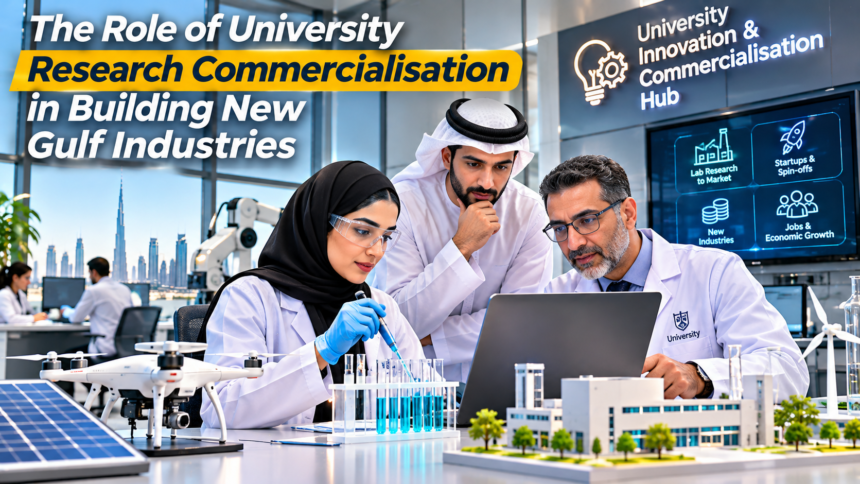
Why University Innovation Matters for the Gulf’s Industrial Future
Across the Arabian Gulf, universities are increasingly becoming more than centres for education and academic research. They are emerging as important participants in economic development, helping transform scientific discoveries into technologies, products, and businesses that could support the region’s next generation of industries.
- 1. Why University Research Commercialisation in the Gulf Matters for Economic Diversification
- 2. How Technology Transfer Offices Connect Universities With Businesses
- 3. What Saudi Arabia’s KAUST Reveals About Research-Based Industries
- 4. How UAE and Qatar Universities Are Developing Research-Driven Businesses
- 5. Why Research Commercialisation Could Support New Gulf Industries
- 6. The Financial and Institutional Barriers to Research Commercialisation
- 7. The Future of University Research Commercialisation in the Gulf
From artificial intelligence and advanced manufacturing to biotechnology, sustainable agriculture, water technology, and clean energy, research institutions are exploring ways to connect laboratory discoveries with commercial opportunities.
University research commercialisation in the Gulf is becoming particularly relevant as countries seek to diversify their economies, develop specialised industries, and strengthen their ability to create technologies locally.
The process involves identifying research with practical applications and developing routes through which discoveries can reach businesses, governments, and consumers. These routes may include patent licensing, startup creation, industrial partnerships, joint ventures, and direct technology deployment.
Across the United Arab Emirates, Saudi Arabia, Qatar, Oman, Bahrain, and Kuwait, universities and research institutions are developing innovation centres, technology-transfer offices, and entrepreneurship programmes to support this transition.
Recent examples demonstrate the direction of change. Khalifa University in Abu Dhabi reported 60 granted patents in 2025, while King Abdullah University of Science and Technology in Saudi Arabia is supporting research-based ventures in agriculture and environmental technology.
Qatar University has also expanded its innovation ecosystem, announcing four licensing agreements with Qatar-based companies in November 2026.
However, turning research into a successful business is far more complicated than obtaining a patent or launching a startup.
Universities must identify real market needs, protect intellectual property where appropriate, secure investment, attract business expertise, and demonstrate that new technologies perform reliably outside laboratory conditions.
Understanding these challenges reveals why commercialisation could become an important link between academic research and the Gulf’s industrial future.
1. Why University Research Commercialisation in the Gulf Matters for Economic Diversification
Economic diversification is a major development objective across the GCC.
Governments are seeking to expand activities beyond traditional sources of income while encouraging advanced industries, skilled employment, and innovation.
Universities can contribute by creating knowledge that businesses are able to develop into useful products and services.
Understanding Research Commercialisation
Research commercialisation is the process of transforming suitable scientific or technical knowledge into practical economic applications.
A university laboratory may discover a new material, develop a software algorithm, or identify a more efficient production technique.
Commercialisation begins when researchers and their partners assess whether that discovery can solve a problem for which organisations or consumers are willing to pay.
The resulting technology may be licensed to an established company or developed through a newly formed business.
However, not every research project requires commercialisation.
Fundamental research, public-interest studies, and knowledge shared openly can create significant value without producing patents or private businesses.
The Connection Between Research and Industry
Traditional industrial development often relies on imported equipment, external expertise, and technologies developed elsewhere.
Domestic research capabilities may help companies adapt technologies to local conditions or create specialised solutions.
For example, Gulf researchers may investigate water treatment, desert agriculture, industrial cooling, and materials suitable for high-temperature environments.
Commercial partnerships can support the testing and deployment of promising discoveries.
What Global Innovation Research Shows
The World Intellectual Property Organization’s Global Innovation Index 2026 reports that the UAE reached 25th place globally, while Saudi Arabia ranked 42nd.
The report identifies strong enabling conditions across several Gulf economies, including infrastructure, digital adoption, talent attraction, and investment.
However, it also highlights the continuing challenge of turning these strengths into proportionate innovation outputs.
This distinction matters because research spending and infrastructure investments do not automatically generate successful commercial technologies.
Research Outcomes and Commercial Applications
| Research Output | Possible Commercial Pathway | Potential Economic Value |
|---|---|---|
| New Material | Patent licensing | Advanced manufacturing |
| Medical Technology | Startup or industry partnership | Healthcare products |
| Water-Treatment Process | Industrial licensing | Water-sector innovation |
| Agricultural Research | Spin-off company | Food-security technology |
| AI Algorithm | Software company | Digital services |
| Energy Technology | Joint development | Industrial efficiency |
| Robotics Research | Commercial prototype | Automation solutions |
Why Local Industry Participation Matters
A university discovery may be scientifically impressive but commercially unsuccessful if it does not address a practical problem.
Involving companies during research planning can improve understanding of market requirements.
However, universities should also preserve academic independence and continue supporting exploratory research without immediate commercial expectations.
2. How Technology Transfer Offices Connect Universities With Businesses
Technology-transfer offices play an important role in moving university research toward commercial applications.
These offices help researchers evaluate inventions, manage intellectual property, identify potential industry partners, and negotiate appropriate agreements.
The Role of Intellectual Property
Intellectual property may include patents, copyrighted software, designs, trade secrets, or other legally protected innovations.
A patent can provide time-limited legal rights over an invention in jurisdictions where protection is obtained.
However, a patent does not automatically establish that a technology works commercially or that customers will purchase it.
Universities must evaluate technical value, market demand, development costs, and available alternatives before investing heavily in protection.
How Commercialisation Usually Progresses
The journey from academic research to market deployment often includes several stages.
Researchers first identify a discovery with potential applications.
The university then assesses novelty, ownership, feasibility, and potential customers.
Further development may involve prototypes, laboratory validation, pilot projects, licensing agreements, or startup formation.
Commercialisation frequently requires repeated testing and changes to the original concept.
Khalifa University’s Technology Management Office
Khalifa University’s Office of Technology Management and Innovation supports the identification, protection, management, and commercialisation of university inventions.
Its technology portfolio covers water and environment, robotics, artificial intelligence, healthcare, communications, clean energy, and advanced materials.
The university identifies startup creation and licensing to industry partners as key routes to market.
KAUST’s Technology-Transfer Approach
KAUST’s Technology Transfer and InnovationOps function works across intellectual property strategy and commercial development.
Its processes include identifying research opportunities, evaluating customer demand, validating technology, and selecting suitable commercialisation pathways.
These may involve licensing, spin-outs, joint ventures, and collaborative research.
Commercialisation Pathways Compared
| Pathway | Main Advantage | Important Consideration |
|---|---|---|
| Patent Licensing | Existing company develops the invention | Depends on licensee commitment |
| University Spin-Off | Creates a dedicated business | Requires funding and management |
| Joint Venture | Combines academic and industrial resources | Complex governance |
| Collaborative Research | Addresses defined industry problems | Intellectual property agreements |
| Consultancy | Provides research expertise directly | May not create a scalable product |
| Open Innovation | Supports wider knowledge adoption | Requires suitable sharing arrangements |
Why Technology Transfer Requires Professional Expertise
Researchers may understand scientific principles but have limited experience negotiating commercial contracts.
Technology-transfer professionals can help bridge this gap.
Their responsibilities often involve intellectual property management, market assessment, regulatory considerations, and business relationships.
However, the commercialisation process should remain transparent and protect the interests of researchers, institutions, and partners.
3. What Saudi Arabia’s KAUST Reveals About Research-Based Industries
Saudi Arabia provides examples of university research progressing into commercial enterprises.
KAUST has developed programmes supporting technology transfer, entrepreneurship, research partnerships, and investment.
Its activities span several sectors relevant to the Kingdom’s economic diversification objectives.
Turning Desert Research Into Commercial Technology
In June 2026, KAUST announced that Terraxy, a startup originating from its research ecosystem, had secured US$3 million in a funding round led by Wa’ed Ventures.
The company develops soil-regeneration technologies intended for desert landscaping and environmental applications.
According to the university, the investment will support a transition from pilot-scale production to industrial production.
The announcement also described plans for a 30,000-square-metre commercial facility in Al Zulfi.
These details demonstrate commercial development, but the planned facility should not be described as already delivering its full intended production capacity.
Agricultural Research and the Namya Venture
In July 2026, KAUST announced the launch of Namya, a company developed around its MiZax research technology.
The venture focuses on bioactive agricultural products intended to help improve crop performance and resource efficiency.
It emerged through collaboration between KAUST and the Riyadh-based venture builder SEQUENCIVE.
The company illustrates how long-term academic research can create opportunities for new agricultural technology businesses.
However, anticipated benefits such as improved yields must be demonstrated under real farming conditions.
Developing Commercialisation Professionals
In August 2025, Saudi Arabia’s Research, Development and Innovation Authority announced a technology-transfer programme with KAUST.
The initiative was designed to strengthen commercialisation capabilities within research and government institutions.
Its initial professional development programme involved five leaders from Saudi research institutions.
Although relatively small in scale, it reflects the importance of specialist expertise in managing research-based innovation.
Saudi Research Commercialisation Examples
| Initiative | Commercialisation Activity | Development Significance |
|---|---|---|
| Terraxy | Research-based startup and investment | Desert technology development |
| Namya | Agricultural technology venture | Potential new agricultural products |
| KAUST Technology Transfer | Licensing and spin-out support | Research-to-market infrastructure |
| RDI Authority Partnership | Professional technology-transfer training | Institutional capability building |
Why These Examples Matter
Research commercialisation can help create businesses in sectors where local environmental conditions provide a reason to develop specialised expertise.
However, a successful startup announcement does not establish that an entire new industry has been created.
Building a sustainable industry requires customers, supply chains, production capacity, skilled workers, and long-term commercial demand.
4. How UAE and Qatar Universities Are Developing Research-Driven Businesses
The UAE and Qatar have developed initiatives aimed at connecting university research with entrepreneurship and industry.
These programmes demonstrate different approaches to intellectual property protection, startup development, and commercial partnerships.
Khalifa University’s Patent Development
In February 2026, Khalifa University announced that it had received 60 granted patents during 2025.
The university reported 22 granted patents in 2023 and 32 in 2024.
This growth indicates increased activity in securing intellectual property rights.
However, patent grants should not be treated as equivalent to commercial revenue or successful product adoption.
The economic value of patented research depends on subsequent development and market use.
From Patents to Startups
Khalifa University’s innovation ecosystem includes the Khalifa Innovation Center and Khalifa University Enterprises Company.
The university reported supporting nearly 60 startups in 2025.
Examples identified by the institution include companies working on AI-powered clinical nutrition, environmental intelligence, autonomous drones, and neuromorphic vision.
These areas illustrate the variety of technologies emerging from academic research.
However, the number of supported startups is different from the number of financially sustainable companies.
Qatar University’s Commercial Licensing
In November 2026, Qatar University announced four technology licensing agreements with Qatar-based companies at MWC Doha.
The agreements involved research applications including coral reef restoration, rapid norovirus testing, and antimicrobial hydrogels.
These examples demonstrate how academic research can address environmental and healthcare challenges.
A licensing agreement represents a commercial development step, but it does not necessarily confirm that a technology has achieved widespread market deployment.
Qatar’s Intellectual Property Support
Qatar University’s Innovation Office provides services related to patent protection, invention evaluation, technology licensing, and industry collaboration.
In February 2026, Qatar’s Ministry of Commerce and Industry also launched an initiative with WIPO and several national partners to support innovators and intellectual property commercialisation.
Such coordination can improve access to specialised advice and market-development assistance.
UAE and Qatar Approaches Compared
| Institution | Reported Activity | Main Commercialisation Focus |
|---|---|---|
| Khalifa University | 60 granted patents in 2025 | Research protection and technology development |
| Khalifa Innovation Center | Startup support | Deep-tech venture development |
| Qatar University | Four licensing agreements announced in November 2026 | Moving research into business applications |
| Qatar University Innovation Office | Intellectual property and industry support | Technology transfer |
| Qatar Ministry of Commerce and Industry | Innovation-support initiative | Commercialisation services |
The Importance of Commercial Follow-Through
Research commercialisation should not end when a patent is granted or a company is registered.
New technologies must progress through testing, production, regulatory approval where necessary, customer acquisition, and continuing improvement.
5. Why Research Commercialisation Could Support New Gulf Industries
University research can support industries by generating specialised knowledge, developing technologies, and training people who understand emerging scientific fields.
However, the transition from research discovery to industrial development is gradual.
It may involve several organisations working together over many years.
Advanced Manufacturing
Universities investigating specialised materials, sensors, robotics, and automation may help manufacturers develop new capabilities.
A research team might create a component that improves equipment performance.
An industrial partner could then evaluate whether the design can be manufactured reliably and economically.
This process requires engineering, quality assurance, production facilities, and market demand.
Water and Environmental Technology
Gulf countries face challenges involving water scarcity, efficient resource use, and environmental management.
University research may contribute to membrane technologies, water monitoring, industrial recycling, or environmental sensors.
Commercial partnerships can help test these solutions under operating conditions.
However, laboratory efficiency should not be confused with performance in full-scale facilities.
Healthcare and Biotechnology
Medical research can generate opportunities in diagnostics, materials, digital health, and medical devices.
The transition into commercial healthcare products may involve regulatory approval, clinical validation, quality systems, and professional oversight.
These requirements can make the process longer and more expensive than commercialising some software applications.
Agricultural Technology
Research into drought tolerance, soil conditions, controlled-environment farming, and agricultural inputs could support specialised businesses.
The KAUST examples show how agricultural discoveries can progress into startups.
However, new products must demonstrate consistent performance under relevant environmental conditions.
Potential Industry Opportunities
| Emerging Sector | University Research Contribution | Commercial Challenge |
|---|---|---|
| Advanced Materials | New compounds and manufacturing methods | Industrial-scale production |
| Medical Technology | Diagnostics and devices | Regulatory validation |
| Agricultural Technology | Crop and soil innovations | Field performance |
| Water Technology | Treatment and monitoring systems | Reliability and cost |
| Robotics | Automation algorithms and hardware | Integration into industry |
| Clean Energy | Energy materials and systems | Technical and financial viability |
| Environmental Technology | Monitoring and restoration solutions | Demonstrating measurable impact |
Why Industry Clusters Matter
A university startup may require suppliers, laboratories, manufacturing partners, logistics providers, investors, and skilled employees.
When these capabilities develop within a regional cluster, companies may find it easier to collaborate and expand.
However, creating a cluster requires more than establishing a research park.
Successful industrial ecosystems depend on sustained business activity and productive relationships between institutions.
6. The Financial and Institutional Barriers to Research Commercialisation
Although university research offers commercial potential, many discoveries never become widely used products.
Some inventions are technically promising but too expensive to manufacture.
Others address problems for which customers are unwilling to pay.
Commercialisation programmes must therefore evaluate both scientific and business risks.
The Gap Between Research and Market Readiness
Early-stage technologies often require further development before companies can use them.
A laboratory prototype may operate successfully under controlled conditions but fail when exposed to different environmental requirements.
Additional testing, certification, industrial design, and production engineering may be necessary.
The cost of these steps can exceed the original research budget.
Access to Patient Capital
Research-based startups often require funding over relatively long periods.
Investors may need to support development before a product generates meaningful revenue.
This can be challenging when commercial outcomes are uncertain.
Venture capital may suit some businesses, while others require grants, industrial partnerships, or strategic investment.
The Importance of Experienced Management
Academic researchers may possess valuable technical expertise without experience managing production, sales, finance, or customer relationships.
Founding teams can benefit from combining scientific knowledge with business capabilities.
Universities may also need clear policies governing researchers’ commercial interests.
Intellectual Property Challenges
Patent protection can be costly across multiple jurisdictions.
Universities must decide where protection is justified and whether licensing terms encourage adoption.
Overly restrictive agreements can discourage partnerships, while poorly structured arrangements may fail to protect legitimate institutional interests.
Common Challenges and Responses
| Challenge | Possible Consequence | Practical Response |
|---|---|---|
| Limited Market Demand | Low product adoption | Early customer validation |
| Technology Immaturity | Development delays | Pilot testing |
| Insufficient Funding | Incomplete development | Appropriate financing |
| Weak Business Expertise | Commercial difficulties | Experienced management |
| Complex Licensing | Partnership delays | Transparent agreements |
| Limited Industrial Infrastructure | Difficult scaling | Manufacturing partnerships |
| Regulatory Requirements | Slower market entry | Early compliance planning |
| Unclear Researcher Incentives | Reduced participation | Fair institutional policies |
The Risk of Measuring the Wrong Outcomes
Universities may report patents, startup launches, and investment announcements because these are relatively easy to count.
However, they do not necessarily measure long-term economic impact.
A stronger assessment also considers whether technologies are adopted, businesses survive, workers gain employment, and customers receive useful products.
7. The Future of University Research Commercialisation in the Gulf
As GCC countries expand their research and innovation systems, universities could become increasingly connected to industrial development.
However, sustained commercial success will require cooperation between academic institutions, companies, investors, and public authorities.
Oman’s Technology-Transfer Development
Sultan Qaboos University established its Innovation and Technology Transfer Center in 2018.
Its activities include intellectual property support, industrial partnerships, licensing, incubation, and entrepreneurship development.
The university identifies the creation of startups and spin-offs as potential contributions to economic diversification.
This demonstrates that research commercialisation is relevant beyond the largest GCC research institutions.
Connecting Research With Real Industry Problems
Universities may strengthen commercial outcomes by engaging companies before research projects reach their final stages.
An industrial partner can help define performance requirements, cost constraints, and practical operating conditions.
Researchers can then evaluate whether their discoveries provide advantages over existing solutions.
However, academic institutions should continue protecting space for independent and fundamental research.
A Practical Research Commercialisation Checklist
- Identify research discoveries with possible practical applications.
- Assess technical novelty and intellectual property ownership.
- Understand customer needs and competing technologies.
- Evaluate suitable patent or open-innovation approaches.
- Develop prototypes and validate performance.
- Engage potential industrial partners.
- Estimate development and production costs.
- Select an appropriate licensing or venture model.
- Build management and commercial capabilities.
- Establish measurable long-term outcomes.
How Universities Should Measure Success
Commercialisation outcomes should be evaluated through a combination of research, economic, and social indicators.
Financial returns matter, but universities also contribute through training, industry collaboration, and technologies that address public needs.
Key Performance Indicators
| Indicator | What It Measures |
|---|---|
| Invention Disclosures | Research identified for assessment |
| Granted Patents | Intellectual property protection |
| Licensing Agreements | Formal technology-transfer activity |
| Licensing Revenue | Financial returns from commercial arrangements |
| Startup Formation | Creation of new ventures |
| Startup Survival | Business continuity over time |
| Follow-On Investment | External investor interest |
| Product Deployment | Practical technology adoption |
| Skilled Employment | Workforce contributions |
| Social and Environmental Outcomes | Broader benefits beyond revenue |
Why Regional Collaboration Matters
GCC universities may benefit from partnerships involving research infrastructure, industrial facilities, and specialised expertise.
A technology developed in one country may have applications elsewhere in the region.
However, cross-border collaboration requires agreements concerning intellectual property, commercial rights, regulations, and data.
Strong institutional coordination can help address these issues.
Balancing Commercial Value With Academic Purpose
Universities exist to educate students, develop knowledge, and contribute to society.
Commercialisation can strengthen these objectives when implemented responsibly.
However, universities should avoid judging all research solely by its immediate financial potential.
Some discoveries produce important benefits only after many years, while others contribute through open scientific knowledge rather than proprietary products.
Conclusion
University research commercialisation could play an important role in building new Gulf industries by connecting scientific discoveries with businesses capable of developing and deploying them.
Institutions such as KAUST, Khalifa University, Qatar University, and Sultan Qaboos University demonstrate how technology-transfer offices, intellectual property systems, startup support, and industrial partnerships can contribute to this process.
Research-based ventures in agricultural technology, environmental solutions, artificial intelligence, and healthcare illustrate the range of potential applications.
However, patents, funding announcements, and newly registered startups do not automatically create sustainable industries.
Long-term progress depends on commercial demand, reliable technology, experienced management, suitable investment, and the ability to scale production.
For Gulf universities, the opportunity is to connect research excellence with practical needs while preserving academic independence.
For businesses, collaboration with research institutions can offer access to specialised expertise and emerging technologies.
For policymakers, strengthening the links between research, industry, entrepreneurship, and skilled employment may help support economic diversification.
Ultimately, the value of university research will not be measured only by discoveries made inside laboratories.
It will also be reflected in how effectively useful discoveries become reliable technologies, productive businesses, and enduring capabilities that contribute to the Gulf’s economic future.
Do follow us on Instagram
Read More – How Medical Simulation Technology Is Changing Healthcare Training in the Middle East