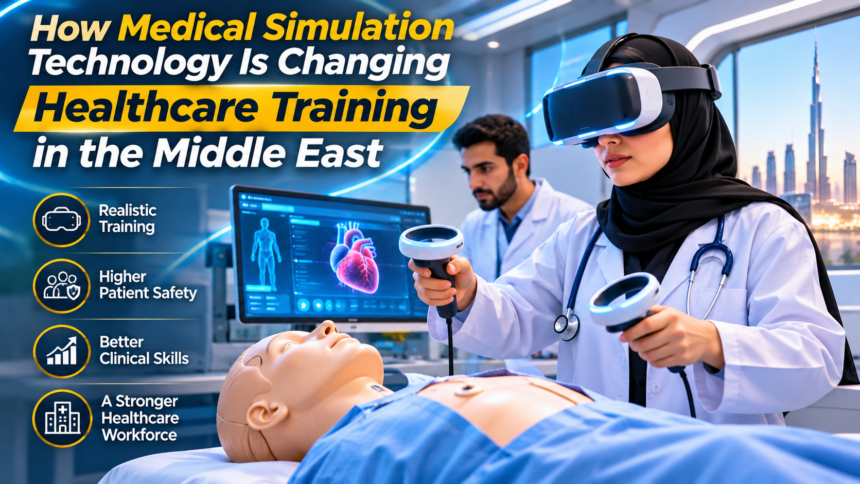
How Medical Simulation Technology Is Transforming GCC Healthcare
Healthcare education across the Middle East is undergoing a significant transformation as universities, hospitals, and specialist training institutions adopt more advanced ways of preparing medical professionals. Traditional classroom learning and supervised clinical experience remain essential, but technology is creating additional opportunities for students and experienced practitioners to develop their skills before applying them in real patient-care situations.
- 1. Why Medical Simulation Technology Is Becoming Essential for Healthcare Training
- 2. How Medical Simulation Technology in the Middle East Is Expanding
- 3. How Virtual Reality and Advanced Simulators Are Changing Surgical Education
- 4. Why Emergency Medicine and Teamwork Benefit From Simulation Training
- 5. How AI and Virtual Patients Could Personalise Healthcare Education
- 6. The Cost, Accessibility, and Practical Challenges of Medical Simulation
- 7. The Future of Medical Simulation Technology in Middle Eastern Healthcare
Medical simulation technology in the Middle East is becoming an important part of this transformation. From realistic patient mannequins and virtual operating rooms to augmented reality and interactive emergency scenarios, simulation allows healthcare professionals to practise procedures, communication, and clinical decision-making within controlled environments.
The approach is particularly relevant to countries investing in healthcare workforce development, including the United Arab Emirates, Saudi Arabia, Qatar, Oman, Bahrain, and Kuwait.
Hospitals and medical schools across the region face the challenge of preparing professionals for increasingly complex healthcare services. Modern treatment involves sophisticated equipment, multidisciplinary teams, specialised procedures, and rapid decisions that may have serious consequences for patients.
Simulation provides opportunities to practise selected tasks repeatedly, review mistakes, and receive structured feedback without exposing real patients to the training exercise.
Recent investments illustrate this growing emphasis. In August 2026, United Arab Emirates University officially opened a 4,000-square-metre medical simulation centre in Al Ain. Qatar’s Hamad Medical Corporation operates its Itqan Clinical Simulation and Innovation Center, while Saudi institutions are developing advanced surgical training using virtual and augmented reality.
However, simulation cannot replace real clinical experience. Its effectiveness depends on educational design, qualified instructors, appropriate assessment, and opportunities to apply learned skills under professional supervision.
Understanding these developments reveals how medical simulation could strengthen healthcare education, support workforce readiness, and contribute to patient-safety improvements across the Middle East.
1. Why Medical Simulation Technology Is Becoming Essential for Healthcare Training
Medical simulation refers to educational activities that recreate selected aspects of clinical practice using equipment, trained participants, computer software, or simulated healthcare environments.
The objective is to help learners develop knowledge, practical skills, and professional judgement through structured experience.
Unlike traditional classroom instruction, simulation often requires participants to make decisions and perform tasks while responding to an unfolding scenario.
From Observation to Practical Experience
Healthcare students traditionally learn through lectures, laboratory demonstrations, supervised clinical placements, and direct observation of experienced professionals.
These methods remain important.
However, not every student encounters the same clinical conditions during training.
A rare emergency may occur infrequently, while some procedures are too complex or hazardous for inexperienced learners to practise independently.
Simulation can provide a controlled environment where selected scenarios are repeated until learners achieve defined educational objectives.
Understanding Different Simulation Methods
Medical simulation is not limited to expensive robotic mannequins.
Some educational activities use simple anatomical models, simulated patients, or structured role-playing exercises.
Other programmes use advanced equipment that responds to treatment decisions.
| Simulation Method | Main Application | Example |
|---|---|---|
| Task Trainers | Practising specific procedures | Injection or suturing models |
| High-Fidelity Mannequins | Complex clinical scenarios | Emergency resuscitation |
| Standardised Patients | Communication and examination | Simulated consultations |
| Virtual Reality | Immersive digital practice | Surgical or anatomical training |
| Augmented Reality | Digital information over physical environments | Procedure guidance |
| Computer-Based Cases | Clinical reasoning | Virtual patient assessment |
| In-Situ Simulation | Team exercises in working clinical environments | Emergency department drills |
Each method has strengths and limitations.
A simple task trainer may be more useful than an expensive immersive system when the objective is to practise one specific technique.
Why Educational Design Matters
The International Nursing Association for Clinical Simulation and Learning recommends that simulation activities begin with measurable objectives.
Its Healthcare Simulation Standards of Best Practice also emphasise preparation, facilitation, structured debriefing, and evaluation.
These principles help ensure that training is purposeful rather than simply technologically impressive.
2. How Medical Simulation Technology in the Middle East Is Expanding
Healthcare simulation is increasingly visible across regional medical education institutions.
Several centres are combining realistic clinical settings with advanced digital technologies, assessment facilities, and specialist training programmes.
United Arab Emirates University’s Medical Simulation Centre
United Arab Emirates University opened its medical simulation centre on August 31, 2026.
The facility occupies approximately 4,000 square metres across two floors.
It includes simulation suites representing intensive care, emergency medicine, obstetrics and gynaecology, operating rooms, and paediatrics.
The centre also contains virtual reality facilities, standardised-patient areas, 24 clinical examination rooms, and eight debriefing rooms.
According to the university, the centre supported more than 250 educational activities from the beginning of 2026 through its August announcement, reaching approximately 9,000 learner participations.
These figures indicate training activity rather than independently verified improvements in patient outcomes.
Khalifa University’s Experiential Learning Centre
Khalifa University in Abu Dhabi operates the Center for Experiential Learning and Clinical Simulation.
Its activities focus on clinical practice, communication, teamwork, and experiential education.
The centre combines simulation facilities with supervised learning and feedback.
This illustrates how simulation can support multiple healthcare disciplines rather than only surgeons or physicians.
Qatar’s Itqan Clinical Simulation and Innovation Center
Hamad Medical Corporation operates the Itqan Clinical Simulation and Innovation Center in Doha.
The facility includes simulated operating theatres, labour and delivery suites, outpatient rooms, surgical-skills laboratories, and virtual reality training.
In 2024, Itqan received full accreditation from the Society for Simulation in Healthcare for its core and teaching activities.
Accreditation recognises compliance with defined educational and operational standards; it does not guarantee that every individual training exercise improves clinical outcomes.
Saudi Arabia’s Simulation Infrastructure
Princess Nourah bint Abdulrahman University’s Clinical Skills and Simulation Center received renewed international accreditation in August 2025, valid through December 2030.
Saudi Arabia’s King Faisal Specialist Hospital and Research Centre has also demonstrated simulation and augmented reality technologies for surgical education.
Regional Examples
| Institution | Country | Training Focus |
|---|---|---|
| United Arab Emirates University | UAE | Clinical simulation, VR and assessment |
| Khalifa University | UAE | Experiential and multidisciplinary learning |
| Hamad Medical Corporation’s Itqan | Qatar | Clinical, surgical and team simulation |
| Princess Nourah University | Saudi Arabia | Clinical skills and simulation education |
| King Faisal Specialist Hospital | Saudi Arabia | Surgical simulation and immersive technologies |
These examples demonstrate institutional investment, although adoption across the wider region remains uneven.
3. How Virtual Reality and Advanced Simulators Are Changing Surgical Education
Surgical training is one of the most prominent applications of medical simulation.
Surgical procedures require technical precision, anatomical knowledge, communication, and effective decision-making.
Simulation offers opportunities to develop some of these capabilities before performing procedures on patients.
Practising Complex Procedures
Advanced surgical simulators can reproduce selected aspects of real procedures.
For example, trainees may practise manipulating instruments during a simulated minimally invasive operation.
Some systems provide feedback about movement, instrument positioning, completion time, and procedural accuracy.
Learners can repeat activities and review their performance.
However, simulated performance does not automatically establish readiness to practise independently.
Saudi Arabia’s Immersive Surgical Training
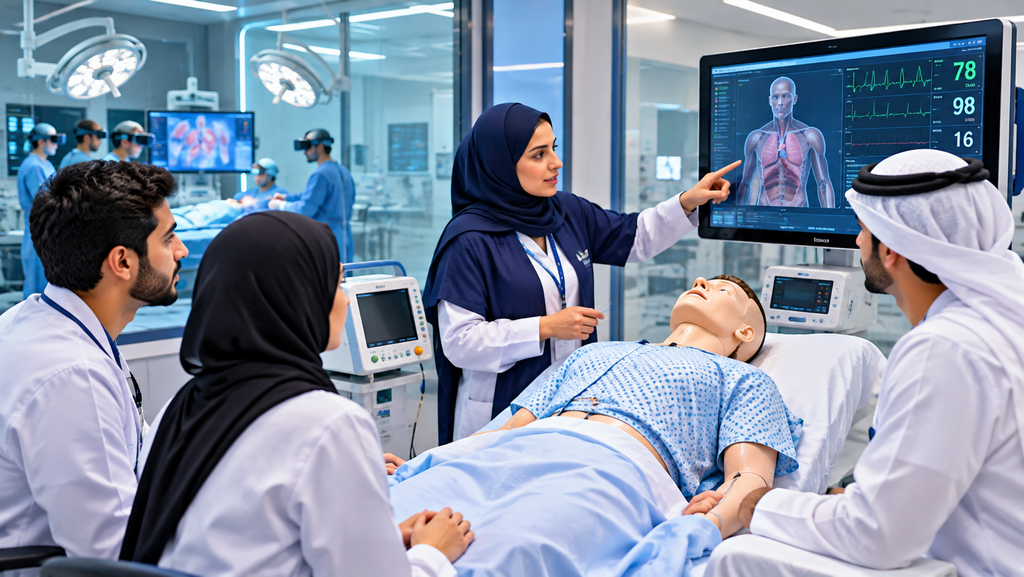
In October 2025, King Faisal Specialist Hospital and Research Centre presented an advanced simulation training environment during the Global Health Exhibition.
The systems included realistic knee and shoulder models, arthroscopic instruments, and augmented reality training applications.
Participants could practise selected procedures and receive performance feedback.
Such technologies may be particularly valuable when access to real clinical cases is limited or when repeated practice is important.
Virtual Reality and Anatomical Learning
Virtual reality can place students inside digital representations of anatomical structures or clinical settings.
A learner may examine spatial relationships between organs or practise a defined sequence of procedural steps.
These systems can make some complex concepts easier to explore interactively.
However, headset comfort, visual accuracy, equipment costs, and the quality of underlying anatomical models all influence educational value.
Simulation-Based Surgical Training Compared
| Training Approach | Potential Advantage | Main Limitation |
|---|---|---|
| Anatomical Models | Practical understanding of structures | Limited physiological response |
| Virtual Reality | Repeatable immersive experience | Digital realism varies |
| High-Fidelity Procedure Simulators | Immediate technical feedback | Expensive equipment |
| Supervised Clinical Practice | Authentic patient-care experience | Limited opportunities for repetition |
| Combined Training | Multiple learning experiences | Requires coordination and assessment |
What Research Suggests
A 2026 systematic review and meta-analysis found that competency-based simulation training improved procedural skill outcomes compared with simulation lacking the same competency-based structure.
However, evidence for changes in real clinical behaviour and patient outcomes was smaller and more limited.
This highlights the importance of evaluating how successfully simulated skills transfer into actual practice.
4. Why Emergency Medicine and Teamwork Benefit From Simulation Training
Healthcare emergencies often require several professionals to work together under time pressure.
Doctors, nurses, pharmacists, respiratory therapists, and other specialists may need to coordinate responsibilities while responding to rapidly changing patient conditions.
Simulation can recreate these challenges in a controlled environment.
Emergency Response Scenarios
A training exercise may involve a simulated patient experiencing cardiac arrest, breathing difficulties, severe bleeding, or another urgent condition.
Participants must interpret information, communicate clearly, and perform appropriate tasks.
Instructors can observe how the team responds and provide feedback afterward.
These exercises should follow relevant clinical protocols and educational standards.
Practising Rare but High-Risk Events
Some emergencies are uncommon but require immediate recognition.
For example, obstetric teams may train for complications that arise unexpectedly during childbirth.
Paediatric teams may rehearse selected life-threatening conditions.
Simulation allows these scenarios to be practised without waiting for real incidents.
However, training equipment cannot fully reproduce every physiological or emotional aspect of an actual emergency.
Communication and Leadership
Many healthcare incidents involve communication challenges as well as technical decisions.
A simulation may test whether team members clearly identify responsibilities, communicate critical information, and escalate concerns.
Structured debriefing can then examine both clinical and nontechnical performance.
The Value of Interprofessional Education
A 2024 systematic review and meta-analysis involving 10 randomised controlled trials and 766 participants found that interdisciplinary simulation-based education improved interprofessional knowledge.
However, improvements in knowledge should not be assumed to translate automatically into fewer clinical errors.
Team Training Opportunities
| Clinical Setting | Simulation Objective |
|---|---|
| Emergency Department | Coordinated urgent response |
| Intensive Care Unit | Managing patient deterioration |
| Operating Theatre | Surgical teamwork and communication |
| Maternity Unit | Managing obstetric emergencies |
| Paediatric Department | Age-specific emergency scenarios |
| Ambulance Services | Prehospital coordination |
| Hospital-Wide Drills | Communication across departments |
In-Situ Simulation
In-situ simulation takes place within actual healthcare environments, such as operating theatres or emergency departments.
It can help teams identify workflow problems, equipment-access difficulties, or communication gaps.
However, exercises must be planned to avoid disrupting real patient care.
5. How AI and Virtual Patients Could Personalise Healthcare Education
Artificial intelligence is creating additional opportunities for simulation-based learning.
AI-assisted systems may provide feedback, adapt scenarios, and support interactive virtual patient encounters.
However, these technologies require careful validation because inaccurate clinical information can reinforce unsafe learning.
AI-Powered Virtual Patients
A virtual patient system may allow a learner to practise asking questions, interpreting symptoms, and making preliminary clinical decisions.
Some applications use conversational AI to generate responses based on a simulated patient’s history.
This could support communication training and clinical reasoning.
However, generative systems may produce inconsistent or medically inaccurate information.
Educators must therefore validate scenarios and maintain oversight.
Personalised Feedback
Some simulation platforms record learner performance and generate reports.
These may include procedural timing, task completion, or deviations from a defined standard.
AI-assisted systems can potentially help identify patterns requiring further practice.
However, automated scores should not replace qualified clinical assessment when evaluating professional competence.
Virtual and Augmented Reality
Augmented reality can overlay digital anatomical or procedural information onto a physical training environment.
Virtual reality creates a predominantly digital learning space.
Both may support selected training objectives.
However, neither is universally superior to conventional educational methods.
Recent Evidence on AI-Assisted Training
A 2026 meta-analysis of 12 randomised controlled trials found improvements in certain clinical skills scores with AI-assisted simulation.
The benefits were more evident for some surgical and invasive procedural skills.
The analysis did not find the same advantage for clinical assessment and diagnostic skills.
This suggests that AI’s value may depend heavily on the task being taught.
AI Applications and Risks
| Application | Potential Benefit | Main Concern |
|---|---|---|
| Virtual Patients | Repeatable clinical conversations | Inaccurate responses |
| Automated Feedback | Faster performance review | Scoring validity |
| Adaptive Scenarios | Tailored practice difficulty | Unpredictable behaviour |
| Virtual Anatomy | Interactive learning | Model accuracy |
| Remote Collaboration | Wider training access | Connectivity and supervision |
| Learning Analytics | Identifying skill gaps | Data protection |
Why Human Educators Remain Essential
Experienced instructors provide professional judgement, contextual knowledge, and guidance that cannot always be captured through automated feedback.
Simulation technology should strengthen their educational role rather than replace it.
6. The Cost, Accessibility, and Practical Challenges of Medical Simulation
Advanced simulation centres can require significant investment.
Facilities may need specialised equipment, software subscriptions, technical support, trained educators, and dedicated physical space.
These requirements can create challenges for smaller hospitals and medical institutions.
High Equipment and Operating Costs
Realistic patient simulators and immersive platforms may be expensive to purchase and maintain.
Equipment can also become outdated as technologies and educational needs evolve.
Institutions should evaluate the total cost of ownership rather than focusing only on initial purchase prices.
The Importance of Trained Educators
A sophisticated simulator is not automatically an effective teaching tool.
Instructors need to design scenarios, supervise learners, facilitate reflection, and evaluate performance.
The Healthcare Simulation Standards of Best Practice emphasise competent educators and structured educational processes.
Accessibility Across the Region
Large academic hospitals may have resources to develop advanced simulation centres.
Smaller healthcare facilities or training institutions may face greater financial and staffing constraints.
Potential responses include shared facilities, regional training partnerships, portable equipment, and remote educational support.
However, distance simulation is not appropriate for every procedural skill.
Ethical and Data Privacy Considerations
Simulation programmes may record participants’ performance, conversations, and decisions.
These records can contain sensitive educational or professional information.
Institutions should establish clear rules for consent, access, storage, and use.
Where AI is involved, appropriate protection of training data is particularly important.
Major Challenges and Responses
| Challenge | Potential Impact | Practical Response |
|---|---|---|
| High Equipment Costs | Limited access | Shared facilities and phased investment |
| Technical Maintenance | Interruptions to training | Dedicated support |
| Instructor Shortages | Weak educational delivery | Faculty development |
| Inaccurate Scenarios | Misleading learning | Clinical validation |
| Unequal Access | Training disparities | Collaborative programmes |
| Data Privacy | Exposure of learner information | Strong governance |
| Limited Clinical Transfer Evidence | Uncertain patient benefits | Long-term evaluation |
Why Simulation Cannot Replace Patients
Real clinical encounters involve individual differences, uncertainty, communication complexity, and ethical responsibility.
A simulator cannot reproduce every aspect of these experiences.
Saudi Arabia’s Commission for Health Specialties explicitly describes simulation as a complement to supervised clinical training.
This distinction should remain central to healthcare education policy.
7. The Future of Medical Simulation Technology in Middle Eastern Healthcare
The future of healthcare simulation is likely to involve greater integration between universities, hospitals, professional regulators, and technology providers.
Institutions may combine physical simulation laboratories with virtual environments, competency-based assessment, and multidisciplinary training.
However, success will depend on educational outcomes rather than the number of advanced devices installed.
Competency-Based Medical Education
Competency-based education focuses on whether learners demonstrate defined professional capabilities.
Simulation can support this approach by providing repeatable assessment opportunities.
For example, a trainee may practise a procedure until an agreed performance standard is achieved.
However, assessment tools must be valid, reliable, and appropriate to the skill being measured.
Continuous Professional Development
Simulation is not relevant only to medical students.
Experienced healthcare professionals may use it when adopting unfamiliar equipment, rehearsing uncommon emergencies, or preparing for new clinical responsibilities.
Hospitals can also use simulation to test workflows before introducing significant operational changes.
A Practical Healthcare Simulation Checklist
- Identify specific clinical training needs.
- Establish measurable learning objectives.
- Select simulation methods appropriate to each task.
- Use clinically validated scenarios.
- Prepare instructors and participants before sessions.
- Include structured feedback and debriefing.
- Evaluate technical and communication skills.
- Protect participant information and recordings.
- Monitor whether skills transfer into clinical practice.
- Review costs, accessibility, and educational outcomes.
Measuring Training Effectiveness
Institutions should assess more than attendance and learner satisfaction.
Useful indicators include demonstrated skills, knowledge retention, teamwork, clinical performance, and appropriately measured patient outcomes.
However, establishing a direct relationship between simulation training and patient safety can be difficult because many other factors influence clinical care.
Performance Indicators
| Indicator | What It Measures |
|---|---|
| Skills Assessment | Demonstrated procedural competence |
| Scenario Completion | Performance against objectives |
| Communication Quality | Team and patient interaction |
| Knowledge Retention | Learning over time |
| Clinical Transfer | Application in actual practice |
| Faculty Competence | Quality of instruction |
| Learner Feedback | Educational experience |
| Patient Outcomes | Possible downstream clinical impact |
Opportunities for Middle Eastern Technology Businesses
Healthcare simulation could create opportunities for regional software developers, medical equipment suppliers, virtual reality specialists, training consultants, and educational technology firms.
Businesses may develop multilingual virtual patients, specialist procedure simulators, or tools that help hospitals organise clinical education.
However, commercial products must be clinically appropriate, technically reliable, and supported by credible evaluation.
The Importance of Collaboration
Universities and hospitals can benefit from sharing expertise and establishing compatible training standards.
Regional partnerships may support faculty development and make specialised training more accessible.
However, institutions should adapt programmes to local clinical requirements and applicable professional regulations.
Conclusion
Medical simulation technology is changing healthcare training in the Middle East by giving students and professionals additional opportunities to practise clinical skills in controlled environments.
Advanced mannequins, virtual reality, augmented reality, simulated patients, and AI-supported systems can help learners prepare for complex procedures and high-pressure clinical situations.
Developments at United Arab Emirates University, Khalifa University, Qatar’s Itqan centre, and leading Saudi medical institutions demonstrate growing regional investment in these approaches.
However, technology alone cannot guarantee better healthcare.
Effective simulation requires clearly defined educational objectives, qualified instructors, structured debriefing, valid assessment, and supervised clinical experience.
Research supports improvements in selected learning and procedural outcomes, while evidence for direct patient benefits remains more variable.
For healthcare institutions, the strongest opportunity lies in combining advanced simulation with established clinical teaching rather than treating it as a replacement.
As Middle Eastern healthcare systems continue developing, well-designed simulation programmes could help prepare more confident, capable, and collaborative professionals.
Ultimately, the value of medical simulation will depend not on how realistic a digital patient appears, but on whether the experience helps healthcare workers make better decisions and deliver safer, more effective care when treating real people.
Do follow us on Instagram
Read More – Why Intergenerational Knowledge Transfer Matters for the Gulf’s Future Workforce