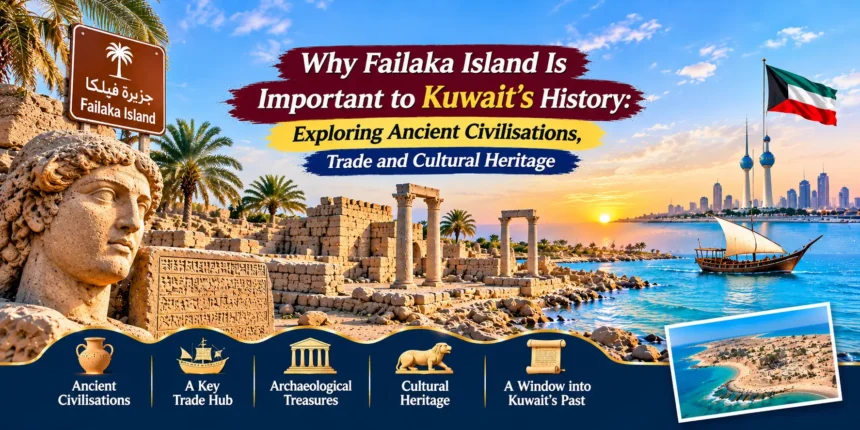
Why Failaka Island Is Important Part of Kuwait’s History: 13 Fascinating Facts
Kuwait is known for its modern skyline, beautiful coastline, traditional markets and rich cultural heritage. However, some of the country’s most interesting historical stories can be found away from the mainland. One such place is Failaka Island, a small island in the Arabian Gulf that holds thousands of years of history.
- 1. Where Is Failaka Island and Why Is It Special?
- 2. Failaka Island and the Ancient Dilmun Civilisation
- 3. An Important Centre for Ancient Trade
- 4. When Failaka Was Known as Ikaros
- 5. The Ancient Temples and Religious Heritage of Failaka
- 6. The Christian Community and the Churches of Al-Qusur
- 7. Traditional Fishing, Farming and Daily Life
- 8. The Old Villages and Historic Buildings of Failaka
- 9. Life on Failaka Island During the Twentieth Century
- 10. The 1990 Iraqi Invasion and Its Impact on Failaka
- 11. Archaeological Discoveries Make Failaka Important Today
- 12. Why Protecting Failaka Island’s Heritage Matters
- 13. Why Failaka Island Is Worth Discovering
- Conclusion
- Frequently Asked Questions (FAQs)
Located around 20 kilometres northeast of Kuwait City, Failaka Island has been home to different communities and civilisations. Ancient settlements, temples, old buildings, fishing villages and archaeological remains show how people lived on the island in different periods. Its location also made it an important point for trade and travel across the Gulf.
Failaka is not only connected with ancient history. It also tells the story of traditional Kuwaiti life, including fishing, farming, religious traditions and local communities. The island experienced a major change during the 1990 Iraqi invasion of Kuwait, when its residents were forced to leave their homes.
Today, Failaka Island is considered one of Kuwait’s most valuable historical landscapes. Its archaeological remains help explain the country’s links with ancient civilisations and the wider history of the Arabian Gulf.
Let’s explore why Failaka Island is such an important part of Kuwait’s history and what makes its past worth discovering.
1. Where Is Failaka Island and Why Is It Special?
Failaka Island is located in the northwestern part of the Arabian Gulf, approximately 20 kilometres from Kuwait City. It is one of Kuwait’s best-known islands and covers an area of around 44 square kilometres.
At first glance, Failaka may look like a quiet coastal destination. However, its location played a major role in its history. The island lies close to the entrance of Kuwait Bay and the wider maritime routes connecting Mesopotamia with other parts of the Gulf.
Its natural conditions also made it suitable for early settlements. The island had access to freshwater, fertile soil, fishing grounds and natural coastal areas where boats could stop.
These resources helped people build communities and develop different ways of earning a living. They could grow crops, collect water, catch fish and take part in maritime trade.
Several natural features made Failaka attractive to early settlers:
- Freshwater sources: Groundwater helped communities survive in a dry region.
- Fertile land: Some areas supported farming and date-palm cultivation.
- Coastal access: The surrounding waters supported fishing and boat activity.
- Trade location: The island offered a useful stopping point for vessels travelling through the Gulf.
The combination of these natural advantages helped Failaka remain important for many centuries.
2. Failaka Island and the Ancient Dilmun Civilisation
One of the most important chapters in Failaka Island’s history is its connection with the ancient Dilmun civilisation.
Dilmun was an important centre of trade and cultural exchange in the Arabian Gulf during the Bronze Age. It was closely associated with Bahrain and had connections with settlements across eastern Arabia and neighbouring regions.
Historical and archaeological evidence suggests that Failaka was known as Agarum in ancient Sumerian texts. The name was associated with Enzak, a major god of the Dilmun civilisation.
In Sumerian and Babylonian stories, Dilmun was described as a peaceful and perfect land. It was also believed to be the eternal home of Utnapishtim, a man who survived a great flood.
Archaeological discoveries show that people lived on the island thousands of years ago. Remains of houses, temples, warehouses, kilns and other buildings help researchers understand how these communities were organised.
One important archaeological area is Tell Sa’ad, where researchers have found remains connected with the Dilmun period. These include a temple courtyard, houses, storage buildings and production areas.
Another important area is Tell F6, which contains evidence of administrative and religious structures. These discoveries suggest that Failaka was more than a small settlement. It had organised community spaces and buildings connected with everyday activities.
The island’s connection with Dilmun makes it an important part of Kuwait’s ancient history. It also shows that the country’s historical links with other Gulf communities go back much further than modern national boundaries.
3. An Important Centre for Ancient Trade
Failaka Island became an important place for trade because of its location between different parts of the ancient world.
Failaka Island is located in the northern part of the Arabian Gulf, near where the Tigris and Euphrates rivers meet the sea. Its location made it an important final stop for ships travelling to the ports of southern Mesopotamia.
Failaka Island it part s an importanof Kuwait’s history, with evidence of human settlement dating back more than 4,000 years. Located about 20 kilometres off the coast of Kuwait City, the island connects Kuwait’s ancient past with its present.
Its location made it an important centre for trade, defence, and cultural exchange.
During the Bronze Age, the Arabian Gulf was an important route for moving goods between Mesopotamia, the Indus Valley, the Iranian region and the Arabian Peninsula. Travelling by sea was often more practical than moving large quantities of goods over long distances by land.
Failaka offered a useful stop along these routes. Its natural harbours, access to water and suitable coastal areas made it attractive to traders and sailors.
Archaeological discoveries from the island include imported objects, pottery and other materials that show connections with different regions.
Trade was not limited to expensive goods. Communities also needed food, raw materials and everyday supplies. The movement of these products helped settlements grow and encouraged contact between people with different languages, beliefs and customs.
The island’s importance as a trading location can be understood through several features:
- Its position along major Gulf sailing routes.
- Its access to natural coastal areas and possible harbour locations.
- Its links with ancient Mesopotamian and Dilmun communities.
- Archaeological evidence of imported objects and trade activities.
- Its role in connecting maritime travellers with nearby settlements.
These connections made Failaka part of a much wider network of ancient economic and cultural activity.
4. When Failaka Was Known as Ikaros
Another fascinating part of Failaka Island’s history comes from the Hellenistic period.
Following the campaigns of Alexander the Great, Greek explorers and officials became increasingly interested in the Arabian Gulf. Historical accounts connect the island with the name Ikaros, which was given during this period.
Archaeologists have discovered the remains of a Greek fortress, a temple dedicated to Artemis, ancient Greek coins, and inscriptions that show Greeks lived on the island as early as the 4th century BCE.
The island was linked with Ikaros in accounts describing Alexander’s efforts to explore the Gulf coastline and nearby islands. It later became an important location under the Seleucid kingdom, which controlled parts of western Asia after Alexander’s empire was divided.
Archaeological evidence has revealed a Hellenistic fortress at Tell Sa’eed, dating to the beginning of the third century BC. The site included defensive structures, residential remains and two temples.
The most interesting feature is the combination of architectural styles. One temple shows elements of Greek religious architecture, while another combines local or eastern design features with Greek decoration.
Coins, terracotta figurines and other objects discovered on the island also provide evidence of this cultural exchange.
This period is important because it shows how Failaka became a meeting point between Greek, Persian and local Arabian traditions. It was not simply influenced by one civilisation; it developed through contact between different cultures.
5. The Ancient Temples and Religious Heritage of Failaka
Failaka Island is also important because of the religious buildings and objects discovered by archaeologists.
During the Dilmun period, the island had temples and other structures connected with local religious practices. These remains provide clues about the beliefs of the people who lived there.
Later, during the Hellenistic period, additional religious sites appeared. Archaeologists discovered temples and sanctuary areas containing objects that suggest links with Greek religious traditions.
One notable example is the sanctuary associated with Artemis, a goddess from Greek mythology. The remains include a small building and an open area where religious activities may have taken place.
These discoveries show how religious ideas travelled across the Gulf. People from different regions brought their traditions with them, while local communities also maintained their own beliefs.
The combination of religious remains from different periods makes Failaka especially interesting. It reflects the island’s position as a place where travellers, traders and settlers met.
6. The Christian Community and the Churches of Al-Qusur
One of the lesser-known chapters of Failaka Island’s history is its connection with early Christianity.
At Al-Qusur, an archaeological site in the centre of the island, researchers uncovered the remains of a Christian monastery and settlement. The site includes two successive churches, a dining area and other buildings connected with daily community life.
The monastery is generally dated to the seventh and eighth centuries, although research into the wider Christian settlement places its origins earlier in some accounts.
The community appears to have supported itself through agricultural and food-production activities. Archaeological discoveries include buildings associated with the production of date molasses, as well as houses and drainage systems.
These remains are significant because they show that Failaka was home to different religious communities during its long history.
The discovery of the churches also adds another layer to the cultural history of Kuwait. It reminds us that the Gulf region was not connected to only one religion or culture in the past. Different communities lived, traded and developed settlements across the same geographical area.
Today, Al-Qusur remains an important archaeological location for understanding the island’s religious and social history.
7. Traditional Fishing, Farming and Daily Life
Failaka’s history was not only shaped by powerful kingdoms and international trade. It was also built through the everyday activities of ordinary people.
Fishing was an important source of food and income for island communities. The surrounding waters provided fish and other marine resources, while coastal settlements offered places for boats and fishing equipment.
The archaeological remains of Kharaib al-Dasht, an old fishing village, provide valuable information about this way of life. Researchers have found evidence of houses, fish ovens and objects connected with fishing and fish processing.
Some discoveries include fishing hooks, net weights, anchors and structures associated with fish traps.
Agriculture was another important part of life on the island. Freshwater sources and fertile areas allowed some communities to grow crops and maintain date palms.
Wells and water-management systems were especially important. Since the island is located in a dry region, people needed practical ways to collect, store and use water.
These activities helped communities become more self-sufficient and created a close relationship between people and the island’s natural environment.
8. The Old Villages and Historic Buildings of Failaka
Failaka Island contains evidence of different settlements from the Islamic and later historical periods.
One important location is Al-Zor, which developed into the island’s main village. Its history goes back several centuries, and it later became an important centre for residential life and public services.
Traditional houses, old buildings and the remains of community facilities help show how people lived before the island experienced major changes in the twentieth century.
Another interesting location is Al-Sa’ida, where researchers have discovered remains of an old village and a large mosque. These buildings provide evidence of religious and residential life during the Islamic period.
The island also contains remains of forts that were traditionally called Portuguese forts. However, archaeological research has linked these structures to the eighteenth century rather than confirming the popular Portuguese attribution.
These defensive buildings had circular towers and were probably used to protect nearby settlements during times of danger.
Other important discoveries include:
- Old fishing settlements along the coastline.
- Remains of mosques and residential buildings.
- Wells and water-collection systems.
- Small agricultural settlements.
- Historic structures linked to traditional community life.
Together, these places tell the story of how Failaka developed from an ancient settlement into a group of villages and communities.
9. Life on Failaka Island During the Twentieth Century
Failaka was not only an archaeological landscape. It was once home to a large and active population.
During the twentieth century, the island developed residential areas, schools, public buildings and other facilities. The main village of Al-Zor became an important centre of community life.
The island’s residents depended on activities such as fishing, farming, livestock keeping and other local work. Families had homes, neighbours, schools and shared spaces that created a close community.
The island also experienced improvements in public infrastructure. A school was established in 1954, and other facilities such as a dispensary, water tower and electricity infrastructure became part of the modern settlement.
According to the UNESCO tentative-list description, Failaka had around 1,500 residents in the 1930s. By 1985, the population had grown to more than 5,800.
This period is important because it shows that Failaka was not simply a place of ancient ruins. It was also a living island where generations of Kuwaitis built their homes and developed their own traditions.
10. The 1990 Iraqi Invasion and Its Impact on Failaka
One of the most painful chapters in Failaka Island’s history is connected with the Iraqi invasion of Kuwait on 2 August 1990.
Before the invasion, the island had an active residential community. Families lived in Al-Zor and other areas, and everyday life continued through fishing, local work and community activities.
The invasion brought a sudden end to much of this way of life. Failaka was occupied, its infrastructure suffered damage, and the island’s residents were forced to leave their homes and move to mainland Kuwait.
The destruction affected public buildings, houses and other facilities. Research also records mined coastal areas and damage caused during the military occupation and conflict.
After the war, many residents did not return to live permanently on the island. Some former inhabitants continued to visit, particularly during weekends and holidays, keeping their emotional connection with their old home.
This event changed Failaka’s identity in a major way. An island that had been a busy residential community became much quieter.
The memory of 1990 remains an important part of Kuwait’s national history. Failaka is therefore not only a place of ancient archaeology but also a reminder of the country’s more recent experience of war and displacement.
11. Archaeological Discoveries Make Failaka Important Today
Archaeological research has played a major role in bringing Failaka Island’s history to wider attention.
Excavations on the island began in 1958, and different teams have continued to study its archaeological sites. Researchers from Kuwait and other countries have investigated its ancient settlements, temples, fortifications, fishing villages and religious buildings.
These discoveries provide information about several historical periods, including:
- The Bronze Age and Dilmun civilisation.
- The Achaemenid and Hellenistic periods.
- Early Christian settlements.
- The early and late Islamic periods.
- Traditional fishing and farming communities.
- Twentieth-century urban development.
The island is particularly valuable because many of these historical layers can be found within a relatively small area. This makes it possible to study how communities changed over time and how different cultures influenced each other.
Researchers also use modern mapping and digital tools to understand the condition of archaeological remains and identify areas that need protection.
Failaka’s importance is recognised internationally. Kuwait submitted Failaka Island: A Palimpsest of Human Civilizations to UNESCO’s World Heritage Tentative List on 29 January 2025. A tentative-list entry is an early stage in the process and does not mean the island has already been inscribed on the UNESCO World Heritage List.
The submission highlights the island’s long history, cultural exchanges and archaeological value.
12. Why Protecting Failaka Island’s Heritage Matters
Failaka Island is a valuable part of Kuwait’s cultural heritage, but its historical sites also face challenges.
Coastal erosion, rising sea levels, changing environmental conditions and damage to archaeological areas can threaten old buildings and remains. Some structures are close to the shoreline and may be affected by water and sediment changes.
Modern development and unmanaged visitor activity can also create pressure on sensitive historical areas.
Protecting the island requires cooperation between government organisations, archaeologists, local communities and heritage experts.
Some important steps include:
- Recording and documenting archaeological remains.
- Protecting old buildings and historic settlements.
- Supporting archaeological research.
- Raising awareness about the island’s importance.
- Managing visitor activity around sensitive sites.
- Sharing local history with younger generations.
- Keeping former residents connected with their cultural heritage.
The aim should be to protect Failaka without removing its natural character and historical identity.
13. Why Failaka Island Is Worth Discovering
Failaka Island offers a different way to understand Kuwait. Its history connects the country with ancient civilisations, maritime trade, religious communities and traditional Gulf life.
Visitors interested in history can learn about the Dilmun period, explore archaeological landscapes and understand how the island became known as Ikaros. Those interested in local culture can discover the stories of old fishing villages, mosques and traditional settlements.
The island also offers a chance to reflect on more recent history. The abandoned and damaged parts of the landscape remind visitors of the impact of the 1990 Iraqi invasion and the changes it brought to local communities.
Failaka is therefore much more than a small island in the Arabian Gulf. It is a place where different periods of history come together.
Its value lies in the way it connects ancient archaeological remains with the memories and experiences of modern Kuwaitis.
Conclusion
Failaka Island is an important part of Kuwait’s history because it preserves the stories of different civilisations and communities that lived there over thousands of years. Its connection with the Dilmun civilisation, ancient trade routes and the Hellenistic period shows the island’s importance in the wider history of the Arabian Gulf.
The remains of temples, churches, fishing villages, mosques and traditional settlements reveal how people lived and adapted to the island’s environment. Its twentieth-century development and the impact of the 1990 Iraqi invasion also make it an important part of modern Kuwaiti history.
Today, protecting Failaka’s archaeological remains and cultural landscape is essential for future generations. The island reminds us that Kuwait’s identity has been shaped not only by its modern development but also by a long history of trade, cultural exchange and community life.
Frequently Asked Questions (FAQs)
1. Why is Failaka Island is important in Kuwait?
Failaka Island is important for its ancient archaeological sites, connection with the Dilmun civilisation, Hellenistic history, Christian remains and traditional fishing villages. It is one of Kuwait’s most important historical locations.
2. Where is Failaka Island located?
Failaka Island is located in the Arabian Gulf, around 20 kilometres northeast of Kuwait City. It is one of the main islands belonging to Kuwait.
3. What was Failaka Island called in ancient times?
Failaka was associated with the name Agarum in ancient Sumerian texts. During the Hellenistic period, it became known as Ikaros.
4. What was the connection between Failaka Island and the Dilmun civilisation?
Failaka was an important settlement connected with the Dilmun cultural and trading network. Archaeological discoveries of temples, houses, storage buildings and imported objects show its role in ancient Gulf life.
5. What happened to Failaka Island during the 1990 Iraqi invasion?
During the 1990 invasion of Kuwait, Failaka was occupied, its infrastructure suffered damage and its residents were forced to leave the island. Many former residents continued to visit after the war, but the island did not return to its previous population level.
6. What are the important archaeological sites on Failaka Island?
Important sites include Tell Sa’ad, Tell F6, Tell Sa’eed, Al-Qusur, Al-Qurainiyah, Al-Khidr, Kharaib al-Dasht and Al-Sa’ida. They contain evidence from different periods of the island’s history.
7. Is Failaka Island a UNESCO World Heritage Site?
Failaka Island was added to Kuwait’s UNESCO World Heritage Tentative List on 29 January 2025. It is not the same as being officially inscribed on the UNESCO World Heritage List.
Do follow us on Instagram
Read More – The Stories Behind Traditional Arabian Handicrafts