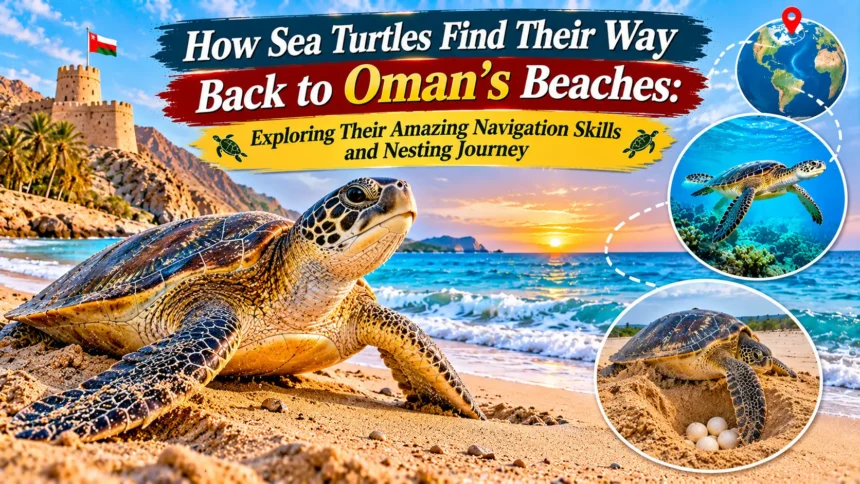
How Sea Turtles Find Their Way Back to Oman’s Beaches: 13 Amazing Facts
Oman’s coastline is famous for its beautiful beaches, clear waters and rich marine life. However, some of its most special visitors are sea turtles that return to the same coastal regions to lay their eggs. These remarkable animals spend much of their lives in the ocean, travelling long distances before returning to suitable nesting beaches.
- 1. Why Sea Turtles Return to the Beaches Where They Were Born
- 2. Earth’s Magnetic Field: A Natural Compass for Sea Turtles
- 3. How Baby Turtles Learn the Magnetic Signature of Their Birthplace
- 4. How How Baby Turtles Learn the Magnetic Signature Map to Navigate the Ocean
- 5. Other Natural Signals That May Help Turtles Find Their Way
- 6. The Long Journey from the Ocean to the Nesting Beach
- 7. How Baby Sea Turtles Find Their Way Towards the Ocean
- 8. Why Oman’s Beaches Are Important for Sea Turtle Nesting
- 9. Different Sea Turtle Species Follow Different Nesting Seasons in Oman
- 10. How Scientists Study the Journey of Sea Turtles in Oman
- 11. The Biggest Threats to Sea Turtles Returning to Oman’s Beaches
- 12. How Visitors Can Help Protect Sea Turtles in Oman
- 13. Why Protecting Oman’s Sea Turtle Beaches Matters
- Conclusion
- Frequently Asked Questions (FAQs)
This journey is one of nature’s most fascinating mysteries. A female sea turtle may leave the beach where she was born, travel across large areas of the ocean and return years later when she is ready to reproduce. But without maps, signs or modern technology, how does she find her way back?
Scientists have discovered that sea turtles can sense Earth’s magnetic field and may use it as a natural navigation system. They can also respond to other environmental signals that help them move through the ocean and approach coastal areas.
Oman is an important part of this story because its beaches provide nesting habitats for several sea turtle species. From the famous green turtles of Ras Al Jinz to the loggerhead turtles of Masirah Island, these animals make the country’s coastline an important destination for marine conservation.
Let’s explore how sea turtles find their way back to Oman’s beaches, what happens during their nesting journey and why protecting these coastal habitats is so important.
1. Why Sea Turtles Return to the Beaches Where They Were Born
One of the most interesting behaviours of sea turtles is known as natal homing.
Returning to familiar nesting areas brings adult turtles together during the breeding season, making it easier for them to find a mate.
It describes the ability of many female turtles to return to the general area where they hatched when they become adults and are ready to lay eggs.
After laying their eggs and covering them with sand, mother turtles return to the sea without caring for their young. Coming back to the beach where they were born helps them choose a familiar place with suitable sand, moisture, and conditions for their eggs to hatch and survive.
Sea turtles begin life on sandy beaches. After hatching, they move towards the sea and start a journey that can take them far away from their birthplace. They spend years travelling, feeding and growing in different marine habitats.
When female turtles reach reproductive maturity, they return to nesting areas to lay their eggs. Many species show a strong connection with their birthplace, although they may nest on a nearby beach rather than on the exact spot where they hatched.
This behaviour is important because nesting beaches usually have natural conditions suitable for turtle eggs. Suitable sand, access to the sea and the shape of the coastline can all influence whether a beach is appropriate for nesting.
Scientists have studied this behaviour for many years. Research suggests that turtles develop memories of the magnetic environment around their birthplace and use those memories when returning as adults.
2. Earth’s Magnetic Field: A Natural Compass for Sea Turtles
One of the main explanations for how sea turtles navigate across large ocean areas is their ability to detect Earth’s magnetic field.
Our planet behaves like a giant magnet. Its magnetic field surrounds the Earth and creates natural patterns that vary from one location to another.
Humans cannot normally feel these magnetic changes, but sea turtles have a special sensory ability known as magnetoreception. It allows them to detect information from the magnetic environment and use it for orientation.
Scientists believe that turtles can respond to two important features of Earth’s magnetic field:
- Magnetic inclination: The angle at which magnetic field lines meet the Earth’s surface.
- Magnetic intensity: The strength of the magnetic field at a particular location.
Together, these features create magnetic signatures that can help identify different areas of the ocean.
Research experiments with sea turtles have shown that they can respond to different magnetic conditions by swimming in particular directions. This suggests that the magnetic field works like a natural navigation system.
3. How Baby Turtles Learn the Magnetic Signature of Their Birthplace
An important part of the turtle navigation story begins when the animals are still very young.
When baby turtles hatch, they leave the nest and move towards the ocean. During this early period, scientists believe they can become familiar with the magnetic information connected with their home beach.
This process is often described as magnetic imprinting.
Imagine a young turtle reaching the sea for the first time. It cannot see a map or remember a road, but it experiences the magnetic conditions of its surrounding environment. These magnetic features may become part of its internal navigation memory.
Years later, when the turtle is an adult, it can use this information to recognise the magnetic signature associated with its birthplace.
Research supports the idea that sea turtles can detect magnetic signatures and that the magnetic conditions along coastlines can help explain where turtles return to nest. However, the exact process is still being studied, and scientists do not yet understand every detail of how the animals store and use this information.
This natural ability is especially fascinating because turtles can remember environmental information for many years without needing to visit their birthplace during that time.
4. How How Baby Turtles Learn the Magnetic Signature Map to Navigate the Ocean
A compass tells an animal which direction to travel, but a map helps it understand where it is. Scientists believe sea turtles may use the Earth’s magnetic field for both types of information.
Their navigation system is thought to work in two connected ways.
First, a magnetic compass helps them maintain a direction while swimming across open water. This is useful when there are no visible landmarks around them.
Sea turtles compare the magnetic signals around them with those of their destination to find the right path. Their natural compass then helps them stay on course, guiding them in the correct direction until they reach their destination.
Second, a magnetic map may help them recognise where they are in relation to their destination. As magnetic intensity and inclination change across the ocean, turtles can use these differences to make decisions about their movement.
Earth’s magnetic field varies from one place to another around the world. Sea turtles can sense these changes and use them to understand their location, much like using latitude and longitude on a map.
This is particularly important during long migrations. A turtle cannot simply swim in one straight direction for its entire journey because ocean currents, weather conditions and the shape of the coastline can affect its route.
The magnetic map idea is supported by laboratory studies and research into the locations where nesting turtles return. It is one of the strongest scientific explanations for long-distance sea turtle navigation.
5. Other Natural Signals That May Help Turtles Find Their Way
Although Earth’s magnetic field is an important navigation tool, it may not be the only source of information sea turtles use.
The ocean contains many natural signals that can help animals understand their surroundings. These may become particularly useful when turtles move closer to their destination.
Some possible navigation cues include:
Ocean currents: Moving water can influence a turtle’s route. Currents may help turtles travel efficiently, although animals sometimes need to swim actively to avoid being carried away from suitable areas.
Smell: Chemical signals in the water may provide information about nearby coastal environments. Scientists continue to study how important smell is during different parts of sea turtle migration.
Waves and water movement: Wave direction and coastal water patterns may provide additional information when turtles approach land.
Visual surroundings: As turtles get closer to shore, visible features such as the coastline and beach environment may help them move through shallow water and find suitable nesting areas.
Not every cue has been confirmed as a major part of natal homing in every species. Scientists believe turtles combine several types of information, but the importance of each signal may change depending on location and stage of the journey.
6. The Long Journey from the Ocean to the Nesting Beach
Returning to a nesting area is not a simple journey. Sea turtles may travel across large areas of the ocean before approaching the coast where they were born.
During this period, they need to find food, avoid predators and deal with changing ocean conditions. Some species travel across thousands of kilometres between feeding grounds and nesting areas.
When a female turtle reaches the coastal region, she begins looking for a suitable beach.
She usually approaches the shore at night, when temperatures are lower and there are fewer disturbances. After reaching the sand, she uses her front flippers to move towards a suitable nesting location.
The female then uses her rear flippers to dig a nest chamber in the sand. Once the eggs have been laid, she covers the nest and returns to the sea.
A single female may lay more than one clutch of eggs during a nesting season, usually returning to the ocean between nesting events.
This journey requires energy and careful movement. The turtle must find a beach where the sand and surroundings provide a suitable environment for her eggs to develop.
7. How Baby Sea Turtles Find Their Way Towards the Ocean
The journey does not end when the eggs are laid. In fact, another fascinating navigation challenge begins when baby turtles hatch.
After spending time developing inside the eggs, hatchlings break out of their shells and slowly move through the sand towards the beach surface.
Once they reach the open beach, they need to find the sea. They do not follow their mothers because adult female turtles return to the ocean after nesting.
Instead, hatchlings use natural light conditions and the appearance of the horizon to help identify the direction of the sea.
On a natural, dark beach, the ocean horizon is usually more open and brighter than the darker land behind the beach. Hatchlings respond to this difference and move towards the water.
Artificial lights can confuse them. Streetlights, buildings, vehicles and other bright sources may attract hatchlings away from the sea.
This is one reason why protecting nesting beaches from light pollution is so important.
The natural movement of hatchlings towards the sea is different from the adult female’s long-distance natal homing journey. One helps a newborn turtle reach the ocean, while the other helps an adult female return to a nesting region years later.
8. Why Oman’s Beaches Are Important for Sea Turtle Nesting
Oman is one of the most important countries for sea turtle conservation in the Indian Ocean region. Its long coastline includes sandy beaches, islands and coastal habitats that provide nesting opportunities for several species.
According to the Environment Society of Oman, four sea turtle species nest along Oman’s coastline:
- Green turtle.
- Loggerhead turtle.
- Hawksbill turtle.
- Olive ridley turtle.
A fifth species, the leatherback turtle, has been recorded in Omani waters but is not known to nest along the country’s coastline.
Several Omani destinations are particularly important for turtle nesting.
Ras Al Jinz and Ras Al Hadd: These beaches in the Ash Sharqiyah region are especially well known for green turtle nesting. Ras Al Jinz is one of the country’s most recognised turtle-watching destinations.
Masirah Island: This island supports one of the world’s largest nesting aggregations of loggerhead turtles. Four species, including loggerhead, green, hawksbill and olive ridley turtles, have been recorded nesting there.
Daymaniyat Islands: These protected islands off the coast near Muscat are important for marine biodiversity and provide nesting habitat for hawksbill turtles.
These coastal areas show why Oman has such an important role in protecting sea turtles across the Indian Ocean.
9. Different Sea Turtle Species Follow Different Nesting Seasons in Oman
Not all sea turtles arrive at the same time. Different species have different nesting patterns, and the timing can vary between locations and years.
For example, Masirah Island supports several nesting species during different parts of the year.
According to the Environment Society of Oman’s turtle guidance:
- Olive ridley turtles: Generally nest between February and May.
- Hawksbill turtles: Also nest during the period from February to May on parts of the island.
- Loggerhead turtles: Commonly nest between May and September.
- Green turtles: Nest during the warmer months, with the season extending towards the later part of the year.
The exact timing of nesting and hatching can change according to local environmental conditions.
The different nesting periods mean that Oman’s beaches can support turtle activity across much of the year.
Visitors interested in seeing turtles should check with authorised conservation organisations and local authorities before planning a visit.
10. How Scientists Study the Journey of Sea Turtles in Oman
Understanding sea turtle migration is not easy because much of their lives are spent underwater.
Researchers use different scientific methods to learn where turtles travel, how long they stay at feeding grounds and which coastal areas they visit during nesting seasons.
One important method is satellite tracking. A small tracking device is attached to a turtle’s shell using a method designed to avoid harming the animal.
The device sends location information to researchers through satellite systems. Scientists can then follow the turtle’s movements and study its migration routes.
In November 2022, Oman’s Environment Authority launched the second phase of a sea turtle satellite-tracking project. Five tracking devices were installed in the Ras Al Jinz area to support research into nesting behaviour, habitats and migration-related threats.
Researchers also carry out regular beach surveys. They record turtle tracks, identify nesting areas and monitor changes in the number of nests.
These studies help conservation teams understand how turtles use Oman’s coastline and what needs to be done to protect their habitats.
11. The Biggest Threats to Sea Turtles Returning to Oman’s Beaches
Although sea turtles have remarkable navigation skills, they still face many dangers during migration and nesting.
Some of the biggest threats are connected with human activities.
Artificial lighting: Bright lights from buildings, roads and vehicles can confuse nesting females and cause hatchlings to move in the wrong direction.
Beach driving: Vehicles on nesting beaches can damage nests, disturb turtles and destroy important sand areas.
Fishing nets and equipment: Turtles may become trapped in fishing nets or abandoned gear, a problem known as bycatch or ghost fishing.
Plastic pollution: Turtles can become entangled in plastic waste or mistake floating plastic for food.
Coastal development: Construction near beaches can change nesting habitats, reduce dark areas and disturb natural beach conditions.
Climate change: Rising temperatures, changing sea levels and stronger coastal events can affect nesting beaches and egg development.
The Environment Society of Oman identifies these pressures as important threats to turtle populations in the country. Its research programme also reports a significant decline in the Masirah Island loggerhead population, estimated at 79 per cent over a loggerhead generation.
12. How Visitors Can Help Protect Sea Turtles in Oman
Tourism can help raise awareness about sea turtles, but visitors need to behave responsibly when exploring nesting beaches.
Turtles are sensitive to light, noise and human movement. Even a small disturbance can affect their behaviour, especially while they are laying eggs or when hatchlings are moving towards the sea.
Here are some important rules to follow:
- Never use flash photography or bright phone lights near nesting turtles.
- Do not touch, chase or block a turtle’s path.
- Keep a safe distance and follow the guide’s instructions.
- Never step on an identified nesting area.
- Do not leave plastic, food packaging or other rubbish on the beach.
- Avoid driving on nesting beaches.
- Keep pets away from turtle nesting areas.
- Choose authorised turtle-watching experiences.
The Environment Society of Oman also recommends reducing lights facing nesting beaches and using suitable low-impact lighting where necessary.
These simple steps help protect nesting females, eggs and newly hatched turtles.
13. Why Protecting Oman’s Sea Turtle Beaches Matters
Oman’s sea turtle beaches are valuable natural habitats. They support breeding populations, contribute to marine biodiversity and form an important part of the country’s natural heritage.
Sea turtles also play roles in maintaining healthy marine ecosystems. Green turtles feed on seagrass, helping influence the condition of seagrass habitats. Hawksbill turtles feed on sponges around coral reefs, while other species have different feeding habits that connect them with marine food chains.
Protecting these animals therefore means protecting the wider ocean environment.
Oman has established protected areas, conservation programmes and research projects to support sea turtle populations. Organisations also work with local communities, fishermen, students and visitors to increase awareness.
Long-term protection requires cooperation between government authorities, researchers and the public.
By keeping beaches clean, reducing artificial lighting and protecting marine habitats, people can help ensure that sea turtles continue returning to Oman’s coastline.
Conclusion
The way sea turtles find their way back to Oman’s beaches is one of nature’s most fascinating journeys. These animals can travel across vast ocean areas and return to the coastal regions where they began life.
Scientists believe that Earth’s magnetic field plays an important role in this ability. Young turtles may become familiar with the magnetic signature of their birthplace, while adults use magnetic information to navigate during long migrations. Other environmental cues may also help them as they approach the coast.
Oman’s beaches, including Ras Al Jinz, Ras Al Hadd and Masirah Island, are important nesting areas for several sea turtle species. Their protection is essential for the survival of these remarkable marine animals.
Understanding how sea turtles navigate also reminds us how closely wildlife depends on natural environments. By protecting nesting beaches, reducing pollution and supporting responsible tourism, Oman can help these incredible travellers continue returning to its shores.
Frequently Asked Questions (FAQs)
1. How do sea turtles find their way back to their birthplace?
Scientists believe sea turtles use Earth’s magnetic field to recognise the magnetic signature of the area where they hatched. They may become familiar with these signals when they are young and use them when returning as adults.
2. What is natal homing in sea turtles?
Natal homing is the behaviour in which adult female sea turtles return to the general region where they were born to lay their eggs. They may choose the same beach or a nearby suitable nesting area.
3. Why is Earth’s magnetic field important for sea turtles?
Earth’s magnetic field provides natural information about direction and location. Sea turtles can sense features such as magnetic intensity and inclination, which may help them navigate through the ocean.
4. Which sea turtles nest on Oman’s beaches?
Four species are known to nest along Oman’s coastline: green turtles, loggerhead turtles, hawksbill turtles and olive ridley turtles.
5. Where can visitors see sea turtles in Oman?
Ras Al Jinz and Ras Al Hadd are famous for green turtle nesting, while Masirah Island is an important destination for loggerhead turtles. The Daymaniyat Islands also provide important nesting habitat for hawksbill turtles.
6. Why do baby sea turtles move towards the sea after hatching?
Hatchlings use natural light and the appearance of the horizon to identify the direction of the ocean. Artificial lights can confuse them and cause them to move away from the water.
7. What threats do sea turtles face in Oman?
Major threats include artificial lighting, coastal development, plastic pollution, fishing nets, abandoned fishing equipment, beach driving and climate change.
8. How can tourists help protect sea turtles?
Visitors can help by avoiding flash photography, keeping their distance, following authorised guides, not touching nests and keeping beaches clean.
Do follow us on Instagram
Read More – Amazing Wildlife Species Found in Oman Natural Landscapes