8 Fascinating Facts About the Arabian Wolf: Arabia’s Desert Survivor
The Arabian wolf is one of the most remarkable yet lesser-known wild animals of the Middle East. Living among rocky mountains, dry valleys and remote desert landscapes, this extraordinary predator has developed unique abilities to survive in some of the harshest environments on Earth. Unlike the large wolves found in colder regions, the Arabian wolf has adapted to extreme heat, limited water and unpredictable food supplies.
- 1. The Arabian Wolf Is One of the Smallest Wolves in the World
- 2. Arabian Wolves Have Special Adaptations for Desert Survival
- 3. The Arabian Wolf Lives Beyond the Desert Sand Dunes
- 4. Arabian Wolves Eat More Than Just Meat
- 5. Arabian Wolves Often Live in Smaller Family Groups
- 6. Arabian Wolves Help Maintain Healthy Desert Ecosystems
- 7. The Arabian Wolf Faces Serious Threats in the Wild
- 8. Conservation Programmes Are Helping Protect the Arabian Wolf
- Conclusion
- Frequently Asked Questions About the Arabian Wolf
Scientifically known as Canis lupus arabs, the Arabian wolf is a subspecies of the grey wolf. It plays an important role in maintaining the natural balance of desert ecosystems and represents a valuable part of the Arabian Peninsula’s wildlife heritage.
Unfortunately, habitat destruction, illegal hunting and conflicts with humans have placed its future at risk. Although conservation programmes are helping protect this remarkable animal, many wild populations continue to face serious challenges.
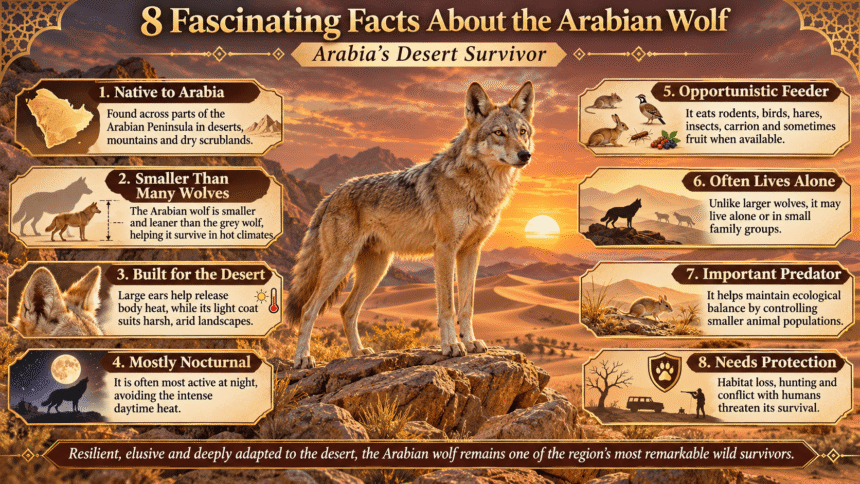
From its unusual physical features to its intelligent hunting behaviour, here are eight fascinating facts about the Arabian wolf that reveal how this incredible animal survives in the Middle East.
1. The Arabian Wolf Is One of the Smallest Wolves in the World
When people imagine a wolf, they often picture a large animal with thick fur living in snowy forests. However, the Arabian wolf looks quite different from its relatives in Europe, Asia and North America.
It is widely recognised as one of the smallest subspecies of the grey wolf. Its relatively lightweight body and slender appearance are particularly suited to the hot and dry conditions of the Arabian Peninsula.
An adult Arabian wolf generally stands around 60 to 65 centimetres tall at the shoulder. Its body weight varies depending on age, sex, food availability and environmental conditions, but it is considerably lighter than many northern grey wolves.
Their short, thin coat is usually greyish-beige or sandy brown, helping them blend into the desert and stay cool. However, a few rare dark-coloured individuals have also been spotted in the western highlands of Saudi Arabia.
Its smaller body requires less food to maintain than the body of a much larger wolf. This can be an advantage in desert environments where prey is often scattered and food availability changes throughout the year.
Quick Facts About the Arabian Wolf
| Feature | Details |
|---|---|
| Scientific name | Canis lupus arabs |
| Animal family | Canidae |
| Animal type | Mammal |
| Natural habitat | Deserts, mountains and rocky valleys |
| Average shoulder height | Approximately 60 to 65 cm |
| Diet | Mainly meat, with some plant-based food |
| Body colour | Sandy brown or greyish brown |
| Social behaviour | Small family groups, pairs or solitary individuals |
| Activity | Often active at night or during cooler hours |
| Geographical range | Arabian Peninsula and neighbouring Middle Eastern regions |
| Major threats | Hunting, habitat loss and human-wildlife conflict |
Despite its relatively small size, the Arabian wolf is a capable predator. Its strength, intelligence and adaptability allow it to survive in landscapes where larger animals may struggle to find enough resources.
2. Arabian Wolves Have Special Adaptations for Desert Survival
The Arabian Peninsula experiences extremely high temperatures during summer, while rainfall is limited across many regions. Finding food, water and shelter can become a daily challenge for wild animals.
The Arabian wolf has developed several physical and behavioural adaptations that help it manage these difficult conditions. Its appearance is not simply a result of living in the desert but reflects generations of adaptation to its surroundings.
Large ears help release body heat
One of the most noticeable features of the Arabian wolf is its relatively large ears. Compared with wolves living in colder climates, its ears are larger in proportion to its body.
Scientists believe this characteristic helps release body heat, making it easier for the animal to manage high temperatures. Its ears also provide excellent hearing, allowing it to detect prey and potential threats.
Their large ears help release body heat and keep them cool in hot weather.
A lighter coat provides natural camouflage
The Arabian wolf usually has sandy-brown or greyish fur that blends naturally with rocky desert landscapes. This camouflage helps it remain less visible while moving through its habitat.
Its coat is generally shorter and lighter than the thick winter coats of northern wolves. However, its fur can change with the seasons, providing additional protection during cooler months.
Other important survival adaptations include:
- A relatively small and lightweight body.
- Strong legs suitable for travelling across rocky terrain.
- Excellent hearing and a sensitive sense of smell.
- Flexible feeding habits during food shortages.
- Increased activity during cooler periods.
- The ability to travel long distances in search of resources.
During extremely hot afternoons, Arabian wolves may rest in shaded areas, caves or sheltered valleys. They often become more active when temperatures begin to fall.
These adaptations demonstrate how an animal’s physical appearance and daily behaviour can develop in response to its natural environment.
3. The Arabian Wolf Lives Beyond the Desert Sand Dunes
Although its name is strongly associated with Arabia’s deserts, the Arabian wolf does not depend entirely on open sandy landscapes. It occupies various environments that provide suitable shelter, prey and access to water.
Rocky mountains and dry valleys are particularly important because they offer natural protection from extreme temperatures and human disturbance. These habitats may also support greater wildlife diversity than large, empty sand dunes.
Historically, Arabian wolves occupied much of the Arabian Peninsula. However, their distribution has become more restricted as human populations, infrastructure and agricultural activities have expanded.
Where is the Arabian wolf found?
Its known or historical geographical range includes:
- Saudi Arabia
- Oman
- Yemen
- Jordan
- Southern Israel
- Parts of the Sinai Peninsula in Egypt
The Arabian wolf was also historically present in the United Arab Emirates. However, recent scientific research describes it as locally extinct in the UAE’s wild environment.
Saudi Arabia remains particularly important for Arabian wolf conservation. Its extensive mountain systems, rocky plateaus and protected natural areas provide suitable habitats for surviving populations.
Natural Habitats of the Arabian Wolf
| Habitat | Importance for Survival |
|---|---|
| Rocky mountains | Provide shelter and hunting opportunities |
| Desert valleys | Offer access to vegetation, prey and seasonal water |
| Gravel plains | Allow movement between different habitats |
| Mountain caves | Provide protection from heat and disturbance |
| Dry shrublands | Support small mammals and other prey |
| Protected nature reserves | Reduce exposure to certain human-related threats |
Unlike animals that can survive within relatively small territories, wolves need enough space to search for food and move between suitable habitats.
Roads, fences and expanding settlements can interrupt these movements. Protecting connections between natural areas is therefore just as important as establishing individual wildlife reserves.
4. Arabian Wolves Eat More Than Just Meat
Another fascinating fact about the Arabian wolf is its flexible diet. Although it is primarily a predator, it can consume a wide variety of foods depending on what is available in its surroundings.
This flexibility is particularly valuable in desert ecosystems, where rainfall and seasonal changes can influence the availability of plants and prey.
Rather than relying entirely on large mammals, the Arabian wolf often feeds on smaller animals that are easier to find. It may also consume carrion, which is the remains of animals that have already died.
What does the Arabian wolf eat?
Its diet may include:
- Desert hares and rabbits.
- Rodents and other small mammals.
- Birds and their eggs.
- Lizards and other reptiles.
- Insects.
- Gazelles and young wild hoofed animals.
- Animal carcasses.
- Fruits and other available plant material.
Arabian wolves may also prey on domestic goats and sheep, particularly where natural prey populations are limited or livestock are left unprotected.
Unfortunately, this behaviour can lead to conflicts with farmers and livestock owners. In some areas, such conflicts have resulted in wolves being hunted or killed.
The Arabian wolf is an opportunistic feeder, meaning it makes use of available food rather than depending on a single type of prey.
Arabian Wolf vs Northern Grey Wolf
| Characteristic | Arabian Wolf | Northern Grey Wolf Populations |
|---|---|---|
| Body size | Smaller and lighter | Generally larger and heavier |
| Natural habitat | Deserts and rocky mountains | Forests, grasslands and tundra |
| Common prey | Small and medium-sized animals | Often larger hoofed mammals |
| Fur | Relatively short and light | Generally thicker in colder regions |
| Hunting groups | Often alone, in pairs or small groups | May hunt in larger packs |
| Climate adaptation | Hot and dry environments | Frequently cooler environments |
Both belong to the same species, but their differences show how wolves can adapt to very different living conditions.
5. Arabian Wolves Often Live in Smaller Family Groups
Wolves are famous for their social behaviour and ability to work together. However, the Arabian wolf does not always form the large packs commonly associated with wolves in northern regions.
Research conducted in desert environments has found that Arabian wolves often search for food in relatively small groups. They may also travel alone or in pairs.
One possible reason is the limited availability of food. Maintaining a large group requires substantial resources, which may be difficult to find in dry landscapes.
Smaller groups can reduce competition for food and allow individuals to search different areas when resources become scarce.
How Arabian wolves communicate
Arabian wolves use several forms of communication to interact with family members and other wolves. These include sounds, scent markings and physical movements.
Their communication methods include:
- Howling to communicate over distances.
- Growling to express warnings.
- Scent marking to communicate territorial information.
- Ear and tail movements to display intentions.
- Facial expressions and body posture.
Communication is particularly important in remote landscapes, where individuals may become separated while searching for food.
Reproduction and family life
Like other grey wolves, Arabian wolves give birth to young known as pups. Their pregnancy period lasts approximately two months.
Female wolves generally select sheltered locations for giving birth, where their young can remain protected during the early stages of development.
Newborn pups depend entirely on their mother and gradually develop the skills needed to survive. As they grow older, they learn how to recognise danger, communicate with other wolves and search for food.
Family cooperation can help young wolves survive, although social arrangements may differ according to local environmental conditions and food availability.
6. Arabian Wolves Help Maintain Healthy Desert Ecosystems
The Arabian wolf is more than an impressive wild animal. It is an important predator that contributes to the natural functioning of desert and mountain environments.
Predators influence the populations and behaviour of other animals. These relationships can affect vegetation, competition between species and the overall health of an ecosystem.
By hunting small mammals and other available prey, Arabian wolves form an important part of regional food chains. Their presence can also influence how smaller predators use the surrounding landscape.
Food is often hard to find in dry desert areas, so Arabian wolves also feed on dead animals. By eating these remains, they help keep their surroundings clean and return nutrients to the environment.
Scientists studying Middle Eastern desert ecosystems have examined how the presence of Arabian wolves affects other members of the dog family, including jackals and foxes.
Ecological importance of the Arabian wolf
| Ecological Role | Environmental Benefit |
|---|---|
| Predation | Helps regulate certain prey populations |
| Scavenging | Contributes to the breakdown of animal remains |
| Food chain interactions | Influences relationships between different species |
| Natural selection | Can affect the survival of prey populations |
| Biodiversity conservation | Forms part of native desert wildlife communities |
| Scientific research | Helps researchers understand predator behaviour |
The disappearance of a predator can create changes throughout an ecosystem. However, these effects depend on the local environment, the species present and other pressures such as human activity.
Protecting Arabian wolves therefore means protecting more than a single animal. It also means maintaining the natural relationships that have developed across desert ecosystems over many generations.
The wolf also has cultural importance in Arabian society. References to wolves can be found in traditional stories, poetry and folklore, where they sometimes represent intelligence, courage, independence and survival.
7. The Arabian Wolf Faces Serious Threats in the Wild
Despite its ability to survive extreme environmental conditions, the Arabian wolf faces significant challenges caused by human activities.
Its natural distribution has declined over time, and several surviving populations occupy increasingly fragmented habitats. Scientists have highlighted the need for stronger conservation measures across the Arabian Peninsula.
The global grey wolf species is classified as Least Concern by the International Union for Conservation of Nature. However, this broad classification does not reflect the more serious situation of Arabian wolf populations.
Regional and national assessments have identified wolves as endangered in parts of the Arabian Peninsula, including Saudi Arabia.
Major threats facing the Arabian wolf
| Threat | Impact on Arabian Wolves |
|---|---|
| Illegal hunting | Direct loss of wild individuals |
| Habitat destruction | Reduces suitable living and breeding areas |
| Road construction | Increases habitat fragmentation and collision risks |
| Livestock conflict | Can lead to retaliatory killing |
| Declining natural prey | Makes finding food more difficult |
| Climate change | May reduce water and food availability |
| Poisoning | Threatens wolves and other wildlife |
| Hybridisation with domestic dogs | May affect the genetic identity of wild populations |
Hybridisation occurs when wolves breed with domestic dogs. Researchers have raised concerns about this issue because repeated interbreeding may affect the unique genetic characteristics of Arabian wolf populations.
Human-wildlife conflict remains another major concern. Livestock owners may suffer financial losses when predators attack their animals, particularly in rural communities where livestock provide an important source of income.
Effective conservation must therefore consider the needs of both wildlife and local people. Better livestock protection and community education can help reduce conflict without harming wild predators.
8. Conservation Programmes Are Helping Protect the Arabian Wolf
Several countries across the Middle East have recognised the importance of conserving native wildlife and restoring damaged natural habitats.
In Saudi Arabia, the National Center for Wildlife and various protected-area authorities are working to improve wildlife protection, scientific research and environmental management.
Arabian wolves have been documented in protected landscapes, including areas within the King Salman bin Abdulaziz Royal Nature Reserve and the Prince Mohammed bin Salman Royal Reserve.
Researchers use camera traps to study these animals without continuously following or disturbing them. These cameras automatically capture photographs when wildlife moves nearby, helping scientists understand where wolves live and how they use their habitats.
Important steps for Arabian wolf conservation include:
- Protecting natural mountain and desert habitats.
- Preventing illegal hunting and poisoning.
- Restoring populations of natural prey.
- Monitoring wolves through camera traps and genetic research.
- Protecting connections between wildlife habitats.
- Improving livestock protection methods.
- Reducing harmful interactions with free-ranging domestic dogs.
- Educating communities about the importance of predators.
- Encouraging responsible wildlife tourism.
- Strengthening regional conservation cooperation.
Conservation requires long-term commitment rather than occasional wildlife protection activities. Healthy populations need sufficient space, natural prey and protection from unnecessary disturbance.
As countries across the Arabian Peninsula continue to invest in environmental restoration and sustainable tourism, the Arabian wolf can become an important symbol of regional biodiversity conservation.
Conclusion
The Arabian wolf is an extraordinary example of nature’s ability to adapt to challenging environments. Its relatively small body, remarkable intelligence, flexible diet and specialised survival abilities allow it to live among the dry deserts and rocky mountains of the Middle East.
Beyond its fascinating physical characteristics, this native predator contributes to biodiversity, natural food chains and the cultural heritage of the Arabian Peninsula.
Protecting the Arabian wolf requires a balanced approach that supports wildlife conservation while addressing the challenges faced by local communities. Through scientific research, habitat protection and greater environmental awareness, future generations can continue to appreciate this remarkable desert survivor.
The survival of the Arabian wolf is not simply about protecting one animal. It is also about preserving the unique natural heritage of Arabia itself.
Frequently Asked Questions About the Arabian Wolf
1. Is the Arabian wolf dangerous to humans?
Arabian wolves generally avoid people. However, they are wild predators and should never be approached, fed or treated like domestic animals.
2. Is the Arabian wolf the smallest wolf in the world?
It is widely recognised as one of the smallest subspecies of the grey wolf, with a lighter body than many wolves living in colder climates.
3. Can Arabian wolves survive in extreme heat?
Yes. Their relatively small bodies, large ears, lighter coats and activity during cooler periods help them survive desert conditions.
4. Are Arabian wolves found in Dubai?
There is no established wild Arabian wolf population in Dubai. The animal historically lived in the UAE but is considered locally extinct in the country’s wild environment.
5. What is the Arabic name for the Arabian wolf?
The wolf is commonly known as Al Dhib or Al Dheeb in Arabic. The Arabian wolf is called الذئب العربي.
6. How many Arabian wolves are left in the wild?
There is no reliable, comprehensive population count covering the animal’s entire geographical range. Its remote habitats and fragmented distribution make accurate estimates difficult.
Do follow us on Instagram
Read More – Nubian Ibex