Nubian Ibex: The Remarkable Mountain Survivor of the Arabian Peninsula
The Nubian ibex is one of the most fascinating wild animals found in the mountainous regions of the Arabian Peninsula and northeastern Africa. Known for its large curved horns, strong legs and extraordinary climbing abilities, this wild goat survives in places where many other animals would struggle to live. From steep mountain cliffs to dry desert valleys, it has adapted to some of the toughest natural environments in the world.
- What Is a Nubian Ibex?
- Natural Habitat and Distribution of the Nubian Ibex
- Physical Characteristics and Extraordinary Survival Skills
- Diet, Daily Behaviour and Reproduction
- The Importance of the Nubian Ibex in Arabian Ecosystems
- Why Is the Nubian Ibex Vulnerable to Extinction?
- Nubian Ibex Conservation Efforts in Saudi Arabia and Oman
- Conclusion
- Frequently Asked Questions About the Nubian Ibex
Unlike animals that depend on green forests and regular rainfall, the Nubian ibex lives in areas with limited vegetation, high temperatures and scarce water resources. Its ability to move across rocky mountains with remarkable balance makes it an impressive example of how wildlife adapts to challenging surroundings.
However, despite its natural survival skills, the Nubian ibex faces serious threats from habitat destruction, illegal hunting, climate change and competition with domestic animals. Protecting this species has become an important part of wildlife conservation efforts across the Middle East.
Understanding its habitat, behaviour, diet and ecological importance can help people appreciate the remarkable biodiversity of the Arabian Peninsula.
What Is a Nubian Ibex?
The Nubian ibex, scientifically known as Capra nubiana, is a species of wild goat belonging to the Bovidae family. This family also includes sheep, cattle, antelopes and several other hoofed animals. The Nubian ibex is particularly well adapted to hot and dry mountain environments.
Its name is associated with Nubia, a historical region covering parts of present-day Egypt and Sudan. However, its natural habitat extends far beyond this region, reaching several countries across the Middle East and the Arabian Peninsula.
Adults usually grow to around 65–75 cm tall at the shoulder and weigh between 25 and 70 kg. Males are generally much larger than females.
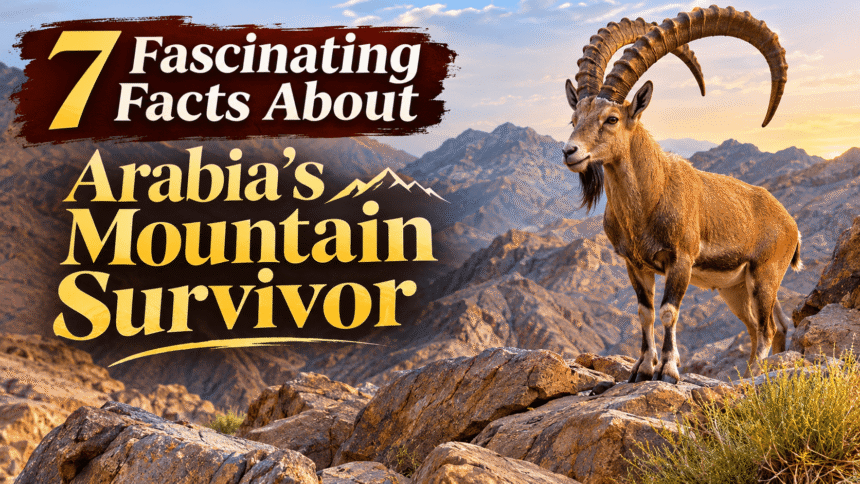
Male have large horns that curve backwards and can grow up to 1.2 metres long. Female horns are much shorter and thinner, usually measuring around 30 to 36 cm.
One of the most noticeable features of the Nubian ibex is its impressive horns. Adult males have long horns that curve backwards, while females have much shorter and thinner horns. Their sandy-brown bodies also allow them to blend naturally into rocky desert surroundings.
Although they belong to the same wider animal group as domestic goats, Nubian ibex are wild animals with specialised survival abilities. Their physical strength, alert nature and climbing skills allow them to occupy remote mountain landscapes.
Quick Facts About the Nubian Ibex
| Feature | Details |
|---|---|
| Scientific name | Capra nubiana |
| Animal family | Bovidae |
| Animal type | Mammal |
| Diet | Herbivore |
| Natural habitat | Rocky mountains, cliffs and desert valleys |
| Geographical range | Middle East and northeastern Africa |
| Horn length | Can exceed one metre in adult males |
| Body colour | Sandy brown with lighter markings |
| Pregnancy period | Approximately five months |
| Young ones | Known as kids |
| Conservation status | Vulnerable |
| Major threats | Hunting, habitat loss and climate change |
The Nubian ibex is also an important part of the natural heritage of Arabian countries, particularly those with extensive mountain ranges and desert ecosystems.
Natural Habitat and Distribution of the Nubian Ibex
The Nubian ibex prefers rocky landscapes with steep cliffs, narrow valleys, mountain ridges and scattered vegetation. These environments provide natural protection from predators while allowing the animals to find food and shelter.
Unlike many large mammals that prefer open grasslands, Nubian ibex are comfortable living on steep mountain slopes. Their ability to climb difficult surfaces gives them access to areas that many predators cannot easily reach.
Unlike many desert antelopes that get water from the plants they eat, Nubian ibex need regular access to fresh water. They usually live near natural springs, oases, and seasonal water pools found in desert valleys known as wadis.
During particularly hot periods, shaded caves, rock formations and narrow mountain passages provide protection from direct sunlight.
Where Is the Nubian Ibex Found?
The natural and historical distribution of the Nubian ibex includes several countries across northeastern Africa and the Middle East:
- Saudi Arabia
- Oman
- Yemen
- Jordan
- Egypt
- Sudan
- Eritrea
- Israel
Its present distribution varies across these countries, and some populations are small or poorly documented.
Saudi Arabia contains several important habitats for the Nubian ibex. Its western mountain ranges and central protected areas provide suitable environments for wild populations. In Oman, Nubian ibex are found in parts of Dhofar and Al Wusta, including protected landscapes.
Mountain habitats are important because they provide more than shelter. Seasonal rainfall encourages the growth of grasses, shrubs and other plants that support wildlife. Small natural water sources can also become essential during dry periods.
However, roads, construction projects and expanding human settlements can divide these habitats into smaller areas. When wildlife populations become separated, finding food, water and suitable breeding partners may become increasingly difficult.
Physical Characteristics and Extraordinary Survival Skills
The Nubian ibex has several physical features that help it survive in extreme mountain and desert conditions. Every part of its body, from its hooves to its coat, plays a role in its ability to live in challenging environments.
Adult males are generally larger and heavier than females. Their long, curved horns and dark beards make them particularly recognisable. Females have a lighter build, which helps them move quickly across rocky surfaces while caring for their young.
Strong and Impressive Horns
The horns of male Nubian ibex are among their most distinctive features. In some large adults, these horns can grow beyond one metre in length.
Male ibex use their horns during competition with other males, particularly during the breeding season. Horn size can also play a role in establishing social position within groups.
Unlike deer antlers, ibex horns are permanent and continue growing throughout much of the animal’s life.
Specially Adapted Hooves
One of the most impressive abilities of the Nubian ibex is its skill in climbing steep cliffs. Its hooves provide grip and support when moving across uneven mountain surfaces.
The hard outer edges of the hooves and softer inner surfaces help the animal maintain balance. This allows it to move confidently along narrow ledges and rocky slopes.
Other important physical adaptations include:
- Strong legs that support climbing and jumping.
- Excellent balance when travelling across uneven rocks.
- Sandy-coloured fur that provides natural camouflage.
- Keen senses that help detect potential danger.
- Behavioural adaptations that reduce exposure to extreme heat.
These abilities allow the Nubian ibex to move between feeding areas, resting places and natural water sources while avoiding many dangers found in open landscapes.
Difference Between Male and Female Nubian Ibex
| Characteristic | Male Nubian Ibex | Female Nubian Ibex |
|---|---|---|
| Body size | Larger and heavier | Smaller and lighter |
| Horns | Long, thick and curved | Shorter and thinner |
| Beard | Often prominent | Generally less noticeable |
| Social behaviour | Often forms male groups | Usually lives with females and young |
| Breeding behaviour | Competes with other males | Raises and protects offspring |
These differences become particularly noticeable during the breeding season, when adult males compete for mating opportunities.
Diet, Daily Behaviour and Reproduction
The Nubian ibex is a herbivore, meaning that it feeds on plants rather than other animals. Living in dry mountain regions requires it to make effective use of whatever suitable vegetation is available.
Its diet changes depending on the season, rainfall and local environmental conditions. During periods of greater plant growth, the animals may have access to fresh leaves and grasses. During dry months, they must search more widely for suitable food.
What Does the Nubian Ibex Eat?
Its natural diet includes:
- Wild grasses
- Small shrubs
- Tree leaves
- Herbs
- Tender plant shoots
- Other available mountain vegetation
Although the Nubian ibex can survive in dry environments, it still requires water. The amount of water it needs depends on temperature, food quality and environmental conditions.
Access to natural springs, temporary pools and other water sources can become particularly important during hot summer months.
Daily Behaviour and Social Life
Nubian ibex generally spend considerable time feeding, resting and moving between different parts of their habitat. During hot weather, they may become more active during cooler parts of the day and seek shade when temperatures rise.
They often live in groups, although the structure of these groups changes throughout the year. Females and their young commonly remain together, while mature males frequently form separate groups outside the breeding season.
Instead of living together in one large population, they are found in small, separate groups across different areas, from sea level to mountain heights of around 3,000 metres.
Living in groups can help the animals detect danger. When one individual notices a potential threat, others may respond by becoming alert or moving towards safer rocky terrain.
Breeding and Raising Young Ibex
The breeding season, commonly known as the rut, usually occurs during autumn. Adult males compete with one another for access to females, sometimes using their powerful horns during physical contests.
Following a pregnancy of approximately five months, females usually give birth to one or two young. Before giving birth, a mother may move away from the group and select a sheltered location among steep rocks.
Young Nubian ibex, known as kids, develop climbing and movement skills remarkably quickly. These abilities are essential because they must learn to follow their mothers across difficult mountain terrain.
During their early months, young ibex depend on their mothers for milk, protection and guidance. As they grow, they gradually begin eating vegetation and become more independent.
The Importance of the Nubian Ibex in Arabian Ecosystems
Every animal plays a role in maintaining the natural balance of its environment. The Nubian ibex is no exception. Its feeding habits, movements and interactions with other wildlife contribute to the functioning of mountain ecosystems.
As a plant-eating animal, the Nubian ibex influences vegetation growth through grazing and browsing. Its activities contribute to the movement of nutrients within the environment.
It also forms part of the natural food chain. Where their habitats overlap, predators such as Arabian wolves and Arabian leopards may hunt ibex. The availability of natural prey is particularly important for the survival of large carnivores.
Major Ecological Benefits of the Nubian Ibex
| Ecological Role | Environmental Importance |
|---|---|
| Grazing and browsing | Influences vegetation growth |
| Nutrient recycling | Returns nutrients to the soil through droppings |
| Supporting predators | Contributes to natural food chains |
| Maintaining biodiversity | Forms part of mountain wildlife communities |
| Scientific research | Helps researchers understand desert survival |
| Wildlife tourism | Creates opportunities for responsible nature-based experiences |
The Nubian ibex also has cultural importance across parts of the Middle East. Images of ibex appear in ancient rock art, reflecting the long relationship between human communities and mountain wildlife.
Today, the species provides an opportunity to educate people about the natural environments that exist beyond the region’s modern cities.
For countries investing in sustainable tourism, protecting native wildlife can also encourage responsible outdoor activities such as wildlife photography, nature observation and guided educational experiences.
However, tourism must be carefully managed to prevent disturbance to animals, particularly around feeding areas and breeding grounds.
Why Is the Nubian Ibex Vulnerable to Extinction?
Despite its remarkable ability to survive extreme natural conditions, the Nubian ibex faces several human-related environmental challenges.
The International Union for Conservation of Nature classified the Nubian ibex as Vulnerable in its 2020 global assessment. This classification indicates that the species faces a high risk of extinction in the wild.
Its total wild population remains difficult to measure because many animals live in remote mountain regions. However, scientific assessments have raised concerns about declining numbers and isolated populations.
Major Threats Facing the Nubian Ibex
- Illegal hunting: Hunting for meat, horns and trophies has contributed to population declines.
- Habitat destruction: Construction and infrastructure projects can reduce suitable living areas.
- Habitat fragmentation: Roads and settlements can separate wildlife populations.
- Climate change: Rising temperatures and changing rainfall patterns may affect food and water availability.
- Competition with livestock: Domestic goats, sheep and other animals may compete for limited vegetation and water.
- Human disturbance: Uncontrolled tourism and off-road activities can disturb sensitive habitats.
- Disease: Contact with domestic livestock may increase exposure to certain infections.
Climate change presents a particularly complex challenge. Although the Nubian ibex is naturally adapted to dry conditions, prolonged droughts can reduce plant growth and make reliable water sources increasingly difficult to find.
Small and isolated populations may also have limited genetic diversity. Over time, this can affect their ability to adapt to environmental changes and recover from population losses.
Protecting the species therefore requires more than preventing hunting. It also requires protecting the landscapes, vegetation and natural resources that support its survival.
Nubian Ibex Conservation Efforts in Saudi Arabia and Oman
Several Middle Eastern countries have recognised the importance of protecting native wildlife. Saudi Arabia and Oman have established protected areas, wildlife monitoring programmes and conservation initiatives that benefit the Nubian ibex.
These efforts are particularly important as both countries continue to develop infrastructure, tourism and other economic activities.
Conservation in Saudi Arabia
Saudi Arabia has established protected areas to safeguard its native wildlife. The Ibex Reserve is one of the country’s notable conservation areas for the Nubian ibex and other desert species.
Additional conservation initiatives in regions such as Soudah and the Prince Mohammed bin Salman Royal Reserve have included the reintroduction of Nubian ibex into suitable natural habitats.
Wildlife reintroduction involves releasing carefully selected animals into protected environments where populations have declined or disappeared.
Camera-trap research has also confirmed that wild populations continue to exist across parts of western Saudi Arabia. These findings demonstrate the importance of conducting field research rather than relying entirely on older population records.
Conservation in Oman
Oman contains important Nubian ibex habitats, particularly in its southern and central regions. Mountain landscapes in Dhofar and protected areas in Al Wusta contribute to the survival of the species.
Researchers have also studied the genetic diversity of Nubian ibex populations in Oman. This type of research helps conservation teams understand how different populations are connected and how they can be protected more effectively.
The Nubian ibex should not be confused with the Arabian tahr, another native mountain animal found primarily in the Hajar Mountains of Oman and the UAE. Although both animals are skilled climbers, they are separate species.
How Conservation Programmes Can Help
Effective wildlife protection can involve:
- Establishing and maintaining protected areas.
- Preventing illegal hunting.
- Monitoring populations through camera traps.
- Protecting natural water sources.
- Reducing harmful human activities.
- Managing competition with domestic livestock.
- Supporting responsible breeding and reintroduction programmes.
- Maintaining connections between natural habitats.
- Educating local communities about wildlife protection.
Long-term conservation requires cooperation between government organisations, scientists, local communities and environmental groups. Releasing animals into the wild is only one step. Their survival depends on healthy habitats and continued protection.
Conclusion
The Nubian ibex is a remarkable symbol of survival, strength and adaptability. Its ability to live among steep mountain cliffs, dry valleys and harsh desert landscapes demonstrates the extraordinary diversity of wildlife across the Arabian Peninsula and northeastern Africa.
Beyond its impressive appearance, the Nubian ibex contributes to natural food chains, mountain biodiversity and the cultural heritage of the region. Its continued survival is closely connected to the health of the environments it occupies.
As development and environmental challenges continue to reshape the Middle East, protecting native animals like the Nubian ibex must remain a priority. Through responsible conservation, scientific research and greater public awareness, future generations can continue to appreciate this extraordinary mountain animal in its natural habitat.
Frequently Asked Questions About the Nubian Ibex
What is special about the Nubian ibex?
The Nubian ibex is known for its remarkable climbing abilities, curved horns and adaptation to hot, dry mountain environments.
Is the Nubian ibex endangered?
The species is globally classified as Vulnerable by the IUCN. Its conservation status may be more serious in certain countries or individual populations.
What does the Nubian ibex eat?
It feeds on grasses, shrubs, herbs, leaves and other available vegetation. Its diet changes according to seasonal conditions.
Can the Nubian ibex survive without water?
Although it is well adapted to dry environments, it cannot survive indefinitely without water. Natural water sources and moisture from vegetation contribute to its survival.
Why do Nubian ibex have large horns?
Males use their horns during competition with other males, particularly during the breeding season. Horns also play a role in social displays.
Is the Nubian ibex found in Saudi Arabia?
Yes. Saudi Arabia contains important wild populations and protected habitats, particularly across its western mountain regions and central conservation areas.
Is the Nubian ibex dangerous to humans?
Nubian ibex generally avoid humans. However, they are wild animals and should never be approached, fed or disturbed.
Do follow us on Instagram
Read More – 8 Fascinating Hidden Ecosystems of the Arabian Gulf