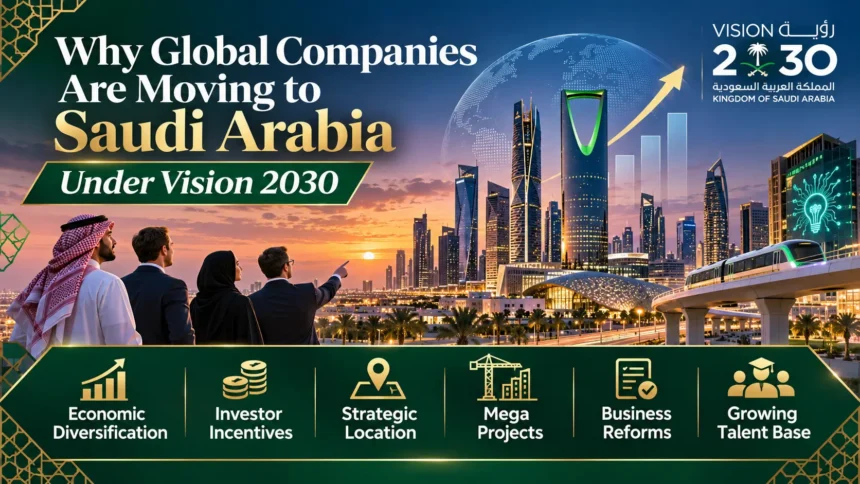
Why Global Companies Are Moving Their Headquarters to Saudi Arabia
Saudi Arabia is undergoing one of the most significant economic transformations in the Middle East. Once widely known for its oil industry, the Kingdom is now attracting international businesses across technology, finance, healthcare, tourism, manufacturing and several other industries.
- 1. Saudi Vision 2030 Is Transforming the Kingdom’s Economy
- 2. How the Saudi Arabia Regional Headquarters Program Attracts Global Companies
- 3. Tax Incentives and Business-Friendly Policies in Saudi Arabia
- 4. Government Contracts Are Encouraging Companies to Establish a Local Presence
- 5. Saudi Arabia’s Mega Projects Are Creating New Business Opportunities
- 6. Why Riyadh Is Becoming a Leading Regional Business Hub
- 7. How International Companies Benefit Saudi Arabia’s Economy and Workforce
- 8. Challenges and the Future of Saudi Arabia as a Global Business Destination
- Conclusion
- Frequently Asked Questions About Regional Headquarters in Saudi Arabia
Over the past few years, numerous global companies have established their regional headquarters in Saudi Arabia, particularly in Riyadh. This growing trend reflects the country’s efforts to diversify its economy, attract foreign investment and become a leading international business destination.
The Regional Headquarters Program, favourable tax incentives, government contracting opportunities and large-scale development projects have made Saudi Arabia increasingly attractive to multinational corporations.
However, the movement of global companies is not simply about reducing taxes or opening new offices. Businesses are also looking to establish closer relationships with customers, access emerging markets and participate in the Kingdom’s long-term economic development.
Understanding why global companies are moving their headquarters to Saudi Arabia reveals how the Kingdom is reshaping its position in the global economy.
1. Saudi Vision 2030 Is Transforming the Kingdom’s Economy
Saudi Vision 2030 aims to reduce Saudi Arabia’s dependence on oil by developing other industries. Its final phase (2026–2030) focuses on long-term growth, encouraging private businesses, and strengthening industries outside the oil sector.
One of the biggest reasons international companies are expanding into Saudi Arabia is Saudi Vision 2030.
Launched in 2016, this long-term national development strategy aims to reduce the country’s dependence on oil revenues, strengthen the private sector and create a more diverse economy.
For decades, oil exports played a central role in Saudi Arabia’s economic development. However, the government recognised the importance of developing alternative sources of income and creating employment opportunities across different industries.
Saudi Vision 2030 has encouraged investment in infrastructure, digital technology, healthcare, tourism, entertainment and renewable energy.
According to Saudi Arabia’s General Authority for Statistics, the country’s real gross domestic product (GDP) grew by 4.5% in 2025 compared with the previous year. Non-oil activities have also become increasingly important to its economic development.
This transformation is creating opportunities for international companies that want to participate in the country’s expanding industries.
Major industries supported by Saudi Vision 2030
| Industry | Business Opportunities |
|---|---|
| Technology | Artificial intelligence, cybersecurity and cloud computing |
| Tourism | Hotels, resorts and travel services |
| Healthcare | Hospitals, medical technology and pharmaceuticals |
| Renewable energy | Solar power and clean energy projects |
| Financial services | Banking, insurance and investment management |
| Manufacturing | Industrial production and supply chains |
| Entertainment | Sports, events and cultural attractions |
| Logistics | Transportation, warehousing and international trade |
By encouraging growth across these industries, Saudi Arabia is creating an environment where multinational companies can explore opportunities beyond the traditional energy sector.
For international businesses, establishing a regional headquarters in the Kingdom can provide better access to these growing markets and allow them to develop long-term business relationships.
2. How the Saudi Arabia Regional Headquarters Program Attracts Global Companies
The Regional Headquarters Program is one of the most important initiatives behind the movement of multinational companies to Saudi Arabia.
Commonly known as the RHQ Program, it was launched in 2021 through cooperation between the Ministry of Investment of Saudi Arabia and the Royal Commission for Riyadh City.
The programme encourages multinational companies to establish offices responsible for managing their business activities across the Middle East and North Africa.
A regional headquarters is different from an ordinary sales office. It generally manages important business functions such as strategic planning, financial management, regional coordination and executive decision-making.
It offers benefits such as a 30-year tax exemption, more flexible hiring rules, and easier relocation for senior staff. It also links government contracts to certain RHQ requirements. More than 780 international companies have received RHQ licences, exceeding the original Vision 2030 target of 480 companies.
Key facts about the Regional Headquarters Program
| Feature | Details |
|---|---|
| Programme launch | 2021 |
| Main business destination | Riyadh |
| Responsible organisations | Ministry of Investment and Royal Commission for Riyadh City |
| Original 2030 target | 500 regional headquarters |
| Reported achievement by the end of 2025 | More than 700 international companies attracted |
| Main objective | Establish Saudi Arabia as a leading regional business hub |
| Tax incentive period | 30 years for qualifying RHQ activities |
It is important to understand that these companies are generally establishing their regional headquarters rather than moving their entire global headquarters to Saudi Arabia.
A multinational company may continue to maintain its main headquarters in the United States, Europe or Asia while managing its Middle Eastern operations from Riyadh.
Common responsibilities of regional headquarters include:
- Developing regional business strategies.
- Coordinating operations across different countries.
- Managing financial planning and budgets.
- Supporting marketing activities.
- Conducting market research.
- Managing regional leadership teams.
- Identifying new business opportunities.
- Supporting employee training and development.
Companies can benefit from having important decision-makers closer to their regional customers and business partners.
For Saudi Arabia, the programme helps attract experienced professionals, strengthen local industries and create opportunities for knowledge sharing.
3. Tax Incentives and Business-Friendly Policies in Saudi Arabia
Tax incentives are another major reason why global companies are moving their headquarters to Saudi Arabia.
In December 2023, the Saudi government announced a 30-year tax incentive package for qualifying multinational companies participating in the Regional Headquarters Program.
The package was introduced to make Saudi Arabia more competitive with other international business destinations.
Under the applicable tax rules, eligible regional headquarters can benefit from a 0% corporate income tax rate on qualifying RHQ activities and a 0% withholding tax rate on certain eligible payments.
These incentives can help businesses reduce some of the costs associated with managing their regional operations.
Major incentives available to qualifying regional headquarters
| Incentive | Potential Business Benefit |
|---|---|
| 0% corporate income tax | Applies to qualifying RHQ income |
| 0% withholding tax | Applies to certain eligible payments |
| 30-year tax incentive period | Supports long-term financial planning |
| Saudization exemption | RHQ entity may qualify for a 10-year exemption from percentage requirements |
| Executive residency support | Facilitates relocation for eligible senior executives |
| Business establishment support | Helps companies navigate administrative procedures |
| Employment-related support | Assists with certain workforce and relocation requirements |
These benefits are subject to eligibility conditions and ongoing compliance requirements.
A company cannot simply register an office in Saudi Arabia and automatically receive every incentive. It must demonstrate that its regional headquarters performs genuine management and support activities.
Companies are generally required to maintain a physical office, employ qualified staff and conduct the approved activities within the Kingdom.
The published RHQ requirements include employing at least 15 full-time employees within the first year, including a minimum of three senior executives.
Saudi Arabia’s updated Investment Law, which came into effect in 2025, also introduced a broader framework for investor protection and investment registration.
However, the tax benefits provided under the RHQ Program do not automatically apply to every commercial activity conducted by the multinational group.
Ordinary business operations may remain subject to Saudi tax laws, VAT and other financial obligations. Large multinational groups must also consider international tax requirements.
Businesses should therefore evaluate their complete tax and operating structure before establishing regional headquarters in Saudi Arabia.
4. Government Contracts Are Encouraging Companies to Establish a Local Presence
Access to Saudi government contracts is another important factor influencing the decisions of multinational companies.
Saudi Arabia has introduced several rules for government contracts to encourage foreign companies to set up offices and operations in the country.
These include requirements for regional headquarters, extra points for using local products and services, and rules that give preference to locally made goods.
Saudi Arabia is investing in major infrastructure projects, public services, healthcare facilities, transportation networks and urban developments.
These projects create commercial opportunities for construction companies, technology providers, engineering firms, consultants and other international businesses.
However, new government contracting regulations introduced from January 1, 2024, changed how certain foreign companies can participate in public procurement.
Under these regulations, Saudi government agencies generally face restrictions on awarding contracts to specified multinational companies that maintain regional headquarters elsewhere in the Middle East and North Africa but do not have one in Saudi Arabia.
The restrictions can also extend to certain related suppliers, distributors and service providers.
This policy has encouraged companies interested in government projects to establish a stronger local presence.
Why access to Saudi government contracts matters
- The government is developing large infrastructure projects.
- Public sector organisations require advanced technologies.
- Healthcare and education systems are expanding.
- Engineering and construction services are in demand.
- Government organisations need professional consulting services.
- Digital transformation is creating new business opportunities.
Nevertheless, the regulations include exceptions. These may apply to certain purchases valued below SAR 1 million, work carried out outside the Kingdom, emergency situations and other specifically permitted circumstances.
The rules also do not represent a general ban on foreign companies conducting private business in Saudi Arabia.
For many multinational corporations, establishing a regional headquarters is therefore a strategic decision that can improve access to government projects while strengthening relationships with local customers.
Companies can improve their local content scores by setting up factories or offices in Saudi Arabia, hiring local workers, buying from local suppliers, and sharing technology. Businesses that only import finished products may receive lower scores than those with local operations.
However, having an RHQ licence does not guarantee government contracts. Companies must still meet the relevant tender, pricing, technical and local content requirements.
5. Saudi Arabia’s Mega Projects Are Creating New Business Opportunities
Saudi Arabia is home to several large development projects designed to transform its cities, infrastructure and industries.
These initiatives are creating demand for international expertise, advanced technologies, construction services and specialised professional skills.
For global companies, establishing a presence in Saudi Arabia provides an opportunity to explore these projects and participate in emerging industries.
Major Saudi development projects and initiatives
| Project or Initiative | Main Business Opportunities |
|---|---|
| NEOM | Urban development, technology and renewable energy |
| The Red Sea | Luxury tourism, hospitality and environmental services |
| Qiddiya | Entertainment, sports and leisure |
| Diriyah | Cultural tourism, heritage development and hospitality |
| New Murabba | Urban development, retail and commercial services |
| Expo 2030 Riyadh | Events, infrastructure, technology and tourism |
| King Salman International Airport | Aviation, logistics and transportation |
| Riyadh Metro | Public transportation and related services |
These developments involve much more than building new properties. They also create demand for cybersecurity, telecommunications, financial services, environmental management and workforce training.
For example, a new tourism destination may require hotel operators, food suppliers, transportation companies, technology providers and healthcare services.
Similarly, modern urban development projects can create opportunities for architects, engineers, construction businesses and digital infrastructure specialists.
International companies may benefit from being located closer to these opportunities, allowing them to communicate directly with project developers and local business partners.
However, development projects are implemented in stages. Their schedules, budgets and commercial requirements can change according to economic conditions and government priorities.
Companies should assess individual projects carefully rather than assuming that every announced development will create immediate or guaranteed revenue.
Despite these uncertainties, Saudi Arabia’s expanding project pipeline remains an important factor attracting international businesses.
6. Why Riyadh Is Becoming a Leading Regional Business Hub
Riyadh has become the centre of Saudi Arabia’s efforts to attract multinational corporations.
As the country’s capital, it brings together government ministries, financial institutions, corporate offices and major investment organisations.
This makes Riyadh a practical location for international companies seeking closer access to policymakers, investors and business customers.
The King Abdullah Financial District, commonly known as KAFD, is one of the most prominent examples of Riyadh’s development as a modern business destination.
It provides commercial office spaces, financial services, residential facilities and other infrastructure designed to support corporate activities.
The city has also invested heavily in public transportation. The Riyadh Metro was officially inaugurated in November 2024, and all six lines became operational in January 2025.
The network covers approximately 176 kilometres and includes 84 stations, connecting important residential, commercial and public service areas.
Major advantages of establishing a business in Riyadh include:
- Proximity to government organisations.
- Access to a large domestic consumer market.
- Modern commercial office developments.
- Growing financial and professional services.
- Expanding public transportation.
- International airport connectivity.
- Opportunities to recruit skilled professionals.
- Access to business conferences and networking events.
Saudi Arabia’s location also provides access to markets across Asia, Africa and Europe.
The development of airport infrastructure, logistics facilities and international flight connections could further strengthen Riyadh’s position as a regional business hub.
Several multinational companies have already established regional headquarters in the city.
PwC Middle East inaugurated its regional headquarters in Riyadh in 2023. PepsiCo also opened an expanded Middle East regional headquarters in the King Abdullah Financial District in 2025.
These examples demonstrate how businesses from different industries are strengthening their presence in the Saudi market.
However, Riyadh still faces challenges related to office availability, traffic congestion, housing demand and competition for experienced professionals.
Its future success will depend on how effectively the city manages these challenges while continuing to improve its business infrastructure.
7. How International Companies Benefit Saudi Arabia’s Economy and Workforce
The arrival of multinational companies can create economic benefits beyond the establishment of corporate offices.
When international businesses expand their operations, they often require legal advisers, accountants, technology providers, office facilities and other professional services.
This can create additional opportunities for local businesses and contribute to the wider private sector.
Regional headquarters may also provide employment opportunities for Saudi nationals in management, finance, technology, marketing and other professional fields.
Potential benefits for the Saudi economy
| Economic Benefit | Potential Impact |
|---|---|
| Foreign investment | Supports business expansion and economic activity |
| Employment opportunities | Creates professional and administrative roles |
| Knowledge transfer | Helps develop local skills and expertise |
| Business partnerships | Connects international and Saudi companies |
| Technology development | Encourages innovation and digital transformation |
| Commercial real estate | Increases demand for office and residential facilities |
| Private sector growth | Supports economic diversification |
| Professional services | Creates demand for legal, financial and consulting support |
International companies can also introduce new business practices, training programmes and management experience.
For young Saudi professionals, these developments may provide opportunities to work within international organisations without relocating overseas.
Experienced employees can develop leadership skills, gain exposure to global business practices and build professional networks.
However, attracting foreign companies does not automatically guarantee widespread employment benefits.
The long-term economic impact depends on whether these businesses establish genuine operations, invest in employee development and build relationships with local suppliers.
Saudi Arabia must also ensure that smaller domestic businesses have opportunities to compete and participate in the country’s economic growth.
A balanced approach can help the Kingdom attract international expertise while continuing to develop its own workforce and businesses.
8. Challenges and the Future of Saudi Arabia as a Global Business Destination
Although Saudi Arabia offers many business opportunities, establishing regional headquarters also involves challenges.
International companies must understand local regulations, employment requirements, cultural expectations and the costs associated with operating in a new country.
Relocating senior executives and their families can require considerable planning, particularly when it comes to accommodation, education, healthcare and immigration procedures.
Businesses must also evaluate the availability of experienced employees and the long-term costs of maintaining regional offices.
Common challenges facing international companies include:
- Understanding local business regulations.
- Managing relocation and operational expenses.
- Recruiting and retaining qualified employees.
- Meeting tax and reporting requirements.
- Adapting to local business practices.
- Managing office and residential rental costs.
- Understanding changing government policies.
- Evaluating project delays and market risks.
Saudi Arabia also faces competition from other established Gulf business centres.
Dubai, Abu Dhabi, Doha and other regional cities continue to attract international investment through established infrastructure, financial services and international business networks.
The rise of Riyadh does not necessarily mean that global companies are leaving these cities entirely.
Many multinational businesses operate across several Gulf countries, maintaining different offices according to their commercial needs.
A company may manage its regional strategy from Saudi Arabia while continuing to operate sales, logistics or specialised financial services elsewhere in the Gulf.
Saudi Arabia’s ability to maintain investor confidence will depend on transparent regulations, reliable infrastructure, competitive operating costs and continued economic development.
As Saudi Vision 2030 progresses, the Kingdom has the potential to strengthen its position as an international business destination.
Conclusion
The movement of global companies to Saudi Arabia reflects the Kingdom’s wider economic transformation and its ambition to become a leading international business destination.
Through Saudi Vision 2030, the Regional Headquarters Program, tax incentives and major development projects, the country is creating new opportunities for multinational corporations.
Riyadh’s growing financial sector, modern infrastructure and expanding professional workforce are further strengthening Saudi Arabia’s appeal to international businesses.
Although companies must consider regulatory requirements, operating costs and market risks, establishing regional headquarters in the Kingdom can provide valuable access to one of the Middle East’s largest economies.
Ultimately, Saudi Arabia is not simply attracting international companies to open offices. It is working to build an economy where global businesses, local entrepreneurs and skilled professionals can contribute to long-term growth and economic diversification.
Frequently Asked Questions About Regional Headquarters in Saudi Arabia
Why are global companies moving their headquarters to Saudi Arabia?
Companies are attracted by tax incentives, government contracting opportunities, growing consumer demand, Saudi Vision 2030 and major development projects.
What is the Regional Headquarters Program in Saudi Arabia?
It is a government initiative launched in 2021 to encourage multinational companies to manage their Middle Eastern and North African operations from Saudi Arabia.
How many international companies have established regional headquarters in Saudi Arabia?
According to the Royal Commission for Riyadh City, the programme had attracted more than 700 international companies by the end of 2025, exceeding its original target of 500.
Is Saudi Arabia offering a 30-year tax exemption?
Yes. Qualifying regional headquarters can receive a 0% corporate income tax rate on eligible RHQ activities and withholding tax relief on certain qualifying payments for 30 years, subject to applicable conditions.
Is a regional headquarters mandatory for every foreign company?
No. The government contracting restrictions apply to specified companies and their related parties, subject to exceptions. Foreign companies may still conduct eligible private-sector activities without an RHQ licence.
Why is Riyadh attracting international businesses?
Riyadh provides access to government organisations, financial institutions, major development projects, commercial infrastructure and a growing domestic market.
Are international companies leaving Dubai for Saudi Arabia?
Some companies are establishing or relocating regional headquarters to Saudi Arabia. However, many continue to maintain business operations in Dubai and other Gulf cities.
Will Saudi Arabia become a major global business hub?
Saudi Arabia has made significant progress in attracting international businesses. Its long-term success will depend on continued economic reforms, infrastructure development and investor confidence.
Do follow us on Instagram
Read More – How to Start Investing in the Gulf as a Beginner