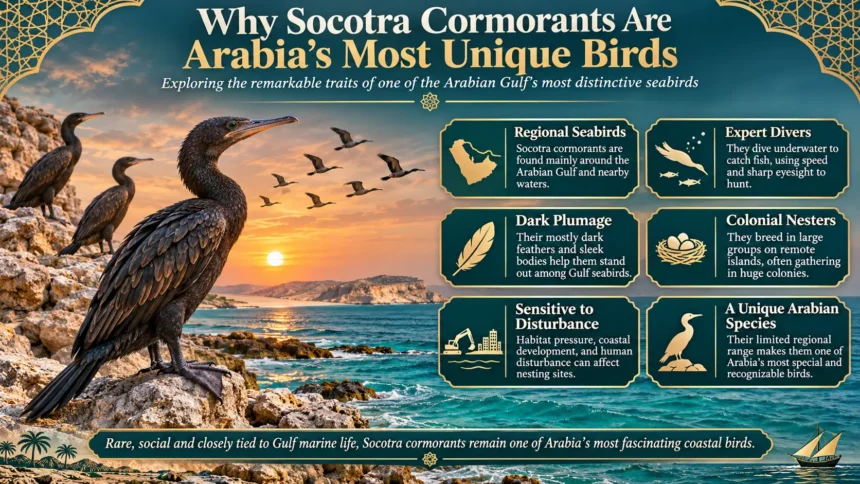
Why Socotra Cormorants Are Among Arabia’s Most Unique Birds
The Arabian Peninsula is often associated with vast deserts, camels, falcons and rocky mountain landscapes. However, its coastal regions and surrounding waters are home to some equally fascinating wildlife. Among these remarkable creatures is the Socotra cormorant, a dark-coloured seabird known for its excellent diving skills, enormous breeding colonies and unusual fishing behaviour.
- 1. What Makes the Socotra Cormorant a Unique Arabian Bird?
- 2. Where Do Socotra Cormorants Live in the Arabian Peninsula?
- 3. The Remarkable Diving and Fishing Abilities of Socotra Cormorants
- 4. Why Socotra Cormorants Hunt and Travel in Large Groups
- 5. The Extraordinary Breeding Colonies of Socotra Cormorants
- 6. Why Socotra Cormorants Are Important for Marine Ecosystems
- 7. Major Threats Facing Socotra Cormorants in Arabia
- 8. Socotra Cormorant Conservation and the Future of Arabian Seabirds
- Conclusion
- Frequently Asked Questions About Socotra Cormorants
Unlike many birds that depend on forests, grasslands or freshwater lakes, Socotra cormorants spend much of their lives around shallow marine waters and remote coastal islands. Their ability to hunt underwater and survive in the hot coastal environments of Arabia makes them particularly interesting.
These birds are mainly found in the Arabian Gulf, the Gulf of Oman and waters surrounding the southern Arabian Peninsula. Some of their breeding colonies contain tens of thousands of birds, creating one of the region’s most impressive natural wildlife spectacles.
Despite their ability to survive in challenging environments, Socotra cormorants face serious threats from coastal development, marine pollution, fishing activities and habitat loss.
Understanding why Socotra cormorants are among Arabia’s most unique birds reveals the extraordinary biodiversity of the Middle East and the importance of protecting its marine ecosystems.
1. What Makes the Socotra Cormorant a Unique Arabian Bird?
The Socotra cormorant, scientifically known as Phalacrocorax nigrogularis, belongs to the cormorant family, known as Phalacrocoracidae. Members of this bird family are recognised for their ability to swim underwater and catch fish.
It often gathers in huge flocks of up to 250,000 birds. Listed as Vulnerable, it faces growing threats from habitat loss and changes in its marine environment.
What makes the Socotra cormorant particularly special is its limited geographical distribution. Unlike some cormorant species found across several continents, this seabird is naturally restricted to waters around the Arabian Peninsula and neighbouring coastal regions.
Scientists describe such animals as regionally endemic, meaning they naturally occur within a particular geographical region.
The bird has a slender body, a long neck, webbed feet and a slightly hooked bill. These physical characteristics help it move efficiently through water and catch slippery fish.
Adult birds generally appear black, although their feathers can develop a noticeable purplish appearance during the breeding season.
In the UAE, the Socotra cormorant is locally known as Looh. Its presence forms an important part of the region’s natural coastal heritage.
Quick facts about the Socotra cormorant
| Feature | Details |
|---|---|
| Scientific name | Phalacrocorax nigrogularis |
| Bird family | Phalacrocoracidae |
| Animal type | Seabird |
| Local name in the UAE | Looh |
| Main diet | Small marine fish |
| Natural habitat | Coastal waters and offshore islands |
| Body colour | Mainly black with a purplish appearance during breeding |
| Breeding behaviour | Large nesting colonies |
| Incubation period | Approximately 24–27 days in a UAE study |
| Global conservation status | Vulnerable |
| Major threats | Habitat loss, pollution and human disturbance |
Although its appearance may seem less colourful than that of other Arabian birds, its remarkable underwater abilities and social behaviour make it an extraordinary species.
Its survival also demonstrates that the Arabian Peninsula contains much more natural diversity than its desert landscapes might suggest.
2. Where Do Socotra Cormorants Live in the Arabian Peninsula?
The Socotra cormorant habitat is closely connected to marine environments. These birds depend on productive coastal waters for food and relatively undisturbed islands for resting and breeding.
They generally prefer areas where small fish are available in large numbers. Offshore islands, shallow bays, coastal lagoons and sheltered waters can provide suitable conditions for their survival.
Despite being named after Socotra, an island archipelago belonging to Yemen, the bird is not restricted to that location.
Its natural geographical range extends across several countries surrounding the Arabian Peninsula.
Countries where Socotra cormorants are found include:
- United Arab Emirates.
- Saudi Arabia.
- Bahrain.
- Qatar.
- Oman.
- Yemen.
- Iran.
Tracking research has also documented individuals using marine protected areas in Kuwaiti waters.
The Arabian Gulf is particularly important because it contains several major breeding colonies. Its relatively shallow waters support populations of small fish that provide food for these seabirds.
Important Socotra cormorant habitats
| Location | Ecological Importance |
|---|---|
| Al Siniyah Island, UAE | Internationally important breeding colony |
| Coastal islands of Abu Dhabi | Nesting, feeding and resting habitats |
| Hawar Islands, Bahrain | One of the world’s largest breeding concentrations |
| Gulf of Salwa | Important breeding and feeding environment |
| Coastal Oman | Suitable marine feeding and breeding habitats |
| Socotra Archipelago, Yemen | Part of the species’ natural geographical range |
These birds do not necessarily remain in the same location throughout the year. Their movements can change according to food availability, breeding activities and seasonal conditions.
Research has documented birds travelling from breeding colonies in Umm Al Quwain towards waters around Abu Dhabi after the breeding season.
Such movements demonstrate why protecting a single island is not enough. The species requires a connected network of healthy coastal and marine habitats across the wider region.
3. The Remarkable Diving and Fishing Abilities of Socotra Cormorants
One of the most fascinating facts about Socotra cormorants is their ability to hunt underwater.
While many seabirds catch fish near the water’s surface, cormorants can actively pursue their prey beneath the waves.
Socotra cormorants are very social birds that gather in large groups of up to 250,000. They hunt for fish in coastal waters and can stay underwater for up to three minutes while searching for food.
Their streamlined bodies help reduce resistance while swimming. Strong webbed feet provide the movement needed to travel underwater, while their long necks and bills help them catch fish.
Before diving, a cormorant typically swims on the surface. It then moves underwater in search of suitable prey and returns to the surface to breathe.
The Environment Agency – Abu Dhabi notes that some reports suggest these birds can remain underwater for up to three minutes. However, ordinary feeding dives are often much shorter, depending on the location of fish and environmental conditions.
Physical features that support underwater hunting include:
- A streamlined body that helps reduce water resistance.
- Strong webbed feet for underwater movement.
- A long neck that helps the bird reach its prey.
- A hooked bill suitable for holding slippery fish.
- Eyes adapted to finding prey during underwater pursuits.
- The ability to remain underwater temporarily while holding its breath.
Another interesting feature of cormorants is their tendency to spread their wings after swimming. This familiar behaviour can help dry their feathers.
The Socotra cormorant diet
Socotra cormorants mainly consume small marine fish. Their diet can change according to seasonal conditions and the availability of different fish species.
Documented food sources include:
- Anchovies.
- Sardines.
- Bluestripe herrings.
- Flying fish.
- Halfbeaks.
- Scads.
- Small rabbitfish.
Rather than depending on a single fish species, these birds can make use of different available food sources.
This feeding flexibility is important because marine environments change throughout the year. Water temperature, currents and seasonal fish movements can influence where suitable prey is found.
4. Why Socotra Cormorants Hunt and Travel in Large Groups
Unlike many birds that spend most of their time searching for food alone, Socotra cormorants are known for their highly social behaviour.
Large numbers of birds may gather in the same coastal waters, creating impressive feeding groups.
A particularly remarkable sight occurs when thousands of cormorants travel across the sea in long lines or closely arranged groups. From a distance, these gatherings can appear like moving dark clouds above the water.
Scientists have studied this behaviour to understand how the birds find and capture fish.
When thousands of birds search for food together, they can spot moving groups of fish like anchovies and sardines more easily than a single bird flying alone.
A 2017 study published in Ecology and Evolution used GPS devices and underwater recording equipment to examine the fishing behaviour of Socotra cormorants breeding on Siniya Island in the UAE.
Researchers documented birds travelling together and gathering in large numbers around productive feeding areas.
Group fishing may offer several advantages when hunting fish that naturally swim in schools.
Possible benefits of group fishing include:
- Helping birds locate large concentrations of fish.
- Allowing individuals to follow other successful hunters.
- Providing access to productive feeding areas.
- Helping birds respond to the movement of fish schools.
- Reducing the time spent searching independently for food.
However, gathering in large groups does not mean that every bird catches the same amount of food. Competition between individuals can also occur.
How group behaviour supports survival
| Social Behaviour | Possible Advantage |
|---|---|
| Group feeding | Helps birds locate suitable fish schools |
| Travelling together | Allows individuals to follow others towards feeding grounds |
| Large resting groups | Provides shared resting locations |
| Colonial breeding | Allows many birds to use suitable nesting habitats |
| Seasonal movement | Helps populations respond to changing marine conditions |
These behaviours are especially interesting because the Arabian Gulf experiences considerable changes in water temperature and food availability.
For Socotra cormorants, the ability to move between feeding areas and respond to the activities of other birds can be valuable in such a changing environment.
5. The Extraordinary Breeding Colonies of Socotra Cormorants
The breeding colonies of Socotra cormorants are among the most remarkable wildlife gatherings in Arabia.
Socotra cormorants are mostly black throughout the year. During the breeding season, they develop a slight purple shine on the front of their heads, a greenish tint on their backs, and small white feathers or streaks around their head, neck, and tail area.
During the breeding season, thousands of birds gather on suitable offshore islands to build nests, lay eggs and raise their young.
Unlike birds that build nests high in trees, Socotra cormorants generally nest on the ground. Sandy and gravel-covered islands with limited human disturbance provide suitable breeding environments.
Nesting materials may include sticks, plant matter, feathers and other available natural materials.
The breeding season varies according to geographical location and environmental conditions. On Al Siniyah Island, research has documented egg-laying activities mainly during September and early October.
Breeding and reproduction
| Breeding Feature | Details |
|---|---|
| Nesting location | Ground nests on suitable islands |
| Breeding behaviour | Large colonies |
| Typical clutch | Around two to three eggs |
| Incubation | Approximately 24–27 days in a Siniya Island study |
| Parental care | Adult birds feed and protect their chicks |
| Young birds | Depend on their parents before becoming independent |
Adult birds must regularly leave their nesting areas to catch fish and bring food back to their growing chicks.
This creates a strong connection between the availability of marine food and successful reproduction.
Al Siniyah Island in Umm Al Quwain
Al Siniyah Island, also written as Siniya Island, is one of the world’s most important breeding locations for the species.
A scientific study published in 2017 recorded approximately 28,152 breeding pairs in 2011 and approximately 41,568 breeding pairs in 2014.
These historical figures demonstrate the enormous size of the colony. However, they should not be treated as current population counts because breeding numbers can change from year to year.
In February 2026, BirdLife International highlighted the island’s importance following its recognition as a Key Biodiversity Area.
The Hawar Islands in Bahrain
Bahrain’s Hawar Islands also support one of the world’s largest concentrations of Socotra cormorants.
The islands are recognised as a wetland of international importance under the Ramsar Convention.
Their ecological value extends beyond seabirds. The surrounding marine environments also support dugongs, sea turtles and other important wildlife.
Protecting these major breeding locations is essential because the species depends on a relatively limited number of suitable nesting areas.
6. Why Socotra Cormorants Are Important for Marine Ecosystems
Socotra cormorants are more than impressive diving birds. They form an important part of the Arabian Gulf’s marine ecosystems.
As fish-eating predators, they contribute to the natural relationships between marine animals. Their feeding activities connect small fish populations with larger ecological processes.
Seabirds can also transport nutrients from the marine environment to land.
When cormorants return to their nesting islands, their droppings introduce nutrients collected through their fish-based diet into the surrounding soil.
Scientific research has examined how large Socotra cormorant colonies influence soil chemistry and vegetation on Siniya Island.
These changes are not always beneficial to every plant species. Large concentrations of bird droppings can alter soil conditions and influence which types of vegetation survive near nesting areas.
Ecological importance of Socotra cormorants
| Ecological Role | Environmental Importance |
|---|---|
| Fish predation | Forms part of marine food chains |
| Nutrient movement | Transfers nutrients between sea and land |
| Biodiversity | Contributes to native Arabian wildlife |
| Scientific research | Helps researchers study marine conditions |
| Environmental monitoring | Provides information about changes in feeding habitats |
| Nature education | Raises awareness about coastal conservation |
Their movements can also help scientists study marine protected areas.
A research project using tracking devices between 2019 and 2023 followed Socotra cormorants from four breeding colonies. Researchers documented the tagged birds using 16 marine protected areas across six Gulf countries.
Such information helps conservation organisations understand how different coastal environments are connected.
Do Socotra cormorants harm commercial fishing?
Because these birds consume considerable quantities of fish, some people believe they compete directly with commercial fishermen.
However, a study published in the conservation journal Oryx found very little overlap between the main fish species consumed by Socotra cormorants on Siniya Island and those recorded in commercial catches in the eastern Arabian Gulf during the study period.
This finding highlights the importance of scientific research before blaming wildlife for declining fish populations.
Healthy fish populations can benefit both seabirds and fishing communities.
7. Major Threats Facing Socotra Cormorants in Arabia
Despite their remarkable survival abilities, Socotra cormorants face several serious environmental challenges.
The International Union for Conservation of Nature (IUCN) classifies the species as Vulnerable. This means it faces a high risk of extinction in the wild.
Its restricted geographical range makes it particularly sensitive to changes in coastal environments.
Even when thousands of birds gather in one location, the loss of an important breeding island can affect a significant part of the wider population.
Coastal development and habitat loss
Rapid development across the Arabian Gulf has increased demand for waterfront properties, tourism facilities, ports and infrastructure.
Construction activities and land reclamation can reduce the availability of suitable nesting and feeding habitats.
Marine pollution
Plastic waste, discarded fishing equipment and oil pollution can cause serious problems for seabirds.
Oil can damage feathers and reduce their ability to function properly, while abandoned fishing lines may trap or injure birds.
Disturbance during the breeding season
Uncontrolled tourism, boat traffic and human access to nesting colonies can cause adult birds to temporarily abandon their nests.
This may leave eggs and young chicks exposed to heat, predators and other environmental dangers.
Natural predators
Predation is another challenge, particularly on islands where foxes and other animals are present.
Research on Siniya Island has documented Arabian red foxes feeding on cormorants and their eggs.
Although predation is a natural ecological process, it can place additional pressure on already vulnerable bird populations.
| Major Threat | Potential Impact |
|---|---|
| Coastal development | Loss of breeding and resting habitats |
| Oil pollution | Damage to feathers and marine environments |
| Fishing nets and lines | Accidental capture and injuries |
| Plastic pollution | Entanglement and possible ingestion |
| Human disturbance | Reduced breeding success |
| Natural predators | Loss of eggs, chicks and adult birds |
| Climate change | Changes in marine conditions and food availability |
| Declining fish populations | Reduced access to suitable prey |
Protecting Socotra cormorants requires attention to both natural ecological processes and human-related environmental pressures.
8. Socotra Cormorant Conservation and the Future of Arabian Seabirds
Several Gulf countries and international conservation organisations are working to protect coastal habitats and monitor native bird populations.
Socotra cormorant conservation is particularly important because the species depends on a relatively small geographical region.
In the UAE, the Environment Agency – Abu Dhabi monitors breeding sites to understand population changes and identify potential threats.
Scientists also use aerial photography, drones, GPS tracking and field observations to study nesting colonies and seasonal movements.
These technologies can help researchers collect valuable information while reducing unnecessary disturbance when used responsibly.
Important steps for Socotra cormorant conservation include:
- Protecting offshore breeding islands.
- Establishing and managing marine protected areas.
- Reducing marine plastic pollution.
- Preventing unnecessary disturbance during nesting periods.
- Encouraging responsible fishing practices.
- Monitoring fish populations and marine habitats.
- Conducting long-term wildlife population surveys.
- Improving environmental assessments for coastal projects.
- Educating residents and tourists about seabird conservation.
- Strengthening cooperation between Gulf countries.
Regional cooperation is especially important because Socotra cormorants move across national boundaries.
Protecting breeding sites in one country may have limited benefits if important feeding habitats elsewhere become damaged.
Individuals can also contribute by avoiding coastal litter, respecting wildlife protection rules and observing birds from safe distances.
The future of Socotra cormorants depends on maintaining healthy marine environments while balancing coastal development with the needs of native wildlife.
Conclusion
Socotra cormorants are among Arabia’s most unique birds because of their remarkable underwater hunting abilities, limited geographical distribution and extraordinary breeding colonies.
From the coastal islands of Abu Dhabi and Umm Al Quwain to Bahrain’s Hawar Islands, these seabirds reveal a natural side of the Arabian Peninsula that often remains overlooked.
Their importance extends beyond their unusual appearance and behaviour. They contribute to marine biodiversity, connect coastal ecosystems and provide valuable information about the health of marine environments.
However, habitat destruction, pollution and increasing human disturbance continue to threaten their future.
Through scientific research, responsible coastal development and effective wildlife conservation, Gulf countries can help protect these remarkable seabirds.
Preserving Socotra cormorants is not simply about protecting one bird species. It is also about protecting the rich marine heritage and natural biodiversity of Arabia for future generations.
Frequently Asked Questions About Socotra Cormorants
What makes Socotra cormorants unique?
Their restricted geographical range, exceptional underwater fishing abilities, large breeding colonies and social feeding behaviour make them among Arabia’s most distinctive seabirds.
Where are Socotra cormorants found?
They are mainly found around the Arabian Gulf, the Gulf of Oman and the southern Arabian Peninsula, including coastal areas of the UAE, Bahrain, Saudi Arabia, Oman and Yemen.
What do Socotra cormorants eat?
Their diet mainly consists of small marine fish, including anchovies, herrings, sardines and flying fish.
Are Socotra cormorants endangered?
The species is globally classified as Vulnerable by the IUCN. It is threatened by habitat loss, coastal development, pollution and other environmental pressures.
Where can Socotra cormorants be found in the UAE?
Al Siniyah Island in Umm Al Quwain and several coastal islands in Abu Dhabi support important populations. Wildlife access restrictions must be respected.
Are Socotra cormorants found only on Socotra Island?
No. Despite their name, they occur across a wider geographical region surrounding the Arabian Peninsula.
Can Socotra cormorants swim underwater?
Yes. Their streamlined bodies and strong webbed feet allow them to dive and actively pursue fish underwater.
Why do Socotra cormorants gather in large groups?
Large gatherings are associated with feeding, travelling, resting and breeding. Group behaviour may help them locate productive feeding grounds.
Do follow us on Instagram
Read More – The Importance of Camels in Traditional Arabian Life