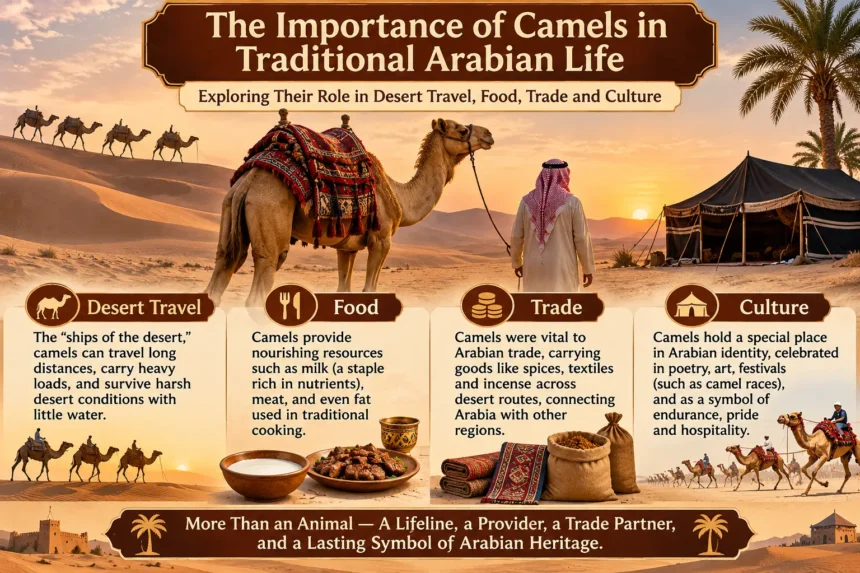
The Importance of Camels in Traditional Arabian Life
For centuries, camels have been an important part of life across the Arabian Peninsula. Before modern roads, cars and advanced transport systems became common, these remarkable animals helped people travel through deserts, carry goods, find food and survive in difficult environments. Their ability to withstand heat and travel long distances made them valuable companions for communities living in dry regions.
- 1. The Arabian Camel: A Natural Companion of the Desert
- 2. Camels as the Main Means of Desert Transportation
- 3. Camels and Traditional Arabian Trade
- 4. Camel Milk: An Important Source of Food
- 5. Camel Meat and Its Place in Traditional Food
- 6. Camel Wool, Hides and Other Useful Materials
- 7. Camels and Traditional Bedouin Family Life
- 8. Alheda’a: The Traditional Calls Used to Guide Camel Herds
- 9. Camels in Arabian Poetry, Stories and Proverbs
- 10. Camel Racing: A Traditional Sport That Continues Today
- 11. Camel Festivals and Cultural Celebrations Across Arabia
- 12. Camels Across Saudi Arabia, Oman, Qatar and the UAE
- 13. How Camels Adapt to the Harsh Desert Environment
- 14. The Role of Camels in Modern Arabian Life
- 15. Why Preserving Camel Heritage Matters
- Conclusion
- Frequently Asked Questions (FAQs)
Often called the “ships of the desert”, camels played a much bigger role than simply carrying people from one place to another. They provided milk, meat, wool and leather, supported traditional trade routes and became closely connected with Bedouin culture. Their presence influenced the daily lives, food habits, stories and traditions of people across Saudi Arabia, Qatar, Oman, the United Arab Emirates and other parts of the Arabian Peninsula.
Even today, camels remain an important symbol of Arabian heritage. Camel racing, breeding festivals, traditional food and cultural celebrations keep their history alive. Understanding the importance of camels in traditional Arabian life helps us discover how people adapted to the desert and built communities around one of their most useful animals.
1. The Arabian Camel: A Natural Companion of the Desert
The camel commonly associated with Arabian life is the dromedary, also known as the Arabian camel. It has one hump and is well suited to hot, dry environments. Its body has several features that help it survive desert conditions.
Camels were first domesticated in the Arabian Peninsula around 4,000 years ago. They soon became an important part of desert life, helping people travel, carry goods, find food, and trade with other communities.
A camel’s hump stores fat, not water. It can hold up to 80 pounds (36 kilograms) of fat, which provides energy when food is hard to find. Keeping this fat in one place also helps the rest of the body stay cool in hot desert weather.
For example, its broad feet make it easier to walk across soft sand, while long eyelashes and closable nostrils help protect it from blowing sand. Its hump stores fat, which the body can use as an energy source when food is limited. Contrary to a common belief, the hump does not store water.
These natural features made camels especially useful to people living in the Arabian Peninsula. They could travel across difficult terrain, carry heavy loads and survive conditions that were challenging for many other domestic animals.
Their ability to adapt to the desert helped create a close relationship between camels and the communities that depended on them.
2. Camels as the Main Means of Desert Transportation
Before modern roads and vehicles, travelling across the Arabian desert could be difficult and dangerous. Long distances, extreme temperatures and limited water sources made journeys challenging.
For many centuries, camels were one of the main ways people travelled across large deserts. They could carry heavy loads over long distances and survive without frequent stops for water. This made it easier for traders to cross deserts and transport goods between regions such as Arabia, the Sahara, and Central Asia.
Camels provided a practical solution. They could carry people, food, water and other supplies across sandy landscapes. Their strength and endurance made them useful for journeys between settlements, wells, farms and coastal trading towns.
For Bedouin communities, camels were particularly important because they allowed families to move in search of water and grazing areas. Instead of depending on permanent settlements, some communities could travel with their animals and belongings as environmental conditions changed.
Camels were also used in larger travelling groups known as caravans. These groups connected inland settlements with markets and coastal towns.
Their transportation role included:
- Carrying people across long desert routes.
- Transporting food and drinking water.
- Moving household belongings between settlements.
- Carrying goods for merchants and traders.
- Supporting journeys between distant oases and markets.
A camel could also carry a considerable load over long distances. This made it a valuable transport animal in areas where wheeled vehicles were difficult to use.
Although cars and trucks have replaced camels for most everyday journeys, their historical contribution to travel across Arabia remains an important part of regional heritage.
3. Camels and Traditional Arabian Trade
Camels helped connect different parts of the Arabian Peninsula through trade. Before modern transport systems developed, merchants depended on animals to carry goods across deserts and between settlements.
Trading caravans transported products such as dates, fabrics, spices, food supplies and other valuable items. These goods moved between inland communities, oasis towns and coastal markets.
Camels were especially useful because they could travel through areas with limited water and rough ground. Their ability to carry supplies helped merchants reach markets that were difficult to access using other forms of transportation.
Trade was not only about exchanging products. It also created connections between different communities. Merchants shared information, customs and ideas while travelling between towns and trading centres.
Camels therefore played an important role in the growth of traditional Arabian commerce. Their contribution helped connect communities that were separated by long distances and difficult natural environments.
4. Camel Milk: An Important Source of Food
One of the most valuable gifts of the camel was its milk. For centuries, camel milk has been part of the traditional diet of communities across the Arabian Peninsula.
In dry regions where fresh food was not always easy to obtain, camel milk provided an important source of nourishment. Families could use it at home, drink it fresh or prepare other foods from it.
Camel milk has a slightly different taste and composition from cow’s milk. Its flavour can vary depending on the animal’s diet, water availability and other conditions.
Traditional ways of enjoying camel milk include:
- Drinking it fresh.
- Serving it during family gatherings.
- Using it in traditional food preparations.
- Making fermented milk products.
- Sharing it with guests as part of local hospitality.
Camels also provided milk during journeys and periods when other food supplies were limited. This made them especially important to families living away from permanent settlements.
Today, camel milk is sold in some modern dairy products, including bottled milk, cheese and yoghurt. It has also become part of a growing market for traditional and locally sourced foods.
5. Camel Meat and Its Place in Traditional Food
Camel meat has also been used as food in different Arabian communities. Although it is not eaten as frequently everywhere as other types of meat, it has a place in traditional regional cooking.
In traditional Arabian culture, camel meat was not eaten every day. It was usually served on special occasions, religious celebrations, and important family gatherings. Since camels were valuable for transport, milk, and trade, slaughtering one was considered a special way to show generosity and welcome honoured guests.
In the past, camels were valuable animals, so they were not always slaughtered for everyday meals. Their milk, transportation and ability to support a family could be more important over a long period. Camel meat was therefore often associated with particular occasions and local food traditions.
Different parts of the Arabian Peninsula have their own ways of preparing it. It can be cooked slowly in stews, served with rice or prepared for large gatherings.
Traditional cooking methods help make the meat tender and allow it to absorb the flavours of spices and other ingredients.
In modern times, camel meat is also sold through specialised markets and food businesses. Its continued use shows how traditional food practices have adapted to changing lifestyles.
6. Camel Wool, Hides and Other Useful Materials
Camels were valuable not only because they provided transport and food. Different parts of their bodies also supplied materials for everyday life.
Camel hair and wool were used to make textiles and household products. The fibres could be collected, cleaned and spun into yarn before being woven into useful items.
Traditional products made from camel hair included:
- Blankets: Used for warmth during cooler nights.
- Tents and coverings: Provided protection from the sun, wind and changing weather.
- Clothing: Used to make warm garments and traditional fabrics.
- Rugs and carpets: Woven for household use.
- Ropes and practical items: Made from suitable fibres and other materials.
Camel hides were also used to produce leather goods, containers and other useful products. In some communities, dried dung was collected and used as fuel where other sources of fuel were limited.
These uses show how people made practical use of the resources available to them. The camel was not simply an animal for riding; it supported many different parts of traditional life.
7. Camels and Traditional Bedouin Family Life
The connection between camels and Bedouin communities developed over generations. For many families, the animals were part of everyday life and were closely connected with their work, food and movement across the desert.
Camel herding required knowledge and experience. People needed to understand the animals’ feeding habits, health, behaviour and water requirements.
Herders also had to know where to find suitable grazing areas and how to move their animals safely between different locations.
The relationship between people and camels was not based only on practical needs. Over time, herders became familiar with individual animals and learned to recognise their behaviour and responses.
Camels could recognise familiar voices and calls. Herders often developed special ways of communicating with their animals, creating a relationship built through daily care and experience.
For some families, camels also represented wealth and social standing. The quality, number and breeding of animals could be important within traditional livestock communities.
This connection between animals, family life and cultural identity remains visible in parts of the Arabian Peninsula today.
8. Alheda’a: The Traditional Calls Used to Guide Camel Herds
One of the most interesting traditions associated with Arabian camels is Alheda’a, an oral tradition used by herders to communicate with their camel flocks.
It involves rhythmic sounds, expressions and sometimes gestures or musical instruments. These calls help herders guide camels towards water, food and suitable grazing areas.
Different sounds can be used for different instructions. Over time, camels become familiar with the calls used by their handlers and learn to respond to them.
Alheda’a also demonstrates the connection between traditional poetry and everyday work. Some of its sounds and expressions are inspired by poetic rhythms.
The tradition has been passed down within families and communities. Children learn by watching and accompanying older herders during their daily activities.
In 2022, UNESCO inscribed Alheda’a, the oral traditions of calling camel flocks, on its Representative List of the Intangible Cultural Heritage of Humanity. The multinational inscription includes Saudi Arabia, Oman and the United Arab Emirates.
This recognition highlights that camel heritage includes more than the animals themselves. It also includes the knowledge, language and skills that people developed through their relationship with them.
9. Camels in Arabian Poetry, Stories and Proverbs
Camels have inspired poets, storytellers and writers across the Arabian Peninsula for centuries.
In traditional Arabic poetry, camels often appear in descriptions of long journeys, desert camps, separation, endurance and loyalty. Their importance in everyday life made them natural subjects for stories and verses.
Poets described their strength, appearance, movement and ability to travel through difficult landscapes. Some poems also reflected the emotional relationship between a rider and an animal that had accompanied them over long journeys.
Traditional sayings and stories also use camels to express ideas about patience, strength and generosity.
This connection between camels and oral storytelling continues today. The animal’s place in Arabian art, literature and modern cultural expression shows how deeply it has influenced regional identity.
The camel has therefore become much more than a practical animal. It is also a lasting symbol in the stories and creative traditions of the region.
10. Camel Racing: A Traditional Sport That Continues Today
Camel racing is one of the most recognised modern traditions connected with camels in the Arabian Peninsula.
Historically, racing developed from the importance of camels in nomadic life. It gradually became a form of competition and a social activity in which communities gathered to watch and celebrate the animals.
Today, camel races are held on specially designed tracks. Racing camels are selected according to factors such as age, breed and physical condition. They receive specialised care, training and diets before competing.
Modern camel races also use robotic jockeys in several countries. These devices allow handlers to guide racing camels without placing a human rider on the animal during the race.
Camel racing remains popular in countries such as Saudi Arabia, Oman, Qatar and the UAE. Festivals and competitions also provide opportunities to celebrate camel breeding, local traditions and community connections.
In 2020, UNESCO inscribed camel racing as a social practice and a festive heritage associated with camels. The inscription includes Oman and the United Arab Emirates.
The sport shows how a traditional relationship with camels has developed into a modern cultural activity.
11. Camel Festivals and Cultural Celebrations Across Arabia
Camel festivals are another important part of the region’s heritage. These events bring together camel owners, breeders, visitors and families to celebrate the animal’s importance.
Saudi Arabia’s King Abdulaziz Camel Festival is one of the best-known examples. It includes camel competitions, cultural activities, traditional performances and events connected with camel breeding.
Camel beauty contests are also held in parts of the Gulf. Judges assess different physical characteristics of the animals according to the rules of each competition.
These festivals provide opportunities for camel owners to share experience, discuss breeding and introduce younger generations to traditional knowledge.
The events also support businesses connected with animal care, transportation, food and tourism.
Saudi Arabia’s Ministry of Culture designated 2024 as the Year of the Camel, highlighting the animal’s role in the country’s history, identity and creative traditions.
Such celebrations help keep camel heritage visible in modern society.
12. Camels Across Saudi Arabia, Oman, Qatar and the UAE
Although camels are connected with the entire Arabian Peninsula, their roles and traditions can vary between countries and communities.
Saudi Arabia: Camels are strongly connected with Bedouin history, poetry, desert travel and national heritage. Camel festivals and racing competitions continue to attract wide interest.
Oman: Camels have traditionally supported transport, herding and desert life. Camel racing and Alheda’a are recognised elements of Oman’s cultural heritage.
Qatar: Camels have long been valued for milk, meat, hides, wool and other practical uses. Camel races and festivals continue to celebrate their importance in Qatari culture.
United Arab Emirates: Camels remain an important national and cultural symbol. Camel racing, breeding and traditional practices are visible through festivals and heritage events.
These examples show that the camel’s importance is shared across the region, even though local traditions and activities may differ.
13. How Camels Adapt to the Harsh Desert Environment
One reason camels became so important in Arabia is their ability to survive in hot and dry conditions.
Their bodies have several natural features that help them cope with the desert environment.
- Fat-storing hump: Provides an energy reserve when food is limited.
- Broad feet: Help distribute body weight over soft sand.
- Long eyelashes: Help protect the eyes from blowing sand.
- Closable nostrils: Help reduce the amount of sand entering the nose.
- Efficient water use: Their bodies can cope with significant changes in water availability.
- Flexible lips: Allow them to eat tough plants and vegetation that many other animals avoid.
These adaptations made camels highly suitable for desert travel and herding. They could use vegetation found in dry areas and travel across terrain that was difficult for many other domestic animals.
Their natural abilities helped people build communities and livelihoods in challenging environments.
14. The Role of Camels in Modern Arabian Life
Modern roads, trucks, cars and refrigeration have changed the role of camels. They are no longer the main means of transport for most families, but they continue to be important in several parts of the Arabian Peninsula.
Today, camels are raised for milk and meat, while their wool and hides are used in selected products. Camel farms also support breeding, animal care and related businesses.
Festivals, racing competitions and heritage events keep traditional knowledge alive. Tourism also gives visitors opportunities to learn about camel culture and experience desert life.
Modern veterinary services and animal-tracking technology have improved the way camel herds are managed. These developments help owners monitor animal health and organise breeding and care.
Camels are therefore not only symbols of the past. They continue to contribute to cultural activities, local economies and the identity of communities across Arabia.
15. Why Preserving Camel Heritage Matters
The history of camels is closely connected with the history of people across the Arabian Peninsula. Losing traditional camel knowledge would also mean losing an important part of the region’s cultural heritage.
Preservation requires more than organising festivals. It involves protecting traditional skills, supporting responsible animal care and passing knowledge from older generations to younger people.
Some ways to support camel heritage include:
- Teaching young people about traditional camel care and herding.
- Supporting responsible breeding and veterinary services.
- Recording oral traditions, poetry and herding calls.
- Encouraging camel museums and cultural exhibitions.
- Supporting local camel festivals and heritage activities.
- Preserving traditional knowledge about camel milk, wool and other products.
These efforts help maintain the connection between modern communities and their traditional way of life.
Conclusion
The importance of camels in traditional Arabian life goes far beyond transportation. For centuries, these animals provided milk, meat, wool and hides, supported trade routes and helped families survive in challenging desert conditions.
They also became an important part of Bedouin culture, inspiring poetry, traditional calls, stories, camel racing and community celebrations. Their relationship with people developed into a cultural bond that continues across Saudi Arabia, Oman, Qatar and the United Arab Emirates.
Although modern technology has changed how people travel and work, camels remain a powerful symbol of Arabian heritage. Protecting their traditions and the knowledge connected with them helps future generations understand the history, resilience and identity of the Arabian Peninsula.
Frequently Asked Questions (FAQs)
1. Why were camels important in traditional Arabian life?
Camels provided transport, milk, meat, wool and hides. They helped people travel across deserts, carry goods and survive in areas with limited water and food.
2. Why are camels called the ships of the desert?
Camels earned this name because they can carry people and heavy loads across sandy deserts and travel long distances in dry conditions.
3. What did people traditionally get from camels?
People used camel milk, meat, wool, hair and hides. In some communities, dried camel dung was also used as fuel.
4. What is Alheda’a in Arabian culture?
Alheda’a is a traditional way of communicating with camel flocks through rhythmic calls, sounds and gestures. It was inscribed by UNESCO in 2022 for Saudi Arabia, Oman and the UAE.
5. Why are camels important in Bedouin culture?
Camels supported Bedouin travel, herding, food supplies and trade. They also became symbols of endurance, wealth, companionship and cultural identity.
6. Is camel racing still popular in the Arabian Peninsula?
Yes. Camel racing continues in Saudi Arabia, Oman, Qatar and the UAE. It is an important sporting and cultural activity, supported by festivals and specialised racing facilities.
7. How do camels survive in hot desert conditions?
Camels have several adaptations, including broad feet, long eyelashes, closable nostrils, efficient water use and a hump that stores fat for energy.
8. What is the modern importance of camels in Arabia?
Today, camels are connected with dairy and meat production, breeding, racing, festivals, tourism and traditional cultural activities.
Do follow us on Instagram
Read More – Amazing Wildlife Species Found in Oman Natural Landscapes