Why Human Assistance Must Remain Available
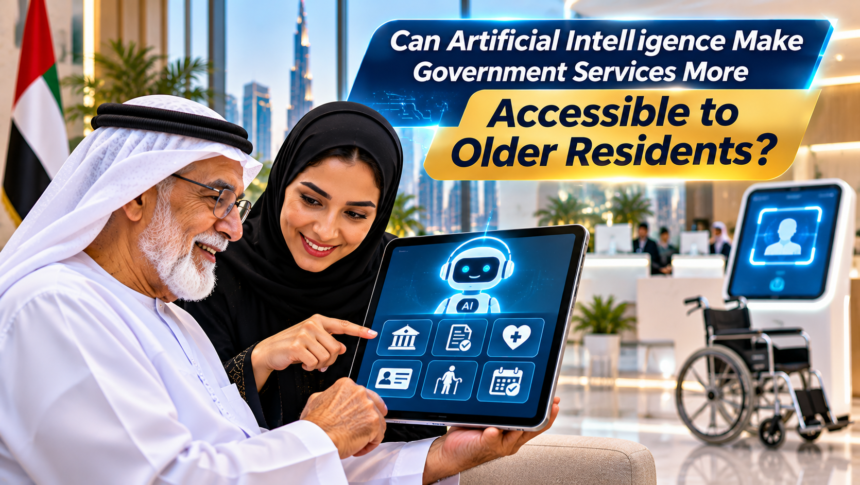
Imagine an older resident in Dubai trying to renew an official document through a government website. The application contains several menus, unfamiliar terminology and multiple verification steps. Instead of navigating everything independently, the resident could ask an artificial intelligence assistant to explain the process in simple language, identify the correct service and provide step-by-step guidance. This illustrates how AI government services could make everyday administrative tasks more accessible for older residents.
- Why Older Residents Need Accessible Government Services
- 7 Ways AI Can Improve Government Accessibility
- UAE and Saudi Arabia: Real Examples of AI Government Services
- Why Human Assistance Must Remain Available
- Privacy, Accuracy and Security Risks of Government AI
- Designing AI Services for Older Adults
- The Economics of Accessible AI Government Services
- The Future of AI Government Services and FAQs
Across the Gulf, governments are introducing digital platforms designed to simplify public services, reduce paperwork and improve access to information.
Artificial intelligence is becoming part of this transformation, with applications ranging from conversational assistants to systems that can coordinate multiple administrative processes.
However, convenience for digitally confident users does not automatically translate into accessibility for everyone.
Some older residents may encounter difficulties with small text, complicated interfaces, unfamiliar authentication procedures or websites that require numerous steps.
Others may be comfortable using smartphones but prefer speaking to an assistant instead of navigating lengthy forms.
The important question is whether AI can reduce these barriers without creating new risks involving privacy, inaccurate information or dependence on technology.
Recent developments in the United Arab Emirates provide a useful example.
On October 30, 2026, the Emirates News Agency reported that several UAE government organisations were expanding the use of AI systems capable of coordinating administrative tasks rather than simply answering questions.
Dubai Electricity and Water Authority reported converting 16 of its 21 services into AI-enhanced autonomous services, while Dubai’s Roads and Transport Authority developed a more capable version of its virtual assistant, Mahboub.
Abu Dhabi is also advancing an AI-enabled government strategy, with its TAMM platform offering multilingual assistance and integrated digital services.
Meanwhile, Saudi Arabia’s Digital Government Authority has identified accessibility and inclusive service design as priorities for public-sector digital transformation.
These initiatives demonstrate growing investment in government AI. However, they do not yet establish that every older resident can use the resulting systems independently.
The real measure of success will be whether technology makes essential services easier, safer and more understandable for people with different abilities and levels of digital experience.
Why Older Residents Need Accessible Government Services
Government services play an important role in everyday life.
Residents may need to renew identification documents, access healthcare information, manage housing-related procedures, pay bills or request official certificates.
When these services move online, people can often complete tasks without travelling to government offices.
However, digital access involves more than making a website available.
The Challenge of Complicated Interfaces
Some government platforms require users to move between several pages, upload documents and complete identity verification.
For people unfamiliar with digital procedures, these steps can create confusion.
Long instructions and technical terminology may make the process even more difficult.
An accessible service should explain what users need to do, why information is required and what happens after submission.
Age-Related Accessibility Needs
Older adults are not a uniform group, and many use digital technology confidently.
Nevertheless, some people experience changes in vision, hearing, movement or memory that affect how they interact with electronic services.
The World Wide Web Consortium explains that accessibility requirements for older users frequently overlap with those of people with disabilities.
For example, readable text, clear navigation and predictable interfaces can benefit users across different age groups.
The Importance of Independence
Being able to complete a government transaction independently can save time and improve convenience.
However, independence should not mean forcing people to use technology without assistance.
Some residents may prefer a trained employee, a telephone conversation or an in-person service centre.
The objective should be meaningful choice rather than replacing every traditional interaction.
Traditional vs AI-Assisted Services
| Feature | Conventional Digital Service | AI-Assisted Service |
|---|---|---|
| Navigation | Menus and search options | Conversational guidance |
| Instructions | Fixed website content | Potentially personalised explanations |
| Language | Available interface languages | Possible multilingual conversations |
| Forms | Manual navigation | Guided completion where supported |
| Support | Help pages or contact centres | Automated guidance with escalation |
| Main Risk | Complex user experience | Incorrect or misleading AI responses |
AI can improve the interface, but underlying services must still be reliable, accessible and properly supervised.
7 Ways AI Can Improve Government Accessibility
Artificial intelligence offers several potential ways to make digital public services easier to use.
Not every capability is currently available across GCC government platforms, and the effectiveness of each approach depends on implementation.
1. Voice-Based Assistance
Voice interaction can allow residents to ask questions without typing or searching through multiple menus.
A user might ask how to renew a document or where to find an official application.
The assistant could provide spoken guidance or direct the person to the appropriate service.
However, voice systems must account for accents, background noise and different communication needs.
2. Simplifying Complicated Instructions
Government information sometimes includes specialised legal or administrative language.
AI can help present approved instructions in shorter, more understandable steps.
This may be useful when residents need to understand required documents, fees or procedures.
However, simplified explanations must preserve important conditions and legal details.
3. Multilingual Communication
Language can be a significant barrier for people who are not comfortable reading official information in the available interface language.
AI-supported translation and conversational systems may make guidance easier to understand.
Abu Dhabi’s TAMM 4.0 initiative, announced in September 2025, includes multilingual AI assistance supporting more than 15 languages.
Translation quality still needs monitoring, particularly for legal, medical and financial information.
4. Guided Form Completion
Instead of displaying a lengthy form without explanation, a digital assistant could guide a user through individual sections.
It might explain what a field means or identify a missing attachment.
However, AI should not invent personal information or submit important applications without appropriate user approval.
5. Personalised Service Guidance
With appropriate permissions and safeguards, an AI system could identify which government service a user is trying to access.
For example, it could help distinguish between renewing a document and applying for a different service.
Personalisation should remain transparent and should not involve unnecessary collection of sensitive information.
6. Faster Access to Human Assistance
AI can help identify when a user needs support from a trained employee.
Instead of repeatedly presenting automated answers, a well-designed system could transfer the conversation or direct the person to a suitable service centre.
This is especially important when the request involves complex personal circumstances.
7. Reducing Repeated Administrative Steps
AI-enabled systems may coordinate information between authorised government services and reduce repetitive tasks.
The October 2026 UAE government report described efforts to move from answering questions towards completing certain interconnected procedures.
However, automated coordination must still respect consent, identity verification and appropriate oversight.
Seven Accessibility Benefits Compared
| AI Capability | Potential Benefit | Main Safeguard |
|---|---|---|
| Voice Assistance | Less typing and navigation | Accurate speech recognition |
| Simple Explanations | Easier understanding | Verified official information |
| Multilingual Support | Fewer language barriers | Translation review |
| Guided Forms | Fewer user errors | User approval |
| Personalised Guidance | More relevant instructions | Data minimisation |
| Human Escalation | Support for difficult cases | Accessible staff |
| Task Coordination | Fewer repeated steps | Secure authorisation |
These capabilities are most valuable when developed around real user needs rather than simply adding more technology to an existing service.
UAE and Saudi Arabia: Real Examples of AI Government Services
The UAE and Saudi Arabia provide practical examples of government organisations exploring AI alongside broader digital accessibility programmes.
Some initiatives already operate, while other capabilities remain in development or are being expanded.
Abu Dhabi’s AI-Enabled TAMM Platform
In September 2025, Abu Dhabi’s Department of Government Enablement announced the next stage of its digital government transformation.
The TAMM 4.0 platform was designed to offer integrated services, contextual AI support and multilingual guidance.
The government also reported deploying more than 100 AI use cases across over 40 entities.
For older residents, conversational support could make it easier to locate relevant procedures without searching through different departments.
However, these figures do not demonstrate specific improvements in older users’ transaction success rates.
Dubai’s AI Government Assistants

Dubai has introduced several AI initiatives intended to improve communication and public services.
In June 2026, Dubai Municipality announced Saeed, an AI-powered virtual spokesperson capable of communicating in Arabic and English.
Saeed was introduced to improve public information and engagement rather than replace all customer-service employees.
Dubai’s RTA has also developed an enhanced version of Mahboub, its virtual assistant.
The October 2026 government report described an initial phase supporting activities such as vehicle-registration renewal and fine payments through coordinated digital processes.
These developments illustrate the potential for simpler service journeys.
Saudi Arabia’s Digital Inclusion Initiatives
Saudi Arabia’s Digital Government Authority has published guidance on digital inclusion and accessible public services.
In July 2025, the Ministry of Commerce reported reviewing public suggestions concerning ways to make services easier for older customers.
The ministry said the findings would inform measures intended to improve independence and simplify transactions.
Saudi Arabia’s Digital Experience Maturity Index also addresses the use of AI to improve service quality and customer experience.
However, government-wide AI adoption should not be confused with proven accessibility for every older person.
Current Initiatives Compared
| Initiative | Location | Accessibility Relevance |
|---|---|---|
| TAMM 4.0 | Abu Dhabi | Multilingual AI guidance |
| Mahboub | Dubai | Conversational service coordination |
| Saeed | Dubai | AI-supported public communication |
| Digital Accessibility Policy | UAE | Prioritises older residents and people of determination |
| Digital Inclusion Guidance | Saudi Arabia | Accessible government services |
| Ministry of Commerce Initiative | Saudi Arabia | Older-user feedback and service improvements |
These examples show that governments are exploring multiple approaches rather than relying on one universal AI platform.
Why Human Assistance Must Remain Available
AI can make government transactions easier, but its usefulness depends on whether residents can obtain reliable help when something goes wrong.
Some people may need assistance because a service is unfamiliar, a document is missing or an application requires special consideration.
Others may simply prefer speaking with a person.
The UAE’s On-Site Digital Support Policy
The UAE government’s official guidance describes a 2025 Cabinet directive requiring federal government entities to provide direct assistance through service centres.
The approach includes trained employees, accessible service points and help for people using digital platforms.
Importantly, the guidance states that customers should not be turned away merely because a service is available online.
It also identifies older residents and people of determination as priority groups for accessible support.
This provides a useful model for combining digital transformation with in-person assistance.
When AI Cannot Resolve a Problem
An automated assistant may struggle with unusual circumstances, conflicting records or unclear documentation.
Repeatedly supplying the same instructions can frustrate users rather than solve the problem.
A well-designed system should recognise its limitations and offer a clear route to an authorised employee.
This is especially important when mistakes could affect a person’s legal status, healthcare access or financial circumstances.
Supporting Different Levels of Digital Confidence
Older residents have different preferences and experiences.
Some may want to use mobile applications independently, while others may appreciate assistance from family members or customer-service staff.
Digital inclusion requires supporting both groups without assuming that age automatically determines technical ability.
A Practical Hybrid Service Model
| Service Stage | AI Support | Human Support |
|---|---|---|
| Finding Information | Search and conversational guidance | Clarifying complicated requests |
| Completing Forms | Explaining fields | Resolving unusual cases |
| Identity Verification | Supported authentication guidance | Official recovery assistance |
| Document Review | Identifying missing information | Reviewing exceptions |
| Complaints | Directing users appropriately | Investigation and resolution |
The objective should be to automate routine tasks while preserving meaningful access to qualified people.
Privacy, Accuracy and Security Risks of Government AI
AI systems can process large amounts of information and generate responses quickly.
However, these capabilities create responsibilities when government services involve confidential personal information or legally significant decisions.
The Risk of Incorrect Answers
Generative AI can produce statements that sound convincing but are inaccurate.
In a government setting, incorrect instructions could cause missed deadlines, inappropriate payments or incomplete applications.
Public-sector AI systems should rely on authoritative information and provide clear ways to verify important requirements.
They should also identify situations in which automated guidance is insufficient.
Protecting Sensitive Information
Government transactions may involve identity documents, medical information, residence records and financial details.
These categories of information require appropriate protection.
AI systems should collect only necessary information, follow applicable data protection rules and prevent unauthorised disclosure.
Residents should use official government applications and avoid entering sensitive documents into unverified AI websites.
Fraud and Impersonation
Criminals may use convincing messages, websites or synthetic voices to impersonate official services.
Older adults should not be treated as uniquely vulnerable, but fraud prevention is important for everyone using digital government channels.
Residents should verify unexpected requests for passwords, one-time codes or payments using independently confirmed official contact details.
Accessibility Without Excessive Surveillance
A system may use personalisation to simplify services, but residents should understand how their information is processed.
Improving accessibility does not justify collecting unnecessary personal data.
Clear privacy notices and appropriate consent or other lawful processing arrangements are essential.
Risks and Safeguards
| Risk | Possible Impact | Recommended Safeguard |
|---|---|---|
| Incorrect AI Guidance | Administrative errors | Verified information sources |
| Data Exposure | Privacy breaches | Secure processing |
| Fraudulent Requests | Financial or identity harm | Official-channel verification |
| System Outages | Interrupted access | Alternative service channels |
| Poor Speech Recognition | Misunderstood requests | Text and human options |
| Inaccessible Design | Exclusion of users | Accessibility testing |
Government agencies should measure whether AI reduces difficulties rather than simply counting automated conversations.
Designing AI Services for Older Adults
Successful AI accessibility depends on more than installing a chatbot.
Government organisations need to examine how people actually use digital services and identify the stages that cause confusion, delays or errors.
The World Wide Web Consortium’s accessibility guidance provides useful principles that apply to users of different ages and abilities.
Clear and Readable Interfaces
Larger adjustable text, strong colour contrast and clearly labelled buttons can make digital platforms easier to navigate.
Users should also be able to enlarge content without losing important information or functionality.
An AI assistant cannot compensate fully for a website that remains difficult to read or operate.
Simple Language and Predictable Navigation
Government platforms should use familiar terminology and explain tasks in a logical sequence.
For example, a service should clearly distinguish between starting an application, saving progress and submitting information.
AI can help explain these steps, but the underlying interface must also remain understandable.
Accessible Voice and Text Options
Some users prefer speaking, while others rely on text, captions or assistive technologies.
Services should offer appropriate alternatives instead of requiring every resident to communicate in the same way.
Voice interactions should also allow users to repeat questions, review information and correct misunderstandings.
Testing With Older Residents
Developers should involve older people with different levels of digital experience during design and testing.
This can reveal problems that technical teams may overlook.
For example, a service might work well during a demonstration but become confusing when users encounter unexpected errors or need to recover an account.
Accessibility Design Checklist
- Provide adjustable text sizes and readable contrast.
- Use clear language and consistent navigation.
- Support keyboard and assistive technology access.
- Offer alternatives to voice-only interactions.
- Explain authentication steps before requesting approval.
- Allow users to review important information.
- Make errors understandable and recoverable.
- Provide an obvious route to human assistance.
- Test services with older residents.
- Measure successful completion, not only usage.
Accessibility should be evaluated through practical outcomes, including whether users can finish the task accurately and confidently.
The Economics of Accessible AI Government Services
Accessibility is usually discussed as a public-service responsibility, but it also has operational and financial implications.
Governments invest in digital systems to improve service delivery, manage demand and reduce unnecessary administrative work.
AI may contribute to these objectives when it helps users complete routine tasks without repeated contact-centre requests or office visits.
However, financial savings should not come at the expense of fairness, accuracy or access to essential services.
Potential Operational Benefits
A well-designed assistant could answer routine questions about service requirements and direct users towards appropriate procedures.
This may reduce avoidable enquiries and allow employees to concentrate on complicated cases.
Digital guidance may also help reduce application errors, although actual benefits must be measured.
Illustrative Service-Cost Model
Consider a hypothetical government service handling 10,000 routine enquiries monthly.
Assume 4,000 enquiries can be resolved through a reliable AI-assisted channel.
| Monthly Measure | Conventional Handling | AI-Assisted Scenario |
|---|---|---|
| Total Enquiries | 10,000 | 10,000 |
| Human-Handled Enquiries | 10,000 | 6,000 |
| AI-Resolved Enquiries | 0 | 4,000 |
| Assumed Human Cost per Enquiry | AED 18 | AED 18 |
| Assumed AI Cost per Resolved Enquiry | — | AED 5 |
| Illustrative Direct Handling Cost | AED 180,000 | AED 128,000 |
The hypothetical difference is AED 52,000 monthly.
These figures are not actual UAE or Saudi government operating costs. They exclude technology development, integration, security, oversight, testing and other expenses.
They also assume that the AI system resolves the stated enquiries accurately without requiring additional work.
Why Accessibility Must Be Measured Separately
A lower cost per enquiry does not automatically demonstrate improved accessibility.
Governments should also evaluate transaction completion rates, error frequency, user confidence and the availability of human assistance.
A system that reduces costs while leaving some residents unable to access essential services would fail an important public-service objective.
Performance Indicators
| Indicator | Why It Matters |
|---|---|
| Transaction Completion Rate | Shows whether users finish successfully |
| Error Rate | Measures accuracy |
| Human Escalation Rate | Identifies unresolved cases |
| Accessibility Test Results | Measures usability for different needs |
| User Satisfaction | Captures service experience |
| Total Service Cost | Evaluates financial efficiency |
| Complaint Resolution | Assesses accountability |
Responsible investment should consider both public value and operational efficiency.
The Future of AI Government Services and FAQs
Government AI is moving towards more conversational, integrated and proactive forms of service delivery.
In the UAE, the October 2026 developments involving DEWA and RTA illustrate efforts to coordinate transactions rather than simply answer questions.
Abu Dhabi’s 2025–2027 digital government strategy also aims to increase the use of AI throughout public administration.
These initiatives may offer new opportunities for older residents, but accessibility must remain a deliberate design priority.
Moving Towards Proactive Support
Future systems may identify when certain administrative services become relevant and provide authorised reminders or guidance.
For example, a resident could receive a notification that an eligible document is approaching renewal.
However, proactive services must use personal information responsibly and avoid completing significant transactions without appropriate authority.
Keeping Services Inclusive
The UAE’s National Digital Accessibility Policy explicitly prioritises older residents and people of determination.
Saudi Arabia’s digital inclusion initiatives also demonstrate recognition that public services should accommodate different user needs.
The long-term challenge is ensuring that AI strengthens these commitments rather than creating another technical barrier.
Frequently Asked Questions
Can AI make government services easier for older residents?
Yes, when appropriately designed. AI can simplify instructions, support voice interaction and help users navigate routine tasks.
Does the UAE have AI-powered government services?
Yes. UAE government entities have introduced AI assistants and integrated digital services, including initiatives involving TAMM, RTA and DEWA.
Can older residents still receive in-person government assistance in the UAE?
Yes. UAE government guidance describes a 2025 directive requiring federal service centres to support customers using digital services, with priority assistance for older residents and people of determination.
Is Saudi Arabia using AI in government services?
Yes. Saudi Arabia’s digital government programmes include AI initiatives, service experience improvements and accessibility guidance.
Can AI complete government applications automatically?
Certain systems may support coordinated transactions, but capabilities vary. Identity verification, legal requirements and appropriate user authorisation remain necessary.
Is voice interaction better than a conventional website?
It can be more convenient for some people, but others prefer text or traditional navigation. Accessible services should provide suitable choices.
What happens when an AI assistant gives incorrect information?
Users should be able to verify important information through official sources and reach a trained employee when necessary.
Can government AI replace customer-service employees?
AI can support routine tasks, but human employees remain important for exceptional cases, complaints and users who need personal assistance.
Are AI government services safe?
They can incorporate strong security safeguards, but no digital system is completely risk-free. Users should access official platforms and protect authentication information.
What makes an AI service genuinely accessible?
Clear instructions, readable interfaces, multiple interaction methods, reliable answers, inclusive testing and accessible human support are important factors.
Final Thoughts
Artificial intelligence has the potential to make government services more accessible for older residents across the Gulf.
Voice guidance, multilingual explanations, simplified forms and coordinated administrative processes could help people complete routine tasks with greater confidence.
Recent developments in the UAE and Saudi Arabia show that governments are investing in AI and more inclusive digital services.
However, technology alone cannot guarantee accessibility.
Older residents have different needs, preferences and levels of digital experience. Some may welcome conversational assistants, while others may prefer help from a trained employee.
For governments, success should be measured by whether residents can obtain services accurately, safely and without unnecessary difficulty.
For technology developers, the priority should be designing systems that respect privacy, communicate clearly and offer meaningful alternatives when automation cannot resolve a problem.
Ultimately, AI government services can support greater independence and convenience for older residents, but they work best when artificial intelligence strengthens rather than replaces human-centred public service.
Do follow us on Instagram
Read More – How Gulf Digital Identity Is Transforming Everyday Services