



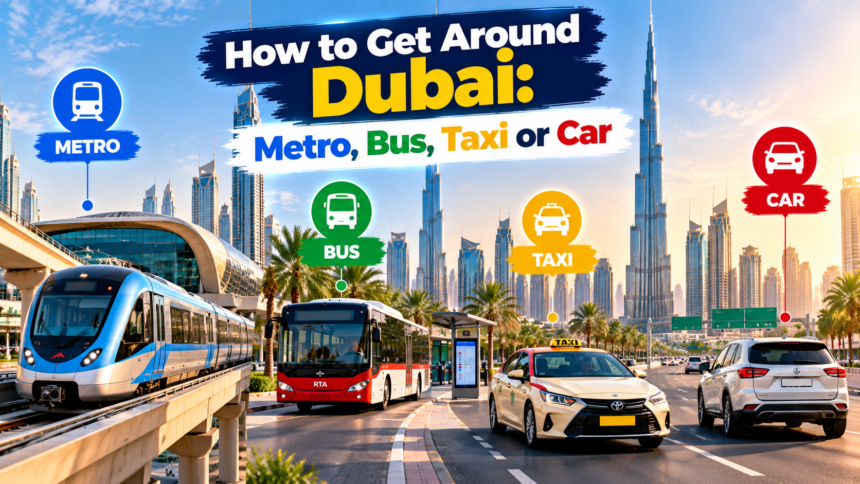
You Need a nol Card for Most Dubai Public Transport
How to get around Dubai is one of the first practical questions new residents and visitors face because the city offers several very different transport options. Dubai Metro can be fast and inexpensive for journeys along major corridors, buses connect neighbourhoods that the rail network does not reach, taxis offer door-to-door convenience, and driving gives maximum flexibility but comes with parking, Salik tolls, insurance and traffic.
- How to Get Around Dubai: Quick Comparison
- Dubai Metro Is Usually the Best Starting Point for New Residents
- Metro Works Best When You Live Close to a Station
- You Need a nol Card for Most Dubai Public Transport
- Dubai Public Transport Fares Are Based on Zones
- Metro Is Excellent for Rush-Hour Predictability
- Metro Has Limitations for Families and Multi-Stop Days
- Dubai Buses Fill the Gaps in the Metro Network
- Buses Are Useful but Traffic Still Matters
- S’hail Makes Public Transport Much Easier to Plan
- Taxis Are the Easiest Door-to-Door Option
- Taxi Costs Become Significant With Daily Commuting
- Metro Plus Taxi Can Be a Very Efficient Combination
- Owning a Car Gives the Most Freedom
- Calculate the Full Cost of a Car Before Buying One
- Salik Is an Important Part of Dubai Driving Costs
- Salik Can Change the Economics of Your Commute
- Parking Can Matter as Much as Fuel
- Traffic Should Influence Where You Live
- Driving Is Often Better for Families
- Metro Can Be Better for Single Professionals
- Remote Workers May Not Need a Car Immediately
- Visitors Often Need Metro and Taxi More Than a Car
- Use Gold Class Only if the Extra Comfort Matters to You
- Learn the Cabin Rules Before Using Metro
- Public Transport Is Much Cheaper When You Use It Consistently
- Public Transport Is Not Always the Cheapest Once Time Is Included
- A Hybrid Transport Strategy Often Works Best
- Which Option Is Cheapest for a Daily Work Commute?
- Which Option Is Best if You Are New to Dubai?
- Common Transport Mistakes New Dubai Residents Make
- A Seven-Day Transport Test for New Residents
- Is It Possible to Live in Dubai Without a Car?
- What Is the Best Way to Get Around Dubai?
The best option depends less on which mode is “best” overall and more on where you live, where you work and how often you travel outside Metro-connected areas. Someone living near a Red Line station and working in Dubai Internet City may rely on public transport almost every day, while a family living farther from the rail network may find a car much more practical.
Dubai’s Roads and Transport Authority operates an integrated public transport system built around Metro, buses, Tram and marine transport, with nol cards used for payment across most services. RTA currently divides the public transport network into seven fare zones, and eligible transfers between Metro and bus services can be completed within 30 minutes while remaining part of the same overall journey calculation.
This guide compares Dubai Metro, buses, taxis and cars in practical terms, including timings, nol cards, fares, commute patterns, Salik charges, parking considerations and which option makes the most sense for different types of residents.
How to Get Around Dubai: Quick Comparison
The easiest way to choose a transport method is to think about three things together: cost, convenience and coverage. Metro is generally strongest when both ends of your journey are close to stations, buses are useful for filling gaps in the rail network, taxis work well for occasional convenience, and cars become more attractive when your schedule involves multiple locations or areas with weak public transport access.
| Transport Option | Best For | Main Advantage | Main Limitation |
|---|---|---|---|
| Dubai Metro | Regular commuters | Fast, predictable and affordable | Limited to station corridors |
| Public bus | Residential connections | Wide network | Can be slower in traffic |
| Taxi | Occasional door-to-door travel | Very convenient | Costs add up with daily use |
| Car | Families and flexible travel | Maximum independence | Parking, fuel, Salik and traffic |
| Tram | Marina/JBR areas | Useful local connections | Limited geographic coverage |
| Marine transport | Selected waterfront routes | Useful and scenic | Not practical for every commute |
For many residents, the most practical answer is not one transport mode but a combination. Metro plus bus, Metro plus taxi, or car plus Metro parking can sometimes work better than relying on a single method for every journey.
Dubai Metro Is Usually the Best Starting Point for New Residents
Dubai Metro is one of the easiest ways for newcomers to understand the city because it follows clear corridors, avoids road congestion and connects many major business and residential areas. RTA operates the Red and Green Lines, with interchange between them at Union and BurJuman stations.
The Red Line is especially important for residents travelling through areas such as Downtown Dubai, Business Bay, Dubai Marina, JLT, Dubai Internet City and Expo City. The Green Line serves several older and central districts, including Deira and Bur Dubai, and connects with the Red Line through the main interchange stations.
RTA currently lists regular Metro station opening hours as follows.
| Day | Metro Operating Hours |
|---|---|
| Monday to Thursday | 5:00am to midnight |
| Friday | 5:00am to 1:00am next day |
| Saturday | 5:00am to midnight |
| Sunday | 8:00am to midnight |
These are general operating hours, and holiday or special-event schedules can change. RTA frequently publishes temporary service timings for Ramadan, Eid and public holidays, so commuters should check current information if travelling during major events.
Metro Works Best When You Live Close to a Station
Distance from the station can completely change the convenience of Dubai Metro. A home five minutes from a station may allow you to commute without a car, while an apartment that technically appears “Metro-connected” but requires a 20-minute walk in summer can feel much less practical.
Before renting a home around public transport, test the full journey rather than only measuring the distance to the nearest station. Consider the walk from your building, station access, interchange time, the distance from the destination station to your office and whether you need an additional bus or taxi for the final part.
A Metro-friendly commute usually has several advantages: travel times are more predictable during rush hour, daily costs can be relatively low, and residents do not need to worry about fuel, parking or Salik. The trade-off is reduced flexibility when travelling to communities outside the rail network.
You Need a nol Card for Most Dubai Public Transport
RTA uses the nol system across Dubai Metro, public buses, Dubai Tram and several marine transport services. Cash is not accepted as the standard payment method across RTA public transport, so new residents should obtain a nol card early.
The Silver nol card is usually the simplest option for regular residents, while Gold provides access to Gold Class cabins at a higher fare. Personal cards offer additional security and concession options for eligible users, and Red Tickets are more suitable for visitors making a limited number of journeys.
RTA currently lists Silver and Gold cards at AED25, including AED19 in initial balance, while Personal cards cost AED70 and include AED20 credit.
| nol Type | Typical User | Current Price |
|---|---|---|
| Silver | Regular commuters | AED25 including AED19 balance |
| Gold | Gold Class users | AED25 including AED19 balance |
| Personal | Registered users/concessions | AED70 including AED20 credit |
| Red Ticket | Short-term visitors | AED2 ticket price |
RTA also requires a minimum nol balance of AED7.50 before starting a Metro journey.
Dubai Public Transport Fares Are Based on Zones
Dubai’s public transport network is divided into seven fare zones. The amount deducted from a nol card depends on how many zones the journey crosses rather than simply the number of stations travelled.
This is particularly useful when combining buses and Metro because RTA allows transfers between different modes within 30 minutes, subject to the applicable journey rules. A commuter can therefore use a feeder bus to reach a Metro station and continue the journey without treating each segment as a completely separate trip in every case.
The practical lesson is simple: residents who use public transport frequently should learn the zones covering home and work instead of trying to memorise every individual fare. This makes monthly commuting costs easier to estimate and helps when comparing public transport with driving.
Metro Is Excellent for Rush-Hour Predictability
One of the strongest reasons to use Metro is that train travel is far less affected by road congestion. Dubai traffic can vary significantly between peak and off-peak periods, particularly on major routes such as Sheikh Zayed Road, Al Khail Road and key bridges linking residential and business districts.
For office commuters, predictable arrival time can matter more than the absolute journey time. A 35-minute Metro journey that stays relatively consistent can sometimes be easier to manage than a car journey that takes 25 minutes one day and 55 minutes the next.
Metro is especially attractive when you work in areas directly connected to the Red Line. Residents in JLT, Dubai Marina, Business Bay and similar neighbourhoods can sometimes build a weekday routine around rail travel and use taxis or a car only on weekends.
Metro Has Limitations for Families and Multi-Stop Days
Public transport becomes less convenient when a normal day involves several separate destinations. Parents may need to travel from home to school, then work, then after-school activities and finally groceries or appointments.
In those situations, the time lost walking, waiting and transferring can outweigh the cost advantage of Metro. The same applies to residents whose office is located inside a business park or industrial area that requires a long feeder-bus journey after leaving the station.
This is why families should test the actual weekday routine before deciding they do not need a car. Metro can still handle individual trips very well, but a complex schedule often changes the calculation.
Dubai Buses Fill the Gaps in the Metro Network
Dubai’s public bus network connects residential communities, Metro stations, commercial areas and intercity routes. Buses are particularly valuable in neighbourhoods that are not directly served by rail and for completing the first or final part of a Metro journey.
RTA regularly adjusts routes as new communities and travel patterns develop. In July 2026, for example, the authority launched four new bus routes and enhanced 13 existing ones to improve connections between residential and commercial areas. New Route 35 connected International City with Dubai Silicon Oasis, while Route 85 linked Al Quoz’s Al Khail Gate area with Dubai Internet City Metro Station.
This ongoing network expansion means old advice about bus routes can become outdated. Residents should use RTA’s S’hail app or current journey-planning tools rather than relying on an old screenshot or blog post.
Buses Are Useful but Traffic Still Matters
Unlike Metro trains, buses operate on normal roads and can therefore be affected by congestion. A route that works very well outside rush hour may take significantly longer during the morning or evening peak.
Buses remain a strong option when they reduce the need to own a car, especially if a direct route connects your home with a Metro station or workplace. They can also make lower-rent neighbourhoods more practical for residents who do not drive.
The main advantage is network reach rather than speed. If Metro is the backbone of public transport, buses are the system that extends coverage into residential areas the rail lines do not directly serve.
S’hail Makes Public Transport Much Easier to Plan
Residents using Metro and buses should keep RTA’s S’hail journey-planning app available. RTA directs passengers to S’hail for updated bus schedules during public holidays and other service changes, which makes it particularly useful when normal timetables are adjusted.
Rather than memorising bus numbers, users can enter an origin and destination and compare available public transport combinations. This can include Metro, bus and other RTA services depending on the journey.
For a new resident, this reduces one of the biggest barriers to using buses: you do not need to understand the entire network before making your first trip.
Taxis Are the Easiest Door-to-Door Option
Dubai taxis remain one of the simplest transport choices for people who want to travel directly between two locations without parking or transfers. RTA operates and regulates different taxi categories, including regular taxis, family taxis, vehicles for female passengers, People of Determination services and airport options.
RTA allows passengers to book taxis through smart and partner apps, including S’hail-supported booking channels. The passenger enters pickup and destination details, selects a vehicle type and confirms the payment method before travelling.
For someone who uses taxis only a few times each week, this can be much cheaper and easier than owning a car once insurance, registration, parking and depreciation are considered.
Taxi Costs Become Significant With Daily Commuting
The weakness of taxis is repetition. One or two rides are convenient, but two journeys every working day can quickly create a substantial monthly transport budget.
Someone commuting by taxi should calculate the monthly cost before assuming it is cheaper than leasing or owning a car. Multiply the typical return journey by around 20 to 22 working days, then add weekend trips and airport journeys.
Taxi Budget Exercise
| Expense | Your Estimate |
|---|---|
| Morning commute | AED ___ |
| Evening commute | AED ___ |
| Daily total | AED ___ |
| 22 workdays | AED ___ |
| Weekend trips | AED ___ |
| Estimated monthly total | AED ___ |
If the monthly figure remains comfortably below the full cost of car ownership, taxis may still make sense. If it starts approaching the cost of a vehicle while limiting flexibility, owning or leasing may become more attractive.
Metro Plus Taxi Can Be a Very Efficient Combination
Residents do not have to choose between Metro and taxi as completely separate lifestyles. A common strategy is to use Metro for the expensive or congested part of the journey and a short taxi ride for the final connection.
This works particularly well when the office or home is a few kilometres from a station. Instead of paying for a 25-kilometre taxi journey, the resident pays for a short ride to the station and completes the longer distance by Metro.
The benefit is balance: you avoid a long walk in hot weather while still keeping the majority of the commute on lower-cost public transport.
Owning a Car Gives the Most Freedom
A car gives residents complete control over departure time, route and stops along the way. For families, people working in multiple locations and residents of communities with limited public transport, that flexibility can be extremely valuable.
Driving also makes weekend trips outside the main urban areas easier. Beaches, desert destinations, neighbouring emirates and family activities can be much simpler to reach with a private vehicle.
The mistake is assuming that the monthly car payment represents the entire cost of driving. The real budget also includes insurance, fuel, parking, Salik, registration, tyres, servicing and depreciation.
Calculate the Full Cost of a Car Before Buying One
Car ownership should be evaluated as a monthly total rather than a purchase price.
| Car Cost | Monthly or Annual? |
|---|---|
| Finance or lease | Monthly |
| Insurance | Annual |
| Registration | Annual |
| Fuel | Monthly |
| Salik | Variable |
| Paid parking | Variable |
| Maintenance | Variable |
| Tyres | Periodic |
| Depreciation | Long-term cost |
A vehicle that appears affordable based on the finance instalment may become significantly more expensive once all running costs are included.
For new residents, waiting one or two months before buying can be useful. That gives you time to understand your real commute, workplace parking and whether Metro or taxis already cover most of your needs.
Salik Is an Important Part of Dubai Driving Costs
Dubai uses the Salik electronic toll system across selected roads. Salik moved to variable toll pricing in January 2025, meaning the charge changes depending on the time of day.
Outside Ramadan, the current structure is:
| Period | Weekday Charge |
|---|---|
| Peak: 6am–10am | AED6 per crossing |
| Off-peak: 10am–4pm | AED4 |
| Peak: 4pm–8pm | AED6 |
| Off-peak: 8pm–1am | AED4 |
| 1am–6am | AED0 |
| Sunday, except certain holidays/events | AED4 during charged periods |
Salik’s official reporting confirms that Sundays are generally AED4 during chargeable hours, while the late-night period is toll-free. Ramadan uses a different timing structure.
This means two people driving similar distances can have different monthly toll costs depending on their route and commute time.
Salik Can Change the Economics of Your Commute
A single AED6 crossing may not sound significant, but regular peak-hour commuting can multiply the cost quickly.
If your daily route crosses one charged gate each way during weekday peak hours, that could mean AED12 per working day before fuel and parking. Across roughly 22 workdays, the toll cost alone would be around AED264.
A commute crossing multiple gates can cost considerably more.
Before choosing a home based on driving distance, check the actual route rather than only the kilometres. A slightly longer route without tolls may be cheaper, while a shorter toll-heavy route may save enough time to justify the additional expense.
Parking Can Matter as Much as Fuel
Parking is another major difference between driving and public transport. Some residential and office buildings include parking, while others require paid public or private parking.
New residents should confirm workplace parking before buying a vehicle. If the employer does not provide a space, the monthly cost and availability of nearby parking can materially affect the value of driving.
Apartment parking deserves the same attention. A household with two cars and one allocated space may need to rent another bay or depend on public parking, which can add both expense and inconvenience.
Traffic Should Influence Where You Live
Dubai’s size can make two apartments with similar rent feel completely different depending on their relationship with your workplace. A property closer on the map does not always create the fastest commute because access roads, bottlenecks and bridge crossings can affect travel time.
Test the journey during your expected working hours before signing a tenancy. Drive it once in the morning and again in the evening if possible.
Commute Decision Guide
| One-Way Travel Time | Likely Impact |
|---|---|
| Under 20 minutes | Very manageable |
| 20–35 minutes | Common and usually manageable |
| 35–50 minutes | Significant daily commitment |
| 50–60 minutes | Major lifestyle factor |
| Over 60 minutes | Worth reconsidering area or transport mode |
Two hours per day spent commuting equals roughly ten hours across a five-day working week. That should be considered when comparing rent savings in a more distant neighbourhood.
Driving Is Often Better for Families
Families generally have more complicated travel patterns than single professionals. School drop-offs, nursery, work, groceries, medical appointments and children’s activities can all happen in different areas.
A car can reduce the number of transfers and waiting periods required to complete those journeys. Parents also gain more control over luggage, pushchairs and children’s schedules.
Public transport can still work well for individual trips, but family logistics often make a vehicle more practical. The decision should be based on the entire household routine rather than only the primary employee’s commute.
Metro Can Be Better for Single Professionals
Single professionals living and working near the Red or Green Line may find car ownership unnecessary for several years.
If Metro handles the weekday commute, taxis can cover occasional evenings and weekends. Even if those taxi rides feel expensive individually, the total may still be far lower than buying, insuring and maintaining a car.
This is especially true for residents living in communities where parking is limited or where many restaurants, gyms and supermarkets are within walking distance.
Remote Workers May Not Need a Car Immediately
People working from home have a completely different transport equation. If you commute to an office only once or twice a week, owning a vehicle solely for work may make little financial sense.
A combination of Metro, taxis, rental cars and occasional car-share services can sometimes cover your needs more economically. The money saved on monthly car costs can instead support housing closer to entertainment or amenities.
Track your journeys for one month before buying. If you discover you use a taxi only five or six times a week, compare that total with the full cost of ownership rather than assuming a car is automatically more economical.
Visitors Often Need Metro and Taxi More Than a Car
Tourists staying in central Dubai can usually reach many popular attractions using Metro and taxis. Renting a car can introduce additional complications such as parking, Salik charges, navigation and driving in unfamiliar traffic.
Metro is especially useful for destinations near the Red Line, while taxis handle hotels, beaches and attractions farther from stations.
A rental car becomes more useful when the itinerary includes several emirates, desert areas or destinations far outside the Metro corridor.
Use Gold Class Only if the Extra Comfort Matters to You
Dubai Metro and Tram include Gold Class sections accessible with the appropriate nol card and fare. RTA states that Gold card users pay double the normal public transport fare in exchange for access to the dedicated premium cabin.
This may appeal to commuters who value additional space during busy periods, but it is unnecessary for someone primarily focused on keeping transport costs low.
New residents should try normal Silver travel first. You can always decide later whether the comfort upgrade is worth the additional cost.
Learn the Cabin Rules Before Using Metro
Metro trains include designated cabin arrangements, including Gold Class and women-and-children sections. Residents should pay attention to signs and platform markings before boarding because entering the wrong cabin can create avoidable problems.
RTA stations provide clear signage, and the easiest habit is to check the floor and door markings while waiting for the train.
This is particularly important for first-time visitors who may assume every carriage is identical.
Public Transport Is Much Cheaper When You Use It Consistently
RTA offers weekly, monthly, quarterly and annual travel products for eligible nol users, which can be useful for residents making the same journeys repeatedly. RTA notes that nol supports unlimited travel bundles across its public transport network depending on the selected product.
A resident commuting five days per week should compare regular pay-as-you-go deductions with available travel passes. Someone travelling only occasionally may be better off keeping a normal stored balance.
The same principle applies across all transport decisions: choose based on actual frequency rather than maximum possible use.
Public Transport Is Not Always the Cheapest Once Time Is Included
Metro and buses are financially inexpensive, but cost is not the only resource involved. A journey that requires a 15-minute walk, 10-minute wait, Metro ride and another bus connection may take much longer than driving.
For someone with flexible working hours, that difference may not matter. For a parent or employee with strict schedules, the value of saved time can justify a higher transport cost.
Cost vs Convenience Comparison
| Mode | Cost | Flexibility | Rush-Hour Predictability | Door-to-Door |
|---|---|---|---|---|
| Metro | Low | Medium | Excellent | Low |
| Bus | Low | Medium | Moderate | Medium |
| Taxi | Medium to high | High | Traffic dependent | Excellent |
| Car | High overall | Excellent | Traffic dependent | Excellent |
The right answer depends on which column matters most to you.
A Hybrid Transport Strategy Often Works Best
Many long-term Dubai residents do not use the same mode for every trip. They may take Metro to work during weekday rush hour, drive on weekends and use taxis for nights out.
Others drive to a Metro-connected parking location and complete the congested part of the journey by train.
A hybrid approach lets you use each mode where it performs best. Metro handles congested corridors, taxis solve first- and last-mile problems, and a car provides flexibility for family or weekend travel.
This can be more practical than trying to force every journey into one system.
Which Option Is Cheapest for a Daily Work Commute?
For a station-to-station commute, Metro is usually difficult to beat on direct financial cost. Public buses can be similarly economical where routes are convenient.
Taxi commuting can become expensive because the cost repeats twice every working day. Driving can also cost more than it appears once fuel, tolls, parking and car ownership are included.
Daily Commuter Comparison
| Situation | Usually Worth Considering First |
|---|---|
| Home and work beside Metro | Metro |
| Home away from station, office near Metro | Bus/Taxi + Metro |
| Several daily work locations | Car |
| Irregular office attendance | Metro + Taxi |
| Family school run + work | Car |
| Short local commute | Bus, taxi or walking |
| Frequent late-night travel | Taxi or car |
This is a practical guide rather than a universal rule, because location can completely change the result.
Which Option Is Best if You Are New to Dubai?
New residents should avoid rushing into car ownership unless their location clearly requires it.
During your first month, test Metro, buses and taxis. Record how much you spend and how much time each journey takes. Once you understand your actual lifestyle, compare that total with the cost of owning or leasing a vehicle.
This approach has two advantages: you learn the city before committing to a large expense, and you can choose housing based on real transport experience rather than assumptions.
If public transport covers 80% of your normal journeys comfortably, keeping taxis for the remaining 20% may be cheaper than maintaining a vehicle.
Common Transport Mistakes New Dubai Residents Make
Newcomers often choose transport based on one factor such as rent, distance or the price of a car. A better decision considers the entire weekly routine and all hidden costs.
| Common Mistake | Better Approach |
|---|---|
| Buy car immediately | Test public transport first |
| Choose home from map distance | Test rush-hour commute |
| Ignore Salik | Calculate route tolls |
| Forget parking cost | Check home and office parking |
| Assume Metro reaches everywhere | Check final kilometre |
| Use taxi daily without tracking | Calculate monthly total |
| Forget nol minimum balance | Keep at least AED7.50 |
| Use outdated bus information | Check S’hail |
| Ignore special-event timings | Check RTA updates |
| Choose cheapest commute only | Consider time and convenience |
The transport system is easiest to use when you build a routine around your real needs rather than trying to copy somebody else’s commute.
A Seven-Day Transport Test for New Residents
If you have just moved to Dubai, spend one week deliberately testing different ways of travelling before making a long-term decision.
During the first two days, use Metro for your main work or city journey and record the total door-to-door time, including walking and waiting. On another day, add a feeder bus or short taxi connection to see whether that improves the experience.
During the middle of the week, take a taxi for the same journey and note the fare at both peak and quieter periods. If you already have access to a car, drive the route during normal working hours and record travel time, parking and Salik crossings.
At the end of the week, compare the results using a simple table rather than relying on memory.
| Mode | Time | Daily Cost | Convenience Score |
|---|---|---|---|
| Metro | ___ | AED ___ | /5 |
| Bus + Metro | ___ | AED ___ | /5 |
| Taxi | ___ | AED ___ | /5 |
| Car | ___ | AED ___ | /5 |
The result often makes the best long-term option much clearer.
Is It Possible to Live in Dubai Without a Car?
Yes, particularly if you choose your neighbourhood carefully.
Residents living close to Metro stations, supermarkets, gyms and restaurants can build a comfortable car-free lifestyle. Metro handles work travel, taxis cover occasional door-to-door journeys and delivery services reduce the need to drive for basic errands.
The challenge is that Dubai is geographically spread out. Living far from rail corridors can make a car-free lifestyle more dependent on taxis and buses, while families with complicated schedules may find driving much easier.
The decision should therefore happen before choosing your apartment. A home that costs slightly more but sits beside a Metro station can sometimes save enough in transport costs to justify the higher rent.
What Is the Best Way to Get Around Dubai?
There is no single transport mode that wins for every resident. Metro offers the best combination of low cost and predictable travel for people living along the rail network, while buses extend affordable public transport into communities beyond the stations. RTA’s current Metro timetable runs from 5am on most weekdays and Saturdays, with Friday services continuing until 1am and Sunday service beginning at 8am.
Taxis are difficult to beat for pure convenience, especially for occasional journeys, airport trips and destinations that require several public transport changes. RTA supports taxi booking through smart and partner channels, including S’hail-based options.
Driving gives the greatest freedom but requires a much wider budget. Fuel, insurance, parking and vehicle ownership matter, and Salik’s variable pricing currently charges AED6 for weekday peak crossings, AED4 during off-peak charged periods and zero during the designated late-night window.
For many people learning how to get around Dubai, the strongest solution is a hybrid one. Use Metro when it saves time and money, buses for connections, taxis when convenience matters and a car only when your lifestyle genuinely benefits from the additional flexibility.
The city’s transport network is large enough that you do not need to make the same choice for every journey. Once you understand your commute, budget and neighbourhood, moving around Dubai becomes much easier.
Do follow us on Instagram
Read More – Essential Apps Every UAE Resident Should Have